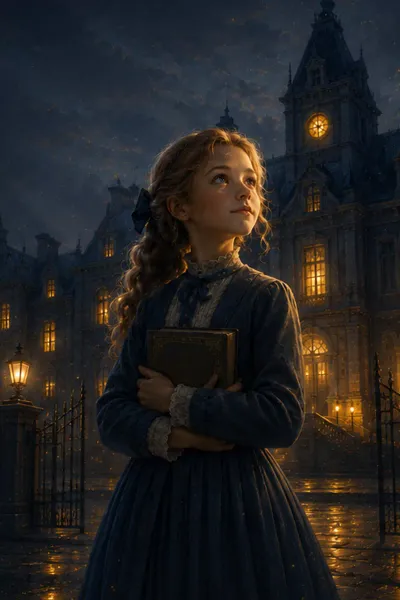
A Little Princess in English
A rich girl at a boarding school loses her fortune in a single day and has to live as the school's servant. The book is about what she does to stay herself.
The book has two halves with a hinge between them. In the first, Sara is the favourite of Miss Minchin's school and the story is mostly daily school life and friendships. In the second, she lives in the attic and works in the kitchen, and the story turns to hunger, cold and small acts of kindness. A third thread, the house next door, slowly connects to Sara's life. The narrator is warm and speaks to the reader directly. The sentences are short and the vocabulary is everyday, with a few Victorian words for clothes, food and household things.
You will like it if
- you like a heroine who wins by kindness and imagination
- you want a short-sentence classic that is easy to follow
- you enjoy school stories and rooms described in detail
- you want a strong emotional story with a hopeful turn
You will not if
- you dislike stories that are openly sentimental
- you want a lot of plot twists and action
- you find cruel adults and a long stretch of hardship hard to read
- you want a heroine with real faults, since Sara is very good
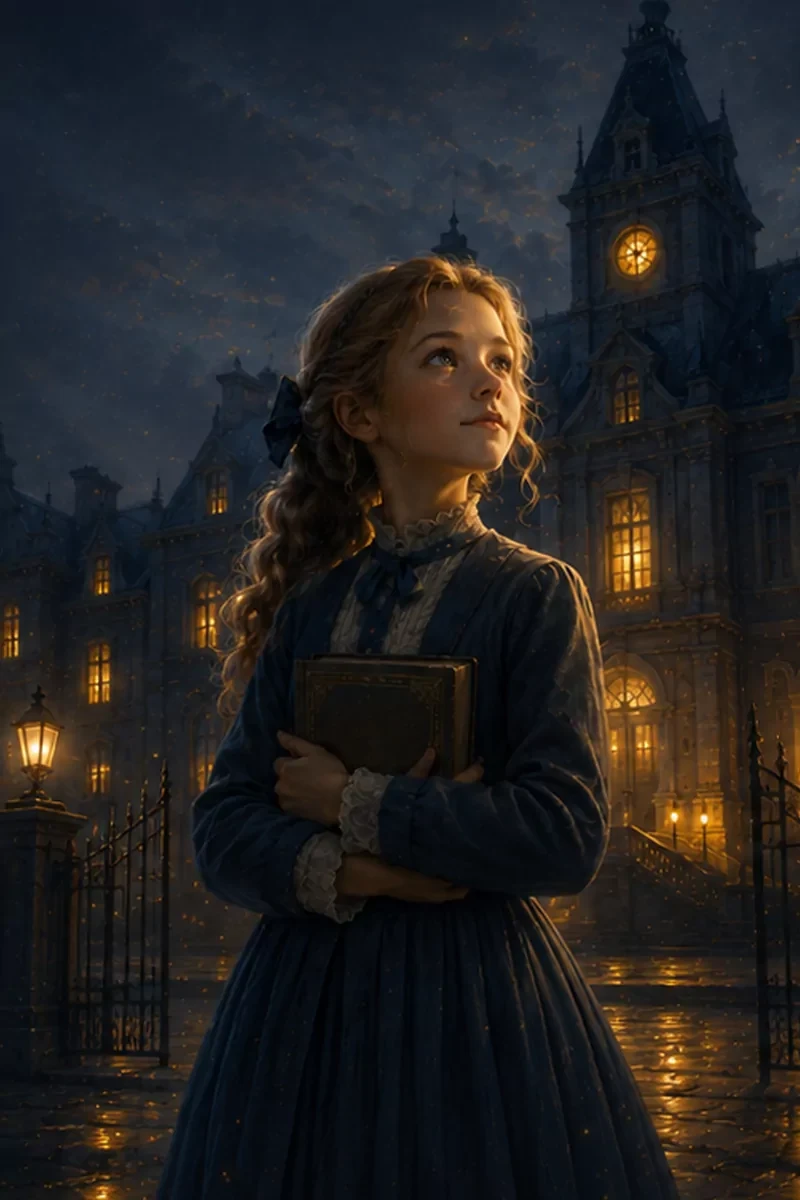
What kind of book“A Little Princess” is
Versions of “A Little Princess” in English: B1
Same book, adapted to a level you can read without stopping
Pick a version. The bar at the foot of the page opens the one you pick.
Vocabulary by level
- A1 67%
- A2 15%
- B1 7%
- B2 6%
- not in dictionary 3%
A sample from “A Little Princess” in English
One passage, the way each version writes it.
Tap any word — we will show the translation
Original · C1.4361 words
I do not know whether many people realize how much more than is ever written there really is in a story —how many parts of it are never told —how much more really happened than there is in the book one holds in one’s hand and pores over. Stories are something like letters. When a letter is written, how often one remembers things omitted and says, “Ah, why did I not tell them that?” In writing a book one relates all that one remembers at the time, and if one told all that really happened perhaps the book would never end. Between the lines of every story there is another story, and that is one that is never heard and can only be guessed at by the people who are good at guessing. The person who writes the story may never know all of it, but sometimes he does and wishes he had the chance to begin again.
When I wrote the story of “Sara Crewe” I guessed that a great deal more had happened at Miss Minchin’s than I had had time to find out just then. I knew, of course, that there must have been chapters full of things going on all the time; and when I began to make a play out of the book and called it A Little Princess, I discovered three acts full of things. What interested me most was that I found that there had been girls at the school whose names I had not even known before. There was a little girl whose name was Lottie, who was an amusing little person; there was a hungry scullery-maid who was Sara’s adoring friend; Ermengarde was much more entertaining than she had seemed at first; things happened in the garret which had never been hinted at in the book; and a certain gentleman whose name was Melchisedec was an intimate friend of Sara’s who should never have been left out of the story if he had only walked into it in time. He and Becky and Lottie lived at Miss Minchin’s, and I cannot understand why they did not mention themselves to me at first.
B1.8336 words
I do not know if many people understand how much more there is in a story than what is written. Many parts are never told. More really happened than what is in the book. Stories are like letters. When you write a letter, you often remember things you forgot to say. In a book, you write what you remember at that time. If you told everything, the book might never end. Between the lines of every story, there is another story. People who are good at guessing can find it. The writer may never know all of it, but sometimes he does and wishes he could start again.
When I wrote the story of "Sara Crewe," I guessed that more happened at Miss Minchin's than I had time to find out. I knew there must have been many chapters of things happening. When I made a play from the book and called it A Little Princess, I found three acts full of things. What interested me most was that there were girls at the school whose names I did not know before. There was a little girl named Lottie. She was funny. There was a hungry scullery-maid who loved Sara. Ermengarde was more fun than she seemed at first. Things happened in the garret that were not in the book. A gentleman named Melchisedec was Sara's close friend. He should not have been left out of the story if he had come in time. He, Becky, and Lottie lived at Miss Minchin's. I do not understand why they did not tell me about themselves at first. They were as real as Sara. It was careless of them not to come out of the story and say, "Here I am — tell about me." But they did not. That was their fault, not mine. People who live in a story should come forward at the beginning and tap the writer on the shoulder and say, "Hello, what about me?" If they do not, only they are to blame.
The original language of “A Little Princess” and what it gives you
How hard the language is C1.4
This is one of the easier classics to read in the original. The average sentence is 15 words, and about 82% of all words fall in the A1–A2 bands (67% + 15%). Only 4% of words lie beyond the 5000 most frequent English words and 3% are outside the dictionary, mostly names and a few period terms. We estimate the original at B1, and the adaptation we ship is A2. The text is long, with 67,317 words, but it rarely gets hard.
What this means in practice: A good first full-length classic: short sentences, common words, and a story that keeps you reading.
What to be ready for
How to read it and not quit
- Watch the modal verbs "would", "might" and "could" in Sara's "suppose" and "pretend" games; they carry the idea of something imagined, not real.
- British school and house words such as "nursery", "scullery" and "attic" are not always the same as in other varieties of English, so check the context before you guess.
- Expect long stretches of reported speech and inner thought; follow who is speaking by the names and pronouns, not by quotation marks alone.
- Do not stop on every unfamiliar object word; the repeated scenes of food, cold and clothing teach most of them by repetition.
Contents of “A Little Princess” · 20 chapters
- The Whole of the Storypage 1
- Ipage 2
- IIpage 13
- IIIpage 18
- IVpage 24
- Vpage 31
All 20 chaptersShow fewer
- VIpage 40
- VIIpage 50
- VII (continued)page 61
- VIIIpage 69
- IXpage 75
- Xpage 86
- X (continued)page 97
- XIpage 97
- XIIpage 107
- XIIIpage 114
- XIVpage 122
- XVpage 126
- XV (continued)page 139
- XVIpage 151
- XVI (continued)page 160
- XVIIpage 163
- XVIIIpage 170
- XIXpage 181
Reader ratings for “A Little Princess”
Nobody has rated it yet. Be the first.
Your rating
Reader reviews of “A Little Princess”
No reviews yet.
The story of “A Little Princess”
First version appears in a magazine
Burnett's short story 'Sara Crewe, or What Happened at Miss Minchin's' began running in the American children's magazine St. Nicholas, finishing in 1888.
Published as a short book
The story came out in book form as 'Sara Crewe', the shorter version of what later became the novel.
Burnett turns it into a play
She expanded the story for the stage as 'A Little Un-Fairy Princess', adding new characters and episodes.
The full novel is published
Burnett published the enlarged version as 'A Little Princess', the text most readers know today.
Shirley Temple film
Twentieth Century-Fox released 'The Little Princess' with Shirley Temple, which made the story familiar to a new generation of readers.
In culture “A Little Princess”
8 adaptations and mentions, 1902–1995
Stage A Little Un-Fairy Princess
Burnett's own stage version, written before the final novel and later folded back into it.
Art Ethel Franklin Betts illustrations
The first edition of the full novel was illustrated by Ethel Franklin Betts, and her pictures shaped how Sara and the attic room were imagined.
In the language 'A princess' in rags
Sara's idea that she is a princess whatever she wears, so that being kind and dignified under hardship is what counts, is the part of the book people quote and remember.
Film The Little Princess (Mary Pickford)
A silent film in which Mary Pickford, then a major star, played Sara.
Film The Little Princess (Shirley Temple)
A Technicolor musical-style version that changed parts of the plot and became the best-known screen Sara for decades.
Series Princess Sarah (Shōkōjo Sara)
A Japanese animated series that carried the story to a large audience in Japan and in many other countries.
Series BBC television serial
A British serial adaptation, one of several made for television.
Film A Little Princess (Alfonso Cuarón)
A film that moved the story partly into a visual fairy-tale world and brought Sara's imagination onto the screen.
Questions and answers about “A Little Princess” in English
Is A Little Princess based on a true story?
No, it is fiction. Burnett first wrote it as a shorter story called "Sara Crewe" in 1888, then turned it into a play and finally into this novel in 1905.
What is the difference between Sara Crewe and A Little Princess?
"Sara Crewe" is the shorter earlier version of the same story. A Little Princess is the longer novel with more characters, more incidents and a fuller ending.
Why does Miss Minchin treat Sara so badly?
She was only kind to Sara because Sara's father was rich, and she needed the money. Once the money is gone, she shows how little she ever cared for the girl, and Sara's calm manners make her angrier.
Who is the Indian gentleman next door?
He is a new neighbour who has come from India and is ill and unhappy. His story is connected to Sara's past, and that link is what the second half of the book builds toward.
Is A Little Princess a children's book or for adults?
It was written for young readers, but it is easy to read as an adult. The themes are poverty, pride and kindness, and the short sentences make it a good book for learners.
Which film is closest to the book?
The 1939 film with Shirley Temple and the 1995 film directed by Alfonso Cuarón both change the setting and parts of the plot. The 1995 film moves the story to New York, and neither is a close copy. The book is the best source for the original story.
Does Sara ever lose her temper?
Yes, but rarely, and the book makes a point of showing how hard she tries to control it. Her self-control is part of how the story tests her.
Is it a sad book?
The middle is sad, with hunger and cruelty, but the book is not hopeless. Most of the sadness is in the attic years, and the story keeps small kindnesses in front of the reader.
Should I read The Secret Garden first?
No, the two books are by the same author but have no shared story, so you can read either first. A Little Princess is the shorter-sentence book of the two and a bit easier to start with.
Why does Sara tell herself she is a princess?
She uses it as a rule for behaving well when everyone around her is behaving badly. Being a princess, in her mind, means staying polite and generous even with nothing, and that idea gives the book its title.
In brief about “A Little Princess”
17 fields of imprint data and measured text characteristics. All of it checkable.
- Original title
- A Little Princess
- Author
- Frances Hodgson Burnett
- First published
- 1905
- Original language
- English
- Genre
- Classics · Romance
- Mood
- Tender
- Themes
- Childhood · Class · Courage
- Setting
- A girls' boarding school in London, England · The late Victorian era, the 1880s–1890s
- Distinct words
- 4,865
- Words per sentence
- 15 words
- Level of the original
- C1.4
- Versions
- C1.4, B1.8
- Length of the original
- 24 ch. · 67,317 words
- Reading time
- ~6 h 10 min
- Source text
- Standard Ebooks
- Download
- EPUB
Similar what to read after “A Little Princess”
By the same author
1The same hand, a different story.
Close in spirit
7The same genre and the same register.
Jane Eyre
Charlotte Brontë
C2orig.B1C1
~17 h 20 min · Classics
Wuthering Heights
Emily Brontë
C2orig.B1C1
~10 h 50 min · Gothic & mystery

The Hound of the Baskervilles
Arthur Conan Doyle
C1.9orig.B1C1
~5 h 30 min · Detective
Three Men in a Boat (To Say Nothing of the Dog)
Jerome K. Jerome
C1.7orig.B1B2C1
~6 h 10 min · Humor
Aesop's Fables
Aesop
C1.2orig.
~3 h 40 min · Fables & parables
Alice's Adventures in Wonderland
Lewis Carroll
C1.2orig.B1B2
~2 h 30 min · Classics
Through the Looking-Glass
Lewis Carroll
C1.1orig.B2
~2 h 50 min · Fairy tale
Book page ≈0.2.0 · Oct 14, 2026