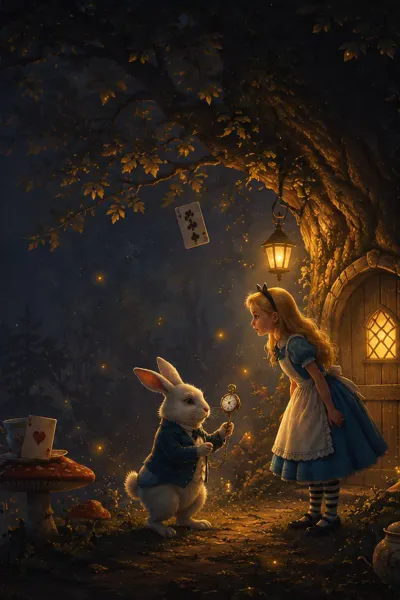
Alice's Adventures in Wonderland in English
A girl falls down a rabbit hole into a world where animals talk, size is unstable and every conversation turns into a puzzle. She tries to behave properly in a place with no sensible rules.
The book is a chain of separate episodes rather than a plot with a single goal. In each one Alice meets a new character, argues with them, and moves on, and the story never stops to explain what is going on. Between the scenes there are short poems that parody verses Victorian children learned at school. The narrator is chatty, speaks to the reader and adds comments in brackets. The language is mostly everyday English, but it is full of puns, word games and logic jokes, so the meaning often hides in the second reading of a sentence.
You will like it if
- you enjoy jokes built on wordplay and logic
- you like short episodes you can read one at a time
- you want a classic that is quick and light in mood
- you are curious about where famous phrases and characters come from
You will not if
- you want a plot that builds towards a clear goal
- you dislike puns that need a second look to understand
- you want deep characters: most are one-joke figures
- you are not interested in Victorian verse parodies
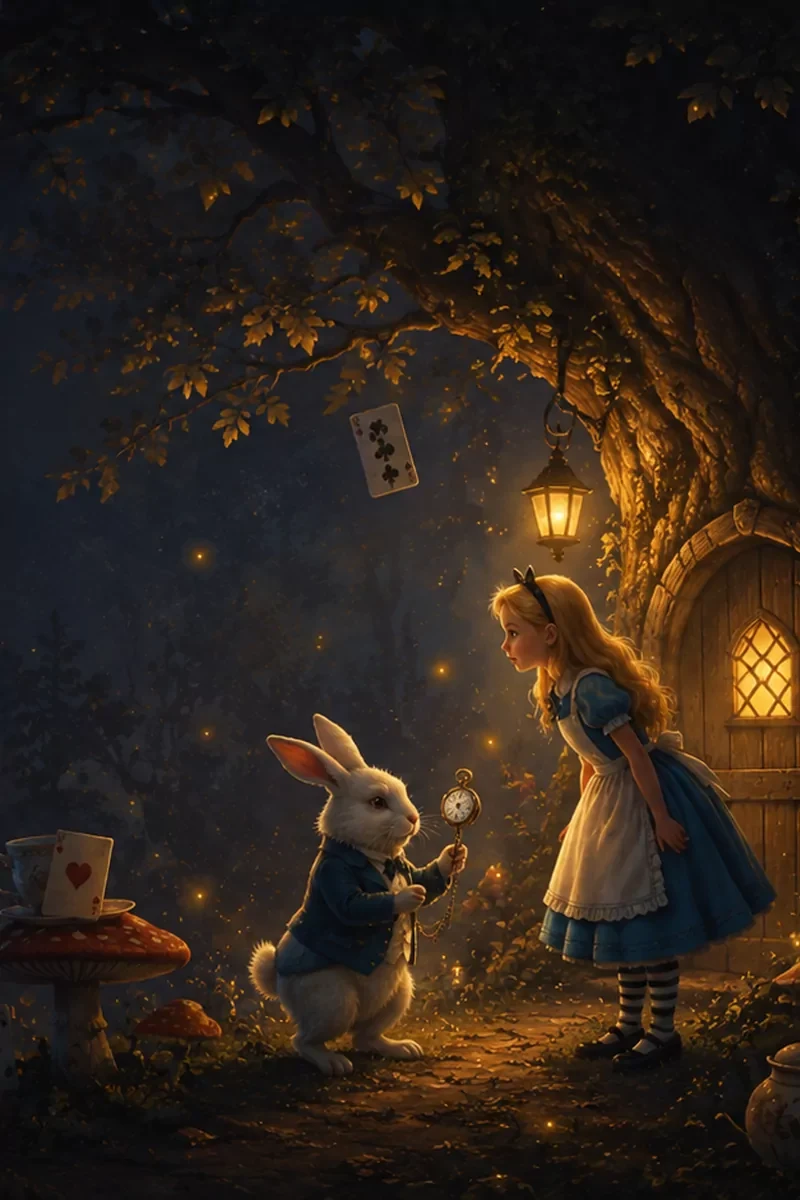
What kind of book“Alice's Adventures in Wonderland” is
Versions of “Alice's Adventures in Wonderland” in English: B1
Same book, adapted to a level you can read without stopping
Pick a version. The bar at the foot of the page opens the one you pick.
Vocabulary by level
- A1 64%
- A2 17%
- B1 7%
- B2 8%
- not in dictionary 3%
A sample from “Alice's Adventures in Wonderland” in English
One passage, the way each version writes it.
Tap any word — we will show the translation
B2.1187 words
“You won’t do that!” thought Alice. She waited until she thought she heard the Rabbit just below the window. Then she suddenly opened her hand wide and grabbed at the air. She caught nothing, but she heard a little scream, a fall, and the crash of breaking glass. From these sounds she guessed it was just possible that it had fallen into a cucumber-frame (low garden structure with a glass cover to protect plants), or something similar.
Next came the Rabbit’s angry voice. “Pat! Pat! Where are you?” Then came a voice she had never heard before. “Sure then I’m here! Digging for apples, your honour!”
“Digging for apples, indeed!” said the Rabbit angrily. “Here! Come and help me out of this!” (Sounds of more breaking glass.)
“Now tell me, Pat, what’s that in the window?”
“Sure, it’s an arm, your honour!” (He said “arm” as “arrum.”)
“An arm, you goose! Who ever saw one that size? Why, it fills the whole window!”
“Sure, it does, your honour: but it’s still an arm.”
“Well, it has no right to be there, anyway. Go and take it away!”
The original language of “Alice's Adventures in Wonderland” and what it gives you
How hard the language is C1.2
The vocabulary is mostly simple: about four words in five fall in the A1–A2 bands, and only about 3% are archaic, dialect or invented words. Even so, our measurement puts the original at C1 and not at an easy level. The sentences average 17 words, but the narrator often writes them much longer, with asides in brackets, and a lot of the humour depends on puns, parody and logic tricks. A learner can follow the words and still miss the joke.
What this means in practice: Simple words, tricky jokes: read it for the humour and accept that some puns will need a second look.
What to be ready for
How to read it and not quit
- When a sentence makes no sense, look for a second meaning of one word: many jokes are puns and the first meaning is the trap.
- Long sentences with brackets are easier if you find the main verb first and read the bracketed part as an aside.
- Do not copy the nonstandard grammar of the gardeners, Pat or Bill in your own writing: it is deliberate characterisation, not a model.
- Read the poems for sound and nonsense rather than sense; looking up every word will not make them clearer.
Contents of “Alice's Adventures in Wonderland” · 13 chapters
- Beginningpage 1
- Ipage 1
- IIpage 4
- IIIpage 10
- IVpage 13
- Vpage 20
All 13 chaptersShow fewer
- VIpage 26
- VIIpage 34
- VIIIpage 41
- IXpage 47
- Xpage 54
- XIpage 59
- XIIpage 64
Reader ratings for “Alice's Adventures in Wonderland”
5.01 rating
Your rating
Reader reviews of “Alice's Adventures in Wonderland”
No reviews yet.
The story of “Alice's Adventures in Wonderland”
La tarde dorada
El 4 de julio, Lewis Carroll contó la historia de Alicia a Alice Liddell y sus hermanas durante un paseo en barco por el Támesis; ella le pidió que la escribiera.
Carroll's diary and later recollections
Primera edición retirada
Macmillan imprimió la primera edición con ilustraciones de John Tenniel, pero los ejemplares fueron retirados porque Tenniel no estaba satisfecho con la calidad de impresión; una nueva edición apareció en 1866.
Macmillan archive records
El libro llega al público
La edición reeditada, fechada en 1866, se publicó y rápidamente se hizo popular, estableciendo la fama de Carroll como autor.
Publication records
Una secuela le sigue
Carroll publicó A través del espejo y lo que Alicia encontró allí, continuando las aventuras de Alicia.
Publication records
Primera película sonora
Una adaptación de Hollywood dirigida por Bud Pollard se convirtió en la primera versión cinematográfica sonora del libro.
Film history records
El clásico animado de Disney
El largometraje animado de Walt Disney llevó una Alicia muy influyente y libremente adaptada a una audiencia global.
Disney studio records
In culture “Alice's Adventures in Wonderland”
10 adaptations and mentions, 1865–2000
Art Ilustraciones de Tenniel
Los grabados en madera de John Tenniel definieron la identidad visual de los personajes y siguen siendo las imágenes estándar.
First edition
Stage Alicia en el país de las maravillas en el teatro
La primera adaptación teatral importante, una obra musical de Henry Savile Clarke, se produjo en Londres.
Film Primera adaptación cinematográfica
Una película británica muda dirigida por Cecil Hepworth y Percy Stow fue una de las películas más largas de su época.
British Film Institute
Film Alicia en el país de las maravillas de Disney
El largometraje animado presentó la historia a generaciones y dio forma a su imaginería popular.
Disney
Series Alicia de Jonathan Miller
Una adaptación televisiva surrealista y repleta de estrellas de la BBC que reimaginó la historia para adultos.
BBC
Music «White Rabbit» de Jefferson Airplane
La canción de rock psicodélico utilizó imágenes de Alicia como metáfora de experiencias con drogas y contracultura.
Game Alicia de American McGee
Una secuela oscura de videojuego donde Alicia regresa a un País de las Maravillas retorcido, influyendo en adaptaciones posteriores.
In the language Por la madriguera del conejo
Una expresión para entrar en un mundo extraño, desorientador u obsesivo, derivada de la caída de Alicia.
In the language Loco como un sombrerero
La frase, popularizada por el Sombrerero, significa completamente demente; es anterior al libro pero se volvió inseparable de él.
In the language Síndrome de Alicia en el país de las maravillas
Una condición neurológica que afecta la percepción, nombrada por las distorsiones de tamaño y espacio del libro.
Questions and answers about “Alice's Adventures in Wonderland” in English
Is Alice in Wonderland based on a true story?
Not as a plot, but it started as a real story told to a real child. Lewis Carroll (Charles Dodgson) made it up for Alice Liddell and her sisters on a boat trip near Oxford in 1862. The character is named after her, though Alice in the book is not a portrait of her.
Is Alice in Wonderland a children's book or for adults?
It was written for children but has always had adult readers, because the jokes work on two levels. The nonsense, the pushy characters and the rules that make no sense can be funny to a child, while the logic games and parodies reward adults who know what is being copied.
Why is a raven like a writing-desk? Is there an answer?
The riddle has no answer in the original book. Carroll said later, in a preface to a later edition, that he had not planned one, and he then offered a joke answer about notes and the wrong end in front. Readers have proposed many other answers since.
Is the Mad Hatter mad because of mercury?
The book never gives that reason. 'Mad as a hatter' was already a common saying before Carroll used it, and in the book the Hatter is simply one of the characters in the tea party scene. The mercury explanation comes from later readers.
Is Alice in Wonderland about drugs?
There is no evidence for that in Carroll's own writing. The strange growing and shrinking, odd logic and sudden changes come from dream logic, Victorian puzzles and parody. The drug reading appeared in the twentieth century.
Should I read Alice in Wonderland or Through the Looking-Glass first?
Read Alice's Adventures in Wonderland first. Through the Looking-Glass is a sequel, but it stands on its own and you do not need the first book to follow it. Reading Wonderland first lets you see which jokes and characters Carroll repeats.
How different is the Disney film from the book?
The 1951 Disney film mixes the two books. Scenes and characters from Through the Looking-Glass, such as Tweedledum and Tweedledee and the Walrus and the Carpenter, appear in it, and it is much more of a continuous story than the book, which is a series of separate episodes.
Why does Alice keep changing size?
She drinks or eats things marked for that purpose and the results are never what she expects. The size changes put her in awkward situations: too big to fit through a door, too small to be taken seriously. The book uses them to show how out of place she is in Wonderland.
Is Alice in Wonderland hard to read in English?
The words are mostly simple, but the humour is not always easy to catch. Puns, parodied poems and Victorian turns of phrase mean you may understand every word and still wonder why something is funny. Taking it one episode at a time helps.
In brief about “Alice's Adventures in Wonderland”
17 fields of imprint data and measured text characteristics. All of it checkable.
- Original title
- Alice's Adventures in Wonderland
- Author
- Lewis Carroll
- First published
- 1865
- Original language
- English
- Genre
- Classics · Adventure · Humor
- Mood
- Dreamlike
- Themes
- Identity · Childhood · Society · Freedom
- Setting
- A riverbank in England, then Wonderland, a strange underground dream world · The mid-Victorian 1860s
- Distinct words
- 2,537
- Words per sentence
- 17 words
- Level of the original
- C1.2
- Versions
- C1.2, B2.1, B1.5
- Length of the original
- 13 ch. · 26,733 words
- Reading time
- ~2 h 30 min
- Source text
- Standard Ebooks
- Download
- EPUB
Similar what to read after “Alice's Adventures in Wonderland”
By the same author
1The same hand, a different story.
Close in spirit
7The same genre and the same register.
Adventures of Huckleberry Finn
Mark Twain
C1.6orig.B1
~10 h 20 min · Adventure
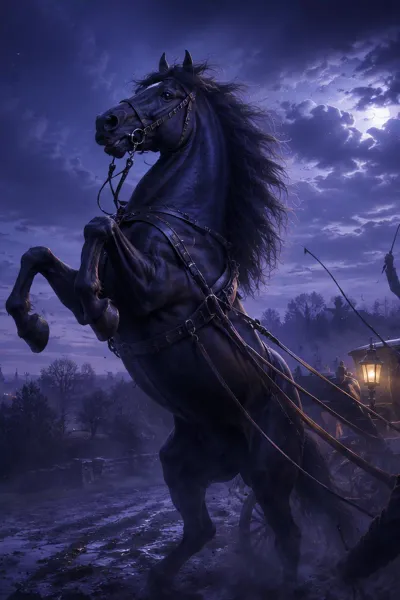
Black Beauty
Anna Sewell
C1.4orig.B1
~5 h 30 min · Classics
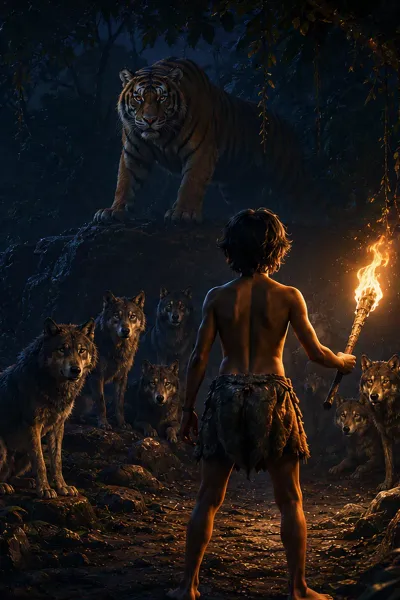
The Jungle Book
Rudyard Kipling
C1.7orig.
~4 h 40 min · Adventure
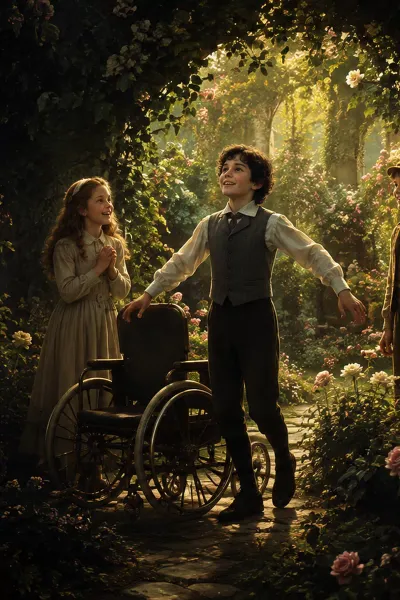
The Secret Garden
Frances Hodgson Burnett
C1.2orig.B1
~7 h 30 min · Classics
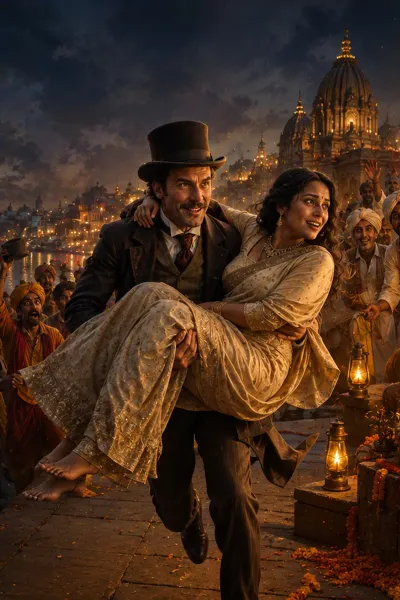
Around the World in Eighty Days
Jules Verne
C2orig.C1
~5 h 50 min · Adventure
The Call of the Wild
Jack London
C2orig.B2C1
~3 h · Adventure
Heart of Darkness
Joseph Conrad
C2orig.
~3 h 30 min · Adventure
Book page ≈0.2.0 · Oct 14, 2026