Anne of Green Gables in English
A farm couple wants an orphan boy to help with the work and gets a chatty, imaginative girl by mistake. Whether she can stay is the question that opens the book.
The book is built from episodes rather than one big plot. Each chapter is a small story, such as a disastrous school day, a tea party gone wrong or a hair-dye disaster, and together they follow Anne through several years of growing up. The first part is about being accepted into the house and the village, and the later part is about school, ambition and choosing a path. The language is chatty and full of long, dramatic speeches, mostly by Anne. Descriptions of the island's seasons and landscape appear often, and they slow the story down.
You will like it if
- you enjoy warm, funny stories about growing up
- you want to practise reading a lot of lively spoken English
- you like a heroine who is stubborn, imaginative and often wrong
- you enjoy small-town life and the changing seasons
You will not if
- you want fast plots or strong suspense
- you find talkative characters and long speeches tiring
- you do not like sentimental scenes or very detailed nature description
- you want modern language: this is early twentieth-century English
What kind of book“Anne of Green Gables” is
Versions of “Anne of Green Gables” in English: B2
Same book, adapted to a level you can read without stopping
Pick a version. The bar at the foot of the page opens the one you pick.
Vocabulary by level
- A1 62%
- A2 16%
- B1 8%
- B2 6%
- not in dictionary 4%
A sample from “Anne of Green Gables” in English
One passage, the way each version writes it.
Tap any word — we will show the translation
Original · C1.6345 words
Mrs. Rachel Lynde Is Surprised
Mrs. Rachel Lynde lived just where the Avonlea main road dipped down into a little hollow, fringed with alders and ladies’ eardrops and traversed by a brook that had its source away back in the woods of the old Cuthbert place; it was reputed to be an intricate, headlong brook in its earlier course through those woods, with dark secrets of pool and cascade; but by the time it reached Lynde’s Hollow it was a quiet, well-conducted little stream, for not even a brook could run past Mrs. Rachel Lynde’s door without due regard for decency and decorum; it probably was conscious that Mrs. Rachel was sitting at her window, keeping a sharp eye on everything that passed, from brooks and children up, and that if she noticed anything odd or out of place she would never rest until she had ferreted out the whys and wherefores thereof.
There are plenty of people, in Avonlea and out of it, who can attend closely to their neighbours’ business by dint of neglecting their own; but Mrs. Rachel Lynde was one of those capable creatures who can manage their own concerns and those of other folks into the bargain. She was a notable housewife; her work was always done and well done; she “ran” the Sewing Circle, helped run the Sunday-school, and was the strongest prop of the Church Aid Society and Foreign Missions Auxiliary. Yet with all this Mrs. Rachel found abundant time to sit for hours at her kitchen window, knitting “cotton warp” quilts —she had knitted sixteen of them, as Avonlea housekeepers were wont to tell in awed voices —and keeping a sharp eye on the main road that crossed the hollow and wound up the steep red hill beyond. Since Avonlea occupied a little triangular peninsula jutting out into the Gulf of St. Lawrence, with water on two sides of it, anybody who went out of it or into it had to pass over that hill road and so run the unseen gauntlet of Mrs. Rachel’s all-seeing eye.
B2.9329 words
Mrs. Rachel Lynde Is Surprised
Mrs. Rachel Lynde lived right where the main road of Avonlea went down into a small hollow. The hollow was lined with alder trees and ladies’ eardrops, and a stream ran through it. The stream started far back in the woods of the old Cuthbert place. People said that in the woods it was a wild, fast stream with dark pools and waterfalls. But by the time it reached Lynde’s Hollow, it was a quiet, well-behaved little stream. Not even a stream could run past Mrs. Rachel Lynde’s door without being proper and decent. It probably knew that Mrs. Rachel was sitting at her window, watching everything that passed, from streams and children to everything else. If she noticed anything strange or out of place, she would never rest until she found out the reasons for it.
There are many people, in Avonlea and elsewhere, who can pay close attention to their neighbors’ business by neglecting their own. But Mrs. Rachel Lynde was one of those capable people who can manage their own affairs and other people’s too. She was a famous housewife; her work was always done and done well. She ran the Sewing Circle, helped run the Sunday school, and was a strong supporter of the Church Aid Society and Foreign Missions Auxiliary. Yet with all this, Mrs. Rachel found plenty of time to sit for hours at her kitchen window. She knitted quilts from cotton thread—she had knitted sixteen of them, as Avonlea housewives often said with awe. And she kept a sharp eye on the main road that crossed the hollow and went up the steep red hill beyond. Since Avonlea was on a small triangular peninsula that stuck out into the Gulf of St. Lawrence, with water on two sides, anyone who went out or came in had to pass over that hill road. So they had to go under the unseen watch of Mrs. Rachel’s all-seeing eye.
The original language of “Anne of Green Gables” and what it gives you
How hard the language is C1.6
This is a middle-level read. The book has about 103,000 words and 7,200 different word forms, and 62% of the words are A1 plus 16% A2, so roughly four in five are very common. The average sentence is 15 words, which is not long, but 5% of the words are beyond the 5,000 most frequent and 4% are not in the dictionary at all (names, old forms and made-up words). We estimate the original at B2, and we ship an adaptation at B1. The difficulty comes less from grammar than from Anne's large, expressive vocabulary and the length of the book.
What this means in practice: A friendly, talkative classic that rewards patience and gives you plenty of everyday English.
What to be ready for
How to read it and not quit
- Do not stop for every long word in Anne's speeches; read for the feeling first, then look up the few words that keep returning.
- Pay attention to articles and little words: Anne often uses the, a and some in ways that depend on the sentence, and learners often skip them in their own writing.
- Notice the past perfect (she had said, he had gone): the book often looks back at what happened before the scene.
- Learn the common phrasal verbs as you meet them (get along, make up, look after, give up); they carry the conversation.
Contents of “Anne of Green Gables” · 38 chapters
- Ipage 1
- IIpage 11
- II (continued)page 25
- IIIpage 29
- IVpage 36
- Vpage 44
All 38 chaptersShow fewer
- VIpage 52
- VIIpage 59
- VIIIpage 63
- IXpage 73
- Xpage 82
- XIpage 91
- XIIpage 97
- XIIIpage 104
- XIVpage 110
- XVpage 121
- XV (continued)page 135
- XVIpage 140
- XVI (continued)page 154
- XVIIpage 154
- XVIIIpage 161
- XIXpage 173
- XIX (continued)page 187
- XXpage 187
- XXIpage 195
- XXIIpage 208
- XXIIIpage 214
- XXIVpage 222
- XXVpage 227
- XXVIpage 239
- XXVIIpage 247
- XXVIIIpage 256
- XXIXpage 266
- XXXpage 278
- XXX (continued)page 292
- XXXIpage 293
- XXXIIpage 301
- XXXIIIpage 310
- XXXIVpage 322
- XXXVpage 330
- XXXVIpage 335
- XXXVIIpage 342
- XXXVIIIpage 351
Reader ratings for “Anne of Green Gables”
Nobody has rated it yet. Be the first.
Your rating
Reader reviews of “Anne of Green Gables”
No reviews yet.
The story of “Anne of Green Gables”
Published in Boston
L. C. Page & Co. issued the book in 1908 and it became an immediate bestseller in North America.
First screen version
A silent film adaptation was released in 1919, the first of many for the screen.
Japanese translation
Hanako Muraoka's Japanese translation appeared in 1952 and made Anne a lasting favourite in Japan.
Canadian television miniseries
Kevin Sullivan's CBC miniseries brought the story to a new generation of viewers.
Written in the mid-1900s and turned down
Montgomery wrote the novel in her spare time in the middle of the 1900s, and publishers rejected it before it found a home.
In culture “Anne of Green Gables”
8 adaptations and mentions, 1908–2017
In the language "Anne with an E"
Anne's insistence that her name be spelled with an "e" became shorthand for demanding to be seen as an individual, and later gave a Netflix series its title.
In the language "Kindred spirit"
Anne's name for a like-minded friend, now used to describe anyone who instantly understands you.
In the language "Carrots"
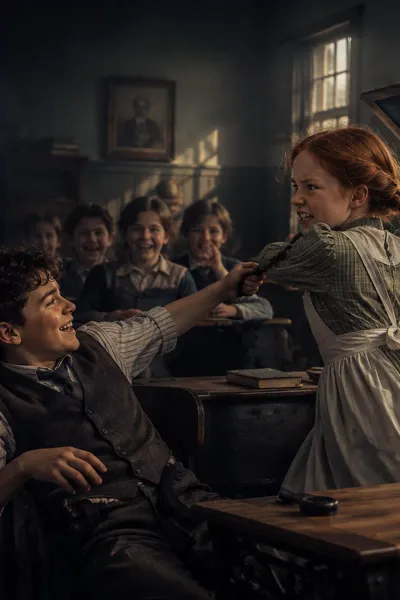
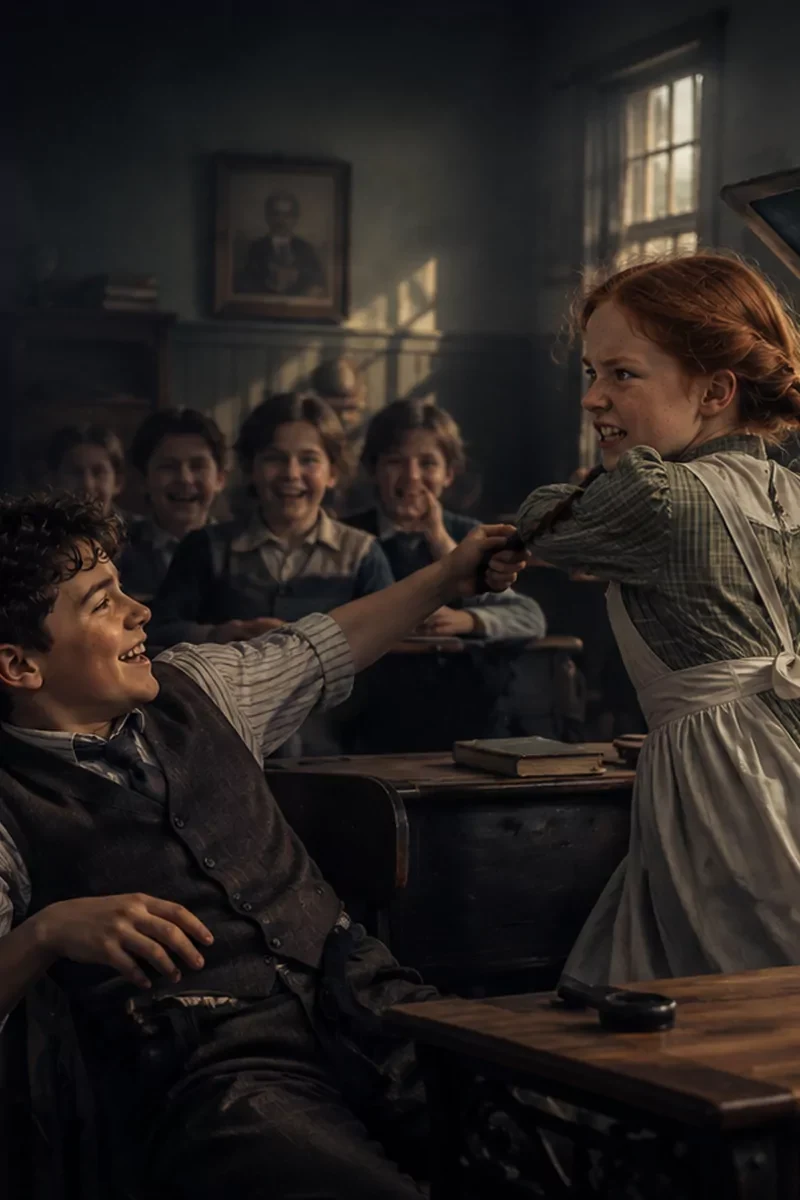
The schoolboy taunt about Anne's red hair, answered by her breaking a slate over Gilbert's head, is one of children's literature's best-known scenes.
Film Anne of Green Gables (RKO)
The 1934 film starred an actress who adopted the name Anne Shirley for the role and kept it for the rest of her career.
Stage Anne of Green Gables - The Musical
Premiered at the Charlottetown Festival in 1965 and has been staged there for decades.
Series Akage no An (Anne of Green Gables)
A Japanese animated series from Nippon Animation, directed by Isao Takahata, followed the book closely.
Series Anne of Green Gables (CBC miniseries)
The Canadian miniseries became the version many viewers think of first.
Series Anne with an E
A darker, more modern reimagining by CBC and Netflix that ran for three seasons.
Questions and answers about “Anne of Green Gables” in English
What is Anne of Green Gables about?
It is about an orphan girl, Anne Shirley, who is sent by mistake to an older brother and sister who wanted a boy. The story follows her through school, friendships and mistakes as she tries to belong in the village of Avonlea.
Why do Matthew and Marilla want a boy?
They need help on their farm, and Matthew is getting older. They ask for a boy because they think a boy will be more useful for the farm work, so they are surprised when Anne arrives.
Is Anne of Green Gables a true story?
No, the story is fiction. Montgomery grew up on Prince Edward Island, and she used the place and parts of her own childhood as the background; the Green Gables house you can visit there is a real farmhouse.
Why does Anne hit Gilbert Blythe with a slate?
He teases her about her red hair and calls her Carrots, and she is proud and furious. The scene starts a long quarrel between the two.
Is there a sequel, and do I need to read it?
Yes, there are several. Anne of Avonlea comes next, and the first book is complete by itself, so you can stop here.
Which film or series is closest to the book?
The 1985 Canadian television version with Megan Follows is usually thought of as the most faithful. The newer series Anne with an E keeps the setting and characters but adds darker storylines that are not in the book.
Is Anne of Green Gables a children's book?
It was written to be read by young people, but it is enjoyed by adults too. The humour and the emotion work at any age, though the pace is gentle.
What makes the book hard to read?
Anne's long speeches and the old-fashioned vocabulary slow you down more than the grammar does. Many readers also find the nature description slow, and they skim it.
Why is Anne of Green Gables so popular in Japan?
It has been very popular there since it was first translated after the Second World War. It is often read in schools, and Japan has made a well-known animated series from the story.
Is it worth reading if I only want to learn English?
Yes, if you like dialogue: it is full of everyday speech, questions and short replies. If you prefer plot to character, you may find it slow.
In brief about “Anne of Green Gables”
17 fields of imprint data and measured text characteristics. All of it checkable.
- Original title
- Anne of Green Gables
- Author
- L. M. Montgomery
- First published
- 1908
- Original language
- English
- Genre
- Classics · Romance
- Mood
- Uplifting
- Themes
- Home · Coming of age · Family · Childhood
- Setting
- Avonlea, a farming village on Prince Edward Island, Canada · the late nineteenth century
- Distinct words
- 7,236
- Words per sentence
- 15 words
- Level of the original
- C1.6
- Versions
- C1.6, B2.9
- Length of the original
- 43 ch. · 102,890 words
- Reading time
- ~9 h 30 min
- Source text
- Standard Ebooks
- Download
- EPUB
Similar what to read after “Anne of Green Gables”
Close in spirit
8The same genre and the same register.
A Little Princess
Frances Hodgson Burnett
C1.4orig.B1
~6 h 10 min · Classics
The Great Gatsby
F. Scott Fitzgerald
C1.8orig.B1C1
~4 h 30 min · Classics
Little Women
Louisa May Alcott
C1.8orig.B1B2
~17 h 20 min · Classics
Jane Eyre
Charlotte Brontë
C2orig.B1C1
~17 h 20 min · Classics
Pride and Prejudice
Jane Austen
C2orig.B1C1
~11 h 20 min · Classics
Aesop's Fables
Aesop
C1.2orig.
~3 h 40 min · Fables & parables
Alice's Adventures in Wonderland
Lewis Carroll
C1.2orig.B1B2
~2 h 30 min · Classics

Black Beauty
Anna Sewell
C1.4orig.B1
~5 h 30 min · Classics
Book page ≈0.2.0 · Oct 14, 2026