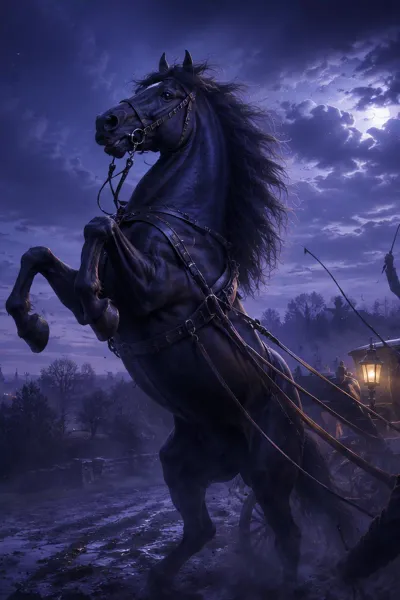
Black Beauty in English
A horse looks back on his life and tells us what it is like to belong to people who may be kind or cruel.
The book is the horse's autobiography, told in the first person in short chapters of two or three pages. It follows one long line, from his foal days to his working years, and each owner brings a new place and a new lesson. Most chapters are small scenes: a runaway, a fire in the stable, a storm, a night ride to fetch a doctor. The tone is calm and plain, and the narrator never pretends to know more than a horse could. Sewell wrote it to make readers think about how horses are treated, and that purpose shapes every episode.
You will like it if
- you like animal stories told from the animal's point of view
- you want short, calm chapters you can read one at a time
- you are interested in daily life in Victorian England
- you like simple language with a gentle moral purpose
You will not if
- you do not want to read about animals being badly treated
- you expect action or a fast plot: many chapters are quiet scenes
- you dislike books with a clear moral message
- you are not interested in horse care, harness and carriages
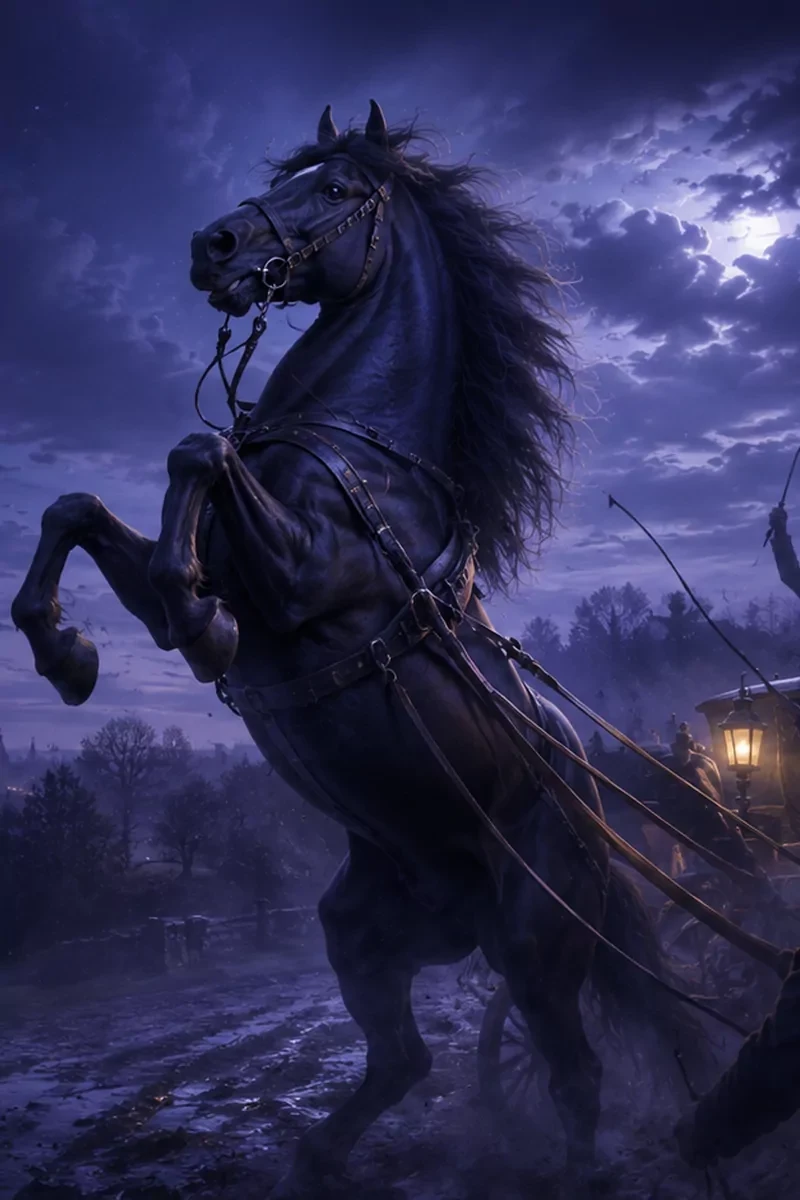
What kind of book“Black Beauty” is
Versions of “Black Beauty” in English: B1
Same book, adapted to a level you can read without stopping
Pick a version. The bar at the foot of the page opens the one you pick.
Vocabulary by level
- A1 68%
- A2 14%
- B1 7%
- B2 6%
- not in dictionary 2%
A sample from “Black Beauty” in English
One passage, the way each version writes it.
Tap any word — we will show the translation
Original · C1.4252 words
My Early Home
The first place that I can well remember was a large pleasant meadow with a pond of clear water in it. Some shady trees leaned over it, and rushes and water-lilies grew at the deep end. Over the hedge on one side we looked into a plowed field, and on the other we looked over a gate at our master’s house, which stood by the roadside; at the top of the meadow was a grove of fir trees, and at the bottom a running brook overhung by a steep bank.
While I was young I lived upon my mother’s milk, as I could not eat grass. In the daytime I ran by her side, and at night I lay down close by her. When it was hot we used to stand by the pond in the shade of the trees, and when it was cold we had a nice warm shed near the grove.
As soon as I was old enough to eat grass my mother used to go out to work in the daytime, and come back in the evening.
There were six young colts in the meadow besides me; they were older than I was; some were nearly as large as grownup horses. I used to run with them, and had great fun; we used to gallop all together round and round the field, as hard as we could go. Sometimes we had rather rough play, for they would frequently bite and kick as well as gallop.
B1.8262 words
My Early Home
The first place I remember was a big field with a pond. Trees gave shade, and flowers grew at the deep end. On one side we saw a plowed field. On the other side we saw our master's house. At the top of the field there were fir trees. At the bottom there was a small river.
When I was young, I drank my mother's milk. I could not eat grass. In the day I ran next to her. At night I slept close to her. When it was hot, we stood by the pond in the shade. When it was cold, we had a warm shed.
When I was old enough to eat grass, my mother went to work in the day and came back in the evening.
There were six young horses in the field with me. They were older than me. Some were almost as big as grown horses. I ran with them and had fun. We ran around the field fast. Sometimes we played rough. They bit and kicked.
One day, there was a lot of kicking. My mother called me to her and said:
"Listen to me. The horses here are good, but they are work horses. They did not learn good manners. You come from a good family. Your father is famous. Your grandfather won a race. Your grandmother had a sweet temper. I never kick or bite. I hope you grow up gentle and good. Do your work well. Lift your feet when you trot. Never bite or kick, even in play."
The original language of “Black Beauty” and what it gives you
How hard the language is C1.4
The words are simple: 68% of the vocabulary is A1 and another 14% is A2, only 2% is outside the dictionary, and only 3% is beyond the 5000 most frequent words. The book has about 3,900 different word forms in almost 60,000 words, so the same words come back often. The sentences are the one thing to watch: they average 23.3 words, which is long for such plain vocabulary. Our estimate for the original is B1, and the adaptation we ship is A2.
What this means in practice: Plain words and long sentences: a good, gentle book for steady reading practice.
What to be ready for
How to read it and not quit
- Learn the main horse words once and then let them repeat: 'groom', 'stable', 'harness', 'reins' and 'carriage' appear all the time.
- Long sentences are usually several short facts joined by 'and', 'but' and commas, so look for each verb and read one idea at a time.
- Pay attention to the past tenses: the narrator remembers events, so 'had done' and 'used to' often mark what happened earlier.
- Do not worry about period words you cannot guess: skip words like 'ostler' or 'hansom' and keep reading, because the story still makes sense.
Contents of “Black Beauty” · 53 chapters
- Part Ipage 1
- Ipage 1
- IIpage 3
- IIIpage 6
- IVpage 11
- Vpage 14
All 53 chaptersShow fewer
- VIpage 18
- VIIpage 20
- VIIIpage 24
- IXpage 29
- Xpage 31
- XIpage 36
- XIIpage 39
- XIIIpage 42
- XIVpage 44
- XVpage 46
- XVIpage 49
- XVIIpage 51
- XVIIIpage 56
- XIXpage 60
- XXpage 62
- XXIpage 64
- Part IIpage 66
- XXIIpage 66
- XXIIIpage 71
- XXIVpage 74
- XXVpage 79
- XXVIpage 82
- XXVIIpage 85
- XXVIIIpage 87
- XXIXpage 89
- XXXpage 95
- XXXIpage 97
- Part IIIpage 100
- XXXIIpage 100
- XXXIIIpage 102
- XXXIVpage 105
- XXXVpage 108
- XXXVIpage 114
- XXXVIIpage 118
- XXXVIIIpage 121
- XXXIXpage 126
- XLpage 129
- XLIpage 130
- XLIIpage 133
- XLIIIpage 135
- XLIVpage 138
- XLVpage 142
- Part IVpage 149
- XLVIpage 149
- XLVIIpage 152
- XLVIIIpage 156
- XLIXpage 159
Reader ratings for “Black Beauty”
Nobody has rated it yet. Be the first.
Your rating
Reader reviews of “Black Beauty”
No reviews yet.
The story of “Black Beauty”
Published by Jarrold & Sons
The book appeared in the autumn of 1877 from the Norwich publisher Jarrold & Sons, as a plea for the kind treatment of horses.
Sewell dies
Anna Sewell died in April 1878, only months after the book came out, so she saw only the start of its success.
American edition promoted by the animal-welfare movement
George T. Angell, founder of the Massachusetts SPCA and of the American Humane Education Society, brought out an American edition and had it widely distributed, helping make the book a bestseller in the United States.
Written by an invalid author
Anna Sewell wrote the book in the last years of her life, when illness kept her indoors and she could hardly walk. It was her only novel, and she is reported to have dictated much of it to her mother.
A campaign against the bearing rein
The book's picture of horses forced to hold their heads up with a tight rein became associated with the campaign against that practice in Britain.
In culture “Black Beauty”
8 adaptations and mentions, 1921–2020
Film Vitagraph's silent film
An early American silent version that carried the horse's story onto the screen.
Film The 20th Century Fox film
A Hollywood version, shot in colour, that moved the story towards a sentimental horse-and-girl tale.
Series The Adventures of Black Beauty
A British ITV series that kept the horse's name but invented new episodes around him; for many viewers this became their Black Beauty.
Film Black Beauty (Warner Bros.)
A film directed by Caroline Thompson that restored the horse's own narration and kept the book's cruel passages.
Film Black Beauty (Disney+)
A modern version in which the mare Beauty is voiced by Kate Winslet and the story is moved closer to our own time.
In the language "Black Beauty" as a name for any dark horse
The title is now used to mean any glossy black horse, and for many people it is the first horse they name.
In the language The bearing rein
The tight rein the book condemns became the thing readers remember about it, and the phrase stands for a cruel fashion that people kept up because it looked good.
In the language The animal narrates
The idea that an animal can tell the story of human cruelty in its own voice, which the book established as a way of arguing for animal welfare and which later animal stories use.
Questions and answers about “Black Beauty” in English
Is Black Beauty based on a true story?
No, the story is fiction, but it is based on real practices of Sewell's time. Many of the cruelties it describes, such as tight reins on carriage horses, were common in Victorian England.
Why is Black Beauty told by a horse?
Sewell wanted readers to see how horses were treated from the horse's own point of view. A narrator who feels pain and fear makes the argument more direct than a human observer could.
Is Black Beauty a children's book?
It is read by children, but it was written for anyone who works with or depends on horses. It is simple in language, but several chapters deal with cruelty, illness and death.
Is it a sad book?
Yes, in places. Several horses suffer and some die, but the tone stays calm and the book is not all misery. Kind owners and moments of peace appear in every part.
Who are Ginger and Merrylegs?
They are two of the horses Black Beauty meets in his first stable. Ginger is proud and has been badly treated, and Merrylegs is a small, cheerful pony.
Where does the story take place?
Mostly in the English countryside and in London. The book follows the horse from a country farm and a large house to the busy city streets, and the places are described through what a horse sees and does there.
Is there a good film or series of Black Beauty?
There are several films and television series, and they usually pick a few episodes from the book. Because the book is a chain of short scenes, adaptations tend to differ a lot from each other.
Do I need to know about horses to read it?
No, the book explains what it needs to explain, and the horse words repeat so often that you learn them as you read. A little interest in animals helps, but it is not required.
Who is this book not for?
It is not for readers who want a fast plot or who cannot bear to read about animals suffering. It is a quiet book with a clear message about kindness.
In brief about “Black Beauty”
17 fields of imprint data and measured text characteristics. All of it checkable.
- Original title
- Black Beauty
- Author
- Anna Sewell
- First published
- 1877
- Original language
- English
- Genre
- Classics · Animals · Adventure
- Mood
- Tender
- Themes
- Justice · Home · Loyalty
- Setting
- England, from a country farm and a squire's park to the streets of London · Victorian England, the 1800s
- Distinct words
- 3,902
- Words per sentence
- 23 words
- Level of the original
- C1.4
- Versions
- C1.4, B1.8
- Length of the original
- 53 ch. · 59,751 words
- Reading time
- ~5 h 30 min
- Source text
- Standard Ebooks
- Download
- EPUB
Similar what to read after “Black Beauty”
Close in spirit
8The same genre and the same register.
The Jungle Book
Rudyard Kipling
C1.7orig.
~4 h 40 min · Adventure
The Call of the Wild
Jack London
C2orig.B1C1
~3 h · Adventure
Aesop's Fables
Aesop
C1.2orig.
~3 h 40 min · Fables & parables
Alice's Adventures in Wonderland
Lewis Carroll
C1.2orig.B1B2
~2 h 30 min · Classics
Adventures of Huckleberry Finn
Mark Twain
C1.6orig.B1
~10 h 20 min · Adventure
The Secret Garden
Frances Hodgson Burnett
C1.2orig.B1
~7 h 30 min · Classics
Around the World in Eighty Days
Jules Verne
C2orig.C1
~5 h 50 min · Adventure
Heart of Darkness
Joseph Conrad
C2orig.
~3 h 30 min · Adventure
Book page ≈0.2.0 · Oct 14, 2026