The Call of the Wild in English
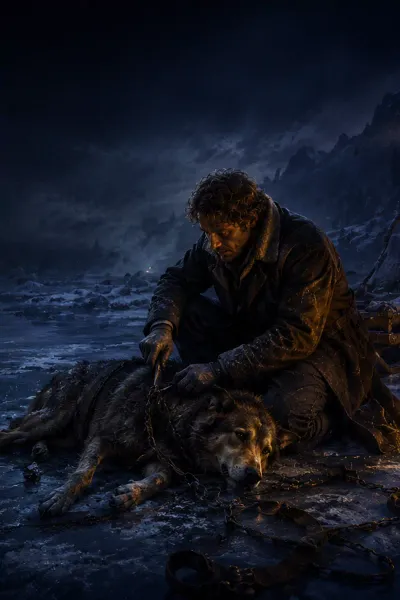
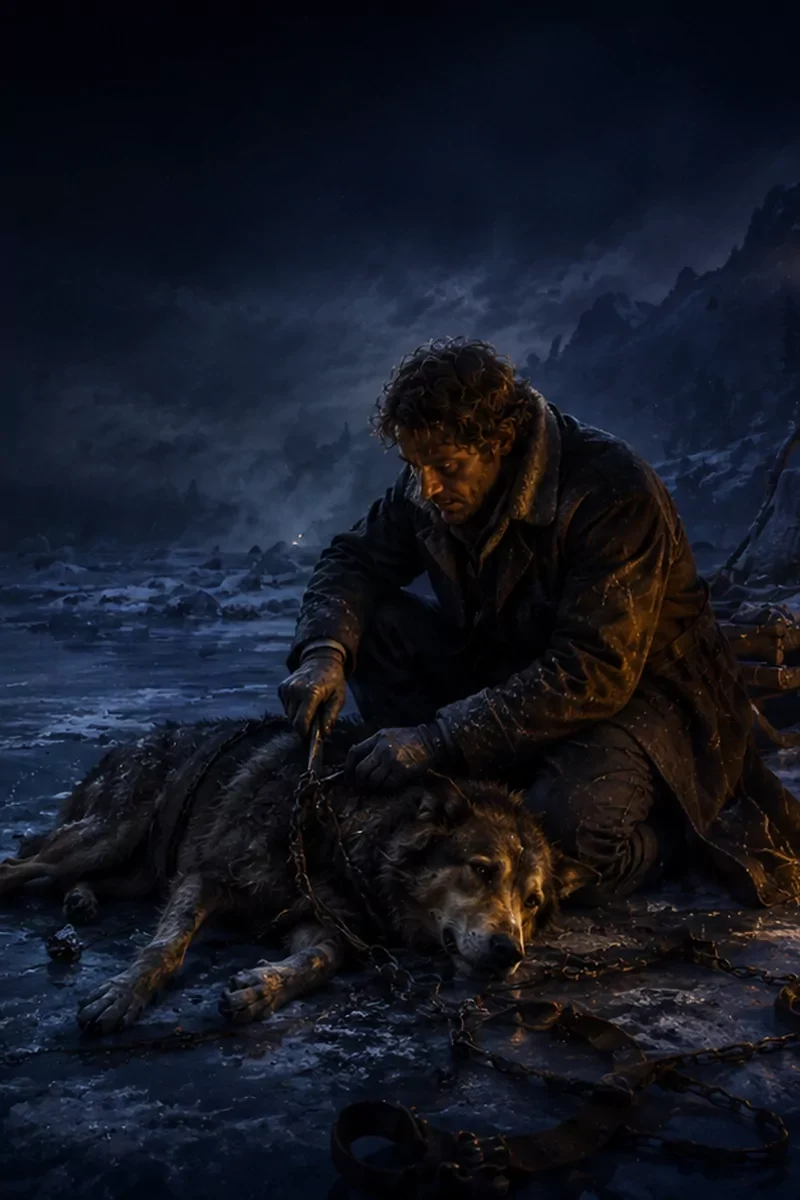
A pampered California dog is stolen and sold as a sled dog during the Klondike gold rush. To survive in the north he has to learn a new set of rules.
The book is short and built in a straight line: Buck's fall from comfort, his training on the trail, a series of owners, and the long stretch that decides what he becomes. It is told in the third person, but you stay close to Buck's mind, and the narrator explains what he senses and feels in a way a dog could not say. Fights, journeys and hunger take up most of the pages, and quieter passages describe cold, snow and instinct. The language is vivid American prose from 1903, with long, rhythmic sentences and some literary words, and only a little dialogue. A short verse epigraph opens the book.
You will like it if
- you like short, focused adventure stories
- you want a story told from an animal's point of view
- you enjoy strong descriptions of weather and landscape
- you are curious about the Klondike gold rush
You will not if
- you dislike scenes of violence against animals or of animals fighting
- you want lots of conversation and a large cast
- you prefer a light, funny story, because this one is serious from start to finish
- you find long literary sentences tiring
What kind of book“The Call of the Wild” is
Versions of “The Call of the Wild” in English: B1
Same book, adapted to a level you can read without stopping
Pick a version. The bar at the foot of the page opens the one you pick.
Vocabulary by level
- A1 60%
- A2 16%
- B1 9%
- B2 6%
- not in dictionary 4%
A sample from “The Call of the Wild” in English
One passage, the way each version writes it.
Tap any word — we will show the translation
C1.3173 words
Day and night the ship throbbed with the steady beat of the propeller, which never tired. One day was very like another, but Buck could tell that the weather was growing steadily colder. At last, one morning, the propeller was quiet, and the Narwhal was full of excitement. Buck felt it, as did the other dogs, and he knew that a change was coming. François put leashes on them and brought them on deck. At the first step onto the cold surface, Buck’s feet sank into something white and soft, very like mud. He sprang back with a snort. More of this white stuff was falling through the air. He shook himself, but more of it fell on him. He sniffed it curiously, then licked some up on his tongue. It bit like fire, and the next moment it was gone. This puzzled him. He tried it again, with the same result. The people watching laughed loudly, and he felt ashamed, though he did not know why, for it was his first snow.
B1.6195 words
Day and night the ship shook. The propeller (a set of turning blades that pushes a ship through water) turned without stopping. One day was very like another. Still, Buck could see clearly that the weather was growing colder all the time. At last, one morning, the propeller was quiet. Everyone on the Narwhal was excited and busy. Buck felt it, and the other dogs felt it too. He knew that a change was coming soon. François put ropes on them and brought them on deck. At the first step onto the cold floor, Buck’s feet went down. They went into a soft white thing very like mud. He jumped back and blew air through his nose. More of this white stuff was falling through the air. He shook himself, but more of it fell on him. He smelled it with interest. Then he took some up on his tongue. It bit like fire, and the next moment it was gone. Buck could not understand this. He tried it again, and the same thing happened. The people watching laughed very loudly. Buck felt ashamed, and he did not know why. It was his first snow.
The original language of “The Call of the Wild” and what it gives you
How hard the language is C2
Most of the words are plain: 60% of the vocabulary is A1 and another 16% is A2, and only 4% falls outside the dictionary. The difficulty comes from the style. Sentences average 18.8 words and are often long and rhythmic, 6% of the words are beyond the 5000 most frequent, and many of them are literary or Latinate. Our own measurement puts the original at C2, which is why we offer adaptations at B2 and B1. Expect an easy first impression and a slower read once the narrator starts describing instinct and the wild.
What this means in practice: Short, plain in vocabulary but demanding in style, and a good book to move from simplified readers to real literature.
What to be ready for
How to read it and not quit
- When a character's speech looks strange on the page, say it aloud: the spelling follows French-Canadian and German accents, and the sound usually gives you the word.
- Do not stop at every Latinate word such as "primordial" or "ferocity"; the meaning is usually clear from the sentence, and the same idea often appears nearby in simpler words.
- Watch the sled and trail vocabulary (traces, harness, runners, "mush") and the animal verbs; a few words repeat all through the book, so they are worth learning once.
- Long sentences often pile up clauses with "and" and participles ("-ing" words); find the main verb first and the rest falls into place.
Contents of “The Call of the Wild” · 8 chapters
- Epigraphpage 1
- I: Into the Primitivepage 1
- I: Into the Primitive (continued)page 9
- II: The Law of Club and Fangpage 17
- III: The Dominant Primordial Beastpage 29
- III: The Dominant Primordial Beast (continued)page 39
All 8 chaptersShow fewer
- IV: Who Has Won to Mastershippage 48
- V: The Toil of Trace and Trailpage 60
- V: The Toil of Trace and Trail (continued)page 70
- VI: For the Love of a Manpage 79
- VI: For the Love of a Man (continued)page 88
- VII: The Sounding of the Callpage 97
- VII: The Sounding of the Call (continued)page 108
Reader ratings for “The Call of the Wild”
Nobody has rated it yet. Be the first.
Your rating
Reader reviews of “The Call of the Wild”
No reviews yet.
The story of “The Call of the Wild”
London goes to the Klondike
Jack London travelled north during the Klondike gold rush and spent a winter in the Yukon region. The sled dogs and the cold he saw there became the material for the novel.
Serialised, then published as a book
The story appeared in The Saturday Evening Post in the summer of 1903 and was issued as a book by Macmillan the same year. London is reported to have sold the book rights outright for a flat fee rather than a royalty.
Illustrated first edition
The first Macmillan edition carried illustrations by Philip R. Goodwin and Charles Livingston Bull, which helped fix the book's look.
Hollywood film
A 20th Century Pictures film with Clark Gable and Loretta Young brought the story to a wide screen audience, though it centres on the human characters rather than the dog.
Questions about sources
London acknowledged that he had drawn on the Canadian missionary Egerton R. Young's book of sled-dog stories, My Dogs in the Northland, as well as on his own Klondike experience.
In culture “The Call of the Wild”
7 adaptations and mentions, 1903–2020
In the language The call of the wild
The title became an idiom for the pull of instinct, wilderness or a freer life against comfort and routine.
In the language The law of club and fang
London's phrase for the rule of brute force in the wild is still quoted to describe a place where only strength counts.
Art Goodwin and Bull illustrations
The first edition's pictures of Buck and the sled teams set the visual template for later illustrated editions.
Film The Call of the Wild (Wellman)
Clark Gable played John Thornton in the best-known classic-era Hollywood version.
Film The Call of the Wild (Annakin)
Charlton Heston played Thornton in a European co-production shot largely on location in northern landscapes.
Film The Call of the Wild (Sanders)
Harrison Ford starred opposite a computer-animated Buck, which gave the dog's point of view a very different look from earlier live-dog films.
Art Classics Illustrated comic
A comic-book version in the Classics Illustrated line introduced the story to young readers who had not met the novel.
Questions and answers about “The Call of the Wild” in English
Is The Call of the Wild based on a true story?
No, Buck is a fictional dog. The setting is real, though: Jack London went to the Klondike during the gold rush of 1897 and 1898, and the cold, the trail work and the sled teams in the book come from that world.
Who tells the story, Buck or a narrator?
A narrator tells it in the third person, but almost all of it is seen through Buck. The book explains his thoughts and instincts in words a dog could not use himself, which is why it can feel more like a fable than a realistic animal story.
What does the title mean?
The "call" is the pull of Buck's wild, ancestral instincts, which grow stronger the longer he lives in the cold. The book follows how far he follows that pull. I will not say where it ends, but the title is a good guide to the direction.
Is The Call of the Wild a children's book?
It is often read by young people, but it was written for adults and it is violent. Dogs fight, are beaten and die, and the people are sometimes cruel, so it can be hard going for readers who are sensitive about animals.
Should I read The Call of the Wild or White Fang first?
Either one, because they are separate stories. White Fang is often described as the mirror of this book: there a wild animal moves towards the human world, here a domestic dog moves the other way. Reading them in either order works.
Which film is closest to the book?
None of the films follows the book closely. The 2020 film with Harrison Ford uses a computer-made Buck and keeps the sled-dog story, but it makes the human characters more important and softens much of the violence. Earlier versions also change the plot.
Why do the dogs fight so much?
Because the book is about a team that must decide who leads it, and the fight for leadership is one of the main plots. Buck's rivalry with another dog on the team drives much of the middle of the story, and the violence shows how harsh the conditions are.
Is it hard to read in English if I am not a native speaker?
The vocabulary is mostly simple, but the style makes it harder than it first looks. Sentences can be long and literary, and a few characters speak in strong accents. Most readers find the first chapters easier than the later descriptive passages.
What kind of reader bounces off it?
Readers who want conversation, a big cast or humour tend to put it down. It is a serious, almost single-subject book about one dog and his surroundings. If that sounds right, it is quick to read.
Is the dialogue in the book hard to understand?
Only some of it, and not much of it. Francois, Perrault and the Scottish driver speak with French-Canadian sounds, and Hans has a German-style accent, but there is little dialogue overall and the meaning is easy to guess.
In brief about “The Call of the Wild”
17 fields of imprint data and measured text characteristics. All of it checkable.
- Original title
- The Call of the Wild
- Author
- Jack London
- First published
- 1903
- Original language
- English
- Genre
- Adventure · Animals · Classics
- Mood
- Dark
- Themes
- Survival · Nature · Freedom · Loyalty
- Setting
- California, then the Yukon and Alaska during the Klondike gold rush · the 1890s, at the height of the gold rush
- Distinct words
- 4,640
- Words per sentence
- 19 words
- Level of the original
- C2
- Versions
- C2, C1.3, B1.6
- Length of the original
- 12 ch. · 31,792 words
- Reading time
- ~3 h
- Source text
- Standard Ebooks
- Download
- EPUB
Similar what to read after “The Call of the Wild”
By the same author
1The same hand, a different story.
Close in spirit
7The same genre and the same register.
Black Beauty
Anna Sewell
C1.4orig.B1
~5 h 30 min · Classics
The Jungle Book
Rudyard Kipling
C1.7orig.
~4 h 40 min · Adventure
Around the World in Eighty Days
Jules Verne
C2orig.C1
~5 h 50 min · Adventure
Heart of Darkness
Joseph Conrad
C2orig.
~3 h 30 min · Adventure
Aesop's Fables
Aesop
C1.2orig.
~3 h 40 min · Fables & parables
Alice's Adventures in Wonderland
Lewis Carroll
C1.2orig.B1B2
~2 h 30 min · Classics
Adventures of Huckleberry Finn
Mark Twain
C1.6orig.B1
~10 h 20 min · Adventure
Book page ≈0.2.0 · Oct 14, 2026