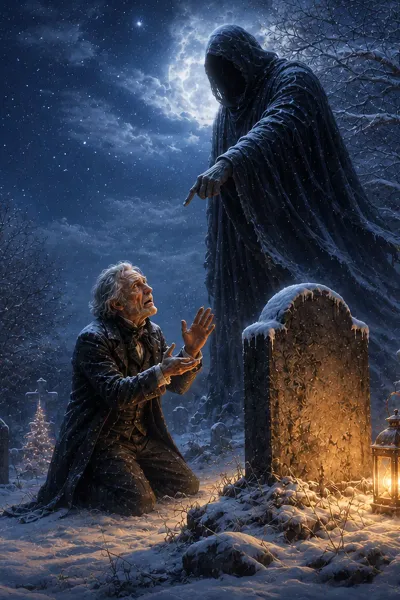
A Christmas Carol in English
A miser who hates Christmas is visited, one night, by the ghost of his dead partner and three spirits. They want him to look at his own life.
Dickens divides the book into five parts, which he calls staves, as if they were verses of a carol. The first sets up Scrooge and his dead partner, then three parts follow, one for each spirit, and the last pulls everything together. A chatty narrator speaks straight to the reader, makes jokes, repeats phrases and piles up long lists of food, people and objects. The scenes switch between cold London streets, warm family rooms and ghostly places. The English is early Victorian: not hard word by word, but dense and rhythmic, and it is better read slowly or aloud.
You will like it if
- you want a famous classic that you can finish quickly
- you like ghost stories that are more moral than frightening
- you enjoy a narrator with a strong voice, and a sense of humour
- you would like to hear the real words behind a story you only know from films
You will not if
- you want realistic, modern prose without Victorian wording
- you find long lists and repeated phrases tiring
- you do not like stories with a clear moral lesson
- you need fast plot: some scenes stop to describe rather than move
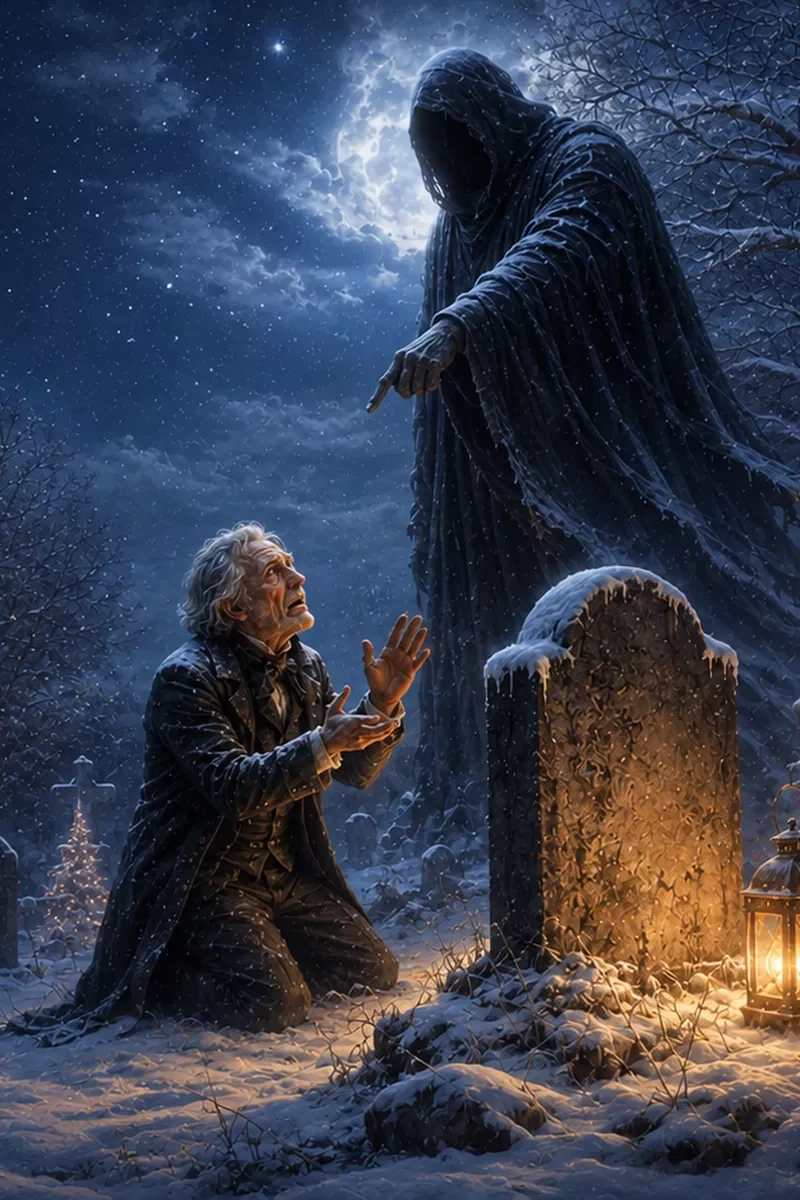
What kind of book“A Christmas Carol” is
Versions of “A Christmas Carol” in English: B1
Same book, adapted to a level you can read without stopping
Pick a version. The bar at the foot of the page opens the one you pick.
Vocabulary by level
- A1 63%
- A2 16%
- B1 7%
- B2 6%
- not in dictionary 4%
A sample from “A Christmas Carol” in English
One passage, the way each version writes it.
Tap any word — we will show the translation
C1.1161 words
“A merry Christmas, uncle! God save you!” cried a cheerful voice. It was the voice of Scrooge’s nephew. He came upon Scrooge so quickly that this voice was the first sign Scrooge had of his coming.
“Bah!” said Scrooge. “Humbug (nonsense; something false or silly)!”
He had heated himself by walking fast in the fog and frost, this nephew of Scrooge’s, and he was all in a glow. His face was red and handsome, his eyes sparkled, and his breath steamed in the cold air.
“Christmas a humbug, uncle!” said Scrooge’s nephew. “You don’t mean that, I am sure?”
“I do,” said Scrooge. “Merry Christmas! What right have you to be merry? What reason have you to be merry? You’re poor enough.”
“Come, then,” returned the nephew gaily. “What right have you to be gloomy? What reason have you to be so bad-tempered? You’re rich enough.”
Scrooge, having no better answer ready at that moment, said “Bah!” again, and then “Humbug!”
B1.8155 words
“A merry Christmas, uncle! God save you!” cried a cheerful voice. It was the voice of Scrooge’s nephew. He came so fast that Scrooge heard nothing before his voice.
“Bah!” said Scrooge. “Humbug (nonsense; something false or silly)!”
Scrooge’s nephew had walked very fast in the fog and frost. So he was warm all over. His face was red and handsome. His eyes shone, and his breath made smoke in the cold air.
“Christmas a humbug, uncle!” said Scrooge’s nephew. “You don’t mean that, I am sure?”
“I do,” said Scrooge. “Merry Christmas! What right have you to be merry? What reason have you to be merry? You are poor enough.”
“Come, then,” the nephew answered happily. “What right have you to be unhappy? What reason have you to be in a bad mood? You are rich enough.”
Scrooge had no better answer ready at that moment. So he said “Bah!” again, and then “Humbug!”
The original language of “A Christmas Carol” and what it gives you
How hard the language is C2
Our measurement puts the original at C2, which can look surprising next to the numbers. Sentences are not long on average (16.1 words), 63% of the words are A1 and another 16% A2, and only 5% fall beyond the 5,000 most frequent words. The difficulty comes from how the sentences are built: Dickens piles up clauses and lists, repeats himself on purpose, and uses period words and old money. Another 3% of the words are outside our dictionary, which means archaic, dialect or invented words. Short as it is, the book reads slower than its word count suggests. We ship adaptations at B2 and B1.
What this means in practice: Short, famous and more demanding than it looks: a good book for a reader who wants rich English in a small package.
What to be ready for
How to read it and not quit
- Read long sentences in chunks: find the main subject and verb first, then the lists and clauses that Dickens adds around them.
- Do not copy the dialogue as grammar: 'warn't' and 'He don't' are marked as working-class or casual speech, not forms to use yourself.
- Treat 'thou', 'thy' and 'ye' as old-fashioned words for 'you' and 'your' and move on.
- Do not stop for every pound, shilling or old coin: the context usually tells you whether something is cheap or dear.
Contents of “A Christmas Carol” · 6 chapters
- Prefacepage 1
- Stave I: Marley’s Ghostpage 1
- Stave I: Marley’s Ghost (continued)page 14
- Stave II: The First of the Three Spiritspage 27
- Stave II: The First of the Three Spirits (continued)page 39
- Stave III: The Second of the Three Spiritspage 50
All 6 chaptersShow fewer
- Stave III: The Second of the Three Spirits (continued)page 61
- Stave III: The Second of the Three Spirits (continued)page 72
- Stave IV: The Last of the Spiritspage 82
- Stave IV: The Last of the Spirits (continued)page 92
- Stave V: The End of Itpage 102
Reader ratings for “A Christmas Carol”
Nobody has rated it yet. Be the first.
Your rating
Reader reviews of “A Christmas Carol”
No reviews yet.
The story of “A Christmas Carol”
Written fast and published at Christmas
Dickens wrote the story in the autumn of 1843 and Chapman & Hall published it on 19 December with illustrations by John Leech. The first printing sold out within days.
Written with the poor in mind
Dickens had recently seen a ragged school and read a report on child labour, and he meant the story as a blow struck for the poor. He paid for the handsome production himself, so the profits were smaller than the sales suggested.
Pirated edition and lawsuit
A cheap pirated version appeared in 1844, and Dickens sued and won, but the publishers went bankrupt and he was left with the costs.
First public reading
Dickens gave his first public reading of the story in Birmingham in December 1853. He kept returning to it on his reading tours for the rest of his career.
Shaped the modern Christmas
The story is often credited with helping fix a warm, family-centred, charitable idea of Christmas in English-speaking culture, though it did not invent the holiday.
In culture “A Christmas Carol”
10 adaptations and mentions, 1843–1994
In the language Scrooge and "Bah! Humbug!"
"Scrooge" became a common word for a miser or a killjoy, and Scrooge's "Bah! Humbug!" is the standard exclamation of someone dismissing festive cheer.
In the language "God bless us, every one"
Tiny Tim's closing words are quoted as shorthand for the book's sentimental, charitable spirit.
Art John Leech's first-edition illustrations
Leech's hand-coloured etchings, including Marley's ghost and the Fezziwig ball, set the visual look of the story for later illustrators.
Stage Unauthorised stage versions
Stage adaptations appeared in London within weeks of publication, and the story has been staged regularly ever since.
Film Scrooge (A Christmas Carol)
Alastair Sim's performance in this British film is often held up as the standard screen Scrooge.
Film Mickey's Christmas Carol
Disney's short cast Scrooge McDuck as Scrooge and introduced the story to generations of children.
Series Blackadder's Christmas Carol
A British TV special that inverts the story by making its Scrooge a kind man tempted to become cruel.
Film Scrooged
Bill Murray plays a ruthless television executive in this comedy that moves the story to modern New York.
Film The Muppet Christmas Carol
Michael Caine plays Scrooge opposite the Muppets in a film that keeps much of Dickens's own narration.
Stage Menken's musical
Alan Menken's musical version, staged in New York in 1994, became an annual holiday production.
Questions and answers about “A Christmas Carol” in English
Is A Christmas Carol based on a true story?
No, Scrooge and the spirits are fiction. The poverty around them was real, though: Dickens wrote about a London with hungry children and crowded workhouses, and he meant his readers to notice it.
Why does Scrooge hate Christmas so much?
He puts money before everything else and sees no use in Christmas. The book then shows how he became that way, through a lonely childhood and a choice he made when he was young.
Is 'Bah! Humbug!' actually in the book?
Yes, it is, in the first part, when Scrooge answers his nephew's Christmas greeting. 'Humbug' means nonsense or a fraud, and it is Scrooge's word for everything he finds useless.
Who is Jacob Marley and why is he in chains?
Marley is Scrooge's business partner, who died seven years before the story begins. The chains are what he built through his own life, and he comes back to warn Scrooge that the same is being built for him.
What is wrong with Tiny Tim?
The book never names Tiny Tim's illness. It only shows that he is weak and walks with a crutch, and that his family cannot easily afford a doctor.
Which film is closest to the book?
The Muppet Christmas Carol (1992) keeps a lot of Dickens's own narration and lines, which surprises many people. The 1951 film with Alastair Sim is the classic straight version.
Is A Christmas Carol a horror story?
No, it is closer to a moral fable with a few frightening scenes. Marley's visit is the spookiest part, and the book is as often funny or warm as scary.
Do I need to read other Dickens books first?
No, it stands alone. It was the first of five Christmas books Dickens wrote, but you do not need the others to follow Scrooge's story.
Why is Dickens hard to read, even in a short book?
His sentences carry many clauses, lists and repeated words, and the vocabulary is from the 1840s. Most learners find it easier to understand a page when they read it aloud or in small chunks.
Is it worth reading in the original after seeing the films?
Yes, because the narrator is the best part and the films can only partly copy him. The jokes, the lists of food and the direct speech to the reader are in the text only.
In brief about “A Christmas Carol”
17 fields of imprint data and measured text characteristics. All of it checkable.
- Original title
- A Christmas Carol
- Author
- Charles Dickens
- First published
- 1843
- Original language
- English
- Genre
- Classics · Fairy tale · Philosophy
- Mood
- Uplifting
- Themes
- Redemption · Greed · Class · Family
- Setting
- London, England · Christmas Eve and Christmas Day in the 1840s, early Victorian England
- Distinct words
- 4,200
- Words per sentence
- 16 words
- Level of the original
- C2
- Versions
- C2, C1.1, B1.8
- Length of the original
- 11 ch. · 28,619 words
- Reading time
- ~2 h 40 min
- Source text
- Standard Ebooks
- Download
- EPUB
Similar what to read after “A Christmas Carol”
Close in spirit
8The same genre and the same register.
Heart of Darkness
Joseph Conrad
C2orig.
~3 h 30 min · Adventure
Crime and Punishment
Fyodor Dostoevsky
C1.7orig.C1
~18 h 50 min · Classics
The Picture of Dorian Gray
Oscar Wilde
C1.8orig.B1C1
~7 h 20 min · Gothic & mystery
Around the World in Eighty Days
Jules Verne
C2orig.C1
~5 h 50 min · Adventure
The Call of the Wild
Jack London
C2orig.B2C1
~3 h · Adventure
Essays
Ralph Waldo Emerson
C2orig.
~12 h 10 min · Philosophy
Frankenstein
Mary Shelley
C2orig.B2C1
~7 h 10 min · Gothic & mystery
Narrative of the Life of Frederick Douglass, an American Slave
Frederick Douglass
C2orig.
~3 h 50 min · Memoir
Book page ≈0.2.0 · Oct 14, 2026