Crime and Punishment in English
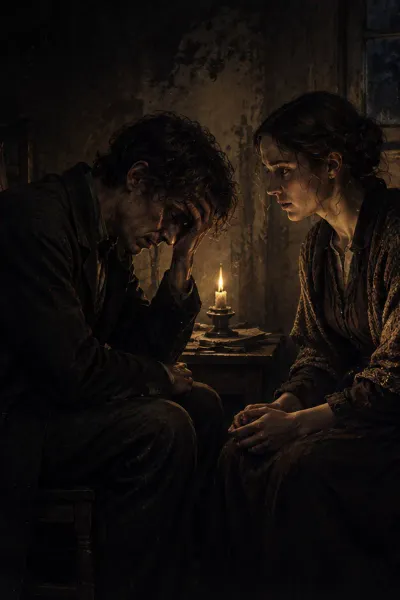
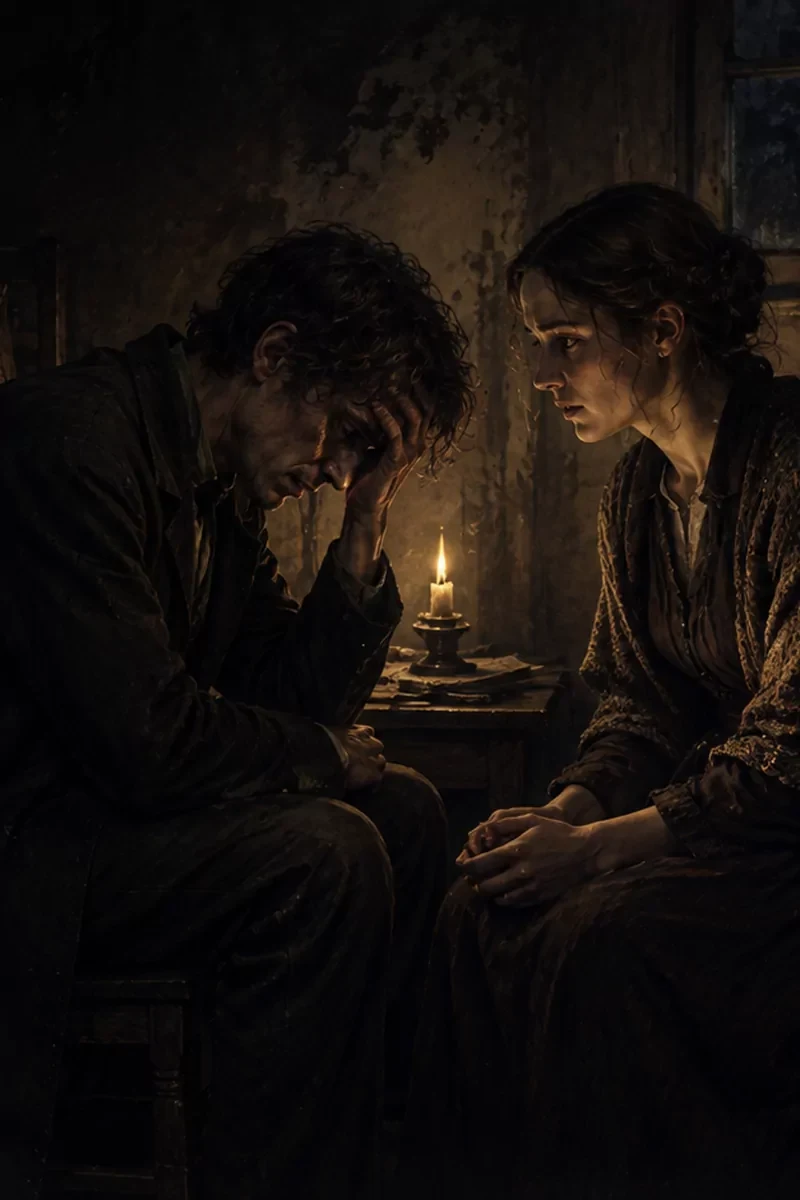
A poor student kills a pawnbroker, convinced he has the right to. The rest of the book is the story of whether he can live with it.
The novel has six parts and an epilogue. The crime comes early, and the rest is a slow, tightening chase that happens mostly in conversations and in Raskolnikov's own head. Chapters alternate between his fevered thoughts and long scenes of people talking: a tavern confession, a family quarrel, an interrogation. The English is plain and mostly direct, with short sentences and few ornaments, which makes the psychological tension easier to follow. It is long, though, and the Russian names, each in several forms, take some getting used to.
You will like it if
- you like psychological stories where the tension is in a character's head
- you want a long book whose sentences are short and clear
- you are interested in big questions about guilt, poverty and conscience
- you want to read a famous novel you may already know the outline of
You will not if
- you want fast, plot-heavy action: much of the book is argument and monologue
- Russian names in several forms for each person will make you stop and check
- it is very long, and the middle slows down with long conversations
- it is bleak and often uncomfortable, with poverty, illness and cruelty on every page
What kind of book“Crime and Punishment” is
Versions of “Crime and Punishment” in English: C1
Same book, adapted to a level you can read without stopping
Pick a version. The bar at the foot of the page opens the one you pick.
Vocabulary by level
- A1 64%
- A2 16%
- B1 8%
- B2 6%
- not in dictionary 3%
A sample from “Crime and Punishment” in English
One passage, the way each version writes it.
Tap any word — we will show the translation
Original · C1.7346 words
A few words about Dostoevsky himself may help the English reader to understand his work.
Dostoevsky was the son of a doctor. His parents were very hardworking and deeply religious people, but so poor that they lived with their five children in only two rooms. The father and mother spent their evenings in reading aloud to their children, generally from books of a serious character.
Though always sickly and delicate Dostoevsky came out third in the final examination of the Petersburg school of Engineering. There he had already begun his first work, Poor Folk.
This story was published by the poet Nekrassov in his review and was received with acclamations. The shy, unknown youth found himself instantly something of a celebrity. A brilliant and successful career seemed to open before him, but those hopes were soon dashed. In 1849 he was arrested.
Though neither by temperament nor conviction a revolutionist, Dostoevsky was one of a little group of young men who met together to read Fourier and Proudhon. He was accused of “taking part in conversations against the censorship, of reading a letter from Byelinsky to Gogol, and of knowing of the intention to set up a printing press.” Under Nicholas I (that “stern and just man,” as Maurice Baring calls him) this was enough, and he was condemned to death. After eight months’ imprisonment he was with twenty-one others taken out to the Semyonovsky Square to be shot. Writing to his brother Mihail, Dostoevsky says: “They snapped words over our heads, and they made us put on the white shirts worn by persons condemned to death. Thereupon we were bound in threes to stakes, to suffer execution. Being the third in the row, I concluded I had only a few minutes of life before me. I thought of you and your dear ones and I contrived to kiss Plestcheiev and Dourov, who were next to me, and to bid them farewell. Suddenly the troops beat a tattoo, we were unbound, brought back upon the scaffold, and informed that his Majesty had spared us our lives.”
C1.7343 words
A few words about Dostoevsky himself may help the English reader to understand his work.
Dostoevsky was the son of a doctor. His parents were very hardworking and deeply religious people, but so poor that they lived with their five children in only two rooms. The father and mother spent their evenings reading aloud to their children, generally from books of a serious nature.
Though always sickly and delicate, Dostoevsky came third in the final examination of the Petersburg School of Engineering. There he had already begun his first work, Poor Folk.
This story was published by the poet Nekrassov in his review and was received with acclaim. The shy, unknown youth found himself instantly something of a celebrity. A brilliant and successful career seemed to open before him, but those hopes were soon dashed. In 1849 he was arrested.
Though neither by temperament nor conviction a revolutionary, Dostoevsky was one of a small group of young men who met to read Fourier and Proudhon. He was accused of “taking part in conversations against the censorship, of reading a letter from Byelinsky to Gogol, and of knowing of the intention to set up a printing press.” Under Nicholas I (that “stern and just man,” as Maurice Baring calls him) this was enough, and he was condemned to death. After eight months’ imprisonment he was, with twenty-one others, taken out to the Semyonovsky Square to be shot. Writing to his brother Mihail, Dostoevsky says: “They snapped words over our heads, and they made us put on the white shirts worn by persons condemned to death. Thereupon we were bound in threes to stakes, to suffer execution. Being the third in the row, I concluded I had only a few minutes of life before me. I thought of you and your dear ones and I contrived to kiss Plestcheiev and Dourov, who were next to me, and to bid them farewell. Suddenly the troops beat a tattoo, we were unbound, brought back upon the scaffold, and informed that his Majesty had spared us our lives.”
The original language of “Crime and Punishment” and what it gives you
How hard the language is C1.7
The English is easier to read than the length of the book suggests. Sentences are short, about 14 words on average, and around 64% of the vocabulary is A1 and 16% A2, with only 5% beyond the 5,000 most common words and 3% outside the dictionary. We estimate the original at C1, which is not a measurement, mainly because of the length, the abstract thinking and the number of voices. A B2 adaptation exists for readers who want to reach the story with less effort.
What this means in practice: A demanding but readable novel: the language is plain, and the challenge is the length and the mood.
What to be ready for
How to read it and not quit
- Make a short list of names on the first page: Raskolnikov is also Rodya, Sonya is Sofya Semyonovna, and Dunya is his sister. It saves a lot of confusion later.
- Read the long speeches as spoken language: they are full of dashes, interruptions and repetitions, and you can often skip the repeated parts without losing the point.
- Learn the abstract words that return all the time (guilt, remorse, delirium, conscience). Knowing a dozen of them makes whole chapters easier.
- Do not stop for every unknown word in a monologue. If the sentence structure is clear, keep going and look it up afterwards.
Contents of “Crime and Punishment” · 48 chapters
- Translator’s Prefacepage 1
- Part Ipage 3
- Ipage 3
- IIpage 16
- II (continued)page 30
- IIIpage 42
All 48 chaptersShow fewer
- III (continued)page 56
- IVpage 62
- IV (continued)page 77
- Vpage 81
- V (continued)page 95
- VIpage 96
- VI (continued)page 110
- VIIpage 114
- VII (continued)page 128
- Part IIpage 132
- Ipage 132
- I (continued)page 146
- IIpage 156
- II (continued)page 171
- IIIpage 171
- III (continued)page 186
- IVpage 191
- IV (continued)page 204
- Vpage 205
- VIpage 220
- VI (continued)page 234
- VIIpage 247
- VII (continued)page 261
- Part IIIpage 272
- Ipage 272
- I (continued)page 286
- IIpage 291
- II (continued)page 305
- IIIpage 307
- III (continued)page 321
- IVpage 325
- IV (continued)page 340
- Vpage 340
- V (continued)page 355
- VIpage 366
- VI (continued)page 377
- Part IVpage 381
- Ipage 381
- I (continued)page 396
- IIpage 399
- II (continued)page 414
- IIIpage 416
- IVpage 427
- IV (continued)page 441
- Vpage 449
- V (continued)page 462
- VIpage 474
- Part Vpage 484
- Ipage 484
- I (continued)page 499
- IIpage 506
- II (continued)page 520
- IIIpage 524
- III (continued)page 538
- IVpage 544
- IV (continued)page 559
- Vpage 568
- V (continued)page 583
- Part VIpage 587
- Ipage 587
- IIpage 600
- II (continued)page 615
- IIIpage 621
- IVpage 634
- IV (continued)page 648
- Vpage 650
- V (continued)page 665
- VIpage 671
- VI (continued)page 685
- VIIpage 690
- VIIIpage 703
- Ipage 717
- IIpage 728
Reader ratings for “Crime and Punishment”
Nobody has rated it yet. Be the first.
Your rating
Reader reviews of “Crime and Punishment”
No reviews yet.
The story of “Crime and Punishment”
Written under pressure of debt
Dostoevsky, in financial trouble, planned the novel in 1865 and wrote it for serial publication while also racing to meet a ruinous contract deadline with another publisher.
Serialised in The Russian Messenger
The novel appeared in monthly instalments in Mikhail Katkov's journal The Russian Messenger (Russkii Vestnik) throughout 1866.
The Russian Messenger, 1866
First book edition
The novel was issued in book form in 1867, after the serial run had made it one of the most discussed works in Russian literature.
Constance Garnett's English translation
Garnett's translation, published in 1914, became the version through which generations of English-language readers knew the novel.
In culture “Crime and Punishment”
9 adaptations and mentions, 1866–1989
In the language Raskolnikov
The name became shorthand for an intellectual who talks himself into murder and is then destroyed by his own conscience.
In the language "A trembling creature or do I have the right?"
Raskolnikov's question about whether exceptional people may break the moral law is quoted whenever someone asks if great ends justify terrible means.
Film Crime and Punishment (Josef von Sternberg)
Columbia's Hollywood version starred Peter Lorre as Raskolnikov and brought the novel's psychology to American screens.
Film Pickpocket
Robert Bresson's film is not an adaptation but takes the novel's idea of a young man who believes himself above the law, and ends in a similar redemption.
Film Rikos ja rangaistus (Aki Kaurismaki)
Kaurismaki's first feature moved the story to modern Helsinki and showed how easily it travels to another city and century.
Film Crimes and Misdemeanors
Woody Allen's film reworks the novel's question of what happens to a man who gets away with murder, and returned to it again in Match Point (2005).
Stage Rodney Ackland's stage adaptation
Ackland's play, with John Gielgud as Raskolnikov, was one of the best-known English-language stage versions of the novel.
Music Raskolnikoff (Heinrich Sutermeister)
Sutermeister's opera is one of several musical settings of the story.
Series BBC television adaptation
A British television version cast John Simm as Raskolnikov for a new generation of viewers.
Questions and answers about “Crime and Punishment” in English
Why does Raskolnikov kill the pawnbroker?
He half-believes that some exceptional people have the right to break moral rules for a greater good, and he wants to test whether he is one of them. Poverty, pride and a feverish state of mind push him along, and the book leaves it open how much each one matters.
Is Crime and Punishment a detective story?
Not in the usual way. You know who committed the crime from the start, and the suspense is about conscience and about when the police will close in, not about who did it.
Is it based on a true story?
There is no single real case behind it. Dostoevsky was interested in crime reports in the press, and he had spent years in a Siberian prison camp, which shaped how he wrote about guilt and punishment.
Why do the characters have so many names?
That is normal Russian naming, with a first name, a patronymic from the father's name, and a family name, plus pet forms. Raskolnikov is called Rodion Romanovich or Rodya, depending on who is speaking, and keeping a short list of names helps.
Is the Garnett translation a good one to read?
It is readable and clear, and it is the version most English readers have known for over a century. Critics say it smooths out the roughness of the Russian, but for a learner that smoothness is a help.
What is the hardest part to get through?
The middle, where the story pauses for long conversations and philosophical arguments. If you hang on, the tension returns, and the last parts move faster.
Do I need to know Russian history to read it?
No. A little background on poverty and class in 1860s St Petersburg helps, but the book explains what it needs through the characters' own situations.
Which film or series is closest to the book?
None of them capture the book fully, because so much of it takes place in Raskolnikov's thoughts. Film versions focus on the crime and the investigation and lose most of the philosophy and the minor characters.
Is it too depressing to enjoy?
It is dark, but it is not hopeless, and many readers find it gripping because of the psychology. Expect an intense, uncomfortable mood rather than a gloomy one.
Do I need to read anything before it?
No, it stands alone. You can read it as your first Russian novel, and the plot is clear enough that you do not need to know Dostoevsky's other books.
In brief about “Crime and Punishment”
17 fields of imprint data and measured text characteristics. All of it checkable.
- Original title
- Crime and Punishment
- Author
- Fyodor Dostoevsky
- First published
- 1866
- Original language
- English
- Genre
- Classics · Philosophy
- Mood
- Dark
- Themes
- Guilt · Redemption · Class · Justice
- Setting
- St Petersburg, Russia, in the poorest streets and rented rooms of the city · The 1860s (the novel was published in 1866)
- Distinct words
- 9,309
- Words per sentence
- 14 words
- Level of the original
- C1.7
- Versions
- C1.7, C1.7
- Length of the original
- 79 ch. · 204,060 words
- Reading time
- ~18 h 50 min
- Source text
- Standard Ebooks
- Download
- EPUB
Similar what to read after “Crime and Punishment”
Close in spirit
8The same genre and the same register.
The Picture of Dorian Gray
Oscar Wilde
C1.8orig.B1C1
~7 h 20 min · Gothic & mystery
A Christmas Carol
Charles Dickens
C2orig.B1C1
~2 h 40 min · Classics
Heart of Darkness
Joseph Conrad
C2orig.
~3 h 30 min · Adventure
A Little Princess
Frances Hodgson Burnett
C1.4orig.B1
~6 h 10 min · Classics
Aesop's Fables
Aesop
C1.2orig.
~3 h 40 min · Fables & parables
Alice's Adventures in Wonderland
Lewis Carroll
C1.2orig.B1B2
~2 h 30 min · Classics
Anne of Green Gables
L. M. Montgomery
C1.6orig.B2
~9 h 30 min · Classics
Black Beauty
Anna Sewell
C1.4orig.B1
~5 h 30 min · Classics
Book page ≈0.2.0 · Oct 14, 2026