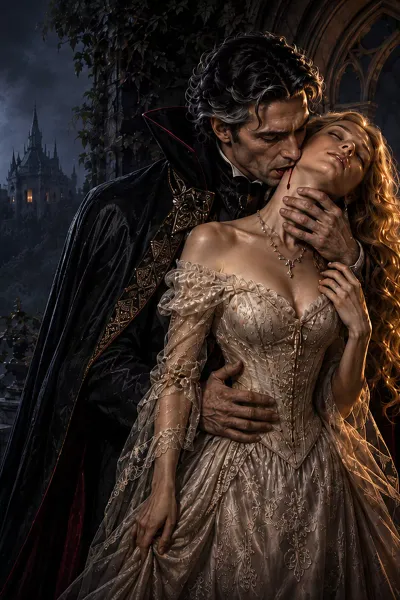
Dracula in English
A lawyer travels to Transylvania to meet a count and finds out his host is not what he seems. When the count follows him to England, a small group of friends tries to stop him.
Dracula has no single narrator. It is built from Jonathan Harker's journal, Dr Seward's recorded diary, letters between two young women, telegrams and newspaper cuttings, arranged in the order the events happened. It has three clear parts: Harker's stay in the castle, the Count's arrival in England, and the journey back to Transylvania. Because each writer sees only part of the story, the reader puts the pieces together at the same speed as the characters. The language changes with the writer: a lawyer's notes, a doctor's clinical record and affectionate letters sound very different. Most of the English is standard and educated, with a few old forms and several strongly marked speakers.
You will like it if
- you like stories told through diaries, letters and documents
- you want to hear many kinds of English in one book
- you enjoy slow-building, atmospheric horror
- you want to see where the familiar vampire story comes from
You will not if
- the Count is absent from the page for long stretches
- a few speakers (Swales, Van Helsing) are slow to read
- the middle is slow, with long discussions and records
- some attitudes towards women feel very Victorian
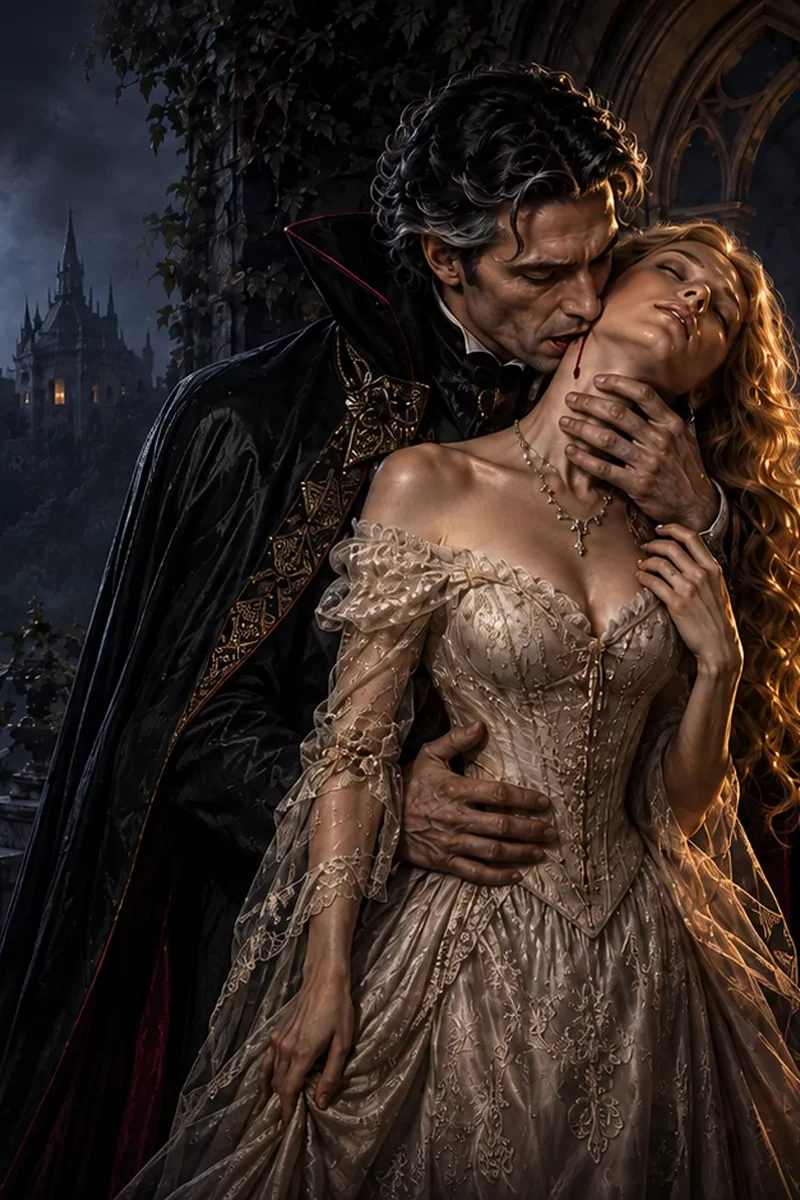
What kind of book“Dracula” is
Versions of “Dracula” in English: B1
Same book, adapted to a level you can read without stopping
Pick a version. The bar at the foot of the page opens the one you pick.
Vocabulary by level
- A1 65%
- A2 17%
- B1 7%
- B2 6%
- not in dictionary 2%
A sample from “Dracula” in English
One passage, the way each version writes it.
Tap any word — we will show the translation
B2.9201 words
“I am glad you found your way in here, for I am sure there is much that will interest you. These companions”—and he laid his hand on some of the books—“have been good friends to me. For some years past, ever since I had the idea of going to London, they have given me many, many hours of pleasure. Through them I have come to know your great England; and to know her is to love her. I want so much to go through the crowded streets of your great London, to be among the swirling, rushing crowds of people. I want to share its life, its change, its death, and all that makes it what it is. But sadly, so far I only know your language through books. I look to you, my friend, to help me learn to speak it.”
“But, Count,” I said, “you know and speak English thoroughly!” He bowed seriously.
“I thank you, my friend, for your far too flattering opinion. But I fear that I am only a little way along the road I would travel. True, I know the grammar and the words, but I do not know how to speak them.”
B1.7214 words
“I am glad you found your way in here. I am sure there is much that will interest you. These companions were good friends to me.” He laid his hand on some of the books. “Some years ago I first thought of going to London. Since then they gave me many, many hours of pleasure.
“Through them I know your great England. To know her is to love her. I long to go through the crowded streets of your mighty London. I want to stand in the middle of its hurry. I want to stand in the rush of people. I want to share its life, its change and its death. I want to share all that makes it what it is.
“But alas! So far I only know your language through books. I look to you, my friend, so that I may learn to speak it.”
“But, Count,” I said, “you know and speak English very well!” He gave a slow, serious bow.
“I thank you, my friend, for your much too kind opinion. But I fear this. I am only a little way on the road. It is the road I want to travel. True, I know the grammar and the words. But I do not yet know how to speak them.”
The original language of “Dracula” and what it gives you
How hard the language is C1.8
The measured numbers say the vocabulary is plain: 82% of the words are in the A1-A2 bands, only 4% are beyond the 5,000 most frequent words, and the average sentence is 18.2 words. Our measurement still puts the original at C1.8, because the difficulty is not in the word list but in the voices. Late Victorian prose, a few old forms and several characters who do not speak standard English mean you meet many styles, and some pages need a second look.
What this means in practice: The words are mostly simple but the voices are many; a good book for a learner who can skim a dialect passage and keep going.
What to be ready for
How to read it and not quit
- Do not copy Van Helsing's grammar. His strange word order and wrong verb endings belong to the character, and the narrators around him write standard English.
- Read Swales's Whitby scenes for the general sense, not word by word. The dialect is heavy but short, and the plot does not depend on understanding every word.
- Check the heading of each entry (date, place, writer) before reading: it tells you whose English you are about to read.
- Old forms are easy once you know them: whilst means while, and nay means no.
Contents of “Dracula” · 30 chapters
- Dedicationpage 1
- Prefacepage 1
- Ipage 1
- I (continued)page 15
- IIpage 23
- II (continued)page 38
All 30 chaptersShow fewer
- IIIpage 45
- III (continued)page 59
- IVpage 66
- IV (continued)page 80
- Vpage 87
- V (continued)page 98
- VIpage 100
- VI (continued)page 110
- VIIpage 121
- VII (continued)page 135
- VII (continued)page 139
- VIIIpage 142
- VIII (continued)page 154
- IXpage 165
- IX (continued)page 175
- Xpage 186
- X (continued)page 195
- XIpage 206
- XI (continued)page 212
- XI (continued)page 221
- XIIpage 225
- XII (continued)page 238
- XII (continued)page 244
- XIIIpage 251
- XIII (continued)page 264
- XIVpage 275
- XIV (continued)page 287
- XVpage 298
- XV (continued)page 312
- XVIpage 319
- XVI (continued)page 333
- XVIIpage 336
- XVII (continued)page 347
- XVIIIpage 354
- XVIII (continued)page 361
- XVIII (continued)page 371
- XIXpage 378
- XIX (continued)page 389
- XXpage 398
- XX (continued)page 409
- XXIpage 418
- XXI (continued)page 432
- XXIIpage 440
- XXII (continued)page 454
- XXIIIpage 459
- XXIII (continued)page 473
- XXIVpage 480
- XXIV (continued)page 491
- XXVpage 502
- XXV (continued)page 512
- XXV (continued)page 515
- XXVIpage 525
- XXVI (continued)page 535
- XXVI (continued)page 545
- XXVIIpage 550
- XXVII (continued)page 563
- XXVII (continued)page 569
- Notepage 578
Reader ratings for “Dracula”
Nobody has rated it yet. Be the first.
Your rating
Reader reviews of “Dracula”
No reviews yet.
The story of “Dracula”
Publicación de Drácula
La novela de Bram Stoker fue publicada en Londres por Archibald Constable and Company el 26 de mayo de 1897.
Bram Stoker's biography and publishing records
Primeras reseñas
Las reseñas contemporáneas fueron mixtas; algunas elogiaron la atmósfera de la novela, mientras que otras la consideraron sensacionalista e inverosímil.
Victorian periodical reviews
Película Nosferatu
Se estrenó la adaptación cinematográfica alemana no autorizada de F. W. Murnau, Nosferatu, eine Symphonie des Grauens; un tribunal ordenó posteriormente la destrucción de todas las copias, pero algunas sobrevivieron.
Film history records
Drácula de Universal
La película estadounidense protagonizada por Bela Lugosi como el conde Drácula fue estrenada por Universal Pictures, consolidando la imagen icónica del personaje.
Universal Pictures archives
Drácula de Bram Stoker
Se estrenó la adaptación cinematográfica de Francis Ford Coppola, titulada Drácula de Bram Stoker, que ganó tres premios Óscar.
Academy Awards records
In culture “Dracula”
10 adaptations and mentions, 1922–2020
Film Nosferatu
La película muda de F. W. Murnau fue una adaptación no autorizada que se convirtió en un hito del cine expresionista alemán.
Stage Drácula (obra de teatro)
La adaptación teatral de Hamilton Deane se estrenó en Derby y posteriormente se representó en Londres y en Broadway, protagonizada por Bela Lugosi.
Film Drácula (Universal)
La interpretación de Bela Lugosi estableció al vampiro aristocrático en la cultura popular y dio origen a una franquicia.
Music Drácula (ballet)
Una adaptación de ballet con música de Franz Liszt fue coreografiada por Lawrence Rhodes para el Houston Ballet.
Game Castlevania
La serie de videojuegos de Konami, que comenzó con Castlevania, presenta al conde Drácula como el antagonista recurrente.
Film Drácula de Bram Stoker
La lujosa adaptación de Francis Ford Coppola renovó el interés por la novela y ganó tres premios Óscar.
Art Ilustraciones de Drácula
Numerosos artistas han ilustrado la novela, incluida una notable edición con ilustraciones de Jae Lee y una adaptación a novela gráfica de Roy Thomas.
Series Drácula (Netflix/BBC)
Una miniserie creada por Mark Gatiss y Steven Moffat ofreció una versión moderna de la historia.
In the language Drácula
El nombre 'Drácula' se ha convertido en sinónimo de tirano sediento de sangre o monstruo seductor, y 'vampiro' en la cultura popular a menudo evoca el arquetipo de Stoker.
In the language Nosferatu
El término 'Nosferatu' entró en inglés como sinónimo de vampiro, en gran parte debido a la película, aunque se usó en la novela de Stoker como una palabra rumana para vampiro.
Questions and answers about “Dracula” in English
Is Dracula based on a real person?
Only the name is. Stoker took the name Dracula from a historical prince of Wallachia, but the Count's character, castle and powers are invented. The real man has very little in common with him.
Is Dracula the first vampire story?
No. John Polidori's The Vampyre (1819) and Sheridan Le Fanu's Carmilla (1872) came earlier. Dracula is the book that made the vampire the main figure of horror fiction.
Why is Dracula told in diaries and letters?
Stoker wanted the story to read like a collection of real documents. Each writer sees only part of events, so the reader builds the full picture slowly, and the format lets him change voice from lawyer to doctor to young woman.
Does Dracula die in sunlight in the book?
No. In the book he can walk about in daylight, though his powers are weaker. The idea that sunlight kills him comes from later films, starting with Nosferatu (1922).
How different are the films from the book?
Most are quite different. Films usually cut characters and add things, such as the love story between Dracula and Mina in Coppola's 1992 film, which is not in the book. If you know the film, expect a slower and stranger book.
Does Dracula appear a lot in the book?
No. He appears directly in the first castle chapters and in a few later scenes. For the rest of the book, you see what he does through other people's diaries.
Why does Van Helsing talk so strangely?
He is a Dutch professor speaking English as a foreign language, and Stoker writes this with unusual word order, wrong verb endings and repeated words. Other characters speak standard English, so you can use their entries to check what he means.
What makes Dracula hard to read in English?
The vocabulary is mostly simple, but the voices change. Swales's Yorkshire dialect, Van Helsing's English and the Cockney workmen are the parts that slow people down, together with some long Victorian sentences.
Do I need to read anything before Dracula?
No. It stands alone and you can start at the first entry of Harker's journal. There is no required reading before it.
Which part of Dracula do people give up on?
The long middle in England, with doctors' diaries and long planning conversations. Readers who keep going reach a fast final chase.
In brief about “Dracula”
17 fields of imprint data and measured text characteristics. All of it checkable.
- Original title
- Dracula
- Author
- Bram Stoker
- First published
- 1897
- Original language
- English
- Genre
- Gothic & mystery · Classics
- Mood
- Dark
- Themes
- Power · Identity · Science
- Setting
- Transylvania, the seaside town of Whitby in Yorkshire, and London · The 1890s, late Victorian England
- Distinct words
- 9,080
- Words per sentence
- 18 words
- Level of the original
- C1.8
- Versions
- C1.8, B2.9, B1.7
- Length of the original
- 55 ch. · 160,455 words
- Reading time
- ~14 h 50 min
- Source text
- Standard Ebooks
- Download
- EPUB
Similar what to read after “Dracula”
Close in spirit
8The same genre and the same register.
The Hound of the Baskervilles
Arthur Conan Doyle
C1.9orig.B1C1
~5 h 30 min · Detective
The Picture of Dorian Gray
Oscar Wilde
C1.8orig.B1C1
~7 h 20 min · Gothic & mystery
Jane Eyre
Charlotte Brontë
C2orig.B1C1
~17 h 20 min · Classics
Wuthering Heights
Emily Brontë
C2orig.B1C1
~10 h 50 min · Gothic & mystery
Strange Case of Dr Jekyll and Mr Hyde
Robert Louis Stevenson
C2orig.B1C1
~2 h 20 min · Gothic & mystery
Frankenstein
Mary Shelley
C2orig.B1C1
~7 h 10 min · Gothic & mystery
Three Men in a Boat (To Say Nothing of the Dog)
Jerome K. Jerome
C1.7orig.B1B2C1
~6 h 10 min · Humor
Aesop's Fables
Aesop
C1.2orig.
~3 h 40 min · Fables & parables
Book page ≈0.2.0 · Oct 14, 2026