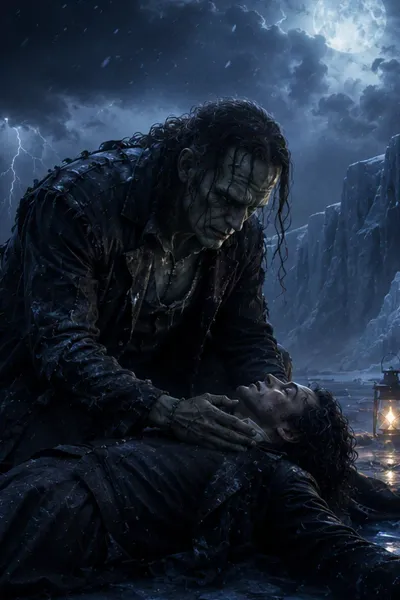
Frankenstein in English
A scientist creates a living being, runs away from it, and has to face what he made.
The book is a story inside a story inside a story. It opens with letters from a polar explorer, who meets Victor on the ice; most of the book is Victor's own account of how he made the creature and what followed. In the middle of that account the creature speaks for himself at length, and then the frame closes again. The pace is steady rather than fast: long, thoughtful stretches of narration, interrupted by a few violent events. The language is formal early-19th-century prose with long, balanced sentences, rhetorical questions and plenty of strong feeling.
You will like it if
- you like gothic stories that are about ideas as well as fear
- you want to read the original behind the famous image
- you enjoy a story told by several narrators
- you are interested in questions about science and responsibility
You will not if
- you want a fast horror story, because most of the book is reflection and conversation
- the opening letters feel slow before the main story starts
- long, formal sentences and old-fashioned vocabulary tire you
- you expect the monster from the films: the book's creature is very different
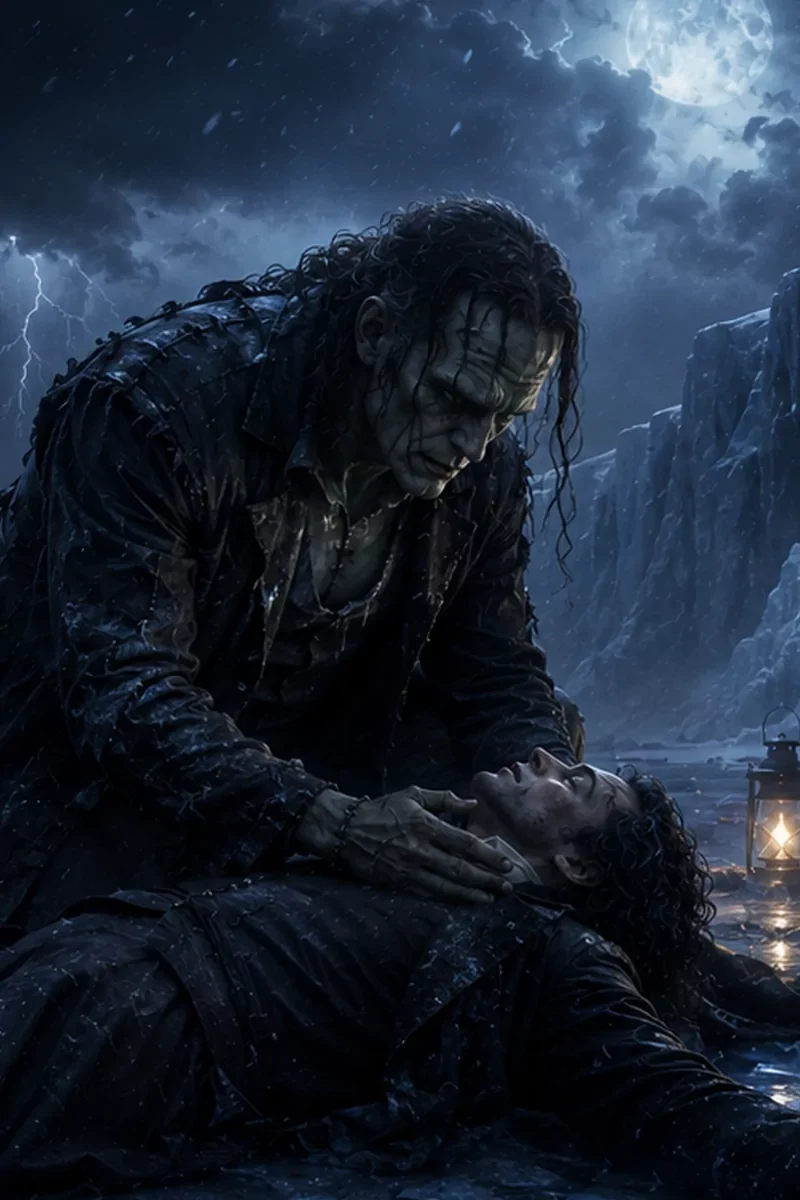
What kind of book“Frankenstein” is
Versions of “Frankenstein” in English: B1
Same book, adapted to a level you can read without stopping
Pick a version. The bar at the foot of the page opens the one you pick.
Vocabulary by level
- A1 59%
- A2 17%
- B1 10%
- B2 6%
- not in dictionary 4%
A sample from “Frankenstein” in English
One passage, the way each version writes it.
Tap any word — we will show the translation
C1.2191 words
When my guest had recovered a little, I had great difficulty keeping the men away. They wished to ask him a thousand questions. But I would not let their idle curiosity trouble him. His body and mind clearly needed complete rest to recover. Once, however, the lieutenant asked why he had come so far across the ice in such a strange vehicle.
His face immediately took on an expression of the deepest sadness, and he replied, “To seek someone who fled from me.”
“And did the man you were pursuing travel in the same way?”
“Yes.”
“Then I think we have seen him. The day before we picked you up, we saw some dogs pulling a sledge across the ice, with a man in it.”
This caught the stranger’s attention. He asked many questions about the route taken by the daemon (an older spelling of demon, used as an angry name for someone thought evil), as he called him. Soon afterwards, when he was alone with me, he said, “I have certainly stirred your curiosity, as well as that of these good people. But you are too thoughtful to ask questions.”
B1.7198 words
My guest was a little better. I had much trouble keeping the men away. They wished to ask him a thousand questions. But I would not let them trouble him with their useless questions. His body and mind clearly needed full rest. Once, however, my officer asked a question. “Why did you come so far on the ice in so strange a carriage?”
His face at once grew very dark and sad. He replied, “To seek one who ran away from me.”
“And did the man you followed travel in the same way?”
“Yes.”
“Then I think we have seen him. One day before we found you, we saw some dogs. They were pulling a sledge (A vehicle on runners that slides over snow or ice) with a man in it across the ice.”
This woke the stranger’s attention. He asked many questions about the road the daemon (an older spelling of demon, used here as an angry name) had taken. He called him that. Soon after he was alone with me. He said, “I have surely woken your curiosity. I have woken the curiosity of these good people too. But you are too kind to ask questions.”
The original language of “Frankenstein” and what it gives you
How hard the language is C2
Most of the words are simple, with 59% in the A1 band and another 17% in A2, and only 7% fall beyond the 5,000 most frequent words. The difficulty is in the sentences: they average 22.5 words and are long, balanced and often full of subordinate clauses. Add formal Latinate vocabulary and 4% of words that a modern dictionary does not cover, and our measurement puts the original at C2. Expect to read slowly, even if you know most of the individual words.
What this means in practice: Simple words in long, formal sentences: a hard read even for strong learners, and a good reason to start with an adaptation.
What to be ready for
How to read it and not quit
- Find the main subject and verb first. In long sentences the clauses are stacked around them with commas and semicolons, and the verb can come late.
- Learn the Latinate words that are rare today, such as countenance (face), endeavour (try) and peruse (read carefully); the same ideas are expressed in shorter words in modern English.
- Check the articles and relative clauses: the nineteenth-century style uses which, whom and whose in long chains, and a missed the or a can hide who is being talked about.
- Keep track of who is speaking. Past perfect and reported speech move you between narrators, and the changes are marked only by the context.
Contents of “Frankenstein” · 32 chapters
- Introductionpage 1
- Prefacepage 10
- Dedicationpage 12
- Epigraphpage 12
- Letter Ipage 12
- Letter IIpage 17
All 32 chaptersShow fewer
- Letter IIIpage 21
- Letter IVpage 23
- Chapter Ipage 32
- Chapter IIpage 38
- Chapter IIIpage 46
- Chapter IVpage 56
- Chapter Vpage 64
- Chapter VIpage 73
- Chapter VIIpage 82
- Chapter VII (continued)page 89
- Chapter VIIIpage 95
- Chapter IXpage 106
- Chapter Xpage 115
- Chapter XIpage 123
- Chapter XIIpage 134
- Chapter XIIIpage 141
- Chapter XIVpage 149
- Chapter XVpage 155
- Chapter XVIpage 166
- Chapter XVIIpage 178
- Chapter XVIIIpage 185
- Chapter XIXpage 195
- Chapter XXpage 204
- Chapter XX (continued)page 210
- Chapter XXIpage 216
- Chapter XXI (continued)page 223
- Chapter XXIIpage 230
- Chapter XXIIIpage 242
- Chapter XXIVpage 252
- Chapter XXIV (continued)page 262
- Chapter XXIV (continued)page 270
Reader ratings for “Frankenstein”
Nobody has rated it yet. Be the first.
Your rating
Reader reviews of “Frankenstein”
No reviews yet.
The story of “Frankenstein”
A ghost-story contest at Lake Geneva
During a wet summer near Geneva, Mary Godwin (later Shelley), then eighteen, began the story after Lord Byron proposed that each of the company write a ghost story.
Mary Shelley, Introduction to the 1831 edition
Anonymous first edition
Frankenstein; or, The Modern Prometheus appeared in three volumes on 1 January 1818, unsigned and with a preface by Percy Bysshe Shelley, so that many reviewers assumed he was the author.
Title page of the 1818 first edition
Second edition names the author
A second edition prepared with help from her father, William Godwin, carried Mary Shelley's name for the first time.
First stage adaptation
Richard Brinsley Peake's play Presumption; or, the Fate of Frankenstein opened in London and began the long stage life of the story; Mary Shelley attended a performance.
Revised one-volume edition
Shelley heavily revised the text for the Standard Novels series and added a new introduction describing how the story came to her; this edition became the standard text for a century.
Mary Shelley, Introduction to the 1831 edition
In culture “Frankenstein”
10 adaptations and mentions, 1818–2011
In the language Frankenstein
The name came to mean any creation that escapes its maker's control and turns on him, even though it belongs to the scientist rather than the creature he made.
Stage Presumption; or, the Fate of Frankenstein
Peake's London melodrama first gave the creature a mute, menacing stage presence, an image that later films would reuse.
Film Frankenstein (James Whale)
Universal's film with Boris Karloff and makeup by Jack Pierce fixed the flat-headed, bolted monster that most people now picture, far from the novel's articulate creature.
Series The Munsters
The American sitcom turned the Universal monster into the gentle father of a family, showing how fully the figure had become folklore.
Music "Frankenstein" (The Edgar Winter Group)
The instrumental hit, reportedly built from spliced pieces of tape, took its name from the idea of assembling something new from parts.
Stage The Rocky Horror Show
Richard O'Brien's musical made Dr Frank-N-Furter a flamboyant creator of an artificial man and became one of theatre's longest-lasting cult shows.
Film Young Frankenstein
Mel Brooks's black-and-white parody affectionately mocked the 1930s Universal films and became a comedy classic.
Art Bernie Wrightson's illustrated Frankenstein
Wrightson's detailed pen-and-ink drawings, produced over several years, are among the best-known illustrations of the novel.
Stage Frankenstein (National Theatre)
Danny Boyle's production, with Benedict Cumberbatch and Jonny Lee Miller alternating the roles of Victor and the Creature, returned the story to the creature's point of view.
In the language Frankenfood
Coined in the early 1990s for genetically modified food, it shows how the novel became the default warning image for scientific overreach.
Questions and answers about “Frankenstein” in English
Is Frankenstein the monster or the scientist?
Frankenstein is the scientist, Victor Frankenstein. The creature never gets a name in the book; he is called the creature, the monster or the wretch. The mix-up comes from the films, which often called the monster Frankenstein.
Does the monster in the book look like the one in the films?
No. The green skin, flat head and neck bolts come from the 1931 film. In the book he is described as unnaturally tall, with yellow skin and watery eyes, and what horrifies people is how he looks, not a costume.
Can the creature talk in the book?
Yes, and well. He teaches himself to speak and read by listening to a family from hiding, and he gives a long and articulate account of his life. This is one of the biggest differences from the films, where he usually grunts.
Is Frankenstein based on a true story?
No. It came out of a ghost-story challenge among friends in the summer of 1816. Scientific experiments with electricity were a hot topic at the time, which is the background of the book's questions.
Does the book explain how the creature is made?
No. Victor talks about collecting materials and working in secret, but he never gives details of the method on purpose. The book is much more interested in what happens after the creature is alive.
Who is the real monster in Frankenstein?
The book leaves it open, and that is why people argue about it. The creature does terrible things, but they follow rejection and loneliness, and Victor abandons what he made. How the story ends is for you to read.
Is Frankenstein a horror story or science fiction?
It is both, and many call it the first science fiction novel. The mood is gothic and sad rather than frightening: there are a few violent scenes, but much of the book is reflection and argument.
Is the book hard to read in English?
Yes. Most of the words are simple, but the sentences are long and formal, and the 1818 style is far from modern speech. It is a book that rewards slow reading, and many learners start with an adaptation.
Which part do readers give up on?
Most often the opening letters, which are slow and set the stage rather than start the story. Once Victor begins his own account the book picks up, and the creature's chapters in the middle are usually the strongest part.
Do the films keep to the book?
Most do not. They tend to follow the 1931 image of a speechless monster, drop the framing letters, and change the ending. If you know only the films, the book is a different experience.
In brief about “Frankenstein”
17 fields of imprint data and measured text characteristics. All of it checkable.
- Original title
- Frankenstein
- Author
- Mary Shelley
- First published
- 1818
- Original language
- English
- Genre
- Gothic & mystery · Classics · Science fiction
- Mood
- Dark
- Themes
- Science · Ambition · Guilt · Identity
- Setting
- Geneva and the Swiss Alps, the German university town of Ingolstadt, parts of Britain and Ireland, and the frozen Arctic · The late 1700s (the opening letters are dated "17—")
- Distinct words
- 7,015
- Words per sentence
- 23 words
- Level of the original
- C2
- Versions
- C2, C1.2, B1.7
- Length of the original
- 33 ch. · 77,832 words
- Reading time
- ~7 h 10 min
- Source text
- Standard Ebooks
- Download
- EPUB
Similar what to read after “Frankenstein”
Close in spirit
8The same genre and the same register.
Jane Eyre
Charlotte Brontë
C2orig.B1C1
~17 h 20 min · Classics
Strange Case of Dr Jekyll and Mr Hyde
Robert Louis Stevenson
C2orig.B1C1
~2 h 20 min · Gothic & mystery
The Picture of Dorian Gray
Oscar Wilde
C1.8orig.B1C1
~7 h 20 min · Gothic & mystery
Dracula
Bram Stoker
C1.8orig.B1B2
~14 h 50 min · Gothic & mystery
The Hound of the Baskervilles
Arthur Conan Doyle
C1.9orig.B1C1
~5 h 30 min · Detective
Around the World in Eighty Days
Jules Verne
C2orig.C1
~5 h 50 min · Adventure
The Call of the Wild
Jack London
C2orig.B1C1
~3 h · Adventure
A Christmas Carol
Charles Dickens
C2orig.B1C1
~2 h 40 min · Classics
Book page ≈0.2.0 · Oct 14, 2026