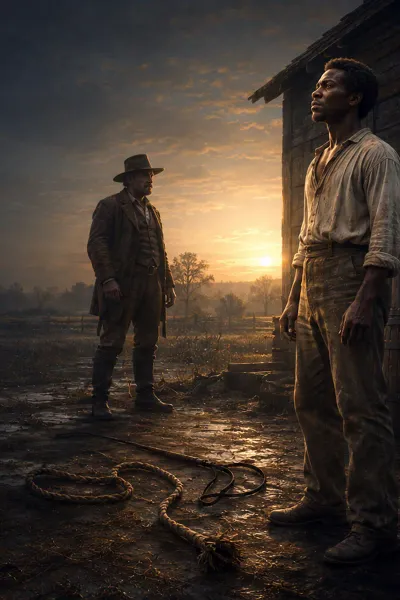
Narrative of the Life of Frederick Douglass, an American Slave in English
A man who escaped from slavery tells his own story in plain, powerful prose. The book follows how he learned to read and why that knowledge made him impossible to keep as a slave.
The book is a first-person memoir that moves in time from Douglass's childhood to his escape in 1838. It begins with his earliest memories on a Maryland plantation, then follows him to Baltimore, where he learns to read, and back into harder work under cruel masters. The turning point is a fight that changes how he sees himself, and the last chapters describe how he left. The writing is formal and balanced, with long sentences, strong moral words and a lot of argument mixed with narrative. It also includes prefaces by white abolitionists and an appendix that criticises slaveholding religion.
You will like it if
- you want a short, true account of slavery in the first person
- you enjoy formal, persuasive writing that argues as it tells
- you are interested in how reading and education change a person
- you want to read a key text of American history and literature
You will not if
- you do not want to read about whippings, family separation and cruelty
- you want an easy, conversational style: the prose is formal and can be heavy
- you want a fast-moving plot with a lot of dialogue
- you want to know how the story continued: the book stops soon after the escape
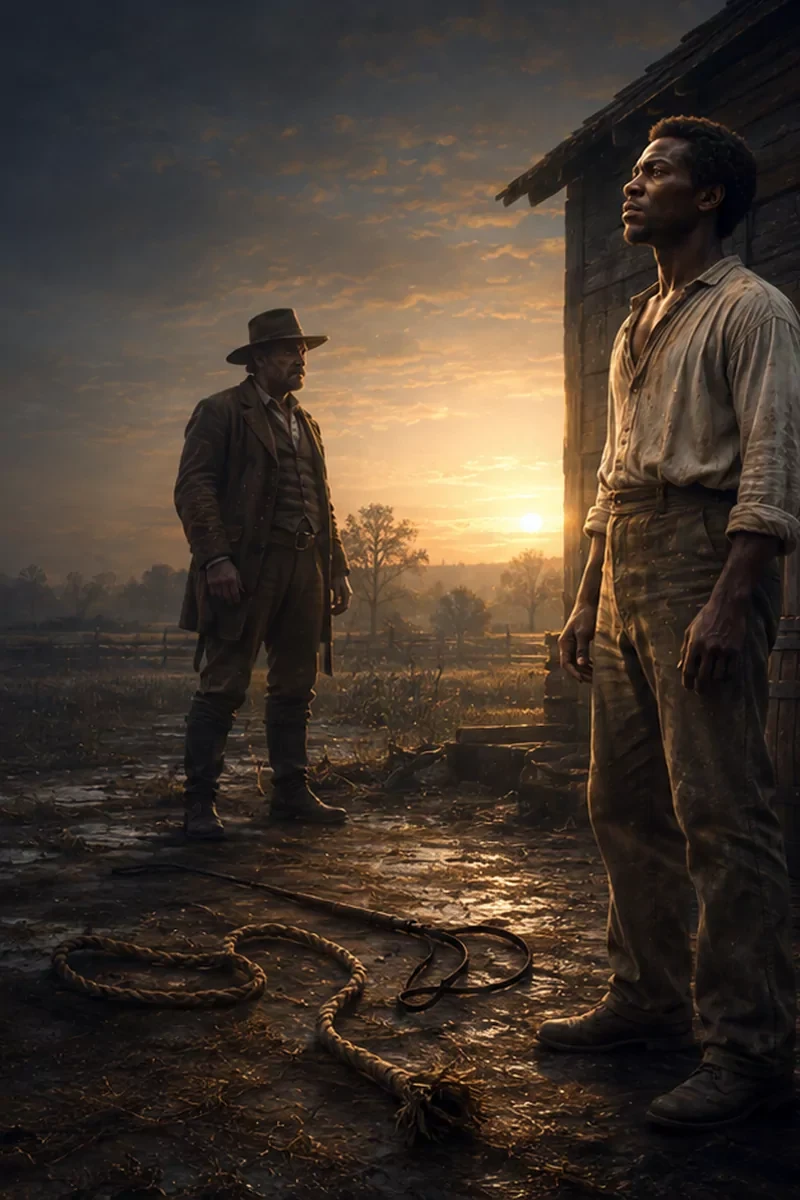
What kind of book“Narrative of the Life of Frederick Douglass, an American Slave” is
Versions of “Narrative of the Life of Frederick Douglass, an American Slave” in English: C2
Same book, adapted to a level you can read without stopping
Pick a version. The bar at the foot of the page opens the one you pick.
Vocabulary by level
- A1 61%
- A2 17%
- B1 9%
- B2 6%
- not in dictionary 3%
A sample from “Narrative of the Life of Frederick Douglass, an American Slave” in English
One passage, the way each version writes it.
Tap any word — we will show the translation
Original · C2290 words
In the month of August, 1841, I attended an anti-slavery convention in Nantucket, at which it was my happiness to become acquainted with Frederick Douglass, the writer of the following Narrative. He was a stranger to nearly every member of that body; but, having recently made his escape from the southern prison-house of bondage, and feeling his curiosity excited to ascertain the principles and measures of the abolitionists —of whom he had heard a somewhat vague description while he was a slave —he was induced to give his attendance, on the occasion alluded to, though at that time a resident in New Bedford.
Fortunate, most fortunate occurrence! —fortunate for the millions of his manacled brethren, yet panting for deliverance from their awful thraldom! —fortunate for the cause of negro emancipation, and of universal liberty! —fortunate for the land of his birth, which he has already done so much to save and bless! —fortunate for a large circle of friends and acquaintances, whose sympathy and affection he has strongly secured by the many sufferings he has endured, by his virtuous traits of character, by his ever-abiding remembrance of those who are in bonds, as being bound with them! —fortunate for the multitudes, in various parts of our republic, whose minds he has enlightened on the subject of slavery, and who have been melted to tears by his pathos, or roused to virtuous indignation by his stirring eloquence against the enslavers of men! —fortunate for himself, as it at once brought him into the field of public usefulness, “gave the world assurance of a man,” quickened the slumbering energies of his soul, and consecrated him to the great work of breaking the rod of the oppressor, and letting the oppressed go free!
The original language of “Narrative of the Life of Frederick Douglass, an American Slave” and what it gives you
How hard the language is C2
The English is formal but not obscure. The book has about 40,500 words and 4,800 different word forms; 61% of the words are A1 and 17% A2, so most of the text is built from common words. The difficulty is in the sentences: the average is 20.2 words, and many run longer, with several clauses joined together. Only 6% of the words are beyond the 5,000 most frequent and 3% are outside the dictionary. We estimate the original at B2, and there is no adaptation yet. A confident intermediate reader can manage it, but the argument and the moral vocabulary ask for slow, careful reading.
What this means in practice: Short, formal and serious: a demanding but rewarding read for intermediate learners.
What to be ready for
How to read it and not quit
- Read long sentences by their punctuation: find the subject and main verb first, then add the phrases separated by commas and semicolons.
- Learn the key vocabulary of the period early (master, overseer, slaveholder, freedom, bondage); the same words come back in every chapter.
- Watch for passive voice, which Douglass uses to show who had power and who did not (I was sent, he was whipped).
- Do not translate word for word the formal connectors such as whence, whereby or nevertheless; look at what logical link they make between two sentences.
Contents of “Narrative of the Life of Frederick Douglass, an American Slave” · 13 chapters
- Prefacepage 1
- Preface (continued)page 12
- Ipage 16
- IIpage 23
- IIIpage 31
- IVpage 36
All 13 chaptersShow fewer
- Vpage 42
- VIpage 48
- VIIpage 52
- VIIIpage 61
- IXpage 68
- Xpage 75
- X (continued)page 85
- X (continued)page 99
- X (continued)page 113
- XIpage 122
- XI (continued)page 136
- Appendixpage 141
Reader ratings for “Narrative of the Life of Frederick Douglass, an American Slave”
Nobody has rated it yet. Be the first.
Your rating
Reader reviews of “Narrative of the Life of Frederick Douglass, an American Slave”
No reviews yet.
The story of “Narrative of the Life of Frederick Douglass, an American Slave”
Published in Boston
The Narrative appeared in May 1845 from the Anti-Slavery Office in Boston with a preface by William Lloyd Garrison and a letter from Wendell Phillips.
Authenticity doubted
Because the book named people and places, and because Douglass wrote so well, some readers doubted that a formerly enslaved man could have written it himself.
Lecture tour of Britain and Ireland
The book's fame made Douglass a target for recapture, and he left for Britain and Ireland in the autumn of 1845, where he lectured for about two years.
Freedom purchased
English friends raised the money to buy Douglass's legal freedom from his former master in 1846.
Expanded as My Bondage and My Freedom
Douglass rewrote and enlarged his story ten years later, and again in Life and Times in 1881.
In culture “Narrative of the Life of Frederick Douglass, an American Slave”
4 adaptations and mentions, 1845–1845
In the language "You have seen how a man was made a slave; you shall see how a slave was made a man"
The line introducing his fight with the slave-breaker Covey is widely quoted as the turning point of the book.
In the language "The pathway from slavery to freedom"
Douglass's description of what learning to read meant to him is often quoted in debates about education and literacy.
In the language "It would forever unfit him to be a slave"
Hugh Auld's words, overheard by young Douglass, are quoted as the moment he understood why reading was forbidden.
In the language The slave narrative as a genre
The book became the model for later first-person accounts of slavery and a standard text in American schools and universities.
Questions and answers about “Narrative of the Life of Frederick Douglass, an American Slave” in English
What is the Narrative of the Life of Frederick Douglass about?
It is Douglass's own account of growing up in slavery in Maryland and escaping to the North in 1838. He describes the cruelty he saw and suffered, and how learning to read became the first step to freedom.
Is the Narrative of the Life of Frederick Douglass a true story?
Yes, it is a memoir written by Douglass himself and published in 1845. He named real people and places, which was risky for a man who had escaped, and he later wrote longer versions of his life, such as My Bondage and My Freedom.
How did Frederick Douglass learn to read?
He was first taught the alphabet by his master's wife in Baltimore until her husband stopped it. After that he kept learning on his own, from children in the street and from any text he could find.
Why did Douglass write the book?
He wrote it to show people in the free states what slavery was really like and to prove that he was who he said he was. Many listeners at antislavery meetings doubted that such a speaker could have been enslaved.
What is the most famous line in the book?
The best known is the idea that you have seen how a man was made a slave and will now see how a slave was made a man. It comes at the turning point of the story and sums up the book's argument.
Is it hard to read because of the content?
Yes, in places: there are scenes of whipping, family separation and other cruelty, told plainly and without exaggeration. Douglass does not dwell on them for effect, but you should expect them.
Is it suitable for school reading?
It is commonly taught in American schools and universities, usually from the later years of secondary school. It is a key text for the history of slavery and of abolition.
What happened to Douglass after the book?
He became one of the leading abolitionists in the United States and a famous speaker and writer, and later worked in public life. His freedom was legally purchased in 1846 by supporters in Britain, which ended the risk of being returned to his former owner.
Is there a film of the Narrative?
There is no single famous film of this book. Douglass appears as a character in many films and documentaries about slavery and abolition.
Is it a good book to practise formal English?
Yes, if you are already comfortable with intermediate texts. The prose is clear but formal, so it prepares you well for academic reading and for essays.
In brief about “Narrative of the Life of Frederick Douglass, an American Slave”
17 fields of imprint data and measured text characteristics. All of it checkable.
- Original title
- Narrative of the Life of Frederick Douglass · “Narrative of the Life of Frederick Douglass, an American Slave”
- Author
- Frederick Douglass
- First published
- 1845
- Original language
- English
- Genre
- Memoir · Classics
- Mood
- Dark
- Themes
- Freedom · Justice · Identity
- Setting
- Maryland (the Eastern Shore and Baltimore), then the northern United States · the early nineteenth century, up to 1838
- Distinct words
- 4,848
- Words per sentence
- 20 words
- Level of the original
- C2
- Versions
- C2
- Length of the original
- 18 ch. · 40,520 words
- Reading time
- ~3 h 50 min
- Source text
- Standard Ebooks
- Download
- EPUB
Similar what to read after “Narrative of the Life of Frederick Douglass, an American Slave”
Close in spirit
8The same genre and the same register.
Little Women
Louisa May Alcott
C1.8orig.B1B2
~17 h 20 min · Classics
Around the World in Eighty Days
Jules Verne
C2orig.C1
~5 h 50 min · Adventure

The Call of the Wild
Jack London
C2orig.B2C1
~3 h · Adventure
A Christmas Carol
Charles Dickens
C2orig.B1C1
~2 h 40 min · Classics
Frankenstein
Mary Shelley
C2orig.B2C1
~7 h 10 min · Gothic & mystery
Heart of Darkness
Joseph Conrad
C2orig.
~3 h 30 min · Adventure
Jane Eyre
Charlotte Brontë
C2orig.B1C1
~17 h 20 min · Classics
Strange Case of Dr Jekyll and Mr Hyde
Robert Louis Stevenson
C2orig.B1C1
~2 h 20 min · Gothic & mystery
Book page ≈0.2.0 · Oct 14, 2026