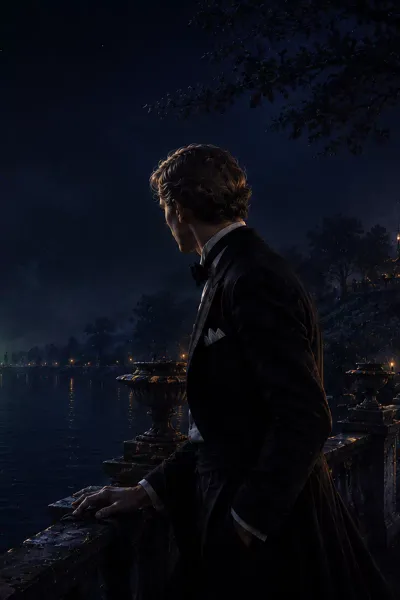
The Great Gatsby in English
A young man from the Midwest watches his mysterious rich neighbour try to win back the woman he loved five years ago.
Nick tells the story himself, looking back on one summer. Most chapters are built around a single event: a party, a lunch, an afternoon in a hotel. The narration is thoughtful and full of images, while the dialogue is fast, casual and full of 1920s slang. Fitzgerald moves between polished upper-class talk and the rougher voices of working-class, immigrant and drunken characters. The sentences are short on average, but the language is dense, so a page can take longer than its length suggests.
You will like it if
- you like novels where a lot happens beneath the surface
- you want to read the 1920s as it was written, with its slang and parties
- you enjoy a short, tightly built story
- you are interested in money, class and the American Dream
You will not if
- you prefer plots that move quickly; much of the book is talk and atmosphere
- you don't like narrators who watch more than they act
- you find none of the characters likeable, and few are
- you want a straightforward moral, because the book leaves judgments open
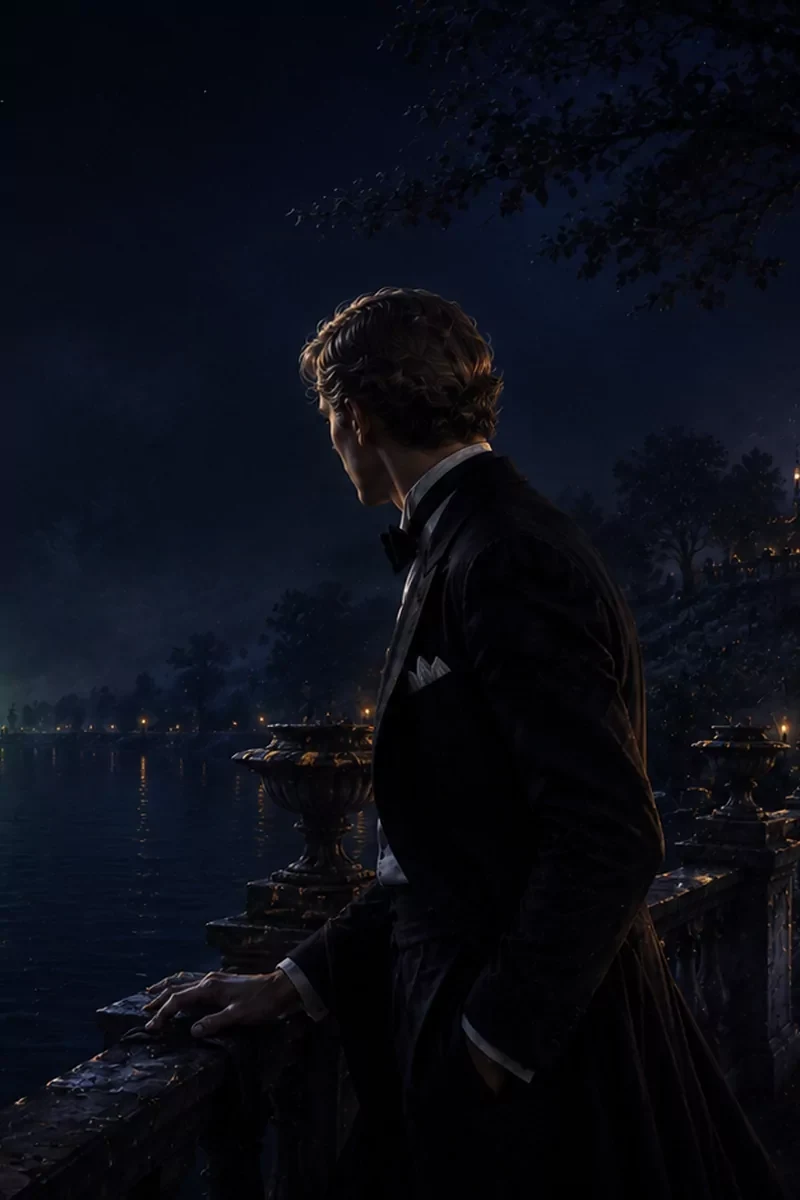
What kind of book“The Great Gatsby” is
Versions of “The Great Gatsby” in English: B1
Same book, adapted to a level you can read without stopping
Pick a version. The bar at the foot of the page opens the one you pick.
Vocabulary by level
- A1 64%
- A2 15%
- B1 8%
- B2 6%
- not in dictionary 4%
A sample from “The Great Gatsby” in English
One passage, the way each version writes it.
Tap any word — we will show the translation
C1.0143 words
“I’ll tell you a family secret,” she whispered enthusiastically. “It’s about the butler’s nose. Do you want to hear about the butler’s nose?”
“That’s why I came over tonight.”
“Well, he wasn’t always a butler. He used to polish silver for some people in New York. They had silver dishes, knives and forks for two hundred people. He had to polish it from morning till night, until finally it began to affect his nose—”
“Things went from bad to worse,” suggested Miss Baker.
“Yes. Things went from bad to worse, until finally he had to give up his job.”
For a moment the last sunshine fell with romantic affection on her glowing face. Her voice pulled me forward, and I listened breathlessly. Then the glow faded. Each light left her slowly and unwillingly, with regret, like children leaving a pleasant street at dusk.
B1.7153 words
“I’ll tell you a family secret,” she said in a low, excited voice. “It’s about the butler’s nose. Do you want to hear about the butler’s nose?”
“That’s why I came over tonight.”
“Well, he wasn’t always a butler. His job was to clean and shine the silver for some people in New York. They had silver dishes for two hundred people. He had to rub the silver clean from morning till night. At last it started to hurt his nose—”
“Things got worse and worse,” Miss Baker said.
“Yes. Things got worse and worse, until at last he had to leave his job.”
For a moment the last sunshine fell with warm love on her bright face. Her voice pulled me closer, and I held my breath as I listened. Then the bright light went away. Each light left her slowly and sadly, like children leaving a nice street when night begins.
The original language of “The Great Gatsby” and what it gives you
How hard the language is C1.8
We measure the original at C1.8, which is demanding, though the numbers look friendly: the average sentence is only 14.5 words, 64% of the words are A1 and another 15% are A2, and just 5% fall beyond the 5,000 most frequent words. The difficulty is in how the words are used. Fitzgerald writes in figurative, compressed prose, and he mixes it with colloquial speech from several social groups. About 4% of the words are not in the dictionary, mostly slang, names and respelt speech. Adaptations are available at B2 and B1 if you want a gentler start.
What this means in practice: Short and well worth reading, but dense: slow down for the descriptions and read the slang aloud.
What to be ready for
How to read it and not quit
- Read the dialogue aloud: the respelt words such as ‘Oggsford’ make sense when you hear them.
- Don't copy the slang. ‘Old sport’ is part of Gatsby's manner; you will not hear it in modern conversation.
- When Nick uses an image or comparison, stop and ask what it describes. Much of the meaning is in these figures.
- American English is used throughout: check spellings and words such as ‘elevator’ and ‘trunk’ that differ from British usage.
Contents of “The Great Gatsby” · 11 chapters
- Dedicationpage 1
- Epigraphpage 1
- Ipage 1
- I (continued)page 12
- IIpage 25
- II (continued)page 33
All 11 chaptersShow fewer
- IIIpage 41
- III (continued)page 50
- IVpage 62
- IV (continued)page 71
- Vpage 83
- V (continued)page 96
- VIpage 100
- VI (continued)page 104
- VIIpage 115
- VII (continued)page 127
- VII (continued)page 138
- VIIIpage 148
- VIII (continued)page 157
- IXpage 165
- IX (continued)page 177
Reader ratings for “The Great Gatsby”
Nobody has rated it yet. Be the first.
Your rating
Reader reviews of “The Great Gatsby”
No reviews yet.
The story of “The Great Gatsby”
Written largely in France
Fitzgerald wrote most of the novel while living on the French Riviera in 1924.
Publication and a quiet reception
Scribner's published the book in April 1925. Reviews were mixed and sales were lower than Fitzgerald hoped. He had considered other titles, such as 'Trimalchio in West Egg'.
First film
A silent film version was made, which is now lost.
Fitzgerald dies
Fitzgerald died in 1940 and is generally said to have believed the book had failed. Its reputation grew in the years that followed.
Enters the US public domain
On 1 January 2021 the novel became free of copyright in the United States.
In culture “The Great Gatsby”
10 adaptations and mentions, 1925–2024
In the language The green light
The light at the end of Daisy's dock is now shorthand for a goal that keeps moving away as you reach for it.
In the language 'Gatsby' and 'Gatsbyesque'
Used for a self-made person who reinvents himself and throws huge, lonely parties.
In the language 'Borne back ceaselessly into the past'
The last line is one of the most quoted endings in American writing, used to talk about nostalgia and the cost of trying to repeat the past.
Film The Great Gatsby (silent film)
The first screen version, now considered lost.
Film The Great Gatsby (Alan Ladd)
A Hollywood version with Alan Ladd as Gatsby.
Film The Great Gatsby (Robert Redford)
A lavish film with Robert Redford and Mia Farrow, remembered for its costumes.
Stage The Great Gatsby (opera by John Harbison)
An opera that premiered at the Metropolitan Opera in New York.
Film The Great Gatsby (Baz Luhrmann)
A colourful, modern-sounding version starring Leonardo DiCaprio.
Music 'Young and Beautiful' (Lana Del Rey)
A song written for the Luhrmann film that gave the story a new audience of pop listeners.
Stage The Great Gatsby (Broadway musical)
A stage musical version that opened on Broadway.
Questions and answers about “The Great Gatsby” in English
What does the green light mean in The Great Gatsby?
The green light at the end of Daisy's dock stands for Gatsby's longing for her and for his belief that the past can be recovered. Fitzgerald never states this directly, so the meaning grows as Gatsby keeps looking at it.
Is The Great Gatsby based on a true story?
No, the plot is invented, but the setting comes from Fitzgerald's own life. He lived on Long Island in the early 1920s, saw the parties and the new money there, and wrote about the world he observed.
Why is Gatsby called ‘great’?
The word is partly admiring and partly ironic. Nick thinks Gatsby is better than the careless people around him, but Gatsby's greatness is also a performance, and readers argue about how much of each the title carries.
What does ‘old sport’ mean?
‘Old sport’ is an affectionate, old-fashioned way of saying ‘friend’. Gatsby uses it all the time, and it is part of the stagey, upper-class manner he has built for himself.
Is Nick Carraway a reliable narrator?
Mostly, but not completely. Nick says he is honest and tries to be fair, yet he leaves things out, admires Gatsby despite disapproving of him, and decides who to like.
Was The Great Gatsby ever banned?
It has been challenged in some US schools and libraries, usually for language and sexual content, but it was never banned across the country. It is one of the most commonly assigned novels in American schools.
Which film is closest to the book?
Both the 1974 film with Robert Redford and the 2013 film by Baz Luhrmann follow the main plot. The 1974 version is quieter, while the 2013 version uses modern music and a flashy style, and puts Nick's words on the screen.
Do I need to know American history to read it?
A little helps. The book assumes you know that alcohol was illegal in the US in the 1920s, which is why Gatsby's money and his friends look suspicious.
Is The Great Gatsby hard to read in English?
It is moderately hard. The sentences are short, but the imagery is dense, and the slang and respelt speech can slow you down. Taking one chapter at a time works well.
In brief about “The Great Gatsby”
17 fields of imprint data and measured text characteristics. All of it checkable.
- Original title
- The Great Gatsby
- Author
- F. Scott Fitzgerald
- First published
- 1925
- Original language
- English
- Genre
- Classics · Romance
- Mood
- Melancholy
- Themes
- Ambition · Love · Class
- Setting
- Long Island and New York City · Summer 1922, the Jazz Age
- Distinct words
- 5,474
- Words per sentence
- 15 words
- Level of the original
- C1.8
- Versions
- C1.8, C1.0, B1.7
- Length of the original
- 20 ch. · 48,392 words
- Reading time
- ~4 h 30 min
- Source text
- Standard Ebooks
- Download
- EPUB
Similar what to read after “The Great Gatsby”
Close in spirit
8The same genre and the same register.
A Little Princess
Frances Hodgson Burnett
C1.4orig.B1
~6 h 10 min · Classics
Anne of Green Gables
L. M. Montgomery
C1.6orig.B2
~9 h 30 min · Classics
Little Women
Louisa May Alcott
C1.8orig.B1B2
~17 h 20 min · Classics
Jane Eyre
Charlotte Brontë
C2orig.B1C1
~17 h 20 min · Classics
Pride and Prejudice
Jane Austen
C2orig.B1C1
~11 h 20 min · Classics
Aesop's Fables
Aesop
C1.2orig.
~3 h 40 min · Fables & parables
Alice's Adventures in Wonderland
Lewis Carroll
C1.2orig.B1B2
~2 h 30 min · Classics
Black Beauty
Anna Sewell
C1.4orig.B1
~5 h 30 min · Classics
Book page ≈0.2.0 · Oct 14, 2026