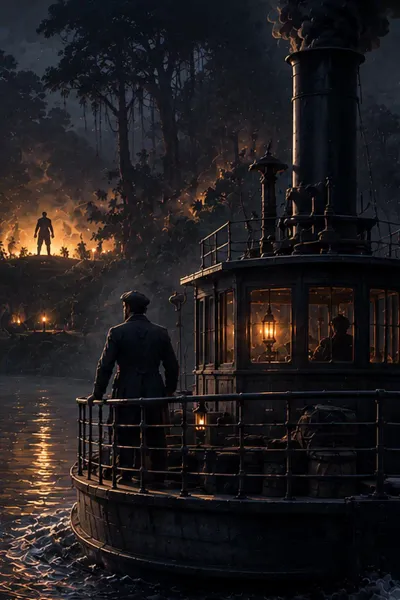
Heart of Darkness in English
A sailor tells a story from his past: his journey up an African river to find a man named Kurtz.
The book is a story inside a story. An unnamed narrator on a boat in London listens while Marlow tells the tale, and the narrator's voice returns only briefly at the start and the end. The book is divided into three parts, and the journey moves slowly upriver, with stops, delays and half-seen shapes along the banks. There is very little dialogue; most of the text is Marlow's long, thoughtful, sometimes confusing narration. Conrad was not a native English speaker, and his sentences are often unusual in rhythm, full of images and abstract words. Marlow's tone changes from dry humour to dread as the river gets narrower and the story gets darker.
You will like it if
- you like dark, atmospheric stories that make you think
- you want to practise reading dense, descriptive English
- you are interested in the history of European empires in Africa
- you like a short book that stays with you after the last page
You will not if
- you want a fast plot with clear events and plenty of dialogue
- you dislike abstract, image-heavy writing that leaves things unexplained
- you are bothered by an outdated and often criticised view of African people
- you find long, winding sentences tiring to follow
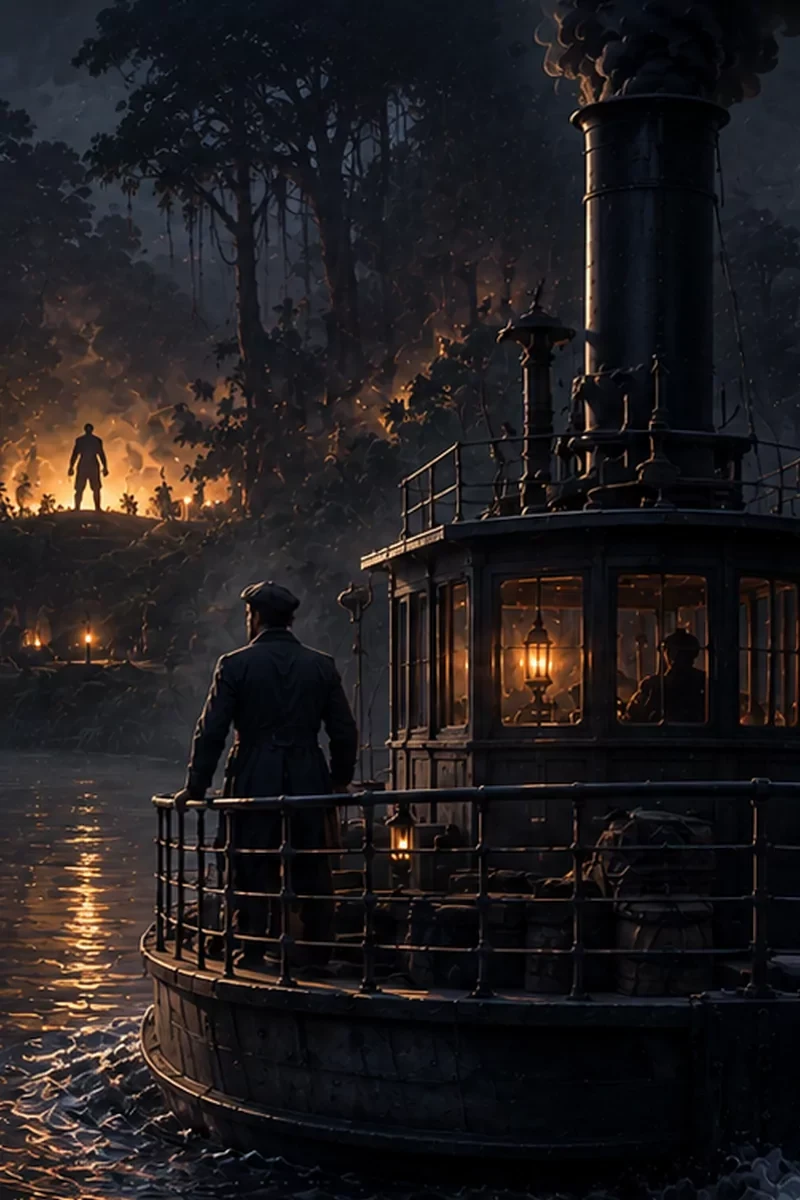
What kind of book“Heart of Darkness” is
Versions of “Heart of Darkness” in English: C2
Same book, adapted to a level you can read without stopping
Pick a version. The bar at the foot of the page opens the one you pick.
Vocabulary by level
- A1 59%
- A2 16%
- B1 9%
- B2 7%
- not in dictionary 4%
A sample from “Heart of Darkness” in English
One passage, the way each version writes it.
Tap any word — we will show the translation
Original · C2224 words
The Nellie, a cruising yawl, swung to her anchor without a flutter of the sails, and was at rest. The flood had made, the wind was nearly calm, and being bound down the river, the only thing for it was to come to and wait for the turn of the tide.
The sea-reach of the Thames stretched before us like the beginning of an interminable waterway. In the offing the sea and the sky were welded together without a joint, and in the luminous space the tanned sails of the barges drifting up with the tide seemed to stand still in red clusters of canvas sharply peaked, with gleams of varnished sprits. A haze rested on the low shores that ran out to sea in vanishing flatness. The air was dark above Gravesend, and farther back still seemed condensed into a mournful gloom, brooding motionless over the biggest, and the greatest, town on earth.
The Director of Companies was our captain and our host. We four affectionately watched his back as he stood in the bows looking to seaward. On the whole river there was nothing that looked half so nautical. He resembled a pilot, which to a seaman is trustworthiness personified. It was difficult to realize his work was not out there in the luminous estuary, but behind him, within the brooding gloom.
The original language of “Heart of Darkness” and what it gives you
How hard the language is C2
Three quarters of the vocabulary is basic: 59% is A1 and another 16% is A2, and 4% is outside the dictionary. About 6% of the words are beyond the 5000 most frequent, so there is a steady stream of rarer words. The sentences average 17.1 words, which is not extreme, but the book has about 5,400 different word forms in only 38,500 words, so the vocabulary is rich for its size. Our estimate for the original is C1, and it is the density of images and abstract ideas, not single hard words, that makes it hard.
What this means in practice: A short but demanding C1 book: the language is manageable, the thinking is the hard part.
What to be ready for
How to read it and not quit
- When a sentence is long, find the main verb first and treat the rest as description: Conrad often puts the key idea at the end.
- Do not translate abstract words one by one; read them as a mood and come back if the meaning still matters.
- Keep a short list of the sea and river terms you meet, since they come back, and ignore the rare ones that appear only once.
- Check who is speaking after each quotation: in some passages Marlow repeats what others said, and it is easy to lose the thread.
Contents of “Heart of Darkness” · 4 chapters
- Heart of Darknesspage 1
- Ipage 1
- I (continued)page 14
- I (continued)page 29
- I (continued)page 43
- IIpage 53
All 4 chaptersShow fewer
- II (continued)page 67
- II (continued)page 81
- II (continued)page 95
- IIIpage 98
- III (continued)page 111
- III (continued)page 126
- III (continued)page 140
Reader ratings for “Heart of Darkness”
Nobody has rated it yet. Be the first.
Your rating
Reader reviews of “Heart of Darkness”
No reviews yet.
The story of “Heart of Darkness”
Conrad's own Congo journey
Conrad spent several months in the Congo in 1890, taking a river steamer upriver for a Belgian trading company. The journey and the illness he caught there were the raw material for the story.
Joseph Conrad, Congo Diary
Serialised in Blackwood's Magazine
The story first appeared in three instalments in Blackwood's Edinburgh Magazine, in February to April 1899.
Collected in a book
It was published in book form in 1902, in the volume Youth: A Narrative, and Two Other Stories.
Achebe's attack on the book
At a lecture in Massachusetts, Chinua Achebe called Conrad a "thoroughgoing racist" and said the book reduces Africa to a backdrop for a European's breakdown. The argument changed how the story is taught.
Chinua Achebe, 'An Image of Africa' (published 1977)
Apocalypse Now
Francis Ford Coppola moved the story to the Vietnam War, which brought it to a far larger audience than the book had ever had.
In culture “Heart of Darkness”
8 adaptations and mentions, 1925–2012
Art The Hollow Men
T. S. Eliot opened the poem with a line from Kurtz's servant in the book, "Mistah Kurtz — he dead".
Film Orson Welles's unmade film
Welles planned to make this his first Hollywood film, but RKO dropped the project over cost, and he made Citizen Kane instead.
Film Apocalypse Now
Coppola's film puts Marlow's river journey into the Vietnam War, with Kurtz as a rogue officer deep in the jungle.
Film Heart of Darkness (TV film)
A more literal screen version, made for American television, that keeps the story in the Congo.
Game Spec Ops: The Line
A shooter that borrows the book's structure, a journey upriver towards a man who has lost himself, to question what the player is doing.
In the language "The horror! The horror!"
Kurtz's last words became a shorthand for the moment someone sees what they and their world are capable of.
In the language Heart of darkness
Now used for any remote place or inner state where the usual rules of civilisation seem to stop working.
In the language A Kurtz
A person of ideals and gifts who, far from any check on their power, turns into a tyrant; the type recurs in later fiction about empire and war.
Questions and answers about “Heart of Darkness” in English
What does 'The horror! The horror!' mean in Heart of Darkness?
It is Kurtz's last cry, and the book never explains it directly. Readers take it as his judgement of his own life and of what he has seen, and Marlow treats it as a kind of truth.
Is Heart of Darkness based on a true story?
It is fiction, but Conrad drew on a real trip. In 1890 he travelled up the Congo River as a steamboat captain for a Belgian company, and that experience gave him the setting.
Who is Kurtz and why does everyone talk about him?
Kurtz is a trader in the interior who collects more ivory than anyone else, and people describe him as brilliant. Marlow's growing curiosity about him drives the journey.
Is Heart of Darkness racist?
It has been called so, most famously by the writer Chinua Achebe in 1975. He argued that the book treats Africa and its people as a backdrop and a symbol, while others argue that Conrad is criticising the Europeans who exploited the Congo.
Is Apocalypse Now the same story?
Not the same, but it is based on it. The 1979 film by Francis Ford Coppola moves the journey to the Vietnam War and keeps the idea of a river trip toward a man who has gone beyond the rules.
Why do so many people find it hard to read?
The plot is simple, but the language is thick with images and abstract words, and the pace is slow. The book rewards a second reading more than a quick first one.
Do I need to know the history of the Congo to understand it?
No, the book gives you enough to follow the story. It helps to know that the Congo was then under Belgian control and that many Europeans went there for ivory and rubber.
Why is it told by Marlow and not by the author?
Conrad uses Marlow so that the story comes through one man's doubts and memory. It also lets him show how hard it is to explain an experience like this to people who were not there.
Is it a good book for learners of English?
It is a good test for a strong reader, because it is short but dense. If you prefer plot and dialogue, you will likely find it slow.
In brief about “Heart of Darkness”
17 fields of imprint data and measured text characteristics. All of it checkable.
- Original title
- Heart of Darkness
- Author
- Joseph Conrad
- First published
- 1899
- Original language
- English
- Genre
- Adventure · Classics · Philosophy
- Mood
- Dark
- Themes
- Power · Society · Guilt
- Setting
- The River Thames in London, and the Congo River in Africa · The late 1800s; the book was published in 1899
- Distinct words
- 5,389
- Words per sentence
- 17 words
- Level of the original
- C2
- Versions
- C2
- Length of the original
- 13 ch. · 38,512 words
- Reading time
- ~3 h 30 min
- Source text
- Project Gutenberg
- Download
- EPUB
Similar what to read after “Heart of Darkness”
Close in spirit
8The same genre and the same register.
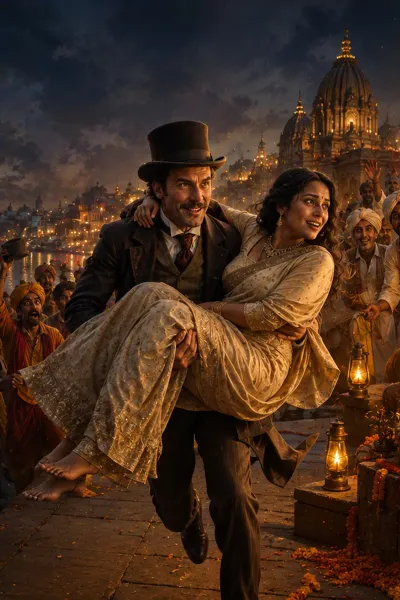
Around the World in Eighty Days
Jules Verne
C2orig.C1
~5 h 50 min · Adventure
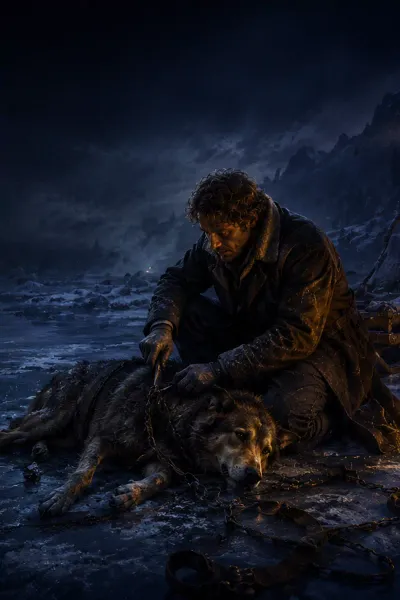
The Call of the Wild
Jack London
C2orig.B2C1
~3 h · Adventure
A Christmas Carol
Charles Dickens
C2orig.B1C1
~2 h 40 min · Classics
Alice's Adventures in Wonderland
Lewis Carroll
C1.2orig.B1B2
~2 h 30 min · Classics
Black Beauty
Anna Sewell
C1.4orig.B1
~5 h 30 min · Classics
Crime and Punishment
Fyodor Dostoevsky
C1.7orig.C1
~18 h 50 min · Classics
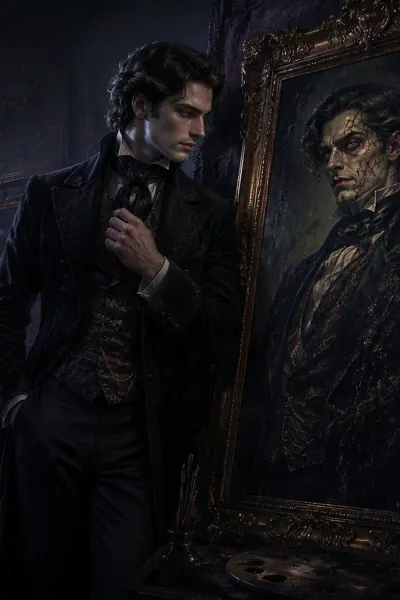
The Picture of Dorian Gray
Oscar Wilde
C1.8orig.B1C1
~7 h 20 min · Gothic & mystery
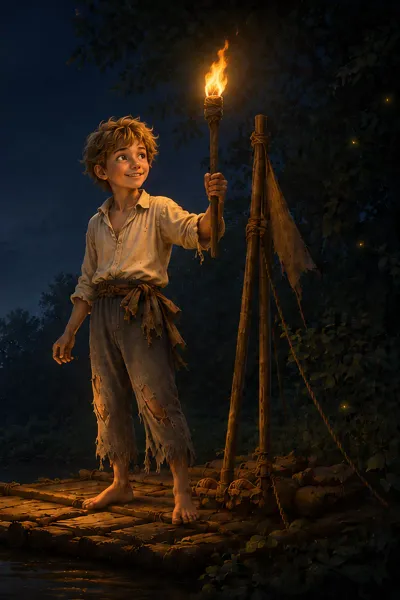
Adventures of Huckleberry Finn
Mark Twain
C1.6orig.B1
~10 h 20 min · Adventure
Book page ≈0.2.0 · Oct 14, 2026