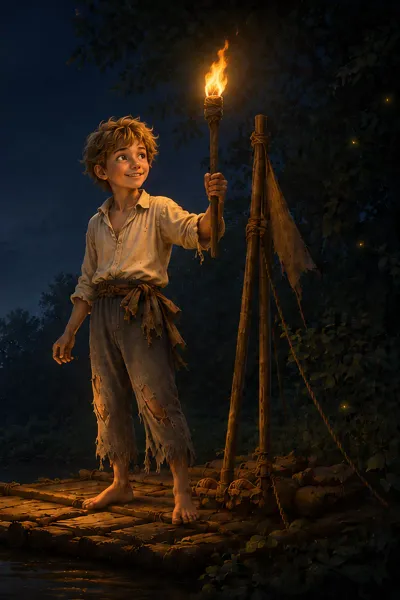
Adventures of Huckleberry Finn in English
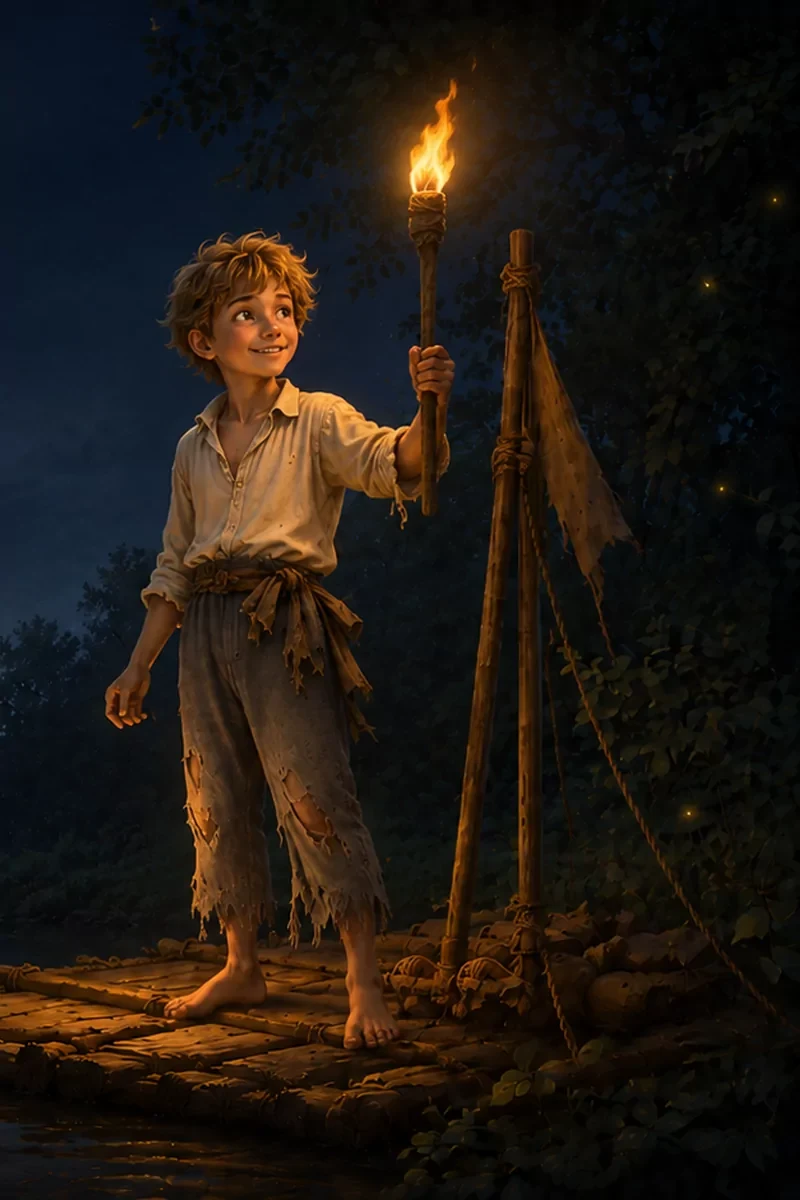
A runaway boy and a man escaping slavery drift down the Mississippi on a raft. Huck tells the story himself, in his own words.
The book is a river trip: the raft carries the plot, and each stop on the bank brings a new town, a new danger or a new set of strangers. Early chapters show Huck's life in a small town and with his father. The long middle follows the raft and the two con men who join it, and the last part returns to Tom Sawyer and a game that many readers find less satisfying than the rest. Everything is told by Huck, in a spoken voice that sounds plain but is carefully built. The comedy and the harsh scenes sit side by side, and Twain often lets Huck miss the point of what he sees.
You will like it if
- you like first-person narrators with a strong, distinctive voice
- you enjoy adventure stories that are also funny and sharp about people
- you want to read the American classic that other writers keep naming
- you are curious about how a book handles slavery through a child's eyes
You will not if
- you do not want to meet period racial slurs, which the book uses freely
- the heavily respelled dialect, especially Jim's, will slow you down
- you prefer a tightly plotted story, since the middle is a series of episodes
- you expect a rewarding last section, when many readers find the ending weaker
What kind of book“Adventures of Huckleberry Finn” is
Versions of “Adventures of Huckleberry Finn” in English: B1
Same book, adapted to a level you can read without stopping
Pick a version. The bar at the foot of the page opens the one you pick.
Vocabulary by level
- A1 63%
- A2 15%
- B1 6%
- B2 6%
- not in dictionary 6%
A sample from “Adventures of Huckleberry Finn” in English
One passage, the way each version writes it.
Tap any word — we will show the translation
B1.7163 words
“Come, now, what’s your real name?”
“Wh—what, mum?”
“What’s your real name? Is it Bill, or Tom, or Bob? Or what is it?”
I reckon I shook all over, and I hardly knew what to do. But I said:
“Please don’t make fun of a poor girl like me, mum. If I’m in the way here, I’ll—”
“No, you won’t. Sit down and stay where you are. I am not going to hurt you. I won’t tell anyone about you, either. Just tell me your secret and trust me. I’ll keep it. And I’ll help you. My old man will help too, if you want him to. You see, you’re a runaway apprentice (a boy who works for a master to learn a job), that’s all. It’s nothing. There’s nothing wrong in it. People were bad to you, and you decided to run away. Bless you, child, I wouldn’t tell on you. Now tell me all about it, that’s a good boy.”
The original language of “Adventures of Huckleberry Finn” and what it gives you
How hard the language is C1.6
The words are simple but the spelling is not. Only 3% of the vocabulary falls beyond the 5,000 most frequent words, 63% is A1 and another 15% A2, and the average sentence is 17.9 words. The difficulty comes from the dialect: 6% of the words are outside our dictionary, which here means respelt, nonstandard forms. Our measured level for the original is C1.6, and it is driven by those forms, not by hard vocabulary. There are no adaptations yet, only the original.
What this means in practice: A great book that asks learners to listen rather than parse, and that is hard for the spelling more than for the words.
What to be ready for
How to read it and not quit
- Read the dialect aloud, or whisper it: a spelling like 'dat' or 'dey' becomes clear as soon as you hear it, and your ear is faster than the dictionary.
- Do not take ain't, warn't, 'I says' or 'he done' as models for your own English; they are marked nonstandard even for American readers.
- Double negatives such as 'I didn't do nothing' mean a plain negative here. If your own language uses double negatives, you will find this easy, but do not use it in formal English.
- Use the context for old Southern words and ignore the ones that do not matter: the story is clear without every word of the dialect.
Contents of “Adventures of Huckleberry Finn” · 45 chapters
- Noticepage 1
- Explanatorypage 1
- Ipage 1
- IIpage 6
- IIIpage 15
- IVpage 21
All 45 chaptersShow fewer
- Vpage 26
- VIpage 33
- VIIpage 44
- VIIIpage 54
- VIII (continued)page 69
- IXpage 71
- Xpage 77
- XIpage 83
- XIIpage 93
- XIIIpage 104
- XIVpage 111
- XVpage 117
- XVIpage 126
- XVIIpage 139
- XVIIIpage 151
- XVIII (continued)page 165
- XIXpage 169
- XXpage 182
- XXIpage 196
- XXIIpage 209
- XXIIIpage 216
- XXIVpage 225
- XXVpage 234
- XXVIpage 244
- XXVIIpage 255
- XXVIIIpage 264
- XXIXpage 277
- XXXpage 290
- XXXIpage 294
- XXXIIpage 308
- XXXIIIpage 316
- XXXIVpage 326
- XXXVpage 334
- XXXVIpage 344
- XXXVIIpage 352
- XXXVIIIpage 361
- XXXIXpage 371
- XLpage 378
- XLIpage 387
- XLIIpage 396
- Chapter the Lastpage 407
Reader ratings for “Adventures of Huckleberry Finn”
Nobody has rated it yet. Be the first.
Your rating
Reader reviews of “Adventures of Huckleberry Finn”
No reviews yet.
The story of “Adventures of Huckleberry Finn”
Written in fits and starts
Twain began the book in 1876 as a sequel to Tom Sawyer, then put it aside for years and finished it in 1883.
Published
It came out in Britain and Canada in December 1884 and in the United States in February 1885, with illustrations by E. W. Kemble.
Banned in Concord
The public library in Concord, Massachusetts, removed the book in 1885 as coarse and unsuitable. Twain reportedly joked that the ban would help sales.
Dropped from New York reading lists
In 1957 New York City schools dropped the book from approved lists for lower grades over its racial language.
Lost manuscript found
The first half of Twain's handwritten manuscript, long thought lost, was found in a trunk in Los Angeles in 1990.
Edition replacing a racial slur
An edition published by NewSouth Books replaced the slur with "slave", prompting wide debate about editing the text.
In culture “Adventures of Huckleberry Finn”
8 adaptations and mentions, 1884–1993
In the language "Light out for the Territory"
Huck's last line gave American English a phrase for leaving settled life behind.
In the language "All right, then, I'll go to hell"
Huck's decision to help Jim despite what he has been taught is cited as a classic moment of conscience against law.
Art E. W. Kemble's illustrations
Kemble's drawings for the first edition fixed the look of Huck, Jim and the raft for later illustrators.
In the language Hemingway's remark on the book
Hemingway wrote that all modern American literature comes from this one book, a line often repeated to describe its influence.
Film The Adventures of Huckleberry Finn
MGM's version with Mickey Rooney was an early major sound film of the book.
Film The Adventures of Huckleberry Finn (1960)
MGM filmed the book again in colour, directed by Michael Curtiz.
Stage Big River
Roger Miller's Broadway musical of the story won the Tony Award for Best Musical.
Film The Adventures of Huck Finn
Disney's film with Elijah Wood tells the river journey for a family audience.
Questions and answers about “Adventures of Huckleberry Finn” in English
Why was Huckleberry Finn banned?
It has been banned or challenged in libraries and schools since soon after it was published. The reasons changed: first its roughness and its poor example for boys, later its repeated use of a racial slur and its portrait of Jim.
Should I be worried about the n-word in Huckleberry Finn?
The slur appears many times, in the narration and in dialogue, because Twain wrote the way people in that place and time spoke. Many readers find it hard, and some editions replace it, so it is worth deciding before you start which version you want to read.
Is Huckleberry Finn racist?
It is one of the most argued-over questions about the book. Jim is a warm and dignified character and Huck comes to see him as a person, but critics also point to the language and to the way the ending treats him.
Do I need to read Tom Sawyer first?
No, you can start with Huck Finn. Tom Sawyer came first and tells about the same boys, but this book has a different narrator and tone, and nothing you need is missing.
Why does Huck say he will go to hell?
Huck was raised to think that helping a runaway is a sin. His decision to help Jim anyway, whatever it costs him, is the moral centre of the book.
Why do people say the ending is a problem?
In the last part Tom Sawyer comes back and turns Jim's situation into a long game of adventure-book tricks. Many readers feel the tone drops and that Jim is treated as a joke after the serious middle of the book.
Was Huck Finn a real person?
Huck is fiction, but Twain said he based him on a boy he knew in childhood in Hannibal, Missouri, named Tom Blankenship. The town in the book is also modelled on his boyhood home.
Why is it called the great American novel?
It is a book told in an ordinary American voice, not in the literary English of the time, and that changed what American fiction could sound like. Ernest Hemingway famously said that modern American literature comes from this book.
How close are the films to the book?
Most films cut or change a lot, because the book is a long string of episodes. They tend to drop the Duke and the King, or the final section, so none replaces the book.
Is it a funny book?
Yes, it has some very funny scenes, especially with the two con men, and Huck's innocent narration makes them funnier. Alongside the comedy there are scenes of feud, murder and cruelty that are not light at all.
In brief about “Adventures of Huckleberry Finn”
17 fields of imprint data and measured text characteristics. All of it checkable.
- Original title
- Adventures of Huckleberry Finn
- Author
- Mark Twain
- First published
- 1884
- Original language
- English
- Genre
- Adventure · Classics · Humor
- Mood
- Funny
- Themes
- Freedom · Friendship · Society · Coming of age
- Setting
- The Mississippi River and the towns along it, from Missouri south to Arkansas and Louisiana · The 1840s, before the American Civil War
- Distinct words
- 6,090
- Words per sentence
- 18 words
- Level of the original
- C1.6
- Versions
- C1.6, B1.7
- Length of the original
- 47 ch. · 111,056 words
- Reading time
- ~10 h 20 min
- Source text
- Standard Ebooks
- Download
- EPUB
Similar what to read after “Adventures of Huckleberry Finn”
By the same author
1The same hand, a different story.
Close in spirit
7The same genre and the same register.
Alice's Adventures in Wonderland
Lewis Carroll
C1.2orig.B1B2
~2 h 30 min · Classics
Black Beauty
Anna Sewell
C1.4orig.B1
~5 h 30 min · Classics
The Jungle Book
Rudyard Kipling
C1.7orig.
~4 h 40 min · Adventure
The Secret Garden
Frances Hodgson Burnett
C1.2orig.B1
~7 h 30 min · Classics
Around the World in Eighty Days
Jules Verne
C2orig.C1
~5 h 50 min · Adventure
The Call of the Wild
Jack London
C2orig.B2C1
~3 h · Adventure
Heart of Darkness
Joseph Conrad
C2orig.
~3 h 30 min · Adventure
Book page ≈0.2.0 · Oct 14, 2026