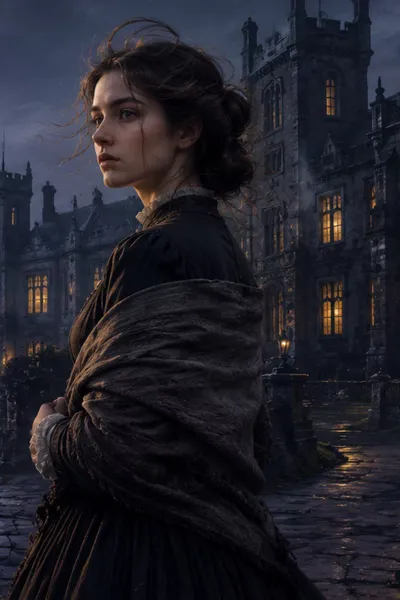
Jane Eyre in English
A poor orphan becomes a governess in a house with a secret. She must decide how far she will go for love without giving up herself.
The novel is a first-person memoir in several stages, each tied to a place: her childhood at her aunt's house, her years at a school, her time at Thornfield, and what comes after. Jane often speaks directly to the 'Reader', and her sentences are long, with many colons and semicolons, and with allusions to the Bible and to classical stories. The narration is formal and emotional, while the dialogue switches between cold genteel speech, servants' talk, Northern country dialect and the broken English of a French child. A few songs and Bible quotations appear in older English. It rewards slow reading more than quick reading.
You will like it if
- you like first-person stories with a strong, honest narrator
- you enjoy gothic atmosphere, big houses and secrets
- you want rich emotional vocabulary you can use in your own writing
- you are happy to read a long classic one stage at a time
You will not if
- you dislike long sentences full of semicolons and formal phrasing
- the opening chapters, at her aunt's house and at school, are bleak before the story opens up
- dialect and French mixed into the dialogue can interrupt your reading
- you expect a modern romance: the love story is intense but also uncomfortable
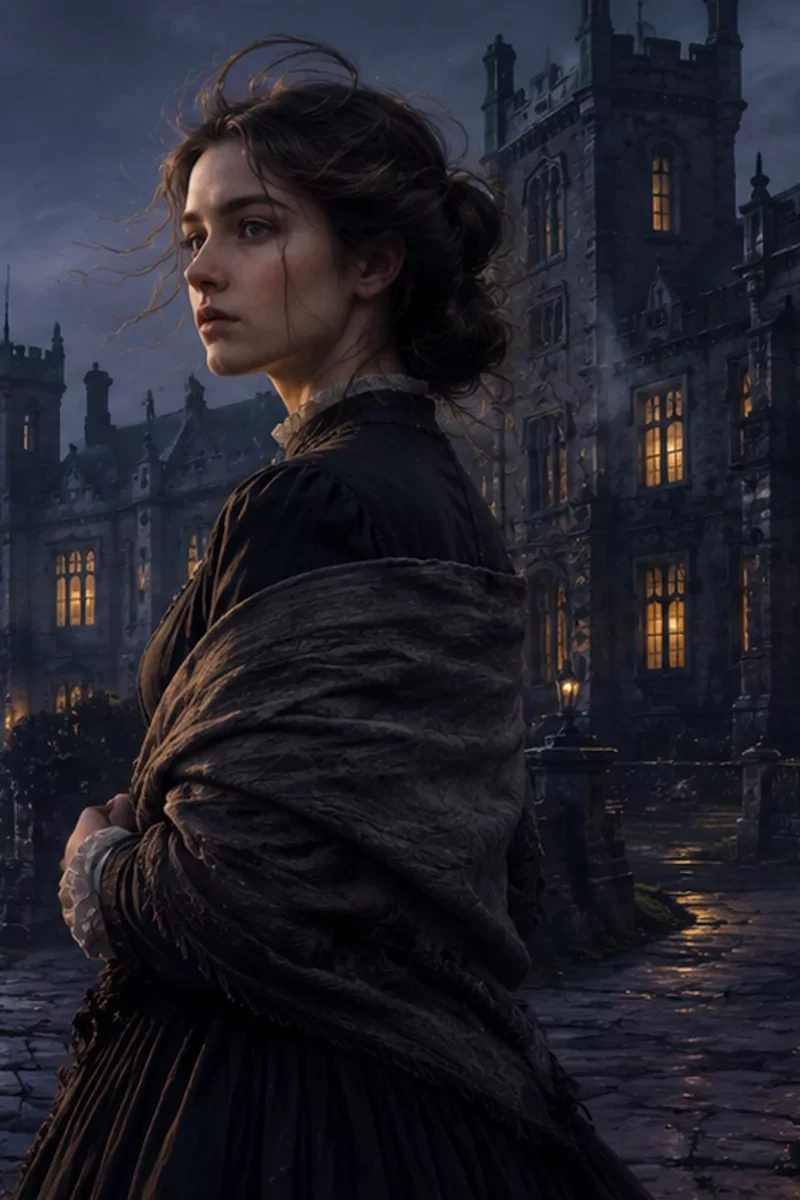
What kind of book“Jane Eyre” is
Versions of “Jane Eyre” in English: B1
Same book, adapted to a level you can read without stopping
Pick a version. The bar at the foot of the page opens the one you pick.
Vocabulary by level
- A1 62%
- A2 15%
- B1 9%
- B2 6%
- not in dictionary 4%
A sample from “Jane Eyre” in English
One passage, the way each version writes it.
Tap any word — we will show the translation
C1.3176 words
“Sorry indeed to hear it! She and I must have some talk.” And bending down from his upright position, he settled himself in the armchair opposite Mrs. Reed’s. “Come here,” he said.
I stepped across the rug, and he placed me square and straight in front of him. What a face he had, now that it was almost level with mine! What a great nose! What a mouth! And what large, sticking-out teeth!
“There is no sight so sad as a naughty child,” he began, “especially a naughty little girl. Do you know where wicked people go after death?”
“They go to hell,” was my quick and correct answer, just as I had been taught.
“And what is hell? Can you tell me that?”
“A pit full of fire.”
“And would you like to fall into that pit and burn there for ever?”
“No, sir.”
“What must you do to avoid it?”
I thought for a moment, and when my answer came, it was a bad one: “I must keep in good health and not die.”
B1.8174 words
“Sorry indeed to hear it! She and I must have some talk.” He bent down from his straight height. He sat down in the armchair opposite Mrs. Reed’s chair. “Come here,” he said.
I stepped across the rug. He placed me straight before him. What a face he had, now that it was almost level with mine! What a big nose! And what a mouth! And what big teeth standing forward!
“Nothing is so sad as a bad child,” he began. “A bad little girl is the saddest sight. Do you know where bad people go after death?”
“They go to hell (the place of fire for bad people after death),” was my quick and right answer.
“And what is hell? Can you tell me that?”
“A pit full of fire.”
“Would you like to fall into that pit? Would you like to burn there for ever?”
“No, sir.”
“What must you do to keep away from it?”
I thought for a moment. My answer was bad: “I must stay well, and not die.”
The original language of “Jane Eyre” and what it gives you
How hard the language is C2
This is a demanding read. Our measurement places the original at C2. It is long, with 187,040 words and over 12,000 distinct word forms, and sentences average 19.5 words, often much longer in descriptive or emotional passages. About 62% of the vocabulary is A1 and 15% A2, but 6% lies beyond the 5,000 most frequent words and 4% is outside the dictionary. A B2 adaptation is available if you want to reach the story with less effort.
What this means in practice: A hard but rewarding classic: take it slowly, and the voice of Jane carries you through.
What to be ready for
How to read it and not quit
- Read long sentences by their punctuation: each colon or semicolon usually starts a new idea, so you can split one long sentence into three short ones in your head.
- Do not try to decode every dialect word. For Hannah and the villagers, notice the rhythm and the missing endings, get the general meaning, and keep going.
- Learn the 'inner life' words that return all the time: passion, conscience, resolve, reproach. They appear on almost every page and give you a base for the emotional scenes.
- Notice how Jane addresses 'Reader': it is a cue that she is about to explain or defend herself, and the grammar around it is usually simpler.
Contents of “Jane Eyre” · 40 chapters
- Prefacepage 1
- Note to the Third Editionpage 4
- Ipage 4
- IIpage 12
- IIIpage 24
- IVpage 35
All 40 chaptersShow fewer
- IV (continued)page 46
- Vpage 57
- V (continued)page 66
- VIpage 74
- VIIpage 84
- VII (continued)page 90
- VIIIpage 97
- IXpage 107
- Xpage 119
- X (continued)page 127
- XIpage 134
- XI (continued)page 146
- XIIpage 158
- XII (continued)page 166
- XIIIpage 174
- XIII (continued)page 181
- XIVpage 189
- XIV (continued)page 197
- XVpage 207
- XV (continued)page 216
- XVIpage 225
- XVI (continued)page 232
- XVIIpage 239
- XVII (continued)page 249
- XVII (continued)page 261
- XVIIIpage 269
- XVIII (continued)page 280
- XIXpage 290
- XIX (continued)page 297
- XXpage 304
- XX (continued)page 315
- XXIpage 325
- XXI (continued)page 336
- XXI (continued)page 347
- XXIIpage 357
- XXIIIpage 368
- XXIII (continued)page 375
- XXIVpage 382
- XXIV (continued)page 392
- XXIV (continued)page 401
- XXVpage 410
- XXV (continued)page 420
- XXVIpage 428
- XXVI (continued)page 437
- XXVIIpage 445
- XXVII (continued)page 457
- XXVII (continued)page 469
- XXVII (continued)page 481
- XXVIIIpage 487
- XXVIII (continued)page 500
- XXIXpage 513
- XXIX (continued)page 521
- XXXpage 529
- XXX (continued)page 535
- XXXIpage 541
- XXXIIpage 553
- XXXII (continued)page 562
- XXXIIIpage 570
- XXXIII (continued)page 579
- XXXIVpage 588
- XXXIV (continued)page 599
- XXXIV (continued)page 611
- XXXVpage 622
- XXXV (continued)page 630
- XXXVIpage 638
- XXXVI (continued)page 646
- XXXVIIpage 653
- XXXVII (continued)page 662
- XXXVII (continued)page 671
- XXXVIII: Conclusionpage 680
Reader ratings for “Jane Eyre”
Nobody has rated it yet. Be the first.
Your rating
Reader reviews of “Jane Eyre”
No reviews yet.
The story of “Jane Eyre”
Accepted by Smith, Elder
Charlotte Brontë sent the manuscript to Smith, Elder & Co., who had declined her earlier novel The Professor but encouraged her, and accepted this one quickly.
Published as Currer Bell
The novel appeared in October 1847 in three volumes under the pseudonym Currer Bell, with the subtitle An Autobiography, and was an immediate success.
Title page of the 1847 first edition
Dedicated to Thackeray
The second edition carried a dedication to William Makepeace Thackeray, whom Brontë admired, which later caused embarrassing gossip because of his own private circumstances.
Condemned in the Quarterly Review
Elizabeth Rigby's review of December 1848 praised its power but attacked it as coarse and anti-Christian, a verdict that shows how disturbing its independent heroine seemed.
Quarterly Review, December 1848
In culture “Jane Eyre”
9 adaptations and mentions, 1847–2015
In the language "Reader, I married him"
The novel's famous line, endlessly echoed and adapted in other books and titles, stands for the moment a heroine claims her own choice.
In the language "I am no bird"
Jane's declaration, "I am no bird; and no net ensnares me", became a favourite quotation for female independence.
In the language Mr Rochester
The brooding, secretive master of the house with a hidden past became a template for the romantic hero in fiction ever since.
Film Jane Eyre (Robert Stevenson)
Joan Fontaine and Orson Welles starred in the Hollywood version, whose shadowy gothic look shaped the novel's screen image.
Art Wide Sargasso Sea
Jean Rhys's novel imagines Bertha's earlier life in the Caribbean and changed how readers see the colonial background of Jane Eyre.
In the language The madwoman in the attic
Bertha Mason, locked away at Thornfield Hall, became shorthand for the suppressed woman, and Sandra Gilbert and Susan Gubar took the phrase as the title of their 1979 study of women writers.
Series Jane Eyre (BBC)
The four-part BBC serial with Ruth Wilson and Toby Stephens gave room to the whole length of the novel.
Film Jane Eyre (Cary Fukunaga)
The film told the story in flashback, opening with Jane's flight across the moors, and stressed the book's gothic atmosphere.
Stage Jane Eyre (National Theatre, Sally Cookson)
Cookson's inventive production, with music and a physical, ensemble style, treated the novel as a living stage story.
Questions and answers about “Jane Eyre” in English
Is Jane Eyre a love story?
It is partly one, but it is mainly about a woman's search for independence and self-respect. The romance is important, and it also tests how much of herself Jane is willing to give up.
Is Mr Rochester a good romantic hero?
That is a matter of debate, and many readers find him manipulative as well as attractive. The book itself seems aware of this, and Jane's answers to him are a big part of its interest.
Is it based on a true story?
The story is invented, but some of it comes from real life. Charlotte Brontë drew on her own time at a harsh charity school when she wrote about Lowood, and on her years as a governess.
What is the secret at Thornfield?
I can't say without spoiling the book, but Jane notices strange sounds and events in the house long before anyone explains them. The mystery is part of what makes the middle of the book gripping.
Why does Jane speak to 'Reader'?
She is telling her own life as if to a close listener, so she explains, argues and sometimes appeals to us directly. It gives the book its direct, confessional tone.
Which film or series is closest to the book?
TV serials such as the BBC adaptations come closest because they have time for the whole story. Films must cut a lot, especially the last part of the book.
Is it hard to read in English?
Yes, it is one of the harder classics because of its length, formal sentences and mixed dialect. The vocabulary itself is not rare, and most of the difficulty comes from sentence structure.
Where do people give up?
Usually in the bleak childhood chapters early on, or in the long final section when the plot slows down. If you stay with it, the pace and the emotion pick up again.
Does it stand alone, or is there a sequel?
It stands alone. A later novel, Wide Sargasso Sea by Jean Rhys, reimagines one of its characters, but it is best read afterwards.
Why is it taught in school?
It is a clear example of first-person narration, and it deals with class, gender and religion in a way that gives students a lot to discuss. It is also a major English novel of the 1840s.
In brief about “Jane Eyre”
17 fields of imprint data and measured text characteristics. All of it checkable.
- Original title
- Jane Eyre
- Author
- Charlotte Brontë
- First published
- 1847
- Original language
- English
- Genre
- Classics · Gothic & mystery · Romance
- Mood
- Romantic
- Themes
- Love · Freedom · Class · Coming of age
- Setting
- Northern England: a harsh charity school, Thornfield Hall, and a moorland village · The early nineteenth century (the novel was published in 1847)
- Distinct words
- 12,729
- Words per sentence
- 20 words
- Level of the original
- C2
- Versions
- C2, C1.3, B1.8
- Length of the original
- 68 ch. · 187,040 words
- Reading time
- ~17 h 20 min
- Source text
- Project Gutenberg
- Download
- EPUB
Similar what to read after “Jane Eyre”
Close in spirit
8The same genre and the same register.
Frankenstein
Mary Shelley
C2orig.B2C1
~7 h 10 min · Gothic & mystery
Strange Case of Dr Jekyll and Mr Hyde
Robert Louis Stevenson
C2orig.B1C1
~2 h 20 min · Gothic & mystery
Pride and Prejudice
Jane Austen
C2orig.B1C1
~11 h 20 min · Classics
A Little Princess
Frances Hodgson Burnett
C1.4orig.B1
~6 h 10 min · Classics
Anne of Green Gables
L. M. Montgomery
C1.6orig.B2
~9 h 30 min · Classics
The Picture of Dorian Gray
Oscar Wilde
C1.8orig.B1C1
~7 h 20 min · Gothic & mystery
Dracula
Bram Stoker
C1.8orig.B1B2
~14 h 50 min · Gothic & mystery
The Great Gatsby
F. Scott Fitzgerald
C1.8orig.B1C1
~4 h 30 min · Classics
Book page ≈0.2.0 · Oct 14, 2026