Little Women in English
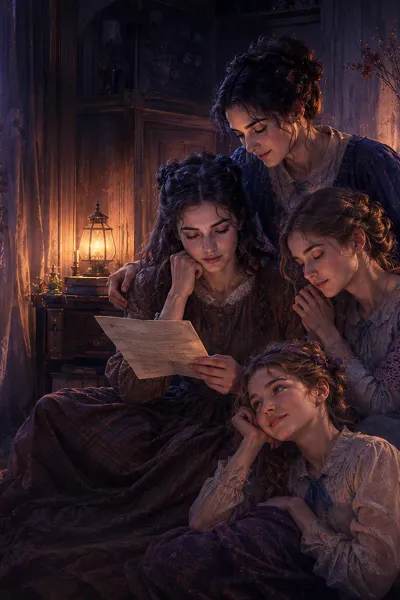
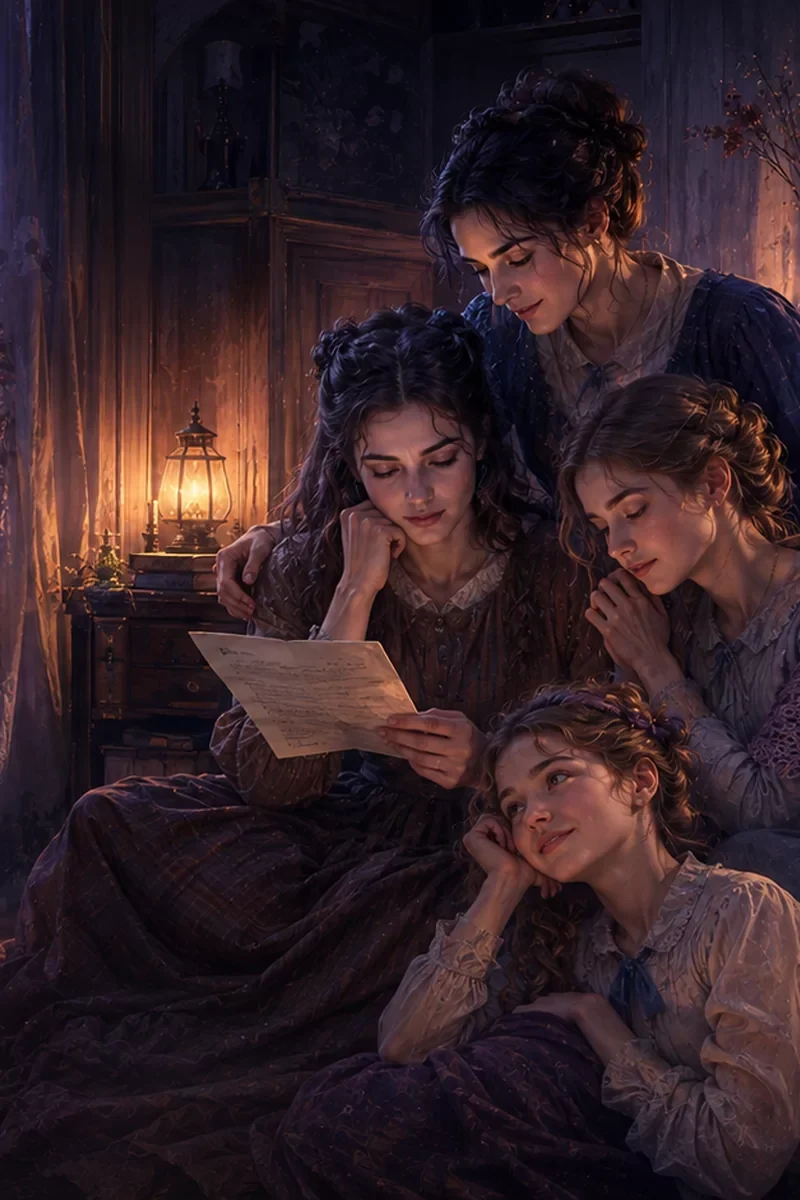
Four sisters grow up in a poor but loving New England family while their father is away at war. Each wants a different life, and the book follows what they do with it.
The book falls into two halves. The first follows the March sisters as children and teenagers over a year, the second follows them as young women, and there are shorter episodes in each. It is made of small domestic scenes: plays, quarrels, parties, letters, a home-made newspaper, songs and poems. A warm narrator speaks to the reader and often draws a moral from what has just happened. The sisters' games are built on Pilgrim's Progress, and there are scattered Bible references. The language is everyday American English of the 1860s, with lots of dialogue and a few characters who speak with accents.
You will like it if
- you like family stories built from everyday scenes
- you enjoy long dialogue-heavy books
- you want to see how girls' lives and ambitions looked in the 1860s
- you like characters who have real faults and learn from them
You will not if
- you want fast, plot-driven action
- you dislike a narrator who stops to teach a lesson
- you do not want a very long book with little suspense
- you find old-fashioned slang and religious references tiring
What kind of book“Little Women” is
Versions of “Little Women” in English: B1
Same book, adapted to a level you can read without stopping
Pick a version. The bar at the foot of the page opens the one you pick.
Vocabulary by level
- A1 63%
- A2 16%
- B1 8%
- B2 6%
- not in dictionary 4%
A sample from “Little Women” in English
One passage, the way each version writes it.
Tap any word — we will show the translation
B2.9167 words
That put Jo at her ease, and she laughed too. She said, in her friendliest way—
“We did have such a good time over your nice Christmas present.”
“Grandpa sent it.”
“But you put it into his head, didn’t you, now?”
“How is your cat, Miss March?” asked the boy, trying to look serious, while his black eyes shone with fun.
“Nicely, thank you, Mr. Laurence; but I am not Miss March, I’m only Jo,” returned the young lady.
“I’m not Mr. Laurence, I’m only Laurie.”
“Laurie Laurence—what an odd name!”
“My first name is Theodore, but I don’t like it, for the fellows called me Dora, so I made them say Laurie instead.”
“I hate my name, too—so sentimental! I wish everyone would say Jo, instead of Josephine. How did you make the boys stop calling you Dora?”
“I beat ’em up.”
“I can’t beat up Aunt March, so I suppose I shall have to bear it.” And Jo accepted it with a sigh.
B1.6177 words
That made Jo feel comfortable. She laughed too, and she spoke in her warmest way.
“We had such a good time over your nice Christmas present.”
“Grandpa sent it.”
“But you gave him the idea, didn’t you, now?”
“How is your cat, Miss March?” asked the boy. He tried to look serious, but his black eyes shone with fun.
“Very well, thank you, Mr. Laurence. But I am not Miss March, I’m only Jo,” answered the young lady.
“I’m not Mr. Laurence, I’m only Laurie.”
“Laurie Laurence—what a strange name!”
“My first name is Theodore, but I don’t like it. The boys called me Dora, so I made them say Laurie instead.”
“I hate my name, too—it is so sentimental (full of soft, romantic feelings)! I wish everyone would say Jo instead of Josephine. How did you make the boys stop calling you Dora?”
“I thrashed (beat in a fight) them.”
“I can’t thrash Aunt March, so I suppose I must bear it.” Jo gave a sigh (long, deep breath of sadness) and accepted it.
The original language of “Little Women” and what it gives you
How hard the language is C1.8
The words are mostly simple: about four in five fall in the A1–A2 bands, and only 4% are archaic, dialect or invented. The measurement still puts the original at a high C1. The reasons are the sentence length, which averages nearly 22 words and runs longer in the narrator's comments, the old-fashioned expressions, the accents in speech and the sheer size of the book. It is a long read in plain words, not a short one in hard words.
What this means in practice: Easy words, long book: a good one for steady reading if you can handle old-fashioned phrasing and a few accents.
What to be ready for
How to read it and not quit
- Do not copy Hannah's 'ain't' or Professor Bhaer's word order as standard English: they are character voices, and Amy's long wrong words are jokes.
- Words like 'jolly' and 'capital' are old-fashioned slang for 'very good' and nobody says them today, but they are easy to guess from context.
- Long sentences with commas and semicolons are easier if you stop at each semicolon and read the parts as separate statements.
- Skip over the French and German phrases if you do not know them: the meaning is usually clear from the next line.
Contents of “Little Women” · 48 chapters
- Epigraphpage 1
- I: Playing Pilgrimspage 1
- I: Playing Pilgrims (continued)page 9
- II: A Merry Christmaspage 18
- II: A Merry Christmas (continued)page 27
- III: The Laurence Boypage 35
All 48 chaptersShow fewer
- III: The Laurence Boy (continued)page 43
- IV: Burdenspage 51
- IV: Burdens (continued)page 61
- V: Being Neighborlypage 71
- V: Being Neighborly (continued)page 79
- VI: Beth Finds the Palace Beautifulpage 88
- VII: Amy’s Valley of Humiliationpage 98
- VIII: Jo Meets Apollyonpage 109
- VIII: Jo Meets Apollyon (continued)page 118
- IX: Meg Goes to Vanity Fairpage 126
- IX: Meg Goes to Vanity Fair (continued)page 139
- X: The P.C. and P.O.page 152
- XI: Experimentspage 166
- XI: Experiments (continued)page 175
- XII: Camp Laurencepage 184
- XII: Camp Laurence (continued)page 195
- XII: Camp Laurence (continued)page 205
- XIII: Castles in the Airpage 215
- XIII: Castles in the Air (continued)page 222
- XIV: Secretspage 229
- XV: A Telegrampage 242
- XVI: Letterspage 255
- XVII: Little Faithfulpage 266
- XVIII: Dark Dayspage 277
- XIX: Amy’s Willpage 289
- XX: Confidentialpage 303
- XXI: Laurie Makes Mischief, and Jo Makes Peacepage 314
- XXI: Laurie Makes Mischief, and Jo Makes Peace (continued)page 323
- XXII: Pleasant Meadowspage 331
- XXIII: Aunt March Settles the Questionpage 342
- XXIII: Aunt March Settles the Question (continued)page 350
- XXIV: Gossippage 358
- XXIV: Gossip (continued)page 367
- XXV: The First Weddingpage 376
- XXVI: Artistic Attemptspage 386
- XXVI: Artistic Attempts (continued)page 394
- XXVII: Literary Lessonspage 402
- XXVIII: Domestic Experiencespage 414
- XXVIII: Domestic Experiences (continued)page 426
- XXIX: Callspage 436
- XXIX: Calls (continued)page 446
- XXX: Consequencespage 456
- XXX: Consequences (continued)page 464
- XXXI: Our Foreign Correspondentpage 473
- XXXI: Our Foreign Correspondent (continued)page 483
- XXXII: Tender Troublespage 489
- XXXII: Tender Troubles (continued)page 498
- XXXIII: Jo’s Journalpage 506
- XXXIII: Jo’s Journal (continued)page 517
- XXXIV: A Friendpage 526
- XXXIV: A Friend (continued)page 538
- XXXV: Heartachepage 550
- XXXV: Heartache (continued)page 558
- XXXVI: Beth’s Secretpage 565
- XXXVII: New Impressionspage 574
- XXXVII: New Impressions (continued)page 582
- XXXVIII: On the Shelfpage 590
- XXXVIII: On the Shelf (continued)page 599
- XXXIX: Lazy Laurencepage 608
- XXXIX: Lazy Laurence (continued)page 618
- XL: The Valley of the Shadowpage 628
- XLI: Learning to Forgetpage 636
- XLI: Learning to Forget (continued)page 647
- XLII: All Alonepage 655
- XLIII: Surprisespage 667
- XLIII: Surprises (continued)page 679
- XLIV: My Lord and Ladypage 691
- XLV: Daisy and Demipage 699
- XLVI: Under the Umbrellapage 708
- XLVI: Under the Umbrella (continued)page 718
- XLVII: Harvest Timepage 728
- XLVII: Harvest Time (continued)page 737
Reader ratings for “Little Women”
Nobody has rated it yet. Be the first.
Your rating
Reader reviews of “Little Women”
No reviews yet.
The story of “Little Women”
Publicación del primer volumen
Roberts Brothers publicó la primera parte de Mujercitas en septiembre de 1868; se agotó casi de inmediato.
Louisa May Alcott, letters and publisher records
Publicación del segundo volumen
La secuela, a menudo llamada Aquellas mujercitas, apareció en 1869 y más tarde se encuadernó con la primera parte como una sola novela.
Roberts Brothers edition
Primera edición británica
Mujercitas se publicó en Gran Bretaña, donde se convirtió en un favorito perdurable.
Primera adaptación cinematográfica sonora
La película de George Cukor con Katharine Hepburn como Jo fue una importante versión de Hollywood.
RKO Pictures
150 aniversario
El sesquicentenario de la novela se celebró con nuevas ediciones, exposiciones y lecturas públicas.
In culture “Little Women”
10 adaptations and mentions, 1868–2019
Art Ilustraciones originales
May Alcott, la hermana de la autora, proporcionó las ilustraciones para la primera edición.
Roberts Brothers edition
Film Mujercitas (película de 1933)
La adaptación de George Cukor ganó un Premio de la Academia al Mejor Guion Adaptado.
RKO Pictures
Film Mujercitas (película de 1949)
La versión en Technicolor de Mervyn LeRoy estuvo protagonizada por June Allyson y Elizabeth Taylor.
Metro-Goldwyn-Mayer
Film Mujercitas (película de 1994)
La película de Gillian Armstrong con Winona Ryder acercó la historia a una nueva generación.
Columbia Pictures
Stage Mujercitas (ópera)
La ópera Mujercitas de Mark Adamo se estrenó en la Houston Grand Opera y se ha representado ampliamente.
Houston Grand Opera
Music Mujercitas (musical)
Un musical de Broadway con música de Jason Howland y letras de Mindi Dickstein se estrenó en 2005.
Broadway production
Series Mujercitas (serie de televisión de 2017)
Una miniserie de BBC One adaptó la novela para televisión.
BBC
Film Mujercitas (película de 2019)
La adaptación de Greta Gerwig obtuvo seis nominaciones a los Premios de la Academia y ganó el de Mejor Diseño de Vestuario.
Sony Pictures
In the language Mujercitas
El título se convirtió en sinónimo de hermandad y de la historia de iniciación doméstica, a menudo utilizado para grupos de hermanas o amigas íntimas.
In the language Jo March
El nombre se convirtió en sinónimo de la escritora ambiciosa e independiente y de la chica poco convencional.
Questions and answers about “Little Women” in English
Is Little Women based on a true story?
Partly. Louisa May Alcott drew on her own family and had three sisters, and Jo is generally seen as a version of Alcott herself. The events are not an exact record of her life, but the family, the poverty and the writing ambitions come from experience.
Who are the four March sisters?
Meg, Jo, Beth and Amy, from oldest to youngest. Meg is the eldest and cares about home and comfort, Jo is the writer with a temper, Beth is shy and musical, and Amy is the youngest and wants to be an artist.
Did Alcott want Jo to get married?
She meant to keep Jo single and said so. Readers and her publisher wanted weddings, and the second half is shaped by that pressure. What Jo does in the end is still something readers argue about.
Is Little Women one book or two? Do I need to read the sequels?
It stands alone as a complete story. The second half was first published separately and is sometimes sold as Good Wives. Alcott later wrote Little Men and Jo's Boys about the same family, but you do not need them.
How different are the Little Women films from the book?
The 1994 film follows the book's order of events quite closely. Greta Gerwig's 2019 film keeps the main story but tells it in two time periods and jumps between them, while the book runs in order. All the films cut scenes to fit the length.
What is the Pilgrim's Progress part in Little Women?
The girls play at Pilgrim's Progress, the seventeenth-century story of a journey to the Celestial City, and their mother uses it to teach them to carry their burdens. The first chapter is even called 'Playing Pilgrims'. Knowing the outline helps, but you can follow the book without it.
Is Little Women a Christmas book?
It begins at Christmas and Christmas returns later, but it is not only a Christmas story. The book covers years of the sisters' lives, so Christmas is one of several important occasions.
Why do some characters talk strangely in Little Women?
Because they come from different backgrounds. Hannah, the family's servant, speaks rural New England English, Professor Bhaer is a German in America, and some other characters speak German- or French-flavoured English. The odd grammar is written on purpose to show who they are.
Is Little Women boring?
It depends on what you want, but it is slow by modern standards. There is no mystery or large plot: the interest is in small events, the sisters' arguments and the way they change. The narrator also preaches from time to time, and some readers skip those parts.
Is Little Women sad?
It has serious moments, including illness and loss, but the tone stays warm and the book is mostly about family life and everyday pleasures. It is not a bleak book.
In brief about “Little Women”
17 fields of imprint data and measured text characteristics. All of it checkable.
- Original title
- Little Women
- Author
- Louisa May Alcott
- First published
- 1868
- Original language
- English
- Genre
- Classics · Romance · Memoir
- Mood
- Tender
- Themes
- Family · Coming of age · Society · Love
- Setting
- A New England town in the United States, mainly the March family's home, with stays in New York and Europe · The American Civil War years and just after, the 1860s
- Distinct words
- 10,578
- Words per sentence
- 22 words
- Level of the original
- C1.8
- Versions
- C1.8, B2.9, B1.6
- Length of the original
- 75 ch. · 186,333 words
- Reading time
- ~17 h 20 min
- Source text
- Standard Ebooks
- Download
- EPUB
Similar what to read after “Little Women”
Close in spirit
8The same genre and the same register.
A Little Princess
Frances Hodgson Burnett
C1.4orig.B1
~6 h 10 min · Classics
Anne of Green Gables
L. M. Montgomery
C1.6orig.B2
~9 h 30 min · Classics
The Great Gatsby
F. Scott Fitzgerald
C1.8orig.B1C1
~4 h 30 min · Classics
Narrative of the Life of Frederick Douglass, an American Slave
Frederick Douglass
C2orig.
~3 h 50 min · Memoir
Jane Eyre
Charlotte Brontë
C2orig.B1C1
~17 h 20 min · Classics
Pride and Prejudice
Jane Austen
C2orig.B1C1
~11 h 20 min · Classics
Aesop's Fables
Aesop
C1.2orig.
~3 h 40 min · Fables & parables
Alice's Adventures in Wonderland
Lewis Carroll
C1.2orig.B1B2
~2 h 30 min · Classics
Book page ≈0.2.0 · Oct 14, 2026