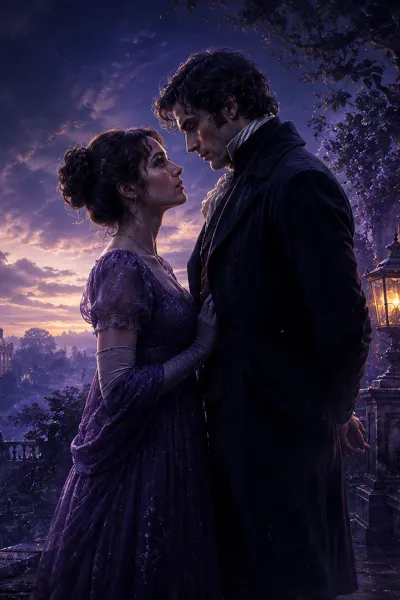
Pride and Prejudice in English
Mrs Bennet wants her five daughters married, and a rich young man has just moved in nearby. Elizabeth, the second daughter, takes an instant dislike to his proud friend.
The book is built around conversation: visits, dinners, balls, walks and letters, nearly all seen through Elizabeth's eyes. A calm third-person narrator describes events but often adds an ironic comment, so you learn to read what is said and what is meant. It was first published in three volumes, and the story moves from the Bennets' village to other houses and counties as Elizabeth's view of people changes. The language is formal Regency English with long, balanced sentences and polite forms of address. Several letters are quoted in full, and they are important to the plot.
You will like it if
- you enjoy sharp, ironic dialogue
- you like characters who change their minds
- you want to practise long, well-built English sentences
- you are curious how money and marriage worked in 1800s England
You will not if
- the world is narrow: houses, visits and conversation, with little action
- the sentences are long and the manners very formal
- the irony is easy to miss if you read literally
- money and class matter in ways that need some explaining
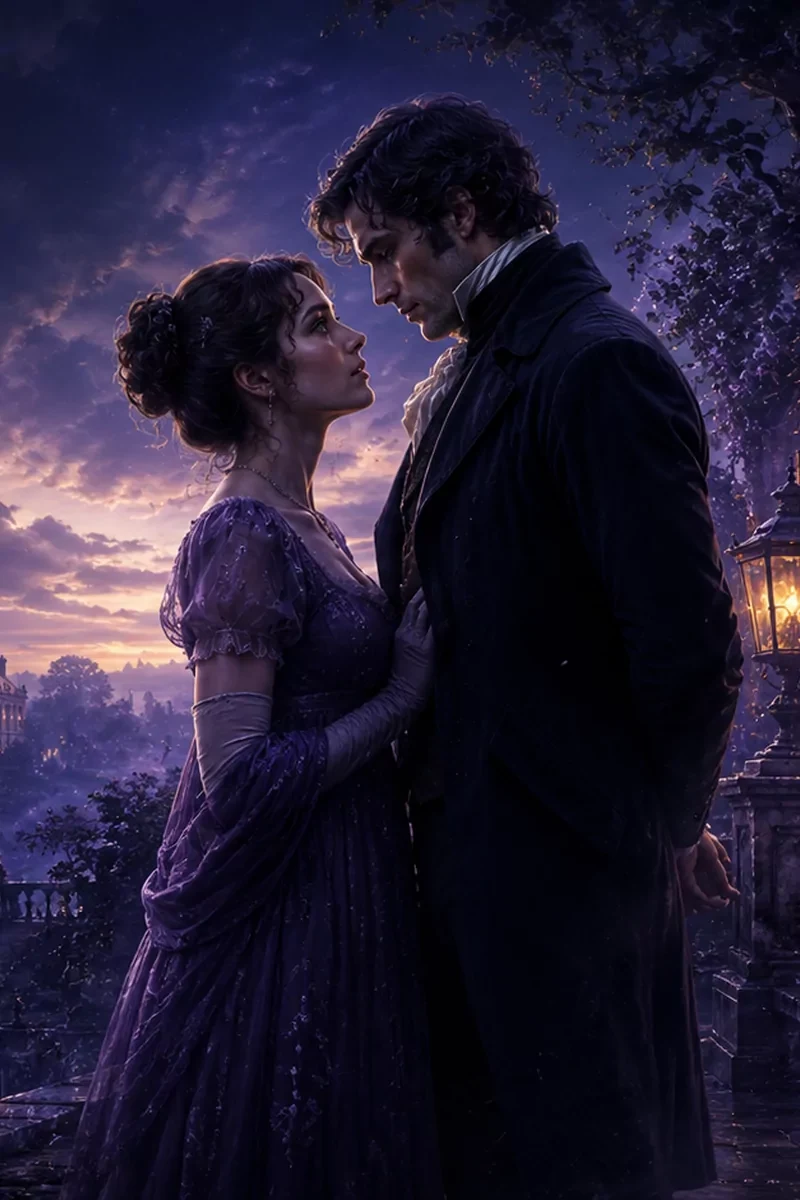
What kind of book“Pride and Prejudice” is
Versions of “Pride and Prejudice” in English: B1
Same book, adapted to a level you can read without stopping
Pick a version. The bar at the foot of the page opens the one you pick.
Vocabulary by level
- A1 64%
- A2 17%
- B1 8%
- B2 6%
- not in dictionary 3%
A sample from “Pride and Prejudice” in English
One passage, the way each version writes it.
Tap any word — we will show the translation
C1.1211 words
“My dear Mr. Bennet,” said his lady to him one day, “have you heard that Netherfield Park is let at last?”
Mr. Bennet replied that he had not.
“But it is,” she answered, “for Mrs. Long has just been here, and she told me all about it.”
Mr. Bennet made no answer.
“Do you not want to know who has taken it?” cried his wife impatiently.
“You want to tell me, and I have no objection to hearing it.”
This was invitation enough.
“Why, my dear, you must know, Mrs. Long says that Netherfield has been taken by a young man of large fortune from the north of England. He came down on Monday in a chaise and four (a light closed carriage pulled by four horses) to see the place, and he was so delighted with it that he agreed with Mr. Morris immediately. He is to take possession before Michaelmas (a church feast on 29 September), and some of his servants are to be in the house by the end of next week.”
“What is his name?”
“Bingley.”
“Is he married or single?”
“Oh! single, my dear, to be sure! A single man of large fortune; four or five thousand a year. What a fine thing for our girls!”
B1.8210 words
“My dear Mr. Bennet,” his wife said to him one day. “Have you heard the news? Someone has rented Netherfield Park at last.”
Mr. Bennet answered that he had not.
“But it is true,” she said. “Mrs. Long was just here, and she told me all about it.”
Mr. Bennet did not answer.
“Do you not want to know who has taken it?” his wife cried impatiently.
“You want to tell me, and I do not mind listening.”
This was enough for Mrs. Bennet.
“Well, my dear, you must know what Mrs. Long says. A rich young man from the north of England has taken Netherfield. He came down on Monday in a chaise and four (a light closed carriage pulled by four horses) to see the place. He liked it very much, and he agreed with Mr. Morris at once. He will move in before Michaelmas (a church feast on 29 September, a usual date for renting houses). Also, some of his servants will be in the house late next week.”
“What is his name?”
“Bingley.”
“Is he married or single?”
“Oh! Single, my dear, of course! A single man with a large fortune; four or five thousand a year (yearly income). What a fine thing for our girls!”
The original language of “Pride and Prejudice” and what it gives you
How hard the language is C2
The measured numbers look friendly: 81% of the words are in the A1-A2 bands, only 5% are beyond the 5,000 most frequent words, and the average sentence is 19.9 words. Yet our measurement puts the original at C2. The difficulty is in how the words are used: long, balanced sentences, irony, formal address and old meanings of common words. Dialogue makes up a large part of the text, which helps, but you must listen to what the speakers imply.
What this means in practice: The vocabulary is simple but the manners and the irony take time to read; a good book for learners who want to practise careful reading.
What to be ready for
How to read it and not quit
- Watch for old meanings of common words: civil means polite, sensible means reasonable, tolerable means just acceptable, and condescension can be a polite, not unkind, word.
- When a sentence is long, find the subject and the main verb first, then add the clauses that are hanging off them.
- Learn the forms of address: the eldest daughter is Miss Bennet, the others are Miss Elizabeth, Miss Lydia and so on.
- When the narrator sounds positive about someone, ask whether it is irony: Austen often says the opposite of what she means.
Contents of “Pride and Prejudice” · 61 chapters
- Ipage 1
- IIpage 4
- IIIpage 6
- IVpage 12
- Vpage 16
- VIpage 20
All 61 chaptersShow fewer
- VIIpage 27
- VIIIpage 35
- IXpage 41
- Xpage 47
- XIpage 55
- XIIpage 60
- XIIIpage 63
- XIVpage 68
- XVpage 72
- XVIpage 79
- XVIIpage 91
- XVIIIpage 95
- XVIII (continued)page 104
- XIXpage 112
- XXpage 119
- XXIpage 124
- XXIIpage 132
- XXIIIpage 137
- XXIVpage 143
- XXVpage 150
- XXVIpage 155
- XXVIIpage 162
- XXVIIIpage 167
- XXIXpage 172
- XXXpage 181
- XXXIpage 185
- XXXIIpage 190
- XXXIIIpage 195
- XXXIVpage 201
- XXXVpage 209
- XXXVIpage 219
- XXXVIIpage 226
- XXXVIIIpage 231
- XXXIXpage 234
- XLpage 240
- XLIpage 246
- XLIIpage 254
- XLIIIpage 260
- XLIII (continued)page 275
- XLIVpage 278
- XLVpage 285
- XLVIpage 292
- XLVIIpage 302
- XLVIIIpage 316
- XLIXpage 323
- Lpage 331
- LIpage 338
- LIIpage 345
- LIIIpage 356
- LIVpage 366
- LVpage 372
- LVIpage 380
- LVIIpage 389
- LVIIIpage 395
- LIXpage 403
- LXpage 412
- LXIpage 417
Reader ratings for “Pride and Prejudice”
Nobody has rated it yet. Be the first.
Your rating
Reader reviews of “Pride and Prejudice”
No reviews yet.
The story of “Pride and Prejudice”
Primer borrador, luego rechazado
Austen completó una versión temprana titulada 'First Impressions'; su padre la ofreció a un librero de Londres, quien la rechazó a vuelta de correo.
Austen family letters and Austen-Leigh's 'A Memoir of Jane Austen'
Publicada anónimamente
La novela apareció en tres volúmenes, acreditada solo a 'la Autora de Sentido y sensibilidad'; Austen vendió los derechos de autor por 110 libras en lugar de aceptar regalías.
Publication records; Austen's letters
Aclamación temprana
La primera edición se agotó en meses, y Austen informó que el círculo del Príncipe Regente la admiraba; se le instó a dedicarle una obra futura.
Austen's correspondence
Primera gran película de Hollywood
La adaptación de MGM con Greer Garson y Laurence Olivier llevó la novela a una audiencia masiva de cine y fijó una imagen popular de Darcy.
Serie de la BBC y darcymánia
La adaptación en seis partes de la BBC con Colin Firth como Darcy se convirtió en una versión televisiva definitoria e hizo de la escena de la 'camisa mojada' una referencia cultural duradera.
Segundo en el Big Read de la BBC
En la búsqueda nacional de la BBC de la novela más querida del país, 'Orgullo y prejuicio' quedó en segundo lugar, detrás de 'El Señor de los Anillos'.
BBC Big Read, 2003
In culture “Pride and Prejudice”
12 adaptations and mentions, 1894–2013
Art Ilustraciones de Hugh Thomson
La célebre edición ilustrada de Thomson fijó una imagen visual de Elizabeth, Darcy y la familia Bennet que los ilustradores posteriores respondieron.
Stage Adaptación de Helen Jerome en Broadway
La versión teatral de Jerome fue un éxito de larga duración en Broadway y demostró que la novela podía funcionar como teatro popular.
Film Orgullo y prejuicio (MGM)
La primera versión de Hollywood con gran presupuesto, con Greer Garson y Laurence Olivier, reformuló la historia para el público de la era de los estudios.
Music First Impressions (musical)
Un musical de Broadway basado en la novela, con música y letras de George Weiss, Robert Goldman y Glenn Paxton, cerró tras una corta temporada.
Series Orgullo y prejuicio (BBC)
Una serie de cinco partes de la BBC recordada por su fidelidad al diálogo de la novela y su ritmo largo y pausado.
Series Orgullo y prejuicio (BBC)
La serie en seis partes de Andrew Davies estableció la plantilla para la adaptación moderna de época e hizo icónico al Darcy de Colin Firth.
Film El diario de Bridget Jones
La novela de Helen Fielding y su película reelaboraron la trama como comedia romántica moderna, con Mark Darcy como descendiente directo del héroe de Austen.
Film Orgullo y prejuicio
La película de Joe Wright con Keira Knightley y Matthew Macfadyen trajo una lectura más joven y lírica a una nueva generación.
In the language Orgullo y prejuicio y zombis
La novela de mash-up de Seth Grahame-Smith convirtió el propio título en una fórmula de broma, generando todo un género de remezclas de clásicos con monstruos.
Game Orgullo y prejuicio (novela visual)
Una adaptación como novela visual permitía a los jugadores dirigir las elecciones de Elizabeth, parte del auge más amplio de ficción interactiva inspirada en Austen.
In the language 'Orgullo y prejuicio' como fórmula
El título se convirtió en una frase general para los errores mutuos de juicio que mantienen separadas a dos personas, usada mucho más allá de la novela.
In the language El señor Darcy
El nombre se convirtió en sinónimo del héroe romántico distante y orgulloso que en secreto está entregado.
Questions and answers about “Pride and Prejudice” in English
Is Pride and Prejudice a true story?
No. It is invented, though it describes the real social world Austen knew, where women of her class had very few ways to earn money. That is why marriage is so important in the book.
Why is Pride and Prejudice so famous?
It combines a strong love story with sharp comedy about manners, and the main characters are easy to love and argue about. It also opens with one of the best-known first lines in English fiction.
Is the first line meant seriously?
No, it is ironic. The sentence says it is a universal truth that a rich man must want a wife, but the story shows that it is really the women and their mothers who are looking.
Why does the Bennet family need their daughters to marry?
Their father's estate is entailed, which means it passes to a male relative, Mr Collins, when he dies. The daughters would have very little money, so a good marriage is also their security.
Is Elizabeth Bennet really right about Mr Darcy?
Not completely, and that is the point. Elizabeth is clever but she judges people quickly, and the story shows both her and Darcy being wrong about each other.
Which film or series is closest to the book?
The 1995 BBC series with Colin Firth and Jennifer Ehle is the one most people call the most faithful, mainly because it has time to include most scenes. The 2005 film with Keira Knightley is shorter and changes more.
Is Bridget Jones's Diary based on Pride and Prejudice?
Yes. Helen Fielding's novel of 1996 borrows the plot and gives its hero the name Mark Darcy. Reading Austen first helps you see the jokes.
Why did Austen not put her name on the book?
At the time, many women authors published anonymously. Austen's title page said only that it was by the author of Sense and Sensibility.
What makes Pride and Prejudice hard going?
The long sentences, formal manners and irony slow people down more than the vocabulary does. The first chapters are mostly talk about a possible marriage, so action only gradually begins.
Do I need to know the Regency period to enjoy it?
No. A short explanation of entails, titles and the idea of a young lady's income is enough, and the story explains the rest through the conversations.
In brief about “Pride and Prejudice”
17 fields of imprint data and measured text characteristics. All of it checkable.
- Original title
- Pride and Prejudice
- Author
- Jane Austen
- First published
- 1813
- Original language
- English
- Genre
- Classics · Romance
- Mood
- Romantic
- Themes
- Love · Class · Family · Identity
- Setting
- Rural Hertfordshire, with Kent, Derbyshire and London · Regency England, the early 1800s
- Distinct words
- 6,186
- Words per sentence
- 20 words
- Level of the original
- C2
- Versions
- C2, C1.1, B1.8
- Length of the original
- 64 ch. · 121,953 words
- Reading time
- ~11 h 20 min
- Source text
- Standard Ebooks
- Download
- EPUB
Similar what to read after “Pride and Prejudice”
Close in spirit
8The same genre and the same register.
Jane Eyre
Charlotte Brontë
C2orig.B1C1
~17 h 20 min · Classics
A Little Princess
Frances Hodgson Burnett
C1.4orig.B1
~6 h 10 min · Classics
Anne of Green Gables
L. M. Montgomery
C1.6orig.B2
~9 h 30 min · Classics
The Great Gatsby
F. Scott Fitzgerald
C1.8orig.B1C1
~4 h 30 min · Classics
Little Women
Louisa May Alcott
C1.8orig.B1B2
~17 h 20 min · Classics
Around the World in Eighty Days
Jules Verne
C2orig.C1
~5 h 50 min · Adventure
The Call of the Wild
Jack London
C2orig.B1C1
~3 h · Adventure
A Christmas Carol
Charles Dickens
C2orig.B1C1
~2 h 40 min · Classics
Book page ≈0.2.0 · Oct 14, 2026