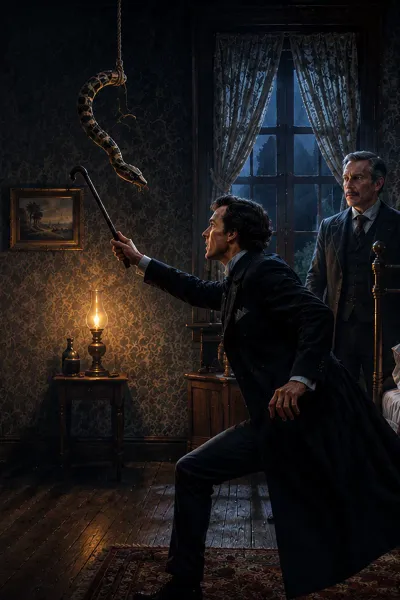
The Adventures of Sherlock Holmes in English
A detective on Baker Street solves puzzling cases with careful observation, while his friend Dr Watson writes down what happens.
The book is a collection of twelve separate stories, so you can read them in any order and each one has its own plot and solution. They follow a steady pattern: a client arrives, Holmes asks a few sharp questions, the case moves to a place or a chase, and he explains how he knew. Watson narrates in a polite, slightly formal voice, with long descriptive sentences that alternate with quick dialogue. Most of the text is dialogue, which makes the stories lively and easy to follow. The English is late Victorian and slightly formal, with some Latin and French phrases.
You will like it if
- you like puzzles and enjoy following clues
- you want short stories that you can finish in a sitting
- you like a clever detective with a dry sense of humour
- you want to hear many voices and accents in one book
You will not if
- you want psychological depth: the characters are drawn quickly and the focus is on the case
- the Victorian setting and the formal narration feel old-fashioned to you
- you are bothered by the national stereotypes of the time
- you prefer one long plot to a set of separate stories
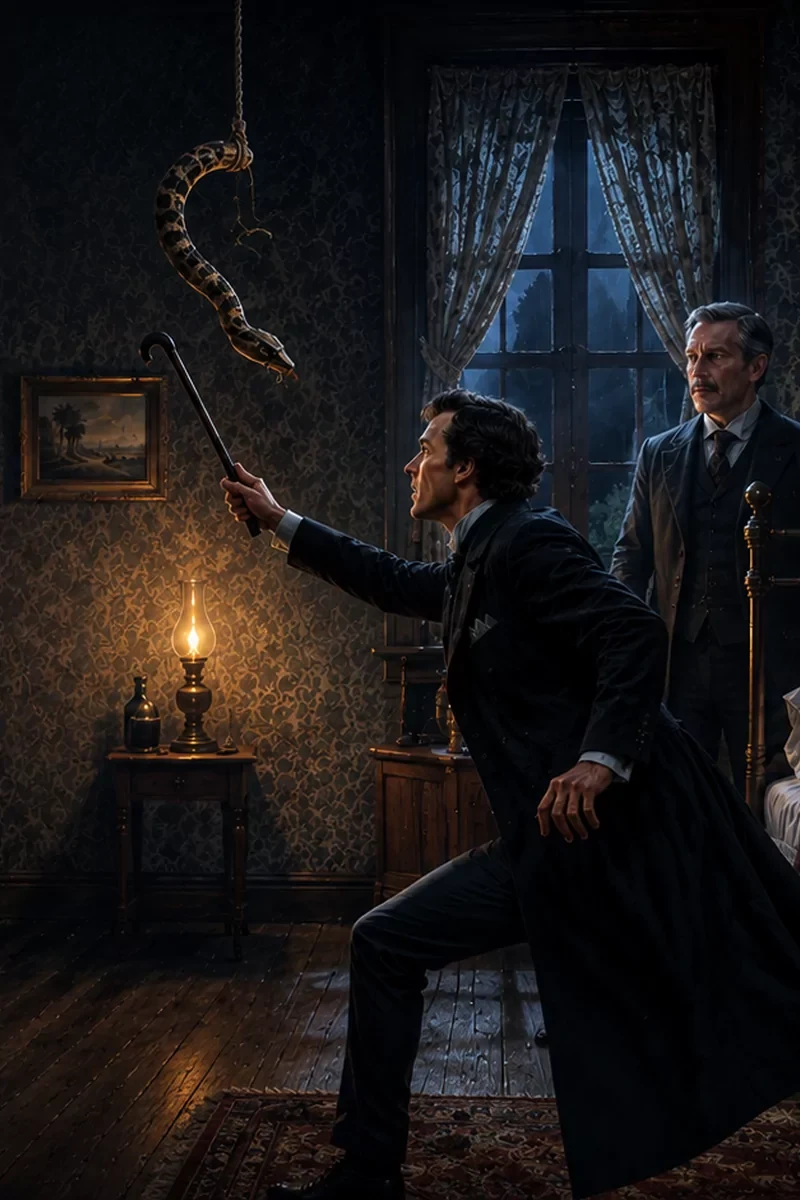
What kind of book“The Adventures of Sherlock Holmes” is
Versions of “The Adventures of Sherlock Holmes” in English: B1
Same book, adapted to a level you can read without stopping
Pick a version. The bar at the foot of the page opens the one you pick.
Vocabulary by level
- A1 64%
- A2 16%
- B1 7%
- B2 7%
- not in dictionary 3%
A sample from “The Adventures of Sherlock Holmes” in English
One passage, the way each version writes it.
Tap any word — we will show the translation
C1.0150 words
“Quite so,” he answered, lighting a cigarette, and throwing himself down into an armchair. “You see, but you do not observe. The difference is clear. For example, you have frequently seen the steps which lead up from the hall to this room.”
“Frequently.”
“How often?”
“Well, some hundreds of times.”
“Then how many are there?”
“How many? I don’t know.”
“Quite so! You have not observed. And yet you have seen. That is just my point. Now, I know that there are seventeen steps, because I have both seen and observed. By the way, you are interested in these little problems. You are also good enough to write down one or two of my small adventures. So you may be interested in this.” He threw over a sheet of thick, pink notepaper that was lying open on the table. “It came by the last post,” said he. “Read it aloud.”
B1.8144 words
“Quite so,” he answered. He lit a cigarette. He sat down in a chair. “You see, but you do not observe. The difference is clear. For example, you have often seen the steps. The steps lead up from the hall to this room.”
“Often.”
“How often?”
“Well, some hundreds of times.”
“Then how many are there?”
“How many? I don’t know.”
“Quite so! You have not observed. And yet you have seen. That is just my point. I know there are seventeen steps, because I have both seen and observed. By the way, these little problems interest you. You kindly write down one or two of my small experiences. So this may interest you too.” A thick sheet of pink writing paper lay open on the table. He threw it over to me. “It came in the last mail,” he said. “Read it aloud.”
The original language of “The Adventures of Sherlock Holmes” and what it gives you
How hard the language is C1.8
Most of the vocabulary is basic: 64% is A1 and another 16% is A2, 3% is outside the dictionary, and 5% is beyond the 5000 most frequent words. The sentences average 16 words, but the stories mix long descriptive sentences with quick dialogue. Our measured level of the original is C1.8 (lingua-level/1.2, band C1), and the book has about 7,600 different word forms in 104,500 words. The difficulty comes from formal Victorian style and a wide range of voices, not from the grammar itself.
What this means in practice: A C1 book in short episodes, with lots of dialogue and some tricky voices.
What to be ready for
How to read it and not quit
- Treat the dialect lines as colour, not as models: 'I asks', 'that be' and 'I guess' are character voices, not standard English to copy.
- The long descriptive sentences use many commas and participles: find the subject and the main verb, and treat the rest as detail.
- Watch the tenses in Watson's narration: he remembers past events, so 'had been' and 'had seen' mark what happened before the main story.
- Learn the words for Victorian life once, such as 'cab', 'lodgings' and 'telegram', since they return in many stories.
Contents of “The Adventures of Sherlock Holmes” · 12 chapters
- A Scandal in Bohemiapage 1
- A Scandal in Bohemia (continued)page 14
- A Scandal in Bohemia (continued)page 22
- The Redheaded Leaguepage 32
- The Redheaded League (continued)page 42
- The Redheaded League (continued)page 52
All 12 chaptersShow fewer
- A Case of Identitypage 63
- A Case of Identity (continued)page 71
- A Case of Identity (continued)page 79
- The Boscombe Valley Mysterypage 87
- The Boscombe Valley Mystery (continued)page 98
- The Boscombe Valley Mystery (continued)page 110
- The Five Orange Pipspage 120
- The Five Orange Pips (continued)page 130
- The Five Orange Pips (continued)page 140
- The Man with the Twisted Lippage 145
- The Man with the Twisted Lip (continued)page 155
- The Man with the Twisted Lip (continued)page 166
- The Adventure of the Blue Carbunclepage 177
- The Adventure of the Blue Carbuncle (continued)page 185
- The Adventure of the Blue Carbuncle (continued)page 195
- The Adventure of the Speckled Bandpage 204
- The Adventure of the Speckled Band (continued)page 212
- The Adventure of the Speckled Band (continued)page 220
- The Adventure of the Speckled Band (continued)page 230
- The Adventure of the Engineer’s Thumbpage 237
- The Adventure of the Engineer’s Thumb (continued)page 247
- The Adventure of the Engineer’s Thumb (continued)page 256
- The Adventure of the Noble Bachelorpage 265
- The Adventure of the Noble Bachelor (continued)page 273
- The Adventure of the Noble Bachelor (continued)page 281
- The Adventure of the Beryl Coronetpage 292
- The Adventure of the Beryl Coronet (continued)page 303
- The Adventure of the Beryl Coronet (continued)page 314
- The Adventure of the Copper Beechespage 325
- The Adventure of the Copper Beeches (continued)page 332
- The Adventure of the Copper Beeches (continued)page 338
- The Adventure of the Copper Beeches (continued)page 348
Reader ratings for “The Adventures of Sherlock Holmes”
Nobody has rated it yet. Be the first.
Your rating
Reader reviews of “The Adventures of Sherlock Holmes”
No reviews yet.
The story of “The Adventures of Sherlock Holmes”
The Strand Magazine series begins
"A Scandal in Bohemia" appeared in The Strand Magazine in July 1891, the first of twelve self-contained stories that made Holmes popular after two earlier novels had made little impression; Sidney Paget's illustrations accompanied the series.
The Strand Magazine, 1891
Collected as a book
George Newnes gathered the twelve stories as The Adventures of Sherlock Holmes in October 1892.
William Gillette's play
The American actor William Gillette, with Doyle's permission, wrote and starred in a stage version drawing on several stories, which shaped how audiences pictured Holmes.
Doyle picks his favourites
Asked by The Strand to choose his twelve best Holmes stories, Doyle placed "The Adventure of the Speckled Band" first.
The Strand Magazine, 1927
In culture “The Adventures of Sherlock Holmes”
9 adaptations and mentions, 1891–2010
In the language "You see, but you do not observe"
Holmes's remark to Watson in A Scandal in Bohemia is now used as the plainest statement of the difference between looking and reasoning.
In the language "The woman"
Irene Adler, whom Holmes always calls the woman, became the type of the adversary who outwits the hero and earns his respect.
Art Sidney Paget's illustrations
Paget's drawings for the Strand gave Holmes his profile and the deerstalker cap, details that are not described in Doyle's text.
Stage The Speckled Band (play)
Doyle himself turned his favourite story into a play that opened at the Adelphi Theatre in London.
Film Basil Rathbone and Nigel Bruce
Their pairing as Holmes and Watson, beginning with The Hound of the Baskervilles, gave film audiences the standard version of the two characters for decades.
Series The Adventures of Sherlock Holmes (Granada)
Jeremy Brett's television Holmes opened with A Scandal in Bohemia and aimed to follow the stories closely.
Series Sherlock (BBC)
The BBC series moved Holmes and Watson to present-day London and reworked the Irene Adler story in its "A Scandal in Belgravia" episode.
In the language "Elementary, my dear Watson"
The line never appears in this form in Doyle's stories, yet stage and screen made it the most quoted words associated with Holmes.
Game Frogwares' Sherlock Holmes games
The Ukrainian studio has built a long-running series of adventure games around Holmes's methods of observation and deduction.
Questions and answers about “The Adventures of Sherlock Holmes” in English
Does Sherlock Holmes ever say 'Elementary, my dear Watson'?
No, that exact phrase does not appear in the original stories. Holmes says 'elementary' and 'my dear Watson' separately, and the full line became famous later through films and plays.
Was Sherlock Holmes based on a real person?
He was partly modelled on Joseph Bell, a doctor Conan Doyle studied under in Edinburgh. Bell was known for guessing facts about patients from small details.
Which story should I read first?
Start with 'A Scandal in Bohemia', the first story, since it introduces Holmes and Watson. The stories are separate, so you can read them in any order.
Who is Irene Adler?
She is the woman who outwits Holmes in 'A Scandal in Bohemia'. Watson calls her 'the woman' because Holmes respects her, but the story is not a romance.
Does Holmes really wear a deerstalker and smoke a curved pipe?
Not really: the deerstalker comes mostly from the illustrations by Sidney Paget, and the stories rarely describe it. The image grew stronger through later stage and film versions.
Which TV or film version is closest to the stories?
The Granada television series with Jeremy Brett is often named as one of the most faithful. Modern versions such as the BBC's 'Sherlock' move the cases to the present day.
How does Holmes work out so much from small details?
He notices things others ignore, such as stains, boots and hands, and reasons from them. In most stories he explains each step afterwards, which is why the cases are fun to read again.
Why are some characters hard to understand?
Doyle spells out accents and non-standard grammar for some speakers, for example a German king or a London tradesman. Read those lines for meaning and move on, since the plot does not depend on every word.
Is it an easy book for learners?
The plots are easy to follow, but the Victorian style and the range of voices make it harder than it looks. If you like short stories and dialogue, the pace helps.
In brief about “The Adventures of Sherlock Holmes”
17 fields of imprint data and measured text characteristics. All of it checkable.
- Original title
- The Adventures of Sherlock Holmes
- Author
- Arthur Conan Doyle
- First published
- 1892
- Original language
- English
- Genre
- Detective · Classics · Short stories
- Mood
- Suspenseful
- Themes
- Justice · Friendship · Society
- Setting
- London, with several cases in the English countryside · Late Victorian England, the 1880s and 1890s
- Distinct words
- 7,585
- Words per sentence
- 16 words
- Level of the original
- C1.8
- Versions
- C1.8, C1.0, B1.8
- Length of the original
- 34 ch. · 104,572 words
- Reading time
- ~9 h 40 min
- Source text
- Standard Ebooks
- Download
- EPUB
Similar what to read after “The Adventures of Sherlock Holmes”
By the same author
2The same hand, a different story.

Close in spirit
6The same genre and the same register.
Short Fiction
O. Henry
C2orig.
~82 h 30 min · Short stories
A Little Princess
Frances Hodgson Burnett
C1.4orig.B1
~6 h 10 min · Classics
Aesop's Fables
Aesop
C1.2orig.
~3 h 40 min · Fables & parables
Alice's Adventures in Wonderland
Lewis Carroll
C1.2orig.B1B2
~2 h 30 min · Classics
Anne of Green Gables
L. M. Montgomery
C1.6orig.B2
~9 h 30 min · Classics
Black Beauty
Anna Sewell
C1.4orig.B1
~5 h 30 min · Classics
Book page ≈0.2.0 · Oct 14, 2026