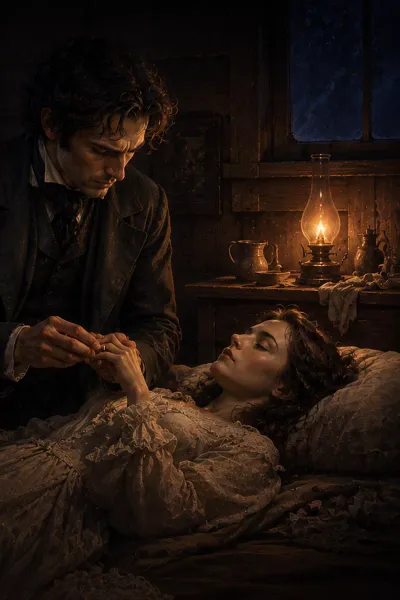
A Study in Scarlet in English
A war doctor looking for a flatmate ends up sharing rooms with a man who calls himself a consulting detective. A strange murder soon gives that man something to do.
The book has two parts. The first is Watson's account of meeting Holmes and of the London investigation, told in the first person with a mix of curiosity and admiration. The second part leaves London completely and tells an old story set in the American West, which explains why the crime was committed. Because of this change, the book feels like two different stories joined by one explanation. The English is clear late-Victorian prose: fairly long sentences, formal, with a lot of words for observation and deduction, and with the dialogue between Holmes and Watson at its centre.
You will like it if
- you want to meet Holmes and Watson at the very beginning
- you like classic detective stories with clues and explanations
- you enjoy first-person narrators who admire the hero
- you want a book that explains the reasoning, not only the result
You will not if
- you do not want the story to leave the detective for a whole second part
- you expect a fast thriller, because the investigation is slow and talkative
- you dislike one-sided portraits of religious groups, which this book contains
- you want a puzzle you can solve yourself, because Holmes uses facts the reader does not have
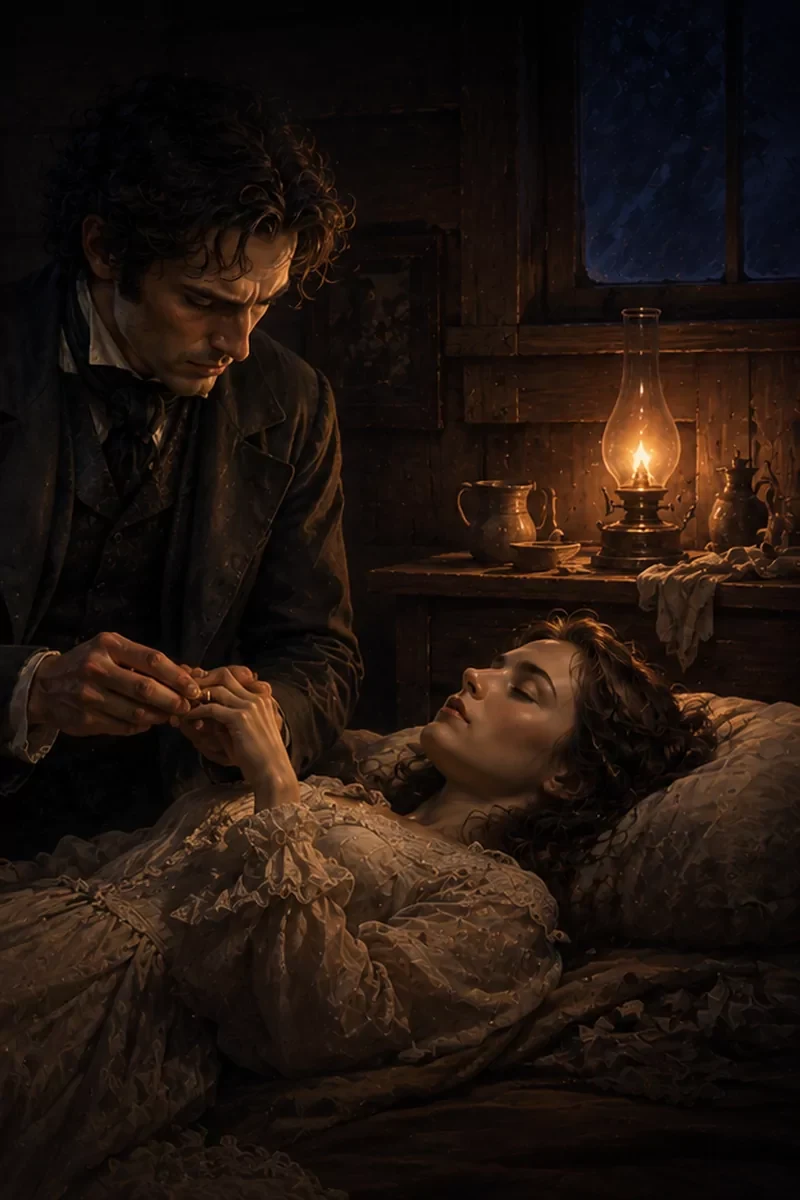
What kind of book“A Study in Scarlet” is
Versions of “A Study in Scarlet” in English: C2
Same book, adapted to a level you can read without stopping
Pick a version. The bar at the foot of the page opens the one you pick.
Vocabulary by level
- A1 63%
- A2 16%
- B1 8%
- B2 6%
- not in dictionary 3%
A sample from “A Study in Scarlet” in English
One passage, the way each version writes it.
Tap any word — we will show the translation
Original · C2249 words
Being a Reprint from the Reminiscences of John H. Watson, M.D., Late of the Army Medical Department
Mr. Sherlock Holmes
In the year 1878 I took my degree of Doctor of Medicine of the University of London, and proceeded to Netley to go through the course prescribed for surgeons in the army. Having completed my studies there, I was duly attached to the Fifth Northumberland Fusiliers as Assistant Surgeon. The regiment was stationed in India at the time, and before I could join it, the second Afghan war had broken out. On landing at Bombay, I learned that my corps had advanced through the passes, and was already deep in the enemy’s country. I followed, however, with many other officers who were in the same situation as myself, and succeeded in reaching Candahar in safety, where I found my regiment, and at once entered upon my new duties.
The campaign brought honours and promotion to many, but for me it had nothing but misfortune and disaster. I was removed from my brigade and attached to the Berkshires, with whom I served at the fatal battle of Maiwand. There I was struck on the shoulder by a Jezail bullet, which shattered the bone and grazed the subclavian artery. I should have fallen into the hands of the murderous Ghazis had it not been for the devotion and courage shown by Murray, my orderly, who threw me across a packhorse, and succeeded in bringing me safely to the British lines.
The original language of “A Study in Scarlet” and what it gives you
How hard the language is C2
The vocabulary is mostly easy: 63% of words are A1 and another 16% A2, only 3% fall outside the dictionary and 5% are beyond the 5000 most frequent. The sentences are a little longer than in a modern novel, with an average of 16.7 words, and the tone is formal. We estimate the original at B2. There is no adaptation yet, so you are reading the original, and the main work is following Holmes's long explanations.
What this means in practice: A formal but readable detective classic, and a good first step into Victorian English.
What to be ready for
How to read it and not quit
- Read Holmes's long speeches in steps: find the main clause first and then add the reasons, which are usually joined by "because", "for" or "so".
- Notice how the verbs of perception and deduction ("observe", "infer", "perceive") differ from "see" and "think"; they carry more precise meanings.
- Do not try to translate every old-fashioned phrase, such as "I perceive"; it is better to treat it as a polite formula and keep going.
- Pay attention to the past perfect ("had been", "had done"), which Holmes uses to explain what happened before the moment of the story.
Contents of “A Study in Scarlet” · 16 chapters
- Part Ipage 1
- Ipage 1
- IIpage 11
- IIIpage 23
- IVpage 37
- Vpage 46
All 16 chaptersShow fewer
- VIpage 56
- VIIpage 67
- Part IIpage 79
- Ipage 79
- IIpage 92
- IIIpage 102
- IVpage 109
- Vpage 121
- VIpage 134
- VI (continued)page 148
- VIIpage 150
Reader ratings for “A Study in Scarlet”
Nobody has rated it yet. Be the first.
Your rating
Reader reviews of “A Study in Scarlet”
No reviews yet.
The story of “A Study in Scarlet”
Written in a few weeks
Doyle wrote the story in the spring of 1886, building Holmes partly on his Edinburgh teacher Joseph Bell.
Published in Beeton's Christmas Annual
It appeared in the 1887 issue, and Doyle sold the rights for a single payment of 25 pounds.
Beeton's Christmas Annual, 1887
First book edition
Ward, Lock & Co. issued it as a book in 1888 with illustrations by Doyle's father, Charles Altamont Doyle.
Success of the next Holmes novel
Interest in Holmes grew mainly after The Sign of the Four (1890) and the short stories in The Strand.
First film
A British silent film of the novel was released in 1914, one of the earliest Holmes films.
In culture “A Study in Scarlet”
8 adaptations and mentions, 1887–2010
In the language "You have been in Afghanistan, I perceive"
Holmes's first words to Watson, the first of his lightning deductions, which have become a model for the trick.
In the language "The scarlet thread of murder"
Holmes's image for the criminal element running through the colourless skein of life.
In the language "The Baker Street Irregulars"
The street boys Holmes hires as informants gave their name to the Sherlockian society founded in New York in 1934.
In the language "Consulting detective"
Holmes calls himself the world's only one in this book, and the job title has stuck to him ever since.
In the language "A Study in ..."
The title became a template, used again for Holmes pastiches and for anything that offers a close examination of one theme.
Film A Study in Scarlet (1914)
An early British silent film adaptation.
Film A Study in Scarlet (1933)
An early sound film version with Reginald Owen as Holmes.
Series Sherlock: "A Study in Pink"
The modern-day BBC series opened with a retelling of this novel.
Questions and answers about “A Study in Scarlet” in English
Is "Elementary, my dear Watson" in A Study in Scarlet?
No, the phrase does not appear in this book. Holmes says things like it, but the famous exact line is a later invention of films and stage versions. If you are looking for the famous deductions, look for the scene where he guesses Watson's past on their first meeting.
What does "a study in scarlet" mean?
Holmes uses the phrase for the case itself: the scarlet thread of murder running through the plain fabric of ordinary life. It is a play on the artist's word "study", so he treats the crime as a picture to be worked out.
Do I need to read the Sherlock Holmes stories in order?
No, but this one is the best place to start, because it is the first. It shows how Watson meets Holmes, so everything later makes more sense. The other books and stories can be read in almost any order.
Why does the book suddenly move to America?
Because the second part explains why the murder happened. The story goes back many years to the American West and tells the history behind the London crime. Many readers find it slows the detective plot, but it is what gives the case its meaning.
What is "Rache" on the wall?
It is the word found written in blood beside the body, and the police take it as the start of a longer name. Holmes disagrees and has his own explanation, which I will not give here. It is one of the clues that the whole case turns on.
Is Holmes based on a real person?
Doyle has said that the way Holmes observes and reasons came from a doctor he studied under in Edinburgh, Joseph Bell. The character himself is fiction, but the idea of a detective who reads small signs on a person's body and clothes has a real source.
How different are the film and TV versions?
Most of them are set in other times or change the story a lot. The BBC series Sherlock moves the case to the present day and renames it "A Study in Pink". A modern version keeps the opening idea, the first meeting of the two men, closer than the case itself.
Is it hard to read if I am not a native speaker?
It is manageable, because the words are mostly common. The difficulty is the formal style and the long reasoning scenes, not the vocabulary. The second part has a different feel and some readers find it slower.
Why do some people say it is not a good Holmes story?
Because Holmes disappears for a long stretch in the middle, and because the way the second part presents one religious group is one-sided and now looks outdated. Fans still value it as the origin of the characters.
Does it stand alone?
Yes. Nothing from other stories is needed, and the case is solved by the end. The only thing you gain from earlier knowledge is fun, from recognising what becomes famous later.
In brief about “A Study in Scarlet”
17 fields of imprint data and measured text characteristics. All of it checkable.
- Original title
- A Study in Scarlet
- Author
- Arthur Conan Doyle
- First published
- 1887
- Original language
- English
- Genre
- Detective · Classics · Adventure
- Mood
- Suspenseful
- Themes
- Justice · Revenge
- Setting
- London, with a long flashback to the American West (Utah) · 1881 for the London story; the flashback goes back to the 1840s and 1850s
- Distinct words
- 5,415
- Words per sentence
- 17 words
- Level of the original
- C2
- Versions
- C2
- Length of the original
- 17 ch. · 43,259 words
- Reading time
- ~4 h
- Source text
- Standard Ebooks
- Download
- EPUB
Similar what to read after “A Study in Scarlet”
By the same author
2The same hand, a different story.

Close in spirit
6The same genre and the same register.
Around the World in Eighty Days
Jules Verne
C2orig.C1
~5 h 50 min · Adventure

The Call of the Wild
Jack London
C2orig.B2C1
~3 h · Adventure
Heart of Darkness
Joseph Conrad
C2orig.
~3 h 30 min · Adventure
Alice's Adventures in Wonderland
Lewis Carroll
C1.2orig.B1B2
~2 h 30 min · Classics

Black Beauty
Anna Sewell
C1.4orig.B1
~5 h 30 min · Classics

Adventures of Huckleberry Finn
Mark Twain
C1.6orig.B1
~10 h 20 min · Adventure
Book page ≈0.2.0 · Oct 14, 2026