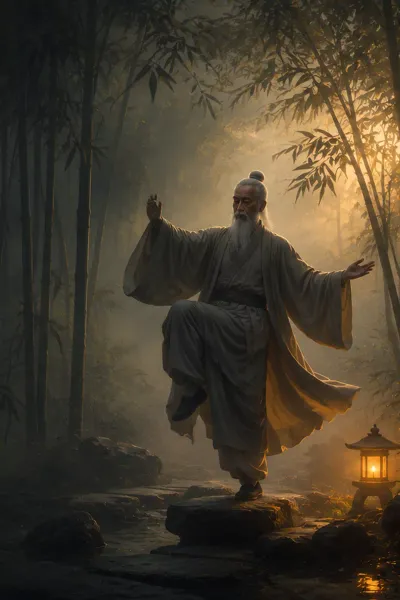
Tao Te Ching in English
A very short Chinese classic of sayings, credited to a sage named Laozi, about the Way and how a wise person lives and rules.
The book is made of short chapters, in two parts: the first deals mostly with the Tao itself and the second with its Teh, the power or virtue that comes from following it. There is no story and no argument that builds from page to page. Each chapter is a small unit of thought, often a paradox or a list of opposites such as soft and hard, empty and full. The ideas come back again and again with new images: water, the valley, the infant, the sage, the ruler. Legge's English is that of a Victorian scholar, plain in its words but formal and careful, and it keeps old Chinese names and measures such as the Tâo and the li.
You will like it if
- you like short pieces you can read in a minute and think about all day
- you are curious about Daoism and Chinese philosophy at the source
- you enjoy paradox and sayings that say more than they seem to
- you want one of the best-known older English translations
You will not if
- you want a story, characters or a clear argument
- you find abstract sayings vague and prefer concrete examples
- you dislike old-fashioned scholarly English and its spellings
- you expect the book to give you practical rules or a clear guide to life
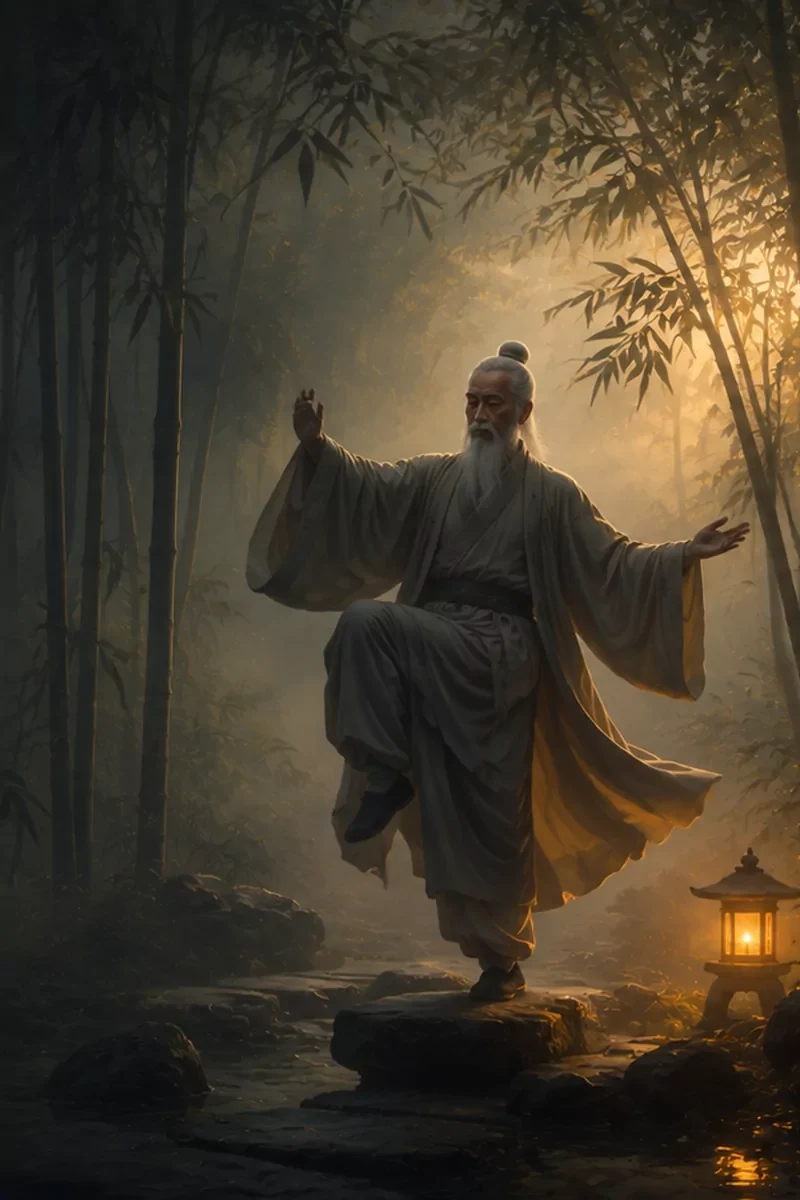
What kind of book“Tao Te Ching” is
Versions of “Tao Te Ching” in English: B1
Same book, adapted to a level you can read without stopping
Pick a version. The bar at the foot of the page opens the one you pick.
Vocabulary by level
- A1 60%
- A2 18%
- B1 8%
- B2 6%
- not in dictionary 4%
A sample from “Tao Te Ching” in English
One passage, the way each version writes it.
Tap any word — we will show the translation
Original · C2234 words
In the “Preface” to the third volume of these Sacred Books of the East (1879), I stated that I proposed giving in due course, in order to exhibit the System of Taoism, translations of the Tao Te Ching by Laozi (sixth century BC),1 the Writings of Chuang-Tzŭ (between the middle of the fourth and third centuries BC), and the Treatise of “Actions and Their Retributions” (of our eleventh century); and perhaps also of one or more of the other characteristic Productions of the System.
The two volumes now submitted to the reader are a fulfilment of the promise made so long ago. They contain versions of the three works which were specified, and, in addition, as appendixes, four other shorter treatises of Taoism; analyses of several of the books of Chuang-tzŭ by Lin Hsi-chung; a list of the stories which form so important a part of those books; two essays by two of the greatest Scholars of China, written the one in AD 586 and illustrating the Taoistic beliefs of that age, and the other in AD 1078 and dealing with the four books of Chuang-tzŭ, whose genuineness is frequently called in question. The concluding index is confined very much to proper names. For subjects the reader is referred to the tables of contents, the introduction to the books of Chuang-tzŭ (vol. xxxix pp. 127 – 163), and the introductory notes to the various appendixes.2
B1.8193 words
The Tao Te Ching (you can say it like "Dow Duh Jing") is one of the most famous books in the world. People have read it for more than two thousand years. It comes from China, and many people believe it was written by a wise man called Laozi (also written as Lao Tzu) around 2,500 years ago. We are not sure if Laozi was one real person or many people. But the book is still here, and people all over the world still read it today.
The book is short. It has 81 small chapters. Some chapters are only a few lines long. The chapters are like poems. They use simple pictures from nature — water, valleys, babies, wood, and the sky — to teach big ideas about life.
The word Tao means "the Way." It is the natural way that the whole world works. It is the source of everything. The Tao is quiet and soft, but it is also the strongest thing of all. Nobody can fully explain the Tao in words. The book says this in its very first lines. But we can feel it and live close to it.
The original language of “Tao Te Ching” and what it gives you
How hard the language is C2
The measurement puts this edition at C2, even though the numbers look friendly. Sentences average 18.8 words, 60% of the words are A1 and another 18% A2, and 7% fall beyond the 5,000 most frequent words. The difficulty comes from meaning, not vocabulary: short sentences use abstract, paradoxical ideas, and many words, such as Tao, Teh and the sage, carry special senses. Another 4% of the words are outside our dictionary, mostly Chinese names and old forms. You can understand every word and still not know what a line means. We ship adaptations at B1 and A2.
What this means in practice: A short book to read slowly and in small pieces: simple words, hard ideas.
What to be ready for
How to read it and not quit
- Read each chapter twice: once for the plain meaning of the words, and once for the idea behind them. The first reading is usually clear; the second takes time.
- Do not translate the key words, Tao, Teh and the sage, into your own language at first. Keep them as labels and let their meaning grow chapter by chapter.
- Watch for the definite article with abstract nouns: 'the Tao' names the one Way, while 'a way' or 'ways' is only a road or a method.
- Notice the parallel structures, 'when … then …' and 'the more … the less …': once you see the pattern, a long line becomes two short ones.
Contents of “Tao Te Ching” · 2 chapters
- About This Bookpage 1
- Part Onepage 2
- Part One (continued)page 16
- Part One (continued)page 31
Reader ratings for “Tao Te Ching”
Nobody has rated it yet. Be the first.
Your rating
Reader reviews of “Tao Te Ching”
No reviews yet.
The story of “Tao Te Ching”
Legge's English translation
James Legge's translation appeared in the Sacred Books of the East series, volume 39, 'The Texts of Taoism', and is the translation used here.
The Sacred Books of the East, vol. 39
Mawangdui manuscripts found
Two silk copies of the text were found in a tomb at Mawangdui in China, sealed in the second century BC. They are far older than the manuscripts known before.
Guodian bamboo slips found
Bamboo strips containing parts of the text were found in a tomb at Guodian, in Hubei, and date from around 300 BC.
Attributed to Laozi
Tradition says the book was written by Laozi, said to have left it for a gatekeeper at the western border before leaving China. Historians doubt that one man wrote it and date the text to roughly the Warring States period.
In culture “Tao Te Ching”
6 adaptations and mentions, 1968–1982
Music 'The Inner Light' (The Beatles)
George Harrison's song takes its words from a chapter of the Tao Te Ching.
In the language 'The Tao of ...' book titles
Benjamin Hoff's 'The Tao of Pooh' and many later books used the word Tao as shorthand for a calm philosophy of everyday life.
In the language 'A journey of a thousand miles begins with a single step'
A line from chapter 64, now used worldwide as encouragement to start a big task.
In the language Wu wei
The idea of 'doing without forcing', often explained in English as going with the flow or acting without struggle.
In the language 'Those who know do not speak'
A line from the text, often quoted to say that real understanding is quiet.
Art Laozi riding an ox
In Chinese painting the author is often shown riding a water buffalo towards the western pass, from the legend of how the book was written.
Questions and answers about “Tao Te Ching” in English
Who wrote the Tao Te Ching?
Tradition credits a sage named Laozi, who is said to have lived in the 6th century BC. Historians doubt that he was a single author or even a real person, and think the text was put together over time.
What does Tao mean?
Tao means 'way' or 'path', and in this book it also means the underlying order that all things follow. The opening chapter says it cannot be fully put into words, which is why the book keeps approaching it by images.
Is the Tao Te Ching a religion or a philosophy?
It is a philosophical text that later became one of the founding texts of religious Daoism. The book itself has no gods to worship and no rituals to follow, only advice about living and ruling.
What does wu wei, or 'doing nothing', mean?
It means acting without forcing, in step with how things naturally go, not being lazy. Legge usually puts it in English as doing nothing or non-action, which can sound like laziness but is meant as effortless effectiveness.
Is the line about a journey of a thousand miles in the book?
Yes, it is in chapter 64. Legge writes it as a journey of a thousand li beginning with a single step, using the Chinese unit li instead of miles.
How should I read it, from beginning to end or at random?
Either works, because each chapter stands alone. Reading a few chapters at a time and coming back is usually better than reading it straight through.
Did Laozi meet Confucius?
Tradition says they met, but historians doubt it. The story appears only in later writings, so it is safest to treat it as legend.
Is Legge's translation the easiest one to read?
No, it is a scholar's translation from 1891 and can sound stiff. It is useful if you want an older, careful rendering, but many modern translations are easier.
Why do people find the Tao Te Ching hard, even though it is so short?
The words are simple but the ideas are paradoxical, and the book gives few examples. Many readers stall at the abstract opening chapters, and it gets easier when the text turns to rulers and war.
Is it good for someone with no interest in Chinese philosophy?
Possibly, if you enjoy short, thoughtful sayings that you can read one at a time. If you want a story or clear instructions, it will probably feel vague.
In brief about “Tao Te Ching”
16 fields of imprint data and measured text characteristics. All of it checkable.
- Original title
- Tao Te Ching
- Author
- Laozi
- Original language
- English
- Genre
- Philosophy · Classics
- Mood
- Gentle
- Themes
- Nature · Power · Society
- Setting
- Ancient China · Traditionally the 6th century BC; the text probably reached its present form later
- Distinct words
- 4,289
- Words per sentence
- 19 words
- Level of the original
- C2
- Versions
- C2, B1.8, B1.0
- Length of the original
- 13 ch. · 38,965 words
- Reading time
- ~3 h 40 min
- Source text
- Standard Ebooks
- Download
- EPUB
Similar what to read after “Tao Te Ching”
Close in spirit
8The same genre and the same register.

A Christmas Carol
Charles Dickens
C2orig.B1C1
~2 h 40 min · Classics
Heart of Darkness
Joseph Conrad
C2orig.
~3 h 30 min · Adventure
Crime and Punishment
Fyodor Dostoevsky
C1.7orig.C1
~18 h 50 min · Classics
The Picture of Dorian Gray
Oscar Wilde
C1.8orig.B1C1
~7 h 20 min · Gothic & mystery
Around the World in Eighty Days
Jules Verne
C2orig.C1
~5 h 50 min · Adventure
The Call of the Wild
Jack London
C2orig.B2C1
~3 h · Adventure
Essays
Ralph Waldo Emerson
C2orig.
~12 h 10 min · Philosophy
Frankenstein
Mary Shelley
C2orig.B2C1
~7 h 10 min · Gothic & mystery
Book page ≈0.2.0 · Oct 14, 2026