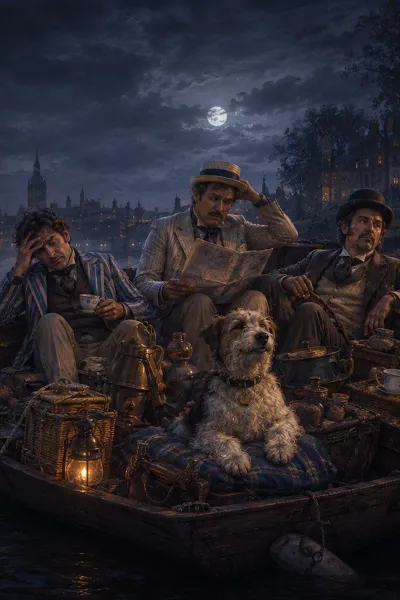
Three Men in a Boat (To Say Nothing of the Dog) in English
Three friends and a dog go on a boating trip up the Thames and do almost everything wrong.
The book has no plot to speak of: it follows the trip, stop by stop, from packing to the end of the journey. Short comic episodes, such as the story of Uncle Podger hanging a picture or the party lost in the Hampton Court maze, alternate with slower passages about the river, its history and its scenery. The narrator is a deadpan first-person voice who exaggerates, goes off on tangents and then pulls himself back. The tone moves between farce, understatement and sudden quiet. The language is chatty Victorian English that sounds like a speaker, not a writer.
You will like it if
- you like dry, understated British humour
- you enjoy comic stories that build from small disasters
- you want a travel book with a very personal voice
- you like books you can read in short, self-contained episodes
You will not if
- you want a strong plot with suspense
- you find long digressions and the jokes of 1889 tiring
- you do not enjoy slower, nostalgic passages about the river's history
- you dislike narrators who exaggerate and stay ironic for a whole book
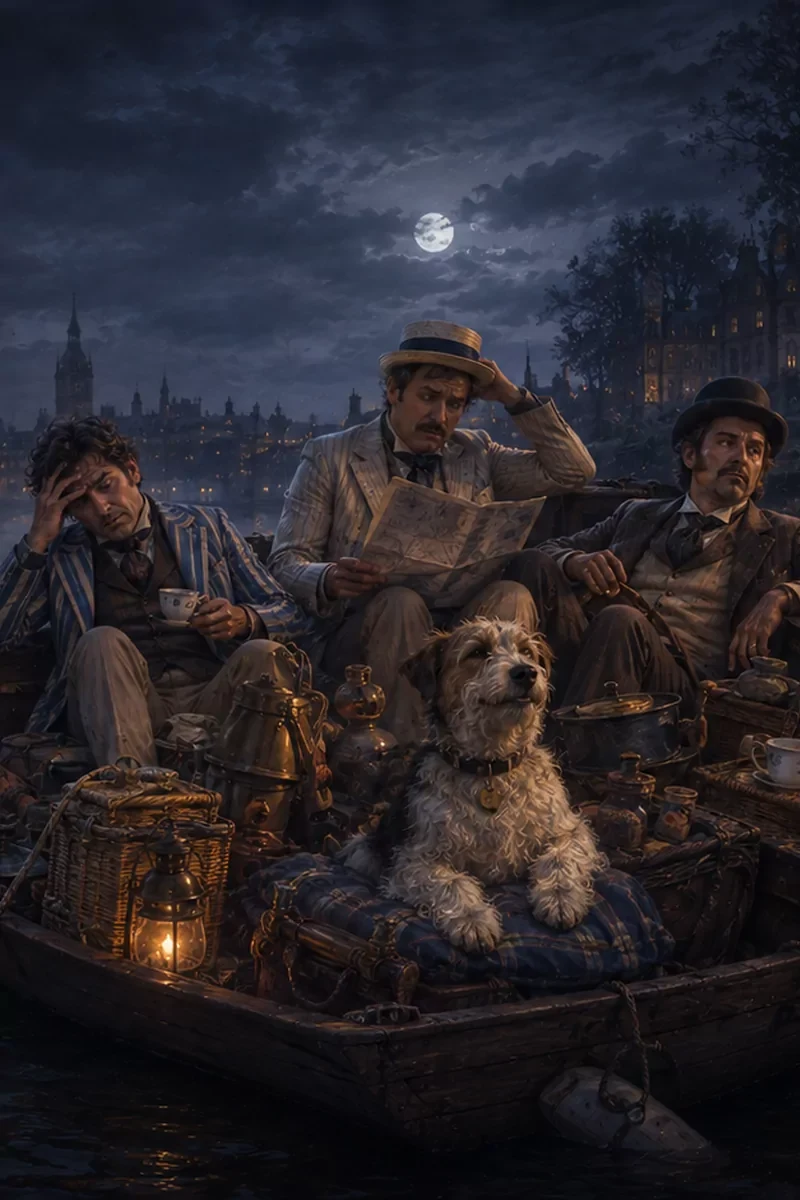
What kind of book“Three Men in a Boat (To Say Nothing of the Dog)” is
Versions of “Three Men in a Boat (To Say Nothing of the Dog)” in English: B1
Same book, adapted to a level you can read without stopping
Pick a version. The bar at the foot of the page opens the one you pick.
Vocabulary by level
- A1 64%
- A2 17%
- B1 8%
- B2 6%
- not in dictionary 3%
A sample from “Three Men in a Boat (To Say Nothing of the Dog)” in English
One passage, the way each version writes it.
Tap any word — we will show the translation
C1.0188 words
It was Mrs. Poppets that woke me up next morning.
She said:
“Do you know that it’s nearly nine o’clock, sir?”
“Nine o’ what?” I cried, starting up.
“Nine o’clock,” she replied, through the keyhole. “I thought you was a-oversleeping yourselves.”
I woke Harris, and told him. He said:
“I thought you wanted to get up at six?”
“So I did,” I answered; “why didn’t you wake me?”
“How could I wake you, when you didn’t wake me?” he retorted. “Now we won’t get on the water till after twelve. I wonder you take the trouble to get up at all.”
“Um,” I replied, “lucky for you that I do. If I hadn’t woken you, you’d have lain there for the whole fortnight.”
We snarled at one another like this for the next few minutes, until a defiant snore from George interrupted us. It reminded us, for the first time since we were called, that he existed. There he lay, on his back, with his mouth wide open and his knees stuck up. He was the man who had wanted to know what time he should wake us.
B2.2192 words
It was Mrs. Poppets who woke me up next morning.
She said:
“Do you know that it’s nearly nine o’clock, sir?”
“Nine o’ what?” I cried, sitting up suddenly.
“Nine o’clock,” she answered, through the keyhole. “I thought you was a-oversleeping yourselves.”
I woke Harris and told him. He said:
“I thought you wanted to get up at six?”
“So I did,” I answered. “Why didn’t you wake me?”
“How could I wake you, when you didn’t wake me?” he said sharply. “Now we won’t get on the water till after twelve. I wonder you take the trouble to get up at all.”
“Um,” I said, “it’s lucky for you that I do. If I hadn’t woken you, you’d have stayed there for the whole two weeks.”
We snapped at each other like this for a few minutes. Then a loud, rude snore from George stopped us. For the first time since we were called, we remembered that he was there. There he lay, on his back, with his mouth wide open and his knees sticking up. This was the man who had wanted to know what time he should wake us.
The original language of “Three Men in a Boat (To Say Nothing of the Dog)” and what it gives you
How hard the language is C1.7
The text is about 66,000 words with roughly 6,400 different word forms. About eight words in ten (64% + 17%) are in the A1–A2 band, only 4% fall beyond the 5,000 most frequent words, and 3% are outside the dictionary. The average sentence is 20.3 words, which is long, and the humour often relies on understatement and irony. Our measured level for the original is C1.7: the vocabulary is plain, but the sentences and the jokes need patience.
What this means in practice: Simple words and long, joking sentences: easy to follow, harder to catch the humour.
What to be ready for
How to read it and not quit
- Learn to hear understatement: when the narrator says a disaster was 'a little inconvenient', the joke is that it was far worse.
- Do not copy the forms in the dialogue, such as 'ain't', 'you was' and 'I'm a-coming'; they are marks of working-class or rural speech, not standard grammar.
- Slow down at the long sentences: the joke often lands in the last clause, so the full sentence matters.
- If a mock-poetic passage is too hard, skip it: it usually ends with a plain sentence that carries the point.
Contents of “Three Men in a Boat (To Say Nothing of the Dog)” · 1 chapter
- Prefacepage 1
- Preface (continued)page 1
- Preface (continued)page 10
- Preface (continued)page 15
- Preface (continued)page 22
- Preface (continued)page 31
All 1 chaptersShow fewer
- Preface (continued)page 38
- Preface (continued)page 49
- Preface (continued)page 57
- Preface (continued)page 67
- Preface (continued)page 68
- Preface (continued)page 77
- Preface (continued)page 86
- Preface (continued)page 95
- Preface (continued)page 105
- Preface (continued)page 107
- Preface (continued)page 118
- Preface (continued)page 119
- Preface (continued)page 129
- Preface (continued)page 129
- Preface (continued)page 139
- Preface (continued)page 141
- Preface (continued)page 145
- Preface (continued)page 152
- Preface (continued)page 157
Reader ratings for “Three Men in a Boat (To Say Nothing of the Dog)”
Nobody has rated it yet. Be the first.
Your rating
Reader reviews of “Three Men in a Boat (To Say Nothing of the Dog)”
No reviews yet.
The story of “Three Men in a Boat (To Say Nothing of the Dog)”
Published as a river guide that turned funny
Jerome K. Jerome's book appeared in 1889 from the Bristol publisher J. W. Arrowsmith. It was planned as a fairly serious guide to the Thames with history and scenery, but the comic episodes took over.
Critics cool, readers delighted
Some reviewers were unimpressed by its informal humour, but the public bought it in large numbers and it has stayed in print ever since.
A sequel on bicycles
Jerome sent the same characters to Germany on bicycles in Three Men on the Bummel.
Soviet television film
A Soviet television film of the book was made in 1979, reflecting how widely the novel was loved in Russia.
A boom in Thames boating
The book is often credited with encouraging holiday boating on the Thames in the years after it appeared.
In culture “Three Men in a Boat (To Say Nothing of the Dog)”
8 adaptations and mentions, 1889–2006
Art A. Frederics illustrations
The first edition's line drawings of the three men, the dog and the boat helped to define their look.
In the language 'I like work: it fascinates me'
The line about sitting and looking at work for hours is one of the most quoted jokes in English about laziness.
In the language Uncle Podger
The scene in which Uncle Podger hangs a picture is used as a shorthand for a person who turns a simple task into a household disaster.
Film Three Men in a Boat (Annakin)
A British colour film starred Laurence Harvey, Jimmy Edwards and David Tomlinson.
Series BBC television film
Tim Brooke-Taylor, Michael Palin and David Hatch played the three men in a BBC production.
Film Troe v lodke, ne schitaya sobaki
The Soviet television film with well-known actors became a favourite in Russia and is still repeated.
In the language To Say Nothing of the Dog
Connie Willis took the book's subtitle for a time-travel comedy that is full of references to Jerome's novel.
Series BBC Three Men in a Boat
Griff Rhys Jones, Dara O Briain and Rory McGrath retraced the Thames journey in a television programme.
Questions and answers about “Three Men in a Boat (To Say Nothing of the Dog)” in English
Why does the title say 'to say nothing of the dog'?
It is a joke on the phrase 'to say nothing of', because the dog Montmorency is mentioned all the time. The subtitle tells you straight away that the book will not be serious.
Is Three Men in a Boat a true story?
It is loosely based on a real boat trip that Jerome made with two friends, and the characters George and Harris are drawn from real people. Jerome adds exaggeration and invented episodes, so it is not a faithful record.
Is it still funny today?
Much of it is, especially the comic set pieces about everyday trouble, such as Uncle Podger hanging a picture. Some jokes depend on 1880s habits and do not land the same way now.
What is the maze story?
Harris brings a party into the maze at Hampton Court, convinced that he knows the way, and they get lost. It is among the best-known episodes in the book.
Why does the book suddenly turn serious about the river?
Jerome stops the jokes to describe the Thames, its scenery and its past, such as the meadow where Magna Carta was sealed. These passages are slower, but they give the comedy somewhere to rest.
Is there a sequel?
Yes, 'Three Men on the Bummel' (1900), in which the same friends travel through Germany by bicycle. You can read it without the first book.
Which adaptation is closest to the book?
The BBC television version of 1975, with Tim Curry, Michael Palin and Stephen Moore, is a good screen version. As with most adaptations, much of the narrator's commentary is lost.
Do I need to know the Thames to enjoy it?
No. The names of places are only a background, and the jokes work without a map.
Is it hard to read?
The words are easy, but the sentences are long and the humour is ironic, so you have to catch understatement. The mock-poetic passages are the slowest part.
In brief about “Three Men in a Boat (To Say Nothing of the Dog)”
17 fields of imprint data and measured text characteristics. All of it checkable.
- Original title
- Three Men in a Boat · “Three Men in a Boat (To Say Nothing of the Dog)”
- Author
- Jerome K. Jerome
- First published
- 1889
- Original language
- English
- Genre
- Humor · Adventure · Classics
- Mood
- Funny
- Themes
- Friendship · Nature · Society
- Setting
- The River Thames, from Kingston upon Thames towards Oxford · Late Victorian England, 1880s
- Distinct words
- 6,406
- Words per sentence
- 20 words
- Level of the original
- C1.7
- Versions
- C1.7, C1.0, B2.2, B1.4
- Length of the original
- 25 ch. · 66,055 words
- Reading time
- ~6 h 10 min
- Source text
- Standard Ebooks
- Download
- EPUB
Similar what to read after “Three Men in a Boat (To Say Nothing of the Dog)”
Close in spirit
8The same genre and the same register.
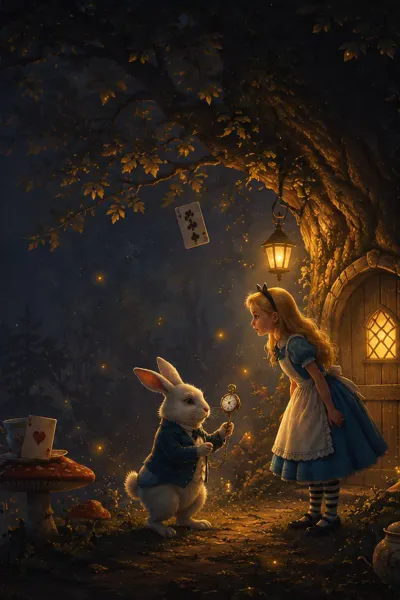
Alice's Adventures in Wonderland
Lewis Carroll
C1.2orig.B1B2
~2 h 30 min · Classics
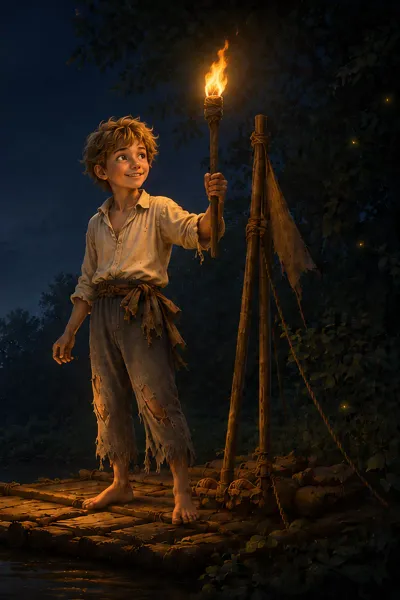
Adventures of Huckleberry Finn
Mark Twain
C1.6orig.B1
~10 h 20 min · Adventure
Black Beauty
Anna Sewell
C1.4orig.B1
~5 h 30 min · Classics

The Jungle Book
Rudyard Kipling
C1.7orig.
~4 h 40 min · Adventure
Around the World in Eighty Days
Jules Verne
C2orig.C1
~5 h 50 min · Adventure
The Call of the Wild
Jack London
C2orig.B1C1
~3 h · Adventure
Heart of Darkness
Joseph Conrad
C2orig.
~3 h 30 min · Adventure

Short Fiction
O. Henry
C2orig.
~82 h 30 min · Short stories
Book page ≈0.2.0 · Oct 14, 2026