Through the Looking-Glass in English
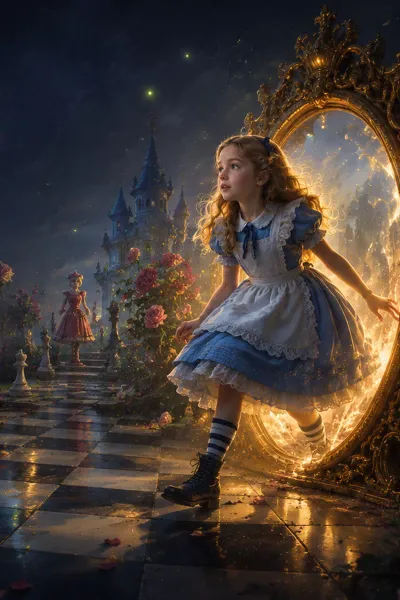
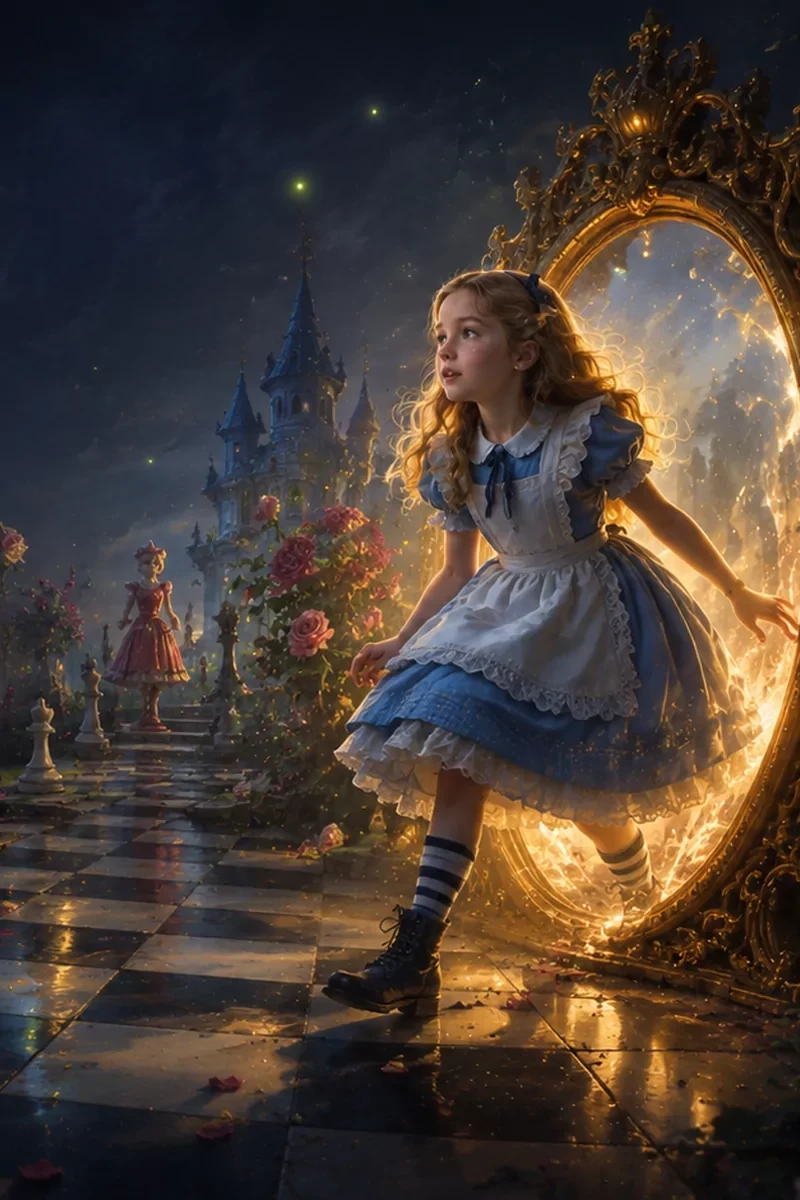
Alice steps through a mirror into a country laid out as a chess game, where she is a pawn who wants to become a queen.
The book is built on a chess problem: Alice starts as a white pawn and moves one square at a time across eight rows. Each chapter is one square, and each square has a new character, a new rule and a new piece of nonsense. Many chapters are mainly conversation, and the talk is full of wordplay, riddles, and rules that make sense only inside the dream. Poems and songs appear in several chapters, and the best-known is Jabberwocky, which is mostly invented words. The plain sentences keep the book readable even when the logic is strange.
You will like it if
- you enjoy wordplay, riddles and puns
- you like fantasy that follows its own rules, even when they are absurd
- you want short chapters of conversation with odd characters
- you like reading poems and nonsense verse aloud
You will not if
- you want a plot that builds to a goal with suspense
- you dislike nonsense, or conversations that turn into arguments about words
- you find wordplay hard when English is not your first language
- you would rather have the cheerful, loose style of the first Alice book
What kind of book“Through the Looking-Glass” is
Versions of “Through the Looking-Glass” in English: B2
Same book, adapted to a level you can read without stopping
Pick a version. The bar at the foot of the page opens the one you pick.
Vocabulary by level
- A1 63%
- A2 17%
- B1 7%
- B2 7%
- not in dictionary 3%
A sample from “Through the Looking-Glass” in English
One passage, the way each version writes it.
Tap any word — we will show the translation
Original · C1.1145 words
Alice meets R. Q.
Alice Through Q.’s 3rd (by railway) to Q.’s 4th (Tweedledum And Tweedledee)
Alice meets W. Q. (with shawl)
Alice to Q.’s 5th (shop, river, shop)
Alice to Q.’s 6th (Humpty Dumpty)
Alice to Q.’s 7th (forest)
W. Kt. takes R. Kt.
Alice to Q.’s 8th (Coronation)
Alice becomes Queen
Alice Castles (feast)
Alice takes R. Q. and wins
R. Q. to K. R.’s 4th
W. Q. to Q. B.’s 4th (after shawl)
W. Q. to Q. B.’s 5th (becomes sheep)
W. Q. to K. B.’s 8th (leaves egg on shelf)
W. Q. to Q. B.’s 8th (flying from R. Kt.)
R. Kt. to K.’s 2nd (check)
W. Kt. to K. B.’s 5th
R. Q. to K.’s Sq. (Examination)
Queens castle
W. to Q. R.’s 6th (soup)
B2.6201 words
Alice meets the Red Queen.
Alice goes through the Queen's 3rd square by railway to the Queen's 4th square, where she meets Tweedledum and Tweedledee.
Alice meets the White Queen, who is carrying a shawl.
Alice moves to the Queen's 5th square, passing through a shop, a river, and another shop.
Alice moves to the Queen's 6th square, where she meets Humpty Dumpty.
Alice moves to the Queen's 7th square, which is a forest.
The White Knight takes the Red Knight.
Alice moves to the Queen's 8th square for her coronation.
Alice becomes a queen.
Alice castles, and there is a feast.
Alice takes the Red Queen and wins the game.
The Red Queen moves to the King's Rook's 4th square.
The White Queen moves to the Queen's Bishop's 4th square after the shawl incident.
The White Queen moves to the Queen's Bishop's 5th square and becomes a sheep.
The White Queen moves to the King's Bishop's 8th square, leaving an egg on a shelf.
The White Queen moves to the Queen's Bishop's 8th square, flying from the Red Knight.
The Red Knight moves to the King's 2nd square, giving check.
The White Knight moves to the King's Bishop's 5th square.
The original language of “Through the Looking-Glass” and what it gives you
How hard the language is C1.1
The sentences are plain: the average is 14.5 words, and 80% of the words fall in the A1–A2 bands (63% + 17%). Only 3% of the words are beyond the 5000 most frequent and 3% are outside the dictionary, mostly invented words. We estimate the original at B2, because the real difficulty is in the wordplay, the logic and the verse, not in the grammar. We ship adaptations at B1.
What this means in practice: Easy words, hard jokes: the book is short and plain but rewards slow, attentive reading.
What to be ready for
How to read it and not quit
- Do not look up the invented words; read them aloud and let the sound carry the meaning, as Alice does.
- Pay attention to what a word means literally; most puns work by reading an ordinary phrase too literally, and you may need to say the sentence aloud to hear the joke.
- Short polite phrases such as "pray" and "I beg your pardon" belong to Victorian manners, and the book plays with them.
- Spell out the logic of each chapter in your own words before moving on; the rules change, but they are always stated.
Contents of “Through the Looking-Glass” · 13 chapters
- The Chess Gamepage 1
- The Chess Game (continued)page 1
- Ipage 2
- IIpage 14
- IIIpage 24
- IVpage 34
All 13 chaptersShow fewer
- Vpage 44
- VIpage 55
- VIIpage 66
- VIIIpage 75
- VIII (continued)page 90
- IXpage 90
- IX (continued)page 104
- Xpage 104
- XIpage 105
- XIIpage 105
- XII (continued)page 107
Reader ratings for “Through the Looking-Glass”
Nobody has rated it yet. Be the first.
Your rating
Reader reviews of “Through the Looking-Glass”
No reviews yet.
The story of “Through the Looking-Glass”
Jabberwocky begins
The first stanza of "Jabberwocky" appeared in 1855 in a family magazine Carroll edited, years before the book.
Published
Macmillan published the book at the end of 1871 with illustrations by John Tenniel, though the title page is dated 1872.
The Wasp episode cut
Tenniel objected to a scene with a Wasp in a Wig, and Carroll cut it before publication. The proofs surfaced much later, long after the author's death.
Built on a chess game
Carroll arranged the book around a chess problem, with Alice as a pawn crossing the board to become a queen.
In culture “Through the Looking-Glass”
9 adaptations and mentions, 1871–2016
In the language Jabberwocky words
"Chortle" and "galumph" entered English from the poem, and Humpty Dumpty's explanation gave the word "portmanteau" its linguistic meaning.
In the language "Through the looking glass"
The phrase means entering a topsy-turvy world where the usual rules are reversed.
In the language Tweedledum and Tweedledee
The nursery-rhyme pair, made famous by the book, became a phrase for two people so alike they are indistinguishable.
Art Tenniel's illustrations
Tenniel's drawings of the Jabberwock, Humpty Dumpty and the Walrus defined how the characters look.
Film Disney's Alice in Wonderland
The film combines both Alice books, borrowing the Tweedles, the Walrus and the Carpenter and the Jabberwocky verse from this one.
Music "I Am the Walrus"
John Lennon's Beatles song took the walrus from "The Walrus and the Carpenter".
In the language The Red Queen hypothesis
The Red Queen's line about running to stay in the same place gave evolutionary biology the "Red Queen hypothesis".
Film Jabberwocky (Terry Gilliam)
Gilliam's comic film takes the poem's title and its monster as its starting point.
Film Alice Through the Looking Glass
Disney's sequel to its 2010 film borrows the title and characters while telling a new story.
Questions and answers about “Through the Looking-Glass” in English
Do I need to read Alice's Adventures in Wonderland first?
No, you can start here. Alice is the same girl, but the story, the setting and nearly all the characters are new.
What is Jabberwocky about?
It tells how a young hero kills a monster called the Jabberwock, but most of the nouns and adjectives are invented. Alice says it fills her head with ideas without her knowing what they are, and that is its point.
Is the book really a game of chess?
Yes, the story follows the moves of a chess game, with Alice as a pawn who is promoted to queen on the eighth rank. The chapter titles, the landscape of squares and the characters all link back to the board.
Are the Cheshire Cat and the Mad Hatter in it?
No, they belong to the first book. This one has its own cast, including Tweedledum and Tweedledee, Humpty Dumpty and the White Knight.
Who is the Red Queen and why does she run so much?
The Red Queen is a chess piece who rules the squares, and she runs only to stay in the same place. It is a joke about a world where you have to run just to avoid falling behind.
Is it based on a real girl?
Alice was inspired by Alice Liddell, a child Carroll knew. The poem that ends the book spells her full name with the first letters of its lines.
How do the recent Disney films compare with the book?
The films mix both Alice books and add a larger adventure plot that neither book has. If you want the original, Through the Looking-Glass is quieter, funnier and more about talk.
Is it a children's book?
It was written for children, but much of the humour is for adults who enjoy logic, language and parody. It reads best as a book with two audiences.
Is it hard to read in English?
The grammar and most of the words are simple, but the wordplay needs close reading. Many learners find the puns the hardest part, not the vocabulary.
Why does Alice have to walk away from things to reach them?
In the Looking-Glass world, things work in reverse, so to get to a place you sometimes have to walk away from it. It is the first of many mirror-logic jokes in the book.
In brief about “Through the Looking-Glass”
17 fields of imprint data and measured text characteristics. All of it checkable.
- Original title
- Through the Looking-Glass
- Author
- Lewis Carroll
- First published
- 1871
- Original language
- English
- Genre
- Fairy tale · Adventure · Classics
- Mood
- Dreamlike
- Themes
- Identity · Childhood · Coming of age
- Setting
- A dream world behind a mirror, reached from a drawing-room in an English house · Victorian England, a winter afternoon in the 1870s
- Distinct words
- 2,731
- Words per sentence
- 15 words
- Level of the original
- C1.1
- Versions
- C1.1, B2.6
- Length of the original
- 17 ch. · 29,772 words
- Reading time
- ~2 h 50 min
- Source text
- Standard Ebooks
- Download
- EPUB
Similar what to read after “Through the Looking-Glass”
By the same author
1The same hand, a different story.
Close in spirit
7The same genre and the same register.
Black Beauty
Anna Sewell
C1.4orig.B1
~5 h 30 min · Classics
Adventures of Huckleberry Finn
Mark Twain
C1.6orig.B1
~10 h 20 min · Adventure
The Jungle Book
Rudyard Kipling
C1.7orig.
~4 h 40 min · Adventure
Around the World in Eighty Days
Jules Verne
C2orig.C1
~5 h 50 min · Adventure
The Call of the Wild
Jack London
C2orig.B2C1
~3 h · Adventure
A Christmas Carol
Charles Dickens
C2orig.B1C1
~2 h 40 min · Classics
Heart of Darkness
Joseph Conrad
C2orig.
~3 h 30 min · Adventure
Book page ≈0.2.0 · Oct 14, 2026