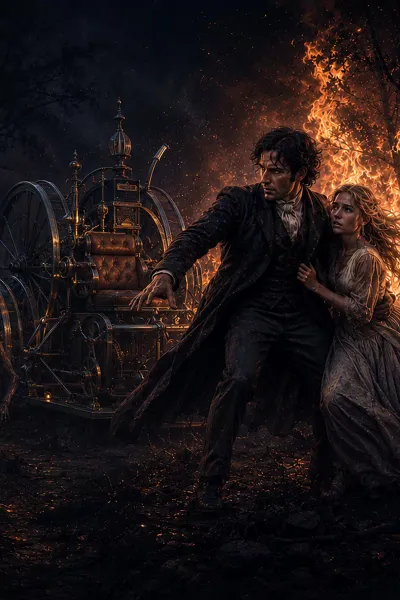
The Time Machine in English
A Victorian inventor builds a machine, travels hundreds of thousands of years into the future, and comes back to tell what he found.
The book is a story told inside a story. A guest at a dinner party, who is never named, retells what the Time Traveller said that evening. The first part is a scientific conversation in a drawing room. Most of the book then follows the Traveller's account, in his own voice, of the future world and the dangers he finds there, and a short return to the dinner table closes it. The language is the plain, direct prose of the 1890s, with long explanations and some scientific vocabulary. Description is more important than dialogue.
You will like it if
- you like science fiction that begins with an idea rather than with a battle
- you want to read the book that made the time machine a standard idea
- you enjoy bleak, thoughtful endings
- you want a classic you can finish quickly
You will not if
- you want fast action in every chapter
- you do not like long passages of explanation and description
- you expect a happy ending
- you want developed characters, since the people are mostly sketches
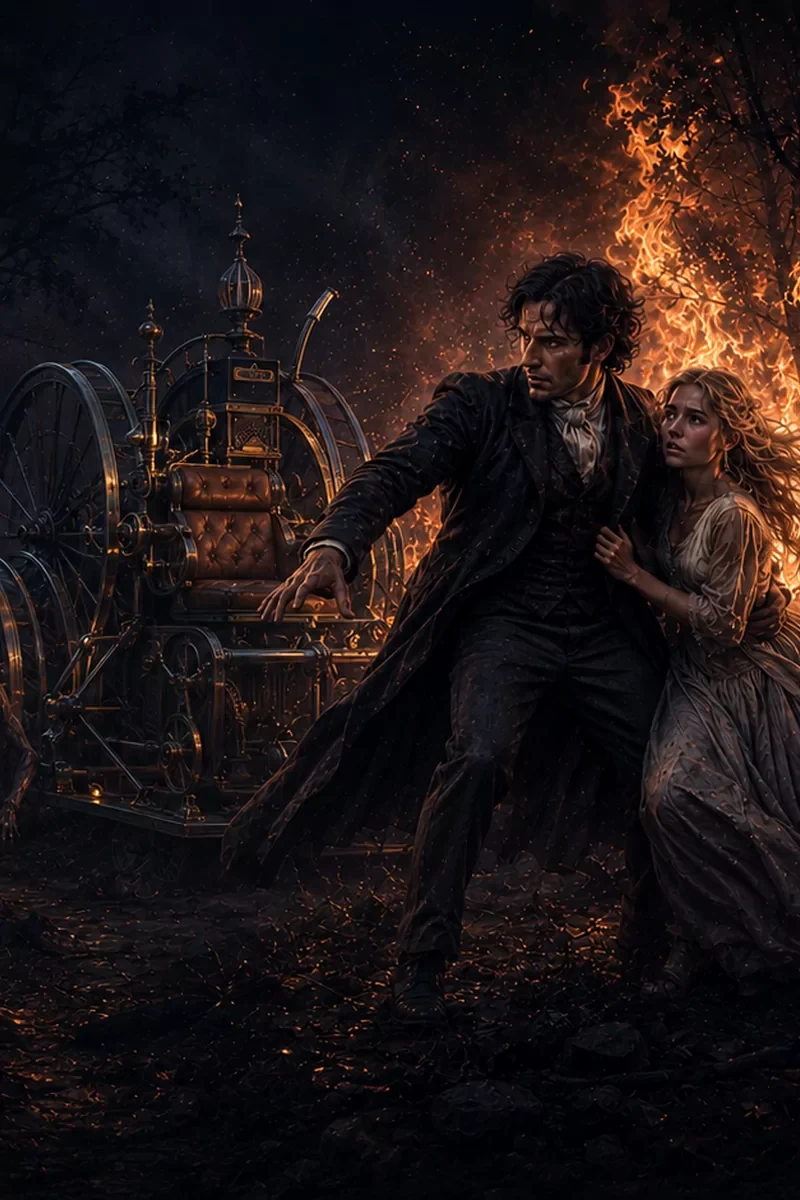
What kind of book“The Time Machine” is
Versions of “The Time Machine” in English: C2
Same book, adapted to a level you can read without stopping
Pick a version. The bar at the foot of the page opens the one you pick.
Vocabulary by level
- A1 60%
- A2 16%
- B1 9%
- B2 7%
- not in dictionary 4%
A sample from “The Time Machine” in English
One passage, the way each version writes it.
Tap any word — we will show the translation
Original · C2241 words
The Time Traveller (for so it will be convenient to speak of him) was expounding a recondite matter to us. His grey eyes shone and twinkled, and his usually pale face was flushed and animated. The fire burned brightly, and the soft radiance of the incandescent lights in the lilies of silver caught the bubbles that flashed and passed in our glasses. Our chairs, being his patents, embraced and caressed us rather than submitted to be sat upon, and there was that luxurious after-dinner atmosphere when thought roams gracefully free of the trammels of precision. And he put it to us in this way —marking the points with a lean forefinger —as we sat and lazily admired his earnestness over this new paradox (as we thought it) and his fecundity.
“You must follow me carefully. I shall have to controvert one or two ideas that are almost universally accepted. The geometry, for instance, they taught you at school is founded on a misconception.”
“Is not that rather a large thing to expect us to begin upon?” said Filby, an argumentative person with red hair.
“I do not mean to ask you to accept anything without reasonable ground for it. You will soon admit as much as I need from you. You know of course that a mathematical line, a line of thickness nil, has no real existence. They taught you that? Neither has a mathematical plane. These things are mere abstractions.”
The original language of “The Time Machine” and what it gives you
How hard the language is C2
The vocabulary is mostly simple: 60% of the words are in the A1 band and another 16% in A2. However, 7% lie beyond the 5,000 most frequent words, and 4% are outside the dictionary because they are invented names or old forms. Sentences average 17.1 words, which is medium length. Taken together this puts the original at around B2: the sentences are manageable, but the ideas are abstract and the descriptions use unusual words.
What this means in practice: Medium sentences and abstract ideas: a good test for strong intermediate readers, and quite hard for anyone below B2.
What to be ready for
How to read it and not quit
- Pay attention to the past perfect, since the Traveller often explains what had happened before a moment in his story: I had set the lever, it had stopped.
- Watch the modals of guessing and hypothesis: could, might and must have, which the Traveller uses when he tries to explain what he sees.
- Capital letters mark special names: the Time Traveller, the Eloi. Note that the article the stays in front of them.
- Look for phrasal verbs such as make out, set out and come across; they are everywhere in the descriptions and rarely have a one-word translation.
Contents of “The Time Machine” · 13 chapters
- Ipage 1
- IIpage 11
- IIIpage 19
- IVpage 26
- Vpage 40
- V (continued)page 55
All 13 chaptersShow fewer
- VIpage 64
- VIIpage 72
- VIIIpage 81
- IXpage 90
- Xpage 100
- XIpage 104
- XIIpage 111
- Epiloguepage 117
Reader ratings for “The Time Machine”
Nobody has rated it yet. Be the first.
Your rating
Reader reviews of “The Time Machine”
No reviews yet.
The story of “The Time Machine”
The Chronic Argonauts
Wells published an earlier, much cruder time-travel story, "The Chronic Argonauts", in the Science Schools Journal; it contained the seed of the later novella.
Science Schools Journal, 1888
Rewritten for the National Observer
Wells reworked the idea as a series of articles in the National Observer, which he then rewrote again into the finished story.
Serialised in the New Review
The final version appeared in the New Review in instalments in the first half of 1895, shortly before its publication as a book.
The New Review, 1895
Published as a book
The novella was issued in 1895 by Henry Holt in New York and William Heinemann in London, and its success established Wells as a writer.
In culture “The Time Machine”
8 adaptations and mentions, 1895–2002
In the language "Time machine"
Wells gave a name and a vehicle to the dream of travelling through time, and the term is now used for anything that carries people into the past.
In the language Eloi and Morlocks
The two future species, one idle and above ground, one toiling underground, became shorthand for a society split by class.
In the language Time as the fourth dimension
The Time Traveller's opening argument, that time is a dimension like length, popularised the idea long before it became common in physics talk.
Film The Time Machine (George Pal)
Rod Taylor starred in the Technicolor film, which won the Academy Award for Best Special Effects.
Series Doctor Who
The long-running British series, built around a travelling time machine, follows the model Wells established.
Film Time After Time
Nicholas Meyer's film imagines Wells himself chasing Jack the Ripper into the present day with his own time machine.
Film The Time Machine (Simon Wells)
Directed by Wells's great-grandson, this version updated the story for the modern screen.
Art The Morlocks of Marvel Comics
The X-Men comics borrowed the name for a group of outcast mutants living in the tunnels beneath New York.
Questions and answers about “The Time Machine” in English
Who are the Eloi and the Morlocks?
They are the two peoples the Traveller finds in the year 802,701. The Eloi are small, gentle and live above ground; the Morlocks live underground. Wells uses them to ask what class division could do to the human race.
Does the Time Traveller have a name?
No. He is only called the Time Traveller. The guests at his dinner are named by their jobs, such as the Medical Man, the Psychologist and the Provincial Mayor.
Did H. G. Wells invent time travel?
Not the idea itself, but this book made the time machine a standard device in science fiction. Earlier stories had people travel in time by dreams or magic; Wells made it a mechanical, scientific question.
Is it a horror story or science fiction?
It is science fiction with a dark side. There are tense scenes in the dark, but the book is mainly about a world and its meaning, not about frights.
Is the ending explained?
Not fully. The last pages leave open what happens next, and readers have argued about it for a long time. I will not say what happens, but expect an ending that asks a question.
How different are the films from the book?
A lot. The 1960 film and the 2002 film both add love stories and change the plot, and neither keeps the book's cold, open ending. If you know the films, the book will feel quieter and more thoughtful.
Is there a sequel?
Wells did not write one. There are later sequels by other authors, for instance The Time Ships by Stephen Baxter, which was authorised by Wells's estate. The Time Machine stands alone.
Is it hard to read in English?
It is moderately hard. We estimate the original at around B2: the sentences are not long, but the vocabulary is sometimes unusual and the ideas are abstract. There are no adaptations yet, only the original.
What is it actually like to read, compared with what it is famous for?
It is famous for the machine, but only a small part of the book is about the machine. Most of it is the Traveller exploring one place, thinking about what he sees and being afraid. If you expect non-stop adventure, you will find it slower.
In brief about “The Time Machine”
17 fields of imprint data and measured text characteristics. All of it checkable.
- Original title
- The Time Machine
- Author
- H. G. Wells
- First published
- 1895
- Original language
- English
- Genre
- Science fiction · Classics · Adventure
- Mood
- Melancholy
- Themes
- Class · Science · Society · Survival
- Setting
- A house in the London suburb of Richmond, and the same spot in the distant future · The 1890s, and then the year 802,701
- Distinct words
- 4,494
- Words per sentence
- 17 words
- Level of the original
- C2
- Versions
- C2
- Length of the original
- 14 ch. · 32,452 words
- Reading time
- ~3 h
- Source text
- Standard Ebooks
- Download
- EPUB
Similar what to read after “The Time Machine”
By the same author
1The same hand, a different story.
Close in spirit
7The same genre and the same register.
Around the World in Eighty Days
Jules Verne
C2orig.C1
~5 h 50 min · Adventure
The Call of the Wild
Jack London
C2orig.B2C1
~3 h · Adventure
Frankenstein
Mary Shelley
C2orig.B2C1
~7 h 10 min · Gothic & mystery
Heart of Darkness
Joseph Conrad
C2orig.
~3 h 30 min · Adventure
Alice's Adventures in Wonderland
Lewis Carroll
C1.2orig.B1B2
~2 h 30 min · Classics
Black Beauty
Anna Sewell
C1.4orig.B1
~5 h 30 min · Classics
Adventures of Huckleberry Finn
Mark Twain
C1.6orig.B1
~10 h 20 min · Adventure
Book page ≈0.2.0 · Oct 14, 2026