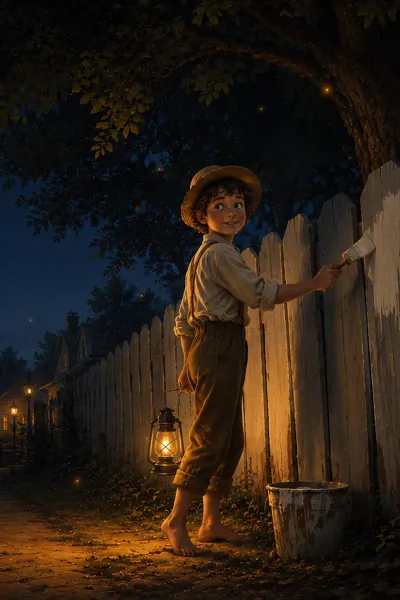
The Adventures of Tom Sawyer in English
A mischievous boy in a Mississippi town gets into every kind of trouble, from school to pirate games. One night he and his friend Huck see something in a graveyard that is far too real to be a game.
The book is made of short, lively episodes that grow into one story. The first half is mostly a comic picture of boyhood: school, a fence, a first love, a dare and Tom's escape from punishment. The second half is darker, and the adventure moves into a murder, a trial and a cave. Twain's narrator is educated and ironic, often using big, grand words for small boyish events and talking to the reader directly. Around a third of the text is dialogue in the speech of Missouri village boys and townspeople, and the book also contains Bible quotations, hymns and a little verse.
You will like it if
- you like funny, mischievous stories about growing up
- you want a classic adventure with a graveyard, a cave and a treasure hunt
- you enjoy ironic narrators who comment on the characters
- you are curious about everyday life in the American South in the 1840s
You will not if
- you want modern, standard spelling and grammar in every line of dialogue
- you are uncomfortable with period attitudes and some racial language
- you do not like episodic books where the plot takes time to arrive
- you want a serious, realistic coming-of-age story: this one is comic and sometimes exaggerated
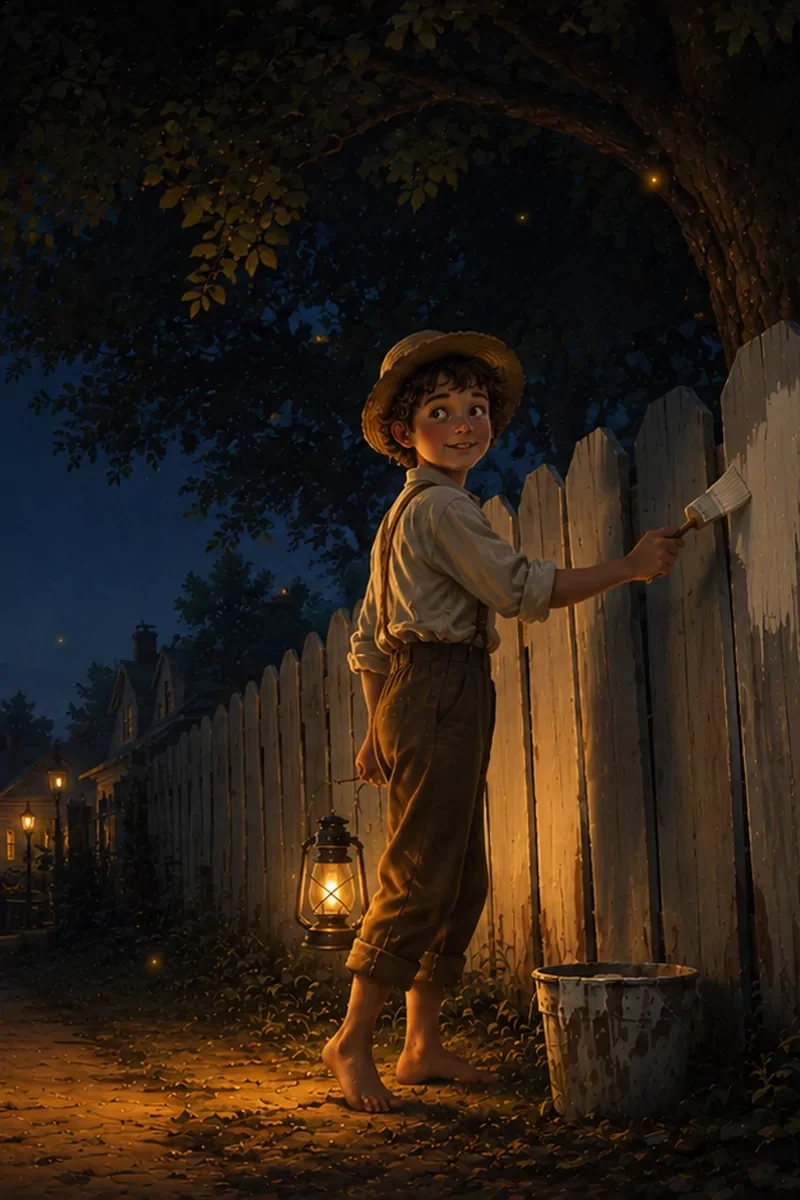
What kind of book“The Adventures of Tom Sawyer” is
Versions of “The Adventures of Tom Sawyer” in English: B1
Same book, adapted to a level you can read without stopping
Pick a version. The bar at the foot of the page opens the one you pick.
Vocabulary by level
- A1 61%
- A2 16%
- B1 8%
- B2 6%
- not in dictionary 5%
A sample from “The Adventures of Tom Sawyer” in English
One passage, the way each version writes it.
Tap any word — we will show the translation
C1.1205 words
Tom went on whitewashing and paid no attention to the boat. Ben stared for a moment and then said: “Hi-Yi! You’re in trouble, ain’t you!”
There was no answer. Tom looked at his last brush stroke with the eye of an artist, then gave his brush another gentle sweep and looked at the result, as before. Ben came up alongside him, and Tom’s mouth watered for the apple, but he stuck to his work. Ben said:
“Hello, old boy, you got to work, hey?”
Tom turned around suddenly and said:
“Why, it’s you, Ben! I wasn’t noticing.”
“Say—I’m going swimming, I am. Don’t you wish you could? But of course you’d rather work—wouldn’t you? Course you would!”
Tom looked at the boy for a moment and said:
“What do you call work?”
“Why, ain’t that work?”
Tom went back to his whitewashing and answered carelessly:
“Well, maybe it is, and maybe it ain’t. All I know is, it suits Tom Sawyer.”
“Oh come, now, you don’t mean to tell me you like it?”
The brush went on moving.
“Like it? Well, I don’t see why I oughtn’t to like it. Does a boy get a chance to whitewash a fence every day?”
B2.4193 words
Tom went on whitewashing and paid no attention to the boat. Ben stared for a moment and then said: “Hi-Yi! You’re in trouble, ain’t you!”
There was no answer. Tom looked at his last touch like an artist. Then he moved the brush gently once more and looked at the result again. Ben came up beside him. Tom’s mouth watered for the apple, but he kept on working. Ben said:
“Hello, old fellow, you got to work, hey?”
Tom turned suddenly and said:
“Why, it’s you, Ben! I wasn’t noticing.”
“Say—I’m going swimming, I am. Don’t you wish you could? But of course you’d rather work—wouldn’t you? Course you would!”
Tom looked at the boy for a moment and said:
“What do you call work?”
“Why, ain’t that work?”
Tom started whitewashing again and answered carelessly:
“Well, maybe it is, and maybe it ain’t. All I know is, it suits Tom Sawyer.”
“Oh come, now, you don’t mean to say you like it?”
The brush kept moving.
“Like it? Well, I don’t see why I shouldn’t like it. Does a boy get a chance to whitewash a fence every day?”
The original language of “The Adventures of Tom Sawyer” and what it gives you
How hard the language is C2
This is the lighter side of Twain, but the English is not simple. The book has about 71,000 words and 7,200 different word forms, and 61% of the words are A1 plus 16% A2. The average sentence is only 13.9 words, which is short, but 5% of the words are beyond the 5,000 most frequent and 5% are not in the dictionary (slang, respellings and dialect). Our measurement puts the original at C2 on our scale, so we also offer adaptations at B2, B1 and A2. The challenge comes less from sentence length than from the dialect in the dialogue and the author's grand, ironic vocabulary.
What this means in practice: Funny and fast, but the Missouri speech and the grand narrator make it harder than the short sentences suggest.
What to be ready for
How to read it and not quit
- Do not copy ain't, warn't or double negatives in your own writing; read them as Missouri speech and translate them in your head into standard forms.
- Read the dialogue aloud when a spelling looks strange: ha'nted becomes haunted and spile becomes spoil, so the sound usually tells you the word.
- Watch for the narrator's irony: a long, formal word used for something small is almost always a joke.
- Learn the common phrasal verbs as they appear (run away, give up, sneak out, turn up); the boys use them constantly.
Contents of “The Adventures of Tom Sawyer” · 37 chapters
- Prefacepage 1
- Ipage 1
- IIpage 8
- IIIpage 12
- IVpage 15
- Vpage 24
All 37 chaptersShow fewer
- VIpage 27
- VIIpage 35
- VIIIpage 40
- IXpage 43
- Xpage 48
- XIpage 53
- XIIpage 57
- XIIIpage 60
- XIVpage 65
- XVpage 69
- XVIpage 72
- XVIIpage 81
- XVIIIpage 83
- XIXpage 90
- XXpage 91
- XXIpage 94
- XXIIpage 99
- XXIIIpage 101
- XXIVpage 106
- XXVpage 108
- XXVIpage 113
- XXVIIpage 121
- XXVIIIpage 123
- XXIXpage 127
- XXXpage 131
- XXXIpage 139
- XXXIIpage 147
- XXXIIIpage 149
- XXXIVpage 158
- XXXVpage 160
- Conclusionpage 164
Reader ratings for “The Adventures of Tom Sawyer”
Nobody has rated it yet. Be the first.
Your rating
Reader reviews of “The Adventures of Tom Sawyer”
No reviews yet.
The story of “The Adventures of Tom Sawyer”
Published in England and America
Chatto & Windus issued it in England in June 1876 and the American Publishing Company in the United States late that year, with illustrations by True Williams.
Sequel: Adventures of Huckleberry Finn
Twain returned to Huck as narrator in the book that came to overshadow Tom Sawyer.
Removed from a library
The Brooklyn Public Library took Tom Sawyer and Huckleberry Finn off the children's shelves, one of the first of many challenges.
Edition replacing offensive words
A NewSouth Books edition replaced a racial slur with "slave", provoking a public debate.
Written over several summers
Twain worked on the book in the first half of the 1870s, drawing on his boyhood in Hannibal, Missouri, which became the town of St. Petersburg.
In culture “The Adventures of Tom Sawyer”
8 adaptations and mentions, 1876–1981
In the language "Whitewashing the fence"
Tom's trick of making a chore look like a privilege so friends pay him for it is now shorthand for getting others to do your work.
In the language "A Tom Sawyer"
A mischievous, imaginative boy who gets into and out of trouble.
In the language "Attending your own funeral"
Tom and his friends turning up at their own funeral is the origin of a familiar story device.
Art Norman Rockwell's illustrations
Rockwell illustrated an edition for the Heritage Club in 1936.
Film The Adventures of Tom Sawyer (Selznick)
A Technicolor film produced by David O. Selznick.
Art Tom Sawyer Island at Disneyland
The theme park built a play island named after the book, which has been a feature of Disney parks since.
Series Tom Sawyer no Bouken
A Japanese animated series from Nippon Animation.
Music "Tom Sawyer" (Rush)
Rush's song, from Moving Pictures, borrows the name for a modern free spirit.
Questions and answers about “The Adventures of Tom Sawyer” in English
What is The Adventures of Tom Sawyer about?
It is about a mischievous boy in a Missouri town on the Mississippi who gets into every kind of trouble. After he sees something terrible in a graveyard with his friend Huck Finn, the story becomes a mystery.
Is Tom Sawyer based on a true story?
The story is fiction, but Twain drew heavily on his boyhood in Hannibal, Missouri. St. Petersburg is based on that town, and a real cave near it gave him the cave in the book.
Is Tom Sawyer a children's book?
It was written partly for boys, but Twain said he wrote it for adults as well. Its humour and its darker parts, including a murder, work for any age.
What is the famous fence scene?
Tom has to whitewash a fence as a punishment and tricks other boys into doing the work for him, even getting them to pay for the privilege. It is one of the best-known scenes in American literature.
Do I need to read Tom Sawyer before Huckleberry Finn?
No, each book stands alone, but Tom Sawyer comes first and introduces Huck. Huckleberry Finn is a very different, more serious book.
Is Tom Sawyer easier than Huckleberry Finn?
Usually yes: the narration is in standard English, and the dialect is present but milder. Huckleberry Finn is narrated by Huck in dialect, which makes the whole book harder.
Is Tom Sawyer banned or controversial?
It has been challenged in some schools because of its racial language and its attitudes to race and to Native Americans. The book reflects the world of the 1840s as Twain remembered it, and many readers discuss this with care.
Which film is closest to the book?
No film follows it exactly, but most versions keep the famous episodes: the fence, the graveyard, the trial and the cave. They usually cut a lot of the narrator's irony.
Why does Tom put up with Huck Finn?
Huck is the free boy that Tom would like to be: he has no school, no aunt and no rules. Tom is attracted by that freedom, and their friendship makes the adventure plot possible.
Is the English hard to read?
It is harder than the short sentences suggest: the dialogue is in dialect, with spellings like warn't and ha'nted. The narration itself is formal and ironic, and once you get used to the speech it reads quickly.
In brief about “The Adventures of Tom Sawyer”
17 fields of imprint data and measured text characteristics. All of it checkable.
- Original title
- The Adventures of Tom Sawyer
- Author
- Mark Twain
- First published
- 1876
- Original language
- English
- Genre
- Adventure · Classics · Humor
- Mood
- Funny
- Themes
- Childhood · Friendship · Freedom
- Setting
- St. Petersburg, a small town on the Mississippi River in Missouri, based on Mark Twain's boyhood home of Hannibal · the 1840s
- Distinct words
- 7,188
- Words per sentence
- 14 words
- Level of the original
- C2
- Versions
- C2, C1.1, B2.4, B1.4
- Length of the original
- 37 ch. · 70,853 words
- Reading time
- ~6 h 30 min
- Source text
- Standard Ebooks
- Download
- EPUB
Similar what to read after “The Adventures of Tom Sawyer”
By the same author
1The same hand, a different story.
Close in spirit
7The same genre and the same register.
Alice's Adventures in Wonderland
Lewis Carroll
C1.2orig.B1B2
~2 h 30 min · Classics
Around the World in Eighty Days
Jules Verne
C2orig.C1
~5 h 50 min · Adventure
The Call of the Wild
Jack London
C2orig.B1C1
~3 h · Adventure
Heart of Darkness
Joseph Conrad
C2orig.
~3 h 30 min · Adventure
Short Fiction
O. Henry
C2orig.
~82 h 30 min · Short stories
Black Beauty
Anna Sewell
C1.4orig.B1
~5 h 30 min · Classics
The Jungle Book
Rudyard Kipling
C1.7orig.
~4 h 40 min · Adventure
Book page ≈0.2.0 · Oct 14, 2026