Treasure Island in English
A boy finds a pirate's treasure map and sails to find the treasure, on a ship whose crew he cannot fully trust.
Jim tells the story himself, as an adult looking back, and the book falls into six parts that follow the journey: the inn, the ship, the island and the fight for the stockade among them. A few chapters are told by Dr Livesey instead, when Jim is not there to see what happens. The plot is straight and quick, with a new danger every few chapters and almost no pause for reflection. The language is Victorian prose looking back at the 18th century, full of sailing terms, old coins and weapons. The pirates' speech is respelt and bends the grammar, so the dialogue is the slowest part to read.
You will like it if
- you want a story that keeps moving, with a new danger every few chapters
- you enjoy a villain you almost like
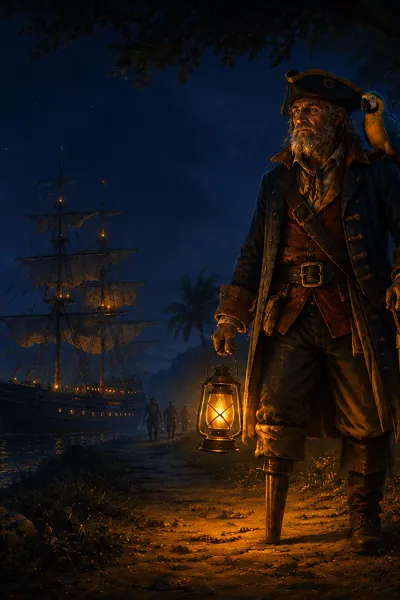
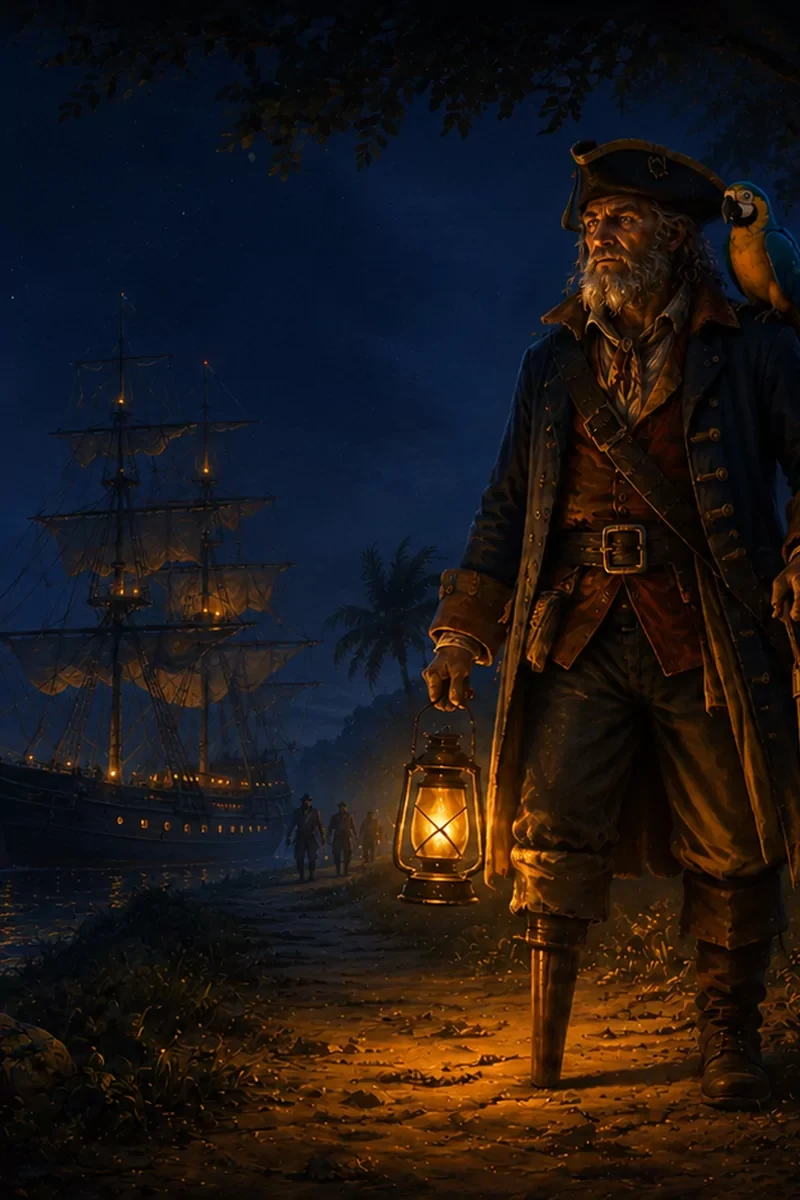
- you want to see where many pirate clichés come from: the map, the parrot, the black spot, the one-legged cook
- you like adventure told through a boy's eyes
You will not if
- the pirates' respelt speech slows you down in every scene with them
- sea vocabulary puts you off: ship words arrive without explanation
- you want deep inner lives: here action comes first
- violence bothers you: the fights are brief but real
What kind of book“Treasure Island” is
Versions of “Treasure Island” in English: B1
Same book, adapted to a level you can read without stopping
Pick a version. The bar at the foot of the page opens the one you pick.
Vocabulary by level
- A1 63%
- A2 15%
- B1 8%
- B2 6%
- not in dictionary 4%
A sample from “Treasure Island” in English
One passage, the way each version writes it.
Tap any word — we will show the translation
C1.3177 words
“Come here, sonny,” he said. “Come nearer here.”
I took a step nearer.
“Is this here table for my mate Bill?” he asked, with a sly, unpleasant look.
I told him I did not know his mate Bill. The table was for a man staying at our inn, whom we called the captain.
“Well,” he said, “my mate Bill would probably be called the captain. My mate Bill has a cut on one cheek, and a very pleasant manner, especially when he’s drinking. Let’s suppose, just for argument, that your captain has a cut on one cheek. And let’s suppose, if you like, that it’s his right cheek. Ah, well! I told you. Now, is my mate Bill in this here house?”
I told him he was out walking.
“Which way, sonny? Which way has he gone?”
I pointed out the rock and told him which way the captain was likely to return, and how soon. I also answered a few other questions. “Ah,” he said then, “this’ll be as good as drink to my mate Bill.”
B1.9185 words
“Come here, sonny,” he said. “Come nearer here.”
I took a step nearer.
“Is this table here for my mate Bill?” he asked, with an unpleasant smile.
I told him that I did not know his mate Bill. I said that the table was for a guest at our house, and we called him the captain.
“Well,” he said, “my mate Bill would probably be called the captain. He has a cut on one side of his face. He has a very pleasant way, especially in drink, has my mate Bill. Just for argument, your captain has a cut on one side of his face. And if you like, it is on the right side. Ah, well! I told you. Now, is my mate Bill in this house here?”
I told him that the captain was out walking.
“Which way, sonny? Which way has he gone?”
I pointed out the rock. I told him which way the captain would probably return and how soon. I answered a few other questions. Then he spoke. “Ah, this will be as good as drink to my mate Bill.”
The original language of “Treasure Island” and what it gives you
How hard the language is C2
The sentences average 18.6 words. About 78% of the words come from the A1–A2 band (63% + 15%) and only 4% lie beyond the 5,000 most frequent words, so the core vocabulary is plain. Even so, we measure the original at C2, the top of the scale. Longer sentences, the 4% of words outside the dictionary (sailor respellings, sea terms, old money and weapons) and Victorian sentence structure explain it. The difficulty comes in patches: the calm narration is clear, and the scenes with Silver and his crew take more work. Our adaptations are at B1 and B2.
What this means in practice: Plain words and a fast plot, with the dialect as the real hurdle.
What to be ready for
How to read it and not quit
- Treat the respellings as sound clues: say 'argyment' aloud and you hear 'argument'; do not learn them as spellings.
- Do not copy the crew's grammar ('I be', 'Be I going'): standard English says 'I am' and 'Am I going'.
- Learn a handful of sea words (deck, cabin, anchor, mast) and skip the rest: the plot works without every rope.
- In the longer sentences, read to the main verb first, then add the extra clauses one by one.
Contents of “Treasure Island” · 36 chapters
- To the Hesitating Purchaserpage 1
- Dedicationpage 1
- I: At the Admiral Benbowpage 1
- II: Black Dog Appears and Disappearspage 10
- III: The Black Spotpage 18
- IV: The Sea-Chestpage 26
All 36 chaptersShow fewer
- V: The Last of the Blind Manpage 33
- VI: The Captain’s Paperspage 40
- VII: I Go to Bristolpage 48
- VIII: At the Sign of the Spy-Glasspage 54
- IX: Powder and Armspage 61
- X: The Voyagepage 67
- XI: What I Heard in the Apple Barrelpage 73
- XII: Council of Warpage 82
- XIII: How My Shore Adventure Beganpage 88
- XIV: The First Blowpage 94
- XV: The Man of the Islandpage 100
- XVI: Narrative Continued by the Doctor—How the Ship Was Abandonedpage 108
- XVII: Narrative Continued by the Doctor—The Jolly-Boat’s Last Trippage 114
- XVIII: Narrative Continued by the Doctor—End of the First Day’s Fightingpage 120
- XIX: Narrative Resumed by Jim Hawkins—The Garrison in the Stockadepage 125
- XX: Silver’s Embassypage 132
- XXI: The Attackpage 139
- XXII: How My Sea Adventure Beganpage 146
- XXIII: The Ebb-Tide Runspage 153
- XXIV: The Cruise of the Coraclepage 158
- XXV: I Strike the Jolly Rogerpage 166
- XXVI: Israel Handspage 172
- XXVII: “Pieces of Eight”page 182
- XXVIII: In the Enemy’s Camppage 190
- XXIX: The Black Spot Againpage 200
- XXX: On Parolepage 208
- XXXI: The Treasure-Hunt—Flint’s Pointerpage 216
- XXXII: The Treasure-Hunt—The Voice Among the Treespage 224
- XXXIII: The Fall of a Chieftainpage 231
- XXXIV: And Lastpage 239
Reader ratings for “Treasure Island”
Nobody has rated it yet. Be the first.
Your rating
Reader reviews of “Treasure Island”
No reviews yet.
The story of “Treasure Island”
Written from a map
Stevenson began the story while on holiday in Scotland, after drawing a treasure map with his young stepson Lloyd Osbourne, and wrote the first chapters quickly.
Serialised in Young Folks
The story ran in the boys' magazine Young Folks from October 1881 under the title 'The Sea Cook; or, Treasure Island'.
Book edition
Cassell published the story as a book, and it became Stevenson's first big success.
Letter about Long John Silver
In a letter to his friend W. E. Henley, Stevenson said Silver was partly inspired by Henley himself, a strong, funny man with one leg.
Stevenson's letter to W. E. Henley
In culture “Treasure Island”
9 adaptations and mentions, 1883–2014
In the language The black spot
The black spot on a piece of paper, the pirates' death sentence in the book, is now used for a sign that someone is marked for trouble.
In the language The pirate treasure map
The map of the island and the image of a pirate with a parrot on his shoulder both come from this book; the image has been copied in nearly every pirate story since.
In the language 'Long John Silver'
The name is used for a charming rogue whose friendliness cannot be trusted.
Art N. C. Wyeth's illustrations
Wyeth's paintings for the Scribner's edition fixed the look of Silver, Jim and the pirates for later artists.
Film Treasure Island (MGM)
A Hollywood film with Wallace Beery as Silver and Jackie Cooper as Jim.
Film Treasure Island (Disney)
Disney's first completely live-action film, with Robert Newton as Silver; his voice shaped the 'Arr, matey' pirate accent.
Film Muppet Treasure Island
A comic version with Tim Curry as Long John Silver and the Muppets as the crew.
Film Treasure Planet
Disney's science-fiction retelling that moves the pirates into space.
Series Black Sails
A TV drama that tells the story of the pirates before the events of the novel.
Questions and answers about “Treasure Island” in English
Is Treasure Island based on a true story?
No, the plot and the main characters are invented. Stevenson said he began with a map he drew himself and built the story from it. The world behind it, the age of sail and pirate legend, is real, but the book is fiction.
Did Treasure Island invent the pirate clichés?
Partly. The parrot, the one-legged pirate, the map with red crosses and the black spot are all in the book, and later stories copied them. Silver's parrot is called Captain Flint and repeats 'Pieces of eight!'. Many other pirate habits people think of as traditional come from films and later books.
Is Long John Silver a villain or a hero?
He is the book's main villain and also its most likable character. Jim finds him cheerful, clever and warm, which makes the danger harder to see. He is loyal first to himself, and that explains most of his choices.
Is Treasure Island a children's book?
It was written as an adventure for boys, but it is not gentle. People are killed, and the pirates are cruel, greedy and often drunk. Adults still read it as the pattern for the pirate story.
Which Treasure Island film is closest to the book?
The 1950 Disney film and Muppet Treasure Island keep the main outline of the plot, while Treasure Planet moves the story into space. All of them shorten it, since the book has many small episodes. None replaces the book's tone, which is darker than the family films.
Does Treasure Island have a sequel?
Not from Stevenson, who wrote none. The book stands alone, and you can start it without reading anything first. Other writers have continued the story in later books.
What makes Treasure Island hard to read?
The pirates' dialect and the ship vocabulary, more than the story. When Silver or his crew talk, the spelling changes and the grammar bends, and for a few lines you may need to say the words aloud to understand them. The narration between those scenes is clear.
Is Treasure Island a real place?
No, the island is invented, and the book keeps its position secret. Jim says at the start that he leaves out the bearings because some of the treasure is still there.
Is the 'Yo-ho-ho and a bottle of rum' song in Treasure Island?
Yes. Billy Bones sings 'Fifteen men on the dead man's chest' at the inn in the opening chapters, with the refrain 'Yo-ho-ho, and a bottle of rum!'. Later pirate stories made the song famous on its own.
In brief about “Treasure Island”
17 fields of imprint data and measured text characteristics. All of it checkable.
- Original title
- Treasure Island
- Author
- Robert Louis Stevenson
- First published
- 1883
- Original language
- English
- Genre
- Adventure · Classics
- Mood
- Suspenseful
- Themes
- Coming of age · Greed · Betrayal
- Setting
- An inn on the English coast and the port of Bristol, then a ship and an island far from home · The 18th century (the book gives the year only as '17—')
- Distinct words
- 5,910
- Words per sentence
- 19 words
- Level of the original
- C2
- Versions
- C2, C1.3, B1.9
- Length of the original
- 41 ch. · 68,360 words
- Reading time
- ~6 h 20 min
- Source text
- Standard Ebooks
- Download
- EPUB
Similar what to read after “Treasure Island”
By the same author
1The same hand, a different story.
Close in spirit
7The same genre and the same register.
Around the World in Eighty Days
Jules Verne
C2orig.C1
~5 h 50 min · Adventure
The Call of the Wild
Jack London
C2orig.B1C1
~3 h · Adventure
Heart of Darkness
Joseph Conrad
C2orig.
~3 h 30 min · Adventure
Alice's Adventures in Wonderland
Lewis Carroll
C1.2orig.B1B2
~2 h 30 min · Classics

Black Beauty
Anna Sewell
C1.4orig.B1
~5 h 30 min · Classics
Adventures of Huckleberry Finn
Mark Twain
C1.6orig.B1
~10 h 20 min · Adventure
The Jungle Book
Rudyard Kipling
C1.7orig.
~4 h 40 min · Adventure
Book page ≈0.2.0 · Oct 14, 2026