The War of the Worlds in English
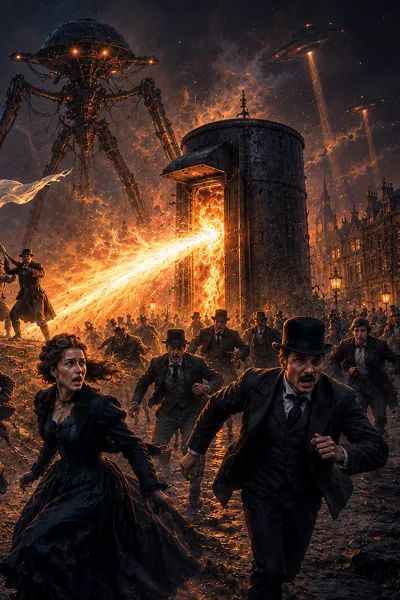
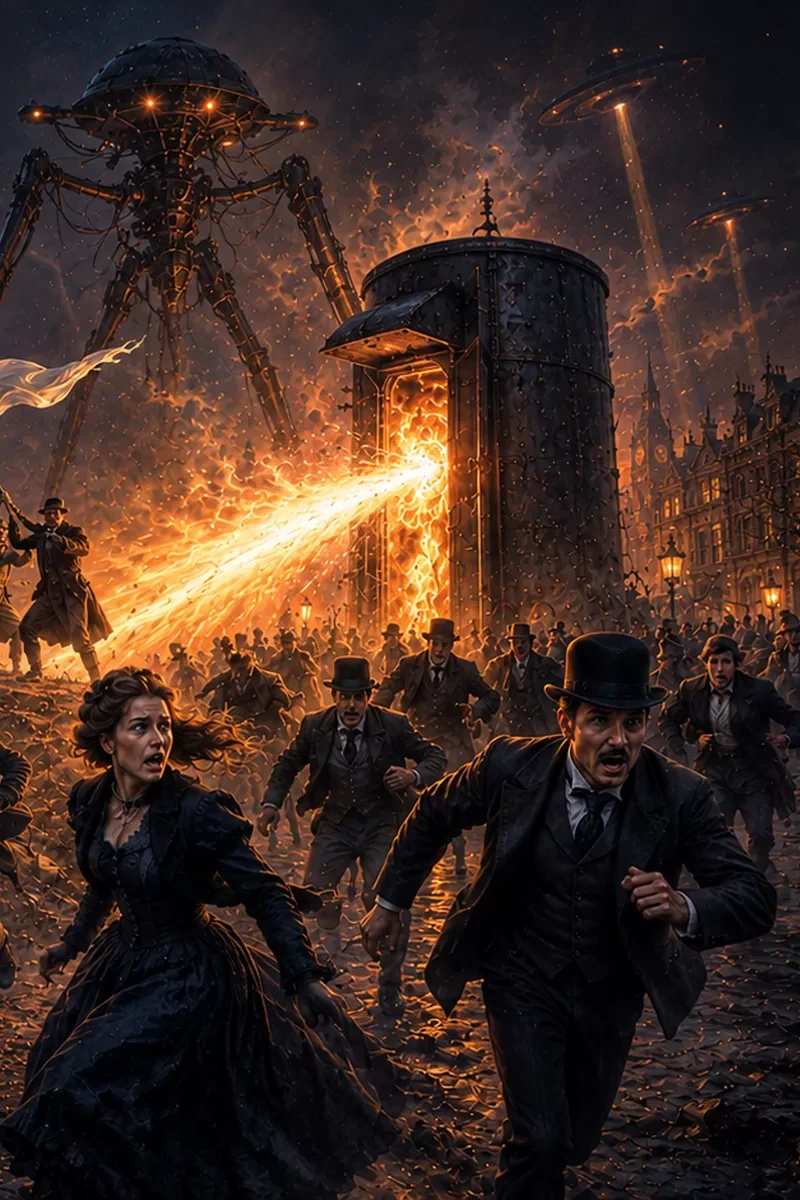
Cylinders fall from Mars onto the English countryside, and creatures with machines far beyond human weapons begin to destroy everything in their path. A man who writes about science watches it happen.
The book has two halves. The first, "The Coming of the Martians", follows the arrival and the first panicked flight; the second, "The Earth under the Martians", shows what is left when the invaders hold the country. The narrator writes after the events, like a witness giving a report, and a section about his brother in London briefly shows the same invasion from another side. The style is formal late-Victorian English, with careful, long sentences and many scientific and philosophical words, broken by short, sharp lines at moments of danger. Dialogue is a small part of the book and the speech of soldiers and Londoners adds some colour.
You will like it if
- you like classic science fiction that still feels tense
- you enjoy a report-like narrator who tells events as they happened
- you are curious about the original alien invasion story
- you want vivid description of panic, ruin and an empty landscape
You will not if
- you want a lot of dialogue and quick scenes, because much of the book is narration
- you find formal, philosophical passages slow
- you prefer a hero who fights back, because this narrator mostly survives
- you dislike bleak endings and grim moods
What kind of book“The War of the Worlds” is
Versions of “The War of the Worlds” in English: B1
Same book, adapted to a level you can read without stopping
Pick a version. The bar at the foot of the page opens the one you pick.
Vocabulary by level
- A1 60%
- A2 16%
- B1 9%
- B2 6%
- not in dictionary 4%
A sample from “The War of the Worlds” in English
One passage, the way each version writes it.
Tap any word — we will show the translation
C1.4184 words
“Henderson,” he called, “you saw that shooting star last night?”
“Well?” said Henderson.
“It’s out on Horsell Common now.”
“Good Lord!” said Henderson. “Fallen meteorite! That’s good.”
“But it’s something more than a meteorite. It’s a cylinder—an artificial cylinder, man! And there’s something inside.”
Henderson stood up with his spade in his hand.
“What’s that?” he said. He was deaf in one ear.
Ogilvy told him all that he had seen. Henderson took a minute or so to understand it. Then he dropped his spade, snatched up his jacket, and came out into the road. The two men hurried back to the common at once and found the cylinder still lying in the same position. But now the sounds inside had stopped, and a thin circle of bright metal showed between the top and the body of the cylinder. Air was either entering or escaping at the rim with a thin, hissing sound.
They listened and rapped on the rough, burnt metal with a stick. They got no answer, and both concluded that the man or men inside must be unconscious or dead.
B1.8197 words
“Henderson,” he called, “you saw that shooting star last night?”
“Well?” said Henderson.
“It is out on Horsell Common now.”
“Good Lord!” said Henderson. “Fallen meteorite! That’s good.”
“But it is something more than a meteorite. It is a cylinder — an artificial cylinder, man! And there is something inside.”
Henderson stood up with his spade (a garden tool for digging) in his hand.
“What’s that?” he said. He was deaf in one ear.
Ogilvy told him all that he saw. Henderson needed a minute or so to take it in. Then he dropped his spade and took up his coat. He came out into the road. The two men hurried back at once to the common. They found the cylinder still lying in the same place. But now the sounds inside stopped. A thin circle of bright metal showed between the top and the body. Air was going in or coming out at the edge. It made a thin hissing sound.
They listened, and they hit the burnt metal with a stick. The metal was grey and like hard scales. They got no answer. They both thought the man or men inside felt nothing, or were dead.
The original language of “The War of the Worlds” and what it gives you
How hard the language is C2
The book is harder than the vocabulary numbers suggest. Sentences average 18.6 words and are often long and carefully built, and 7% of the words are beyond the 5000 most frequent, which is higher than in most classics. On the other side, 60% of the words are A1 and 16% A2, and 4% fall outside the dictionary. Our measurement puts the original at C2, so we offer an adaptation at B2; the original rewards readers who are comfortable with long, formal sentences.
What this means in practice: A short, gripping classic in dense Victorian English; the dialogue is easy, the narration is the challenge.
What to be ready for
How to read it and not quit
- Read the long sentences in chunks: find the subject and main verb, then see what time, place and manner words are added.
- Learn the main science and war words early (cylinder, heat-ray, tripod-like machines, smoke), since they repeat throughout the book.
- Do not try to decode every Cockney spelling; say it aloud and the word usually appears, for example "ain't" for "isn't".
- Watch the past perfect ("had fallen", "had been") in the narrator's memories: it separates what happened before the moment he is describing.
Contents of “The War of the Worlds” · 29 chapters
- Dedicationpage 1
- Epigraphpage 1
- I: The Eve of the Warpage 1
- II: The Falling Starpage 9
- III: On Horsell Commonpage 15
- IV: The Cylinder Openspage 19
All 29 chaptersShow fewer
- V: The Heat-Raypage 23
- VI: The Heat-Ray in the Chobham Roadpage 28
- VII: How I Reached Homepage 32
- VIII: Friday Nightpage 37
- IX: The Fighting Beginspage 40
- X: In the Stormpage 48
- XI: At the Windowpage 56
- XII: What I Saw of the Destruction of Weybridge and Sheppertonpage 63
- XIII: How I Fell in with the Curatepage 78
- XIV: In Londonpage 85
- XV: What Had Happened in Surreypage 99
- XVI: The Exodus from Londonpage 109
- XVI: The Exodus from London (continued)page 123
- XVII: The Thunder Childpage 126
- I: Under Footpage 138
- II: What We Saw from the Ruined Housepage 147
- III: The Days of Imprisonmentpage 159
- IV: The Death of the Curatepage 166
- V: The Stillnesspage 172
- VI: The Work of Fifteen Dayspage 175
- VII: The Man on Putney Hillpage 180
- VII: The Man on Putney Hill (continued)page 193
- VIII: Dead Londonpage 201
- IX: Wreckagepage 213
- X: The Epiloguepage 219
Reader ratings for “The War of the Worlds”
Nobody has rated it yet. Be the first.
Your rating
Reader reviews of “The War of the Worlds”
No reviews yet.
The story of “The War of the Worlds”
Serialised in magazines
The story ran in Pearson's Magazine in Britain and in Cosmopolitan in the United States in 1897. Warwick Goble's drawings accompanied the British serial.
Published as a book
William Heinemann published the novel in book form in 1898, and it was soon reprinted.
The Orson Welles radio broadcast
Orson Welles and the Mercury Theatre on the Air adapted the story as a series of news bulletins on 30 October 1938. Reports of panic afterwards were widely repeated, though how many listeners were really frightened is disputed.
George Pal's film
Paramount released a colour film that moved the invasion to modern California and won the Academy Award for special effects.
Written in Woking
H. G. Wells wrote the novel while living in Woking, Surrey, and set the first Martian landing on the commons nearby. He later said the idea of a technologically stronger people arriving and destroying others was prompted by thinking about what happened to the Tasmanians.
In culture “The War of the Worlds”
9 adaptations and mentions, 1897–2005
Art Warwick Goble's illustrations
Goble's pictures of the tripods and the Martians in the British serial set the first visual image of the invaders.
In the language The Martians and the heat-ray
Hostile Martians, tripod machines and the heat-ray became the template for the alien-invasion story, and 'Martian' still means a creature from space in everyday talk.
In the language 'No one would have believed...'
The book's opening sentence about being watched by intelligences greater than man's is one of the most quoted openings in science fiction.
Art Alvim Correa's illustrations
The Brazilian artist Henrique Alvim Correa made a set of dark, scratchy drawings for a Brussels edition that Wells himself admired.
Series Mercury Theatre on the Air
Orson Welles's Halloween radio play turned the novel into a lasting example of how a fiction can be mistaken for the news.
Film The War of the Worlds (Pal)
The first major film version won an Oscar for its special effects.
Music Jeff Wayne's Musical Version
A rock-and-orchestra concept album narrated by Richard Burton and containing the song 'Forever Autumn' became a long-running best-seller.
Series The War of the Worlds (TV series)
A North American television series imagined the Martians returning decades after the first invasion.
Film War of the Worlds (Spielberg)
Steven Spielberg's film with Tom Cruise moved the story to modern America and followed an ordinary family on the run.
Questions and answers about “The War of the Worlds” in English
Did the 1938 radio version of The War of the Worlds really cause panic?
Not as much as the legend says. Orson Welles's broadcast moved the story to New Jersey and was presented as news bulletins, and some listeners were frightened, but later research shows that reports of mass panic were largely exaggerated by newspapers.
How does The War of the Worlds end without spoiling it?
It does not end with a battle won by humans. The reason the invasion fails is set up earlier in the book, and it is a clever turn on the idea of who is superior. I will not say more than that.
Is the narrator named in the book?
No, the main narrator is never given a name. He is a writer on scientific subjects, and the lack of a name makes him feel like a witness reporting what he saw.
Which adaptation is closest to the book?
The 1978 musical album by Jeff Wayne and the 2019 BBC series both keep the story in Victorian or Edwardian England, which is where the book is set. Most film versions, including the 1953 and 2005 films, move the action to America.
Was it the first alien invasion story?
It was not the first story about a hostile invasion, but it set the pattern for modern alien invasion fiction. Wells combined the invasion story with science and a cold, observing narrator.
Why do the Martians attack?
The narrator suggests it is because their own world is dying and they need a new one. The book treats this as a practical reason, with no cruelty beyond what the Martians' needs require.
Is the book a political allegory?
Many readers see it as a comment on empire, because Wells asks what it feels like for Europeans to be treated the way colonial powers treated other peoples. The book never says this outright, so you can read it as a plain adventure as well.
Where does the first half stop and the second begin?
The first half ends when the Martians take over the country around London, and the second begins with the narrator hiding in a ruined house. The change of pace is clear, since the second half is quieter and more reflective.
What kind of reader gives up on it?
Readers who expect non-stop action. The middle of the book has long stretches of waiting and thinking, and the narration can be dense, but the sharpest scenes make up for it.
Is it hard to read in English if I am not a native speaker?
It is demanding: the vocabulary is mostly common, but the sentences are long and formal. Dialogue is short and easier, and the action scenes use shorter lines.
In brief about “The War of the Worlds”
17 fields of imprint data and measured text characteristics. All of it checkable.
- Original title
- The War of the Worlds
- Author
- H. G. Wells
- First published
- 1898
- Original language
- English
- Genre
- Science fiction · Classics · Adventure
- Mood
- Dark
- Themes
- Survival · Science · Society
- Setting
- Surrey and London, in the south of England · late Victorian England, around the time the book was written
- Distinct words
- 6,532
- Words per sentence
- 19 words
- Level of the original
- C2
- Versions
- C2, C1.4, B1.8
- Length of the original
- 32 ch. · 60,168 words
- Reading time
- ~5 h 30 min
- Source text
- Standard Ebooks
- Download
- EPUB
Similar what to read after “The War of the Worlds”
By the same author
1The same hand, a different story.
Close in spirit
7The same genre and the same register.
Around the World in Eighty Days
Jules Verne
C2orig.C1
~5 h 50 min · Adventure
The Call of the Wild
Jack London
C2orig.B1C1
~3 h · Adventure
Frankenstein
Mary Shelley
C2orig.B1C1
~7 h 10 min · Gothic & mystery
Heart of Darkness
Joseph Conrad
C2orig.
~3 h 30 min · Adventure
Alice's Adventures in Wonderland
Lewis Carroll
C1.2orig.B1B2
~2 h 30 min · Classics
Black Beauty
Anna Sewell
C1.4orig.B1
~5 h 30 min · Classics
Adventures of Huckleberry Finn
Mark Twain
C1.6orig.B1
~10 h 20 min · Adventure
Book page ≈0.2.0 · Oct 14, 2026