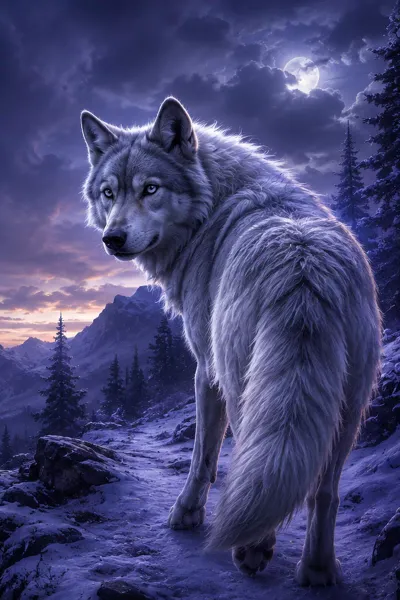
White Fang in English
A wolf cub born in the Yukon wilderness passes from owner to owner and learns that the law of the wild and the law of men are not the same. Whether he can trust a person at all is the question that drives the book.
The book has five parts. The first follows two men and their sled dogs through the cold while wolves hunt them, before the cub is even born. The next parts follow White Fang in the wild, in an Indian camp, and then in the hands of the man who fights him. The last part puts him in a very different world. London writes like a naturalist with a storyteller's heart: simple, hard sentences, strong repeated phrases, and a narrator who shows what the animal thinks and fears. Chapters are short and often end on a small shock, so the book is easy to read in sittings.
You will like it if
- you like animal stories that stay inside the animal's mind
- you enjoy survival stories in snow, cold and hunger
- you want an adventure with a clear sense of danger on every page
- you read The Call of the Wild and want to see the opposite story
You will not if
- you do not want scenes of dog-fighting and cruelty to animals
- the slow, cold opening with two men and their sled does not interest you
- you do not like heavily humanised animals with thoughts and feelings
- you want a lot of conversation: most of the book is narration
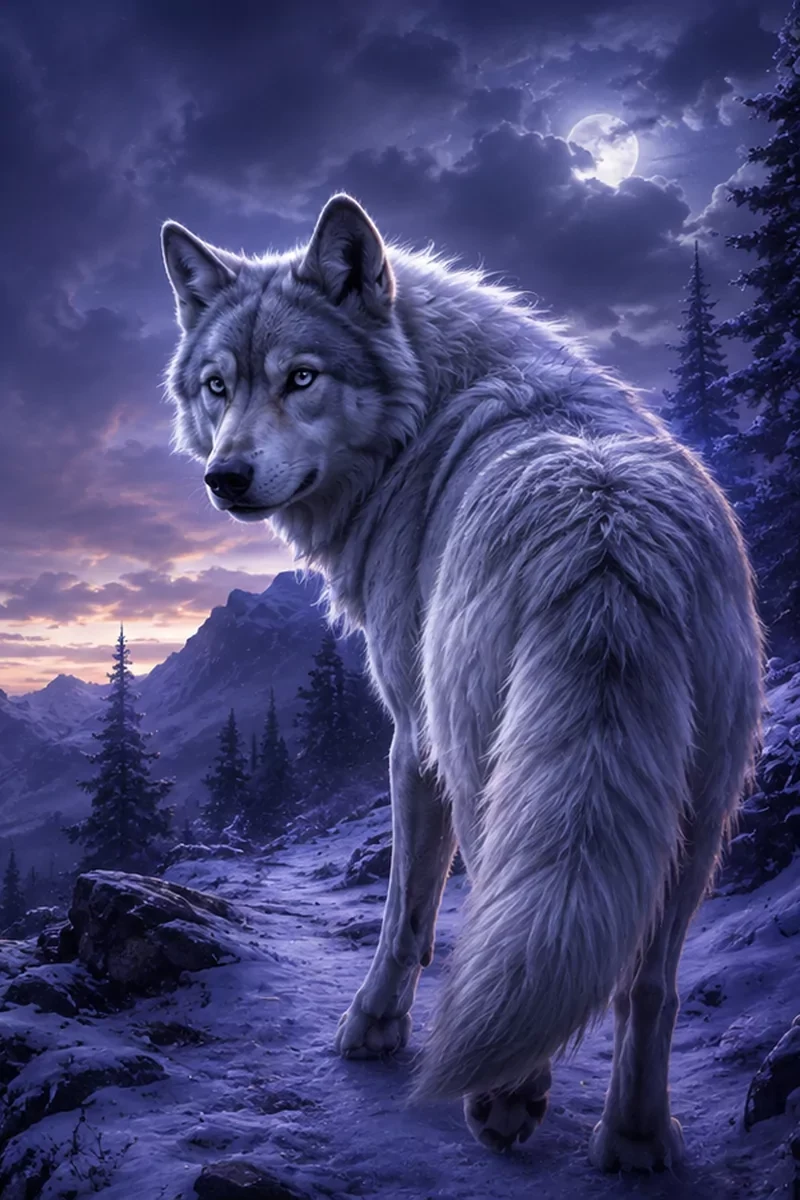
What kind of book“White Fang” is
Versions of “White Fang” in English: B1
Same book, adapted to a level you can read without stopping
Pick a version. The bar at the foot of the page opens the one you pick.
Vocabulary by level
- A1 61%
- A2 15%
- B1 8%
- B2 7%
- not in dictionary 4%
A sample from “White Fang” in English
One passage, the way each version writes it.
Tap any word — we will show the translation
B2.6190 words
“I’ve heard sailors talk of sharks following a ship,” Bill remarked, as he crawled back into the blankets after he put more wood on the fire. “Well, them wolves is land sharks. They know their business better than we do, and they ain’t following our trail this way for their health. They’re going to get us. They’re sure going to get us, Henry.”
“They’ve half got you already, talking like that,” Henry answered sharply. “A man’s half beaten when he says he is. And you’re half eaten from the way you’re going on about it.”
“They’ve got away with better men than you and me,” Bill answered.
“Oh, shut up your complaining. You make me sick and tired.”
Henry rolled over angrily on his side, but he was surprised that Bill showed no anger in return. This was not Bill’s way, for he was easily angered by sharp words. Henry thought about it for a long time before he went to sleep. As his eyes closed and he dozed off, the thought in his mind was: “There’s no mistaking it, Bill’s very low. I’ll have to cheer him up tomorrow.”
B1.5193 words
Once, Bill put more wood on the fire and crawled back into his blankets. “I’ve heard sailors talk about sharks following a ship,” Bill said. “Well, them wolves are land sharks. They know their business better than we do. And they ain’t following our trail like this for nothing. They’re going to get us. They’re sure going to get us, Henry.”
“They’ve half got you already, when you talk like that,” Henry answered sharply. “A man is half beaten when he says he is. And you’re half eaten already, from the way you’re talking about it.”
“They’ve killed better men than you and me,” Bill answered.
“Oh, shut up your sad talk. You make me very tired.”
Henry rolled over angrily on his side. Bill did not get angry back, and this surprised Henry. This was not like Bill, because sharp words usually made him angry very fast. Henry thought about this for a long time before he went to sleep. His eyes slowly closed, and he began to sleep. He had one clear thought. “There is no doubt about it. Bill is very sad. I’ll have to make him feel happier tomorrow.”
The original language of “White Fang” and what it gives you
How hard the language is C2
The English is clear and direct. The average sentence is 15.2 words, 61% of the vocabulary is A1 and another 15% A2, and 6% falls beyond the 5,000 most frequent words. What raises the bar is the subject matter: terms for animals, weather, sleds and trails, and many words for violence and cold, such as snarl, bristle and fang. 4% of the words are outside our dictionary, largely Native names and Northland terms. We estimate the original at B2, and we ship an adaptation at B1.
What this means in practice: A fast, strong read with plain sentences, as long as you can bear the harder scenes.
What to be ready for
How to read it and not quit
- Do not stop for every word of violence: snarl, growl, bristle, crouch and spring are easier to learn from the scene than from a dictionary.
- Read the fights and chases for the action first and the exact words later: the sentences are short, so the order of events is easy to follow even when some words are new.
- In flashbacks, notice the past perfect (had learned, had been) that separates what White Fang remembers from what is happening now.
- Keep a short list of Northland words, such as trail, sled, camp and pack, because they return in every part of the book.
Contents of “White Fang” · 25 chapters
- I: The Trail of the Meatpage 1
- II: The She-Wolfpage 10
- III: The Hunger Crypage 23
- III: The Hunger Cry (continued)page 30
- I: The Battle of the Fangspage 37
- I: The Battle of the Fangs (continued)page 43
All 25 chaptersShow fewer
- II: The Lairpage 49
- III: The Grey Cubpage 60
- IV: The Wall of the Worldpage 67
- IV: The Wall of the World (continued)page 74
- V: The Law of Meatpage 81
- I: The Makers of Firepage 89
- I: The Makers of Fire (continued)page 96
- II: The Bondagepage 103
- III: The Outcastpage 114
- IV: The Trail of the Godspage 119
- V: The Covenantpage 126
- VI: The Faminepage 137
- I: The Enemy of His Kindpage 148
- I: The Enemy of His Kind (continued)page 155
- II: The Mad Godpage 162
- III: The Reign of Hatepage 173
- IV: The Clinging Deathpage 179
- IV: The Clinging Death (continued)page 186
- V: The Indomitablepage 193
- VI: The Love-Masterpage 200
- VI: The Love-Master (continued)page 209
- I: The Long Trailpage 217
- II: The Southlandpage 223
- III: The God’s Domainpage 231
- III: The God’s Domain (continued)page 238
- IV: The Call of Kindpage 245
- V: The Sleeping Wolfpage 253
Reader ratings for “White Fang”
Nobody has rated it yet. Be the first.
Your rating
Reader reviews of “White Fang”
No reviews yet.
The story of “White Fang”
Serialised and published
The book ran in Outing magazine in 1906 and was published by Macmillan the same year.
The "nature fakers" dispute
Theodore Roosevelt and John Burroughs criticised writers, London among them, for attributing human thought to animals; London defended himself in print the following year.
A mirror of The Call of the Wild
London planned it as the reverse of his 1903 novel, in which a dog turns wild while here a wild animal is tamed.
The Klondike background
London drew on the winter he spent in the Klondike in 1897 and 1898, which gave him the landscape and the trail life he described.
In culture “White Fang”
6 adaptations and mentions, 1906–2018
In the language "Eat or be eaten"
The book's statement of the law of the wild is often quoted as shorthand for life as a struggle.
Art Charles Livingston Bull's illustrations
Bull's illustrations for the first edition showed the wolf-dog in the snow.
Film White Fang (20th Century Fox)
A Hollywood version moved the story into an adventure-romance plot.
Film Zanna Bianca
An Italian-Spanish-French adaptation directed by Lucio Fulci.
Film White Fang (Disney)
Ethan Hawke stars in this popular Disney film, which fixed the story for many viewers.
Film White Fang (animated)
A French-Luxembourg animated feature retold the story for a new generation.
Questions and answers about “White Fang” in English
Is White Fang a true story?
No, White Fang is fiction. London drew on his own experience in the Klondike gold rush of 1897 to write about the Yukon, but the animals and their adventures are invented.
Is White Fang a wolf or a dog?
He is mostly wolf: three-quarters wolf and one-quarter dog. That mix is what the book is about, because he has wolf instincts but must live among people and dogs.
Do I need to read The Call of the Wild first?
No, White Fang stands alone. London wrote The Call of the Wild earlier, and White Fang is often seen as its mirror image, since one goes from civilisation to the wild and the other the opposite way.
What does 'eat or be eaten' mean in the book?
It sums up the law of the wild: you survive by killing, or you become food. The story asks whether that law can change once an animal finds love and trust.
How violent is White Fang?
It is violent and sometimes cruel, with fights between animals and a long stretch of dog-fighting for money. The violence is told plainly and is not there for fun, but it can be upsetting for a sensitive reader.
Does the animal really think in the book?
Yes, London describes White Fang's thoughts and feelings from the inside, although the animals never speak to people. It is the narrator who translates instinct into words.
Which film is closest to the book?
None is close, because films show the animals from outside and the book lives inside White Fang's mind. The 1991 film with Ethan Hawke is the best known, but it is a different kind of story.
Which part do readers give up on?
The slow opening, in which two men and their sled dogs are followed by hungry wolves, loses some readers before White Fang appears. The book changes completely when the cub is born and the story moves into his world.
Is it a children's book?
It is often read by young people, but it has hard themes and plenty of cruelty. Adults usually find it a serious animal story and not a sweet one.
How does it compare with The Call of the Wild?
The Call of the Wild is shorter and bleaker, while White Fang is longer and ends differently. Reading both in either order is a good way to see London's ideas about nature and civilisation.
In brief about “White Fang”
17 fields of imprint data and measured text characteristics. All of it checkable.
- Original title
- White Fang
- Author
- Jack London
- First published
- 1906
- Original language
- English
- Genre
- Adventure · Animals · Classics
- Mood
- Dark
- Themes
- Survival · Nature · Redemption · Loyalty
- Setting
- The frozen wilderness of the Yukon, in the Canadian north, and later California · The late 1890s, the time of the Klondike gold rush
- Distinct words
- 6,717
- Words per sentence
- 15 words
- Level of the original
- C2
- Versions
- C2, B2.6, B1.5
- Length of the original
- 32 ch. · 72,081 words
- Reading time
- ~6 h 40 min
- Source text
- Standard Ebooks
- Download
- EPUB
Similar what to read after “White Fang”
By the same author
1The same hand, a different story.
Close in spirit
7The same genre and the same register.
Black Beauty
Anna Sewell
C1.4orig.B1
~5 h 30 min · Classics
The Jungle Book
Rudyard Kipling
C1.7orig.
~4 h 40 min · Adventure
Around the World in Eighty Days
Jules Verne
C2orig.C1
~5 h 50 min · Adventure
Heart of Darkness
Joseph Conrad
C2orig.
~3 h 30 min · Adventure
Aesop's Fables
Aesop
C1.2orig.
~3 h 40 min · Fables & parables
Alice's Adventures in Wonderland
Lewis Carroll
C1.2orig.B1B2
~2 h 30 min · Classics
Adventures of Huckleberry Finn
Mark Twain
C1.6orig.B1
~10 h 20 min · Adventure
Book page ≈0.2.0 · Oct 14, 2026