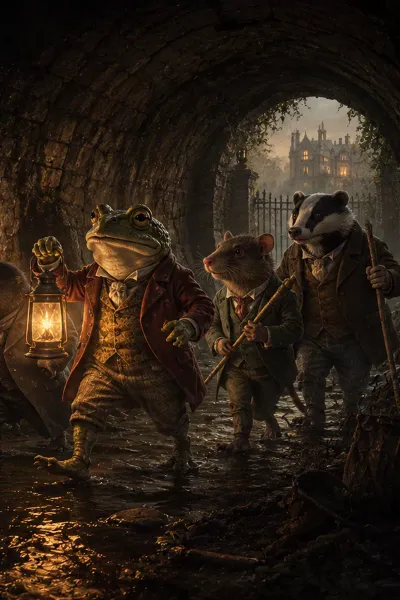
The Wind in the Willows in English
A shy mole meets a water rat on the river bank. Together they get involved in the trouble caused by their friend Mr Toad.
The book is episodic: each chapter can be read almost as its own story, and the same four animals move between them. Some chapters follow Mr Toad's disasters with motor cars and prison escapes, while others describe quiet days on the river, a trek through the Wild Wood, or a dreamlike night. The language is full of description of water, plants and weather, in long, musical sentences. The animals speak politely, like English gentlemen, and talk about picnics, boats and houses. It rewards readers who enjoy atmosphere as much as plot.
You will like it if
- you like cosy, atmospheric stories about friendship and home
- you want chapters that work as separate short stories
- you enjoy nature descriptions and vocabulary for plants, water and weather
- you want a funny character like Mr Toad and a warm tone
You will not if
- you want a single plot that moves forward at speed
- the long descriptions of landscape can slow the story down
- one or two chapters are dreamy and almost without events
- the English style is old-fashioned and sometimes elaborate for a children's book
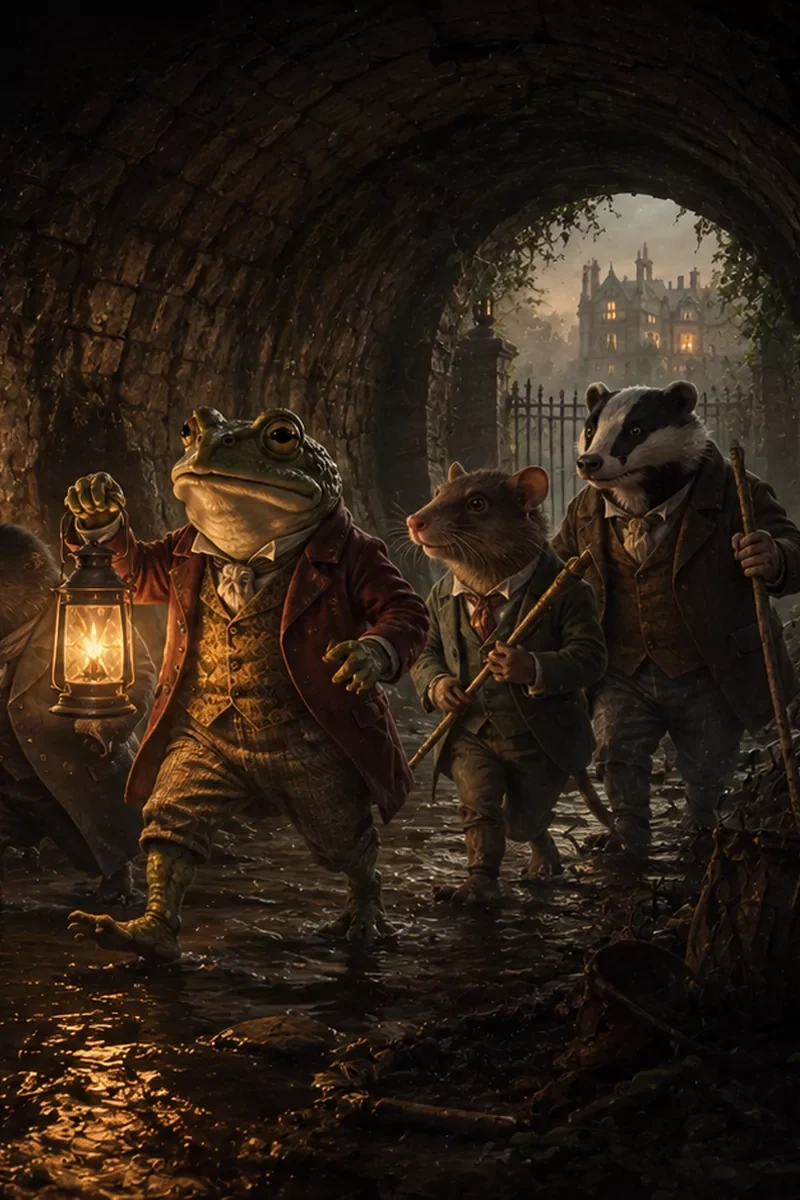
What kind of book“The Wind in the Willows” is
Versions of “The Wind in the Willows” in English: C1
Same book, adapted to a level you can read without stopping
Pick a version. The bar at the foot of the page opens the one you pick.
Vocabulary by level
- A1 61%
- A2 16%
- B1 8%
- B2 6%
- not in dictionary 5%
A sample from “The Wind in the Willows” in English
One passage, the way each version writes it.
Tap any word — we will show the translation
Original · C2228 words
The River Bank
The Mole had been working very hard all the morning, spring-cleaning his little home. First with brooms, then with dusters; then on ladders and steps and chairs, with a brush and a pail of whitewash; till he had dust in his throat and eyes, and splashes of whitewash all over his black fur, and an aching back and weary arms. Spring was moving in the air above and in the earth below and around him, penetrating even his dark and lowly little house with its spirit of divine discontent and longing. It was small wonder, then, that he suddenly flung down his brush on the floor, said, “Bother!” and “O blow!” and also “Hang spring-cleaning!” and bolted out of the house without even waiting to put on his coat. Something up above was calling him imperiously, and he made for the steep little tunnel which answered in his case to the gravelled carriage-drive owned by animals whose residences are nearer to the sun and air. So he scraped and scratched and scrabbled and scrooged, and then he scrooged again and scrabbled and scratched and scraped, working busily with his little paws and muttering to himself, “Up we go! Up we go!” till at last, pop! his snout came out into the sunlight and he found himself rolling in the warm grass of a great meadow.
C1.3227 words
The River Bank
The Mole had been working very hard all morning, spring-cleaning his little home. First with brooms, then with dusters; then on ladders and steps and chairs, with a brush and a bucket of whitewash; until he had dust in his throat and eyes, and splashes of whitewash all over his black fur, and an aching back and tired arms. Spring was moving in the air above and in the earth below and around him, entering even his dark and lowly little house with its spirit of divine discontent and longing. It was no wonder, then, that he suddenly threw down his brush on the floor, said, “Bother!” and “Oh, blow!” and also “Hang spring-cleaning!” and ran out of the house without even waiting to put on his coat. Something up above was calling him strongly, and he made for the steep little tunnel which in his case was like the gravel driveway owned by animals whose homes are nearer to the sun and air. So he scraped and scratched and scrabbled and pushed, and then he pushed again and scrabbled and scratched and scraped, working busily with his little paws and saying to himself, “Up we go! Up we go!” until at last, pop! his nose came out into the sunlight and he found himself rolling in the warm grass of a great meadow.
The original language of “The Wind in the Willows” and what it gives you
How hard the language is C2
The English is richer than the cosy story suggests. The book has 58,744 words, and sentences average 19.4 words. About 61% of the vocabulary is A1 and 16% A2, but 5% lies beyond the 5,000 most frequent words and 5% is outside the dictionary, mostly nature words, place names and old-fashioned expressions. Our estimate for the original is B2, which is not a measurement. An adaptation at B1 is available.
What this means in practice: A warm, gentle read with a rich vocabulary: take it chapter by chapter and enjoy the atmosphere.
What to be ready for
How to read it and not quit
- Read the descriptions for the picture, not for every word: if a plant or bird name is unfamiliar, you do not need it to follow the story.
- Pay attention to the dialogue tags (said the Rat, replied Mole) and polite phrases; they follow patterns and are easy to learn as chunks.
- Read one chapter at a time. Each one is a complete story, and finishing one is a good place to stop.
Contents of “The Wind in the Willows” · 12 chapters
- Ipage 1
- I (continued)page 15
- IIpage 16
- II (continued)page 30
- IIIpage 31
- III (continued)page 44
All 12 chaptersShow fewer
- IVpage 46
- IV (continued)page 60
- Vpage 63
- V (continued)page 76
- VIpage 81
- VI (continued)page 95
- VIIpage 96
- VIIIpage 110
- VIII (continued)page 123
- IXpage 126
- IX (continued)page 139
- Xpage 146
- X (continued)page 159
- XIpage 166
- XI (continued)page 179
- XIIpage 186
- XII (continued)page 200
Reader ratings for “The Wind in the Willows”
Nobody has rated it yet. Be the first.
Your rating
Reader reviews of “The Wind in the Willows”
No reviews yet.
The story of “The Wind in the Willows”
Published by Methuen
Methuen published the book in 1908; early reviews were mixed, but it soon became a lasting favourite.
Toad of Toad Hall
A. A. Milne's stage adaptation opened in London in December 1929, focused on Toad's adventures, and became a Christmas tradition.
Ernest Shepard's illustrations
E. H. Shepard's illustrated edition appeared in 1931 and established the standard look of Mole, Rat, Badger and Toad.
Bedtime stories for a son
The book grew out of stories and letters that Kenneth Grahame made up for his young son Alastair, which included the first adventures of Mr Toad.
In culture “The Wind in the Willows”
8 adaptations and mentions, 1908–1996
In the language "Messing about in boats"
Rat's line that there is nothing half so worth doing as simply messing about in boats is quoted as a motto for pleasure without purpose.
In the language Mr Toad
The name is used for a boastful, impulsive enthusiast who drops one craze for the next, with the motorcar and its "Poop-poop!" as the best-known one.
Art Arthur Rackham's illustrations
Rackham's last major commission, an illustrated edition, was published after his death and offers a rival picture to Shepard's.
Film The Adventures of Ichabod and Mr. Toad (Disney)
Disney's animated version of Toad's story later led to the Mr. Toad's Wild Ride attractions in its theme parks.
Music The Piper at the Gates of Dawn (Pink Floyd)
The band took the title of its first album from the book's seventh chapter.
Stage The Wind in the Willows (Alan Bennett)
Bennett's adaptation at the National Theatre brought out the book's melancholy and its English countryside world.
Film The Wind in the Willows (Terry Jones)
The Monty Python member directed and played Toad in a live-action version with a Python-style comic tone.
Series Cosgrove Hall's The Wind in the Willows
The British studio's animated version, with David Jason as Toad, made the characters familiar to a generation of television viewers.
Questions and answers about “The Wind in the Willows” in English
Is The Wind in the Willows a children's book?
It was written as one, but adults read it for the atmosphere and the humour. Kenneth Grahame first made up the stories for his young son, and that origin shows in the warm, storytelling voice.
What kind of animal is Ratty?
Ratty is a water vole, even though the book calls him a Water Rat. That is a common mix-up, because water voles were often called water rats.
Which chapters are the funniest?
The chapters about Mr Toad, who gets obsessed with motor cars and keeps getting into trouble. They are the most comic and the most action-filled in the book.
Which chapter is the strangest?
'The Piper at the Gates of Dawn' is a quiet, almost mystical chapter, unlike the rest. It surprises many readers, and some love it while others skip it.
Is there a plot, or is it just episodes?
It is mostly episodes, held together by the same characters and the changing seasons. Each chapter can be read alone, but the story of Mr Toad runs through several of them.
Does it have sequels?
Not by Grahame. Other writers have produced sequels, but the original book stands alone and does not need them.
How close is the Disney film to the book?
Disney's 1949 film is a short version that focuses on Mr Toad. It leaves out most of the quiet chapters, so the book has a calmer, more varied feeling.
Is it hard to read in English?
It is moderately hard. The vocabulary is mostly common, but the long descriptive sentences and the Edwardian expressions take some getting used to.
Who drew the best-known illustrations?
E. H. Shepard, who also illustrated Winnie-the-Pooh, drew the version many people picture. His 1931 drawings of Mole, Ratty and Toad are still printed in many editions.
Where do people give up?
Usually in the long descriptive passages, or the slow, dreamy chapters. If you find one dull, move to the next: the episodes do not depend on each other.
In brief about “The Wind in the Willows”
17 fields of imprint data and measured text characteristics. All of it checkable.
- Original title
- The Wind in the Willows
- Author
- Kenneth Grahame
- First published
- 1908
- Original language
- English
- Genre
- Adventure · Animals · Classics
- Mood
- Cosy
- Themes
- Friendship · Home · Nature · Freedom
- Setting
- The English countryside: a river bank, the Wild Wood, fields and a grand country house · Edwardian England, around the time the book appeared in 1908
- Distinct words
- 6,580
- Words per sentence
- 19 words
- Level of the original
- C2
- Versions
- C2, C1.3
- Length of the original
- 23 ch. · 58,744 words
- Reading time
- ~5 h 30 min
- Source text
- Standard Ebooks
- Download
- EPUB
Similar what to read after “The Wind in the Willows”
Close in spirit
8The same genre and the same register.
The Call of the Wild
Jack London
C2orig.B2C1
~3 h · Adventure
Black Beauty
Anna Sewell
C1.4orig.B1
~5 h 30 min · Classics
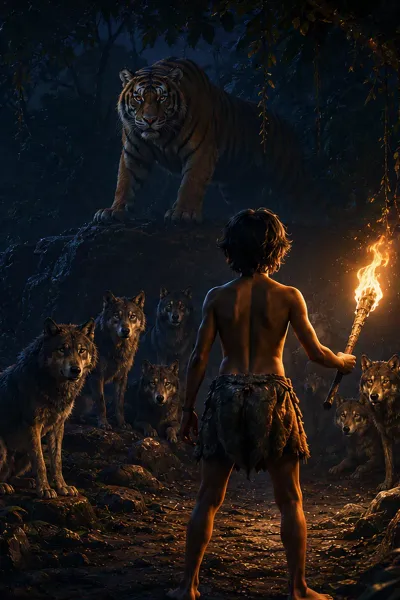
The Jungle Book
Rudyard Kipling
C1.7orig.
~4 h 40 min · Adventure

Around the World in Eighty Days
Jules Verne
C2orig.C1
~5 h 50 min · Adventure
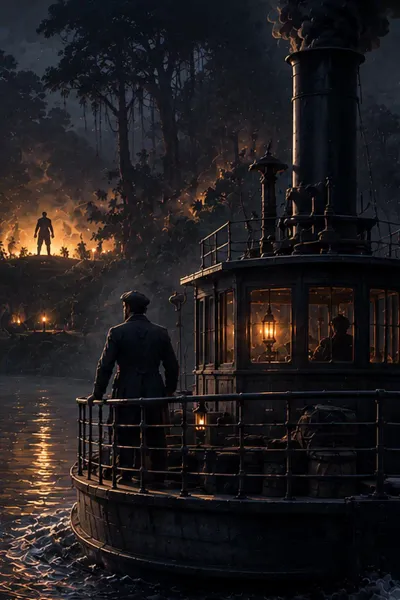
Heart of Darkness
Joseph Conrad
C2orig.
~3 h 30 min · Adventure
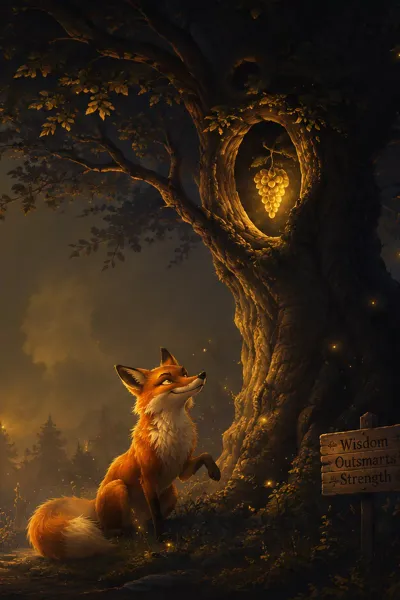
Aesop's Fables
Aesop
C1.2orig.
~3 h 40 min · Fables & parables
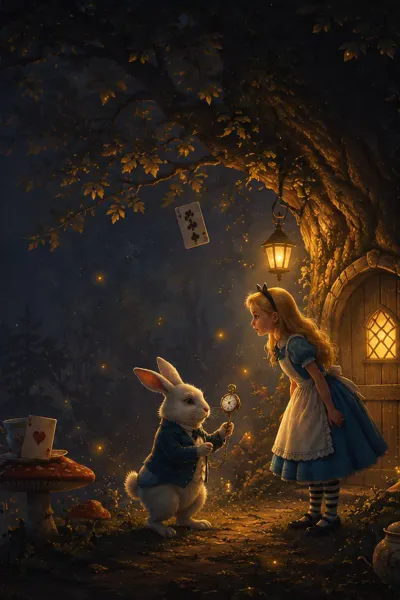
Alice's Adventures in Wonderland
Lewis Carroll
C1.2orig.B1B2
~2 h 30 min · Classics
Adventures of Huckleberry Finn
Mark Twain
C1.6orig.B1
~10 h 20 min · Adventure
Book page ≈0.2.0 · Oct 14, 2026