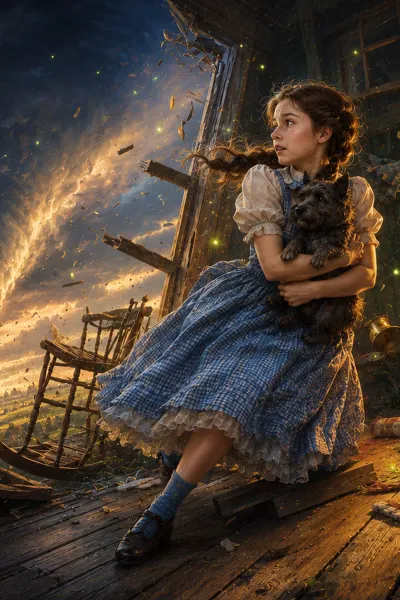
The Wonderful Wizard of Oz in English
A girl from Kansas is swept by a cyclone to a magic land and must find the Wizard who can send her home.
The book has twenty-four short chapters, and each one is a stage on the road: a fight with a beast, a river to cross, a strange country with its own rules. The shape is simple and repetitive, and the friends collect one another along the way before the final stretch. The story is told by a plain narrator in the past tense, in short scenes, with clear cause and effect. Baum wrote it as a fairy tale for children, but the adventure and the humour work for any age. The pictures by W. W. Denslow, in the first edition, are part of the book's character.
You will like it if
- you want a clear, well-known story that is easy to follow
- you like fairy tales with strange creatures and simple adventures
- you enjoy a journey with a different challenge in each chapter
- you want a short classic for relaxed reading
You will not if
- you expect the songs and the ruby slippers of the 1939 film, which are not in the book
- you want deep characters: the travellers are drawn simply
- you dislike an episodic story in which the same pattern repeats
- you are not comfortable with fairy-tale violence told matter-of-factly
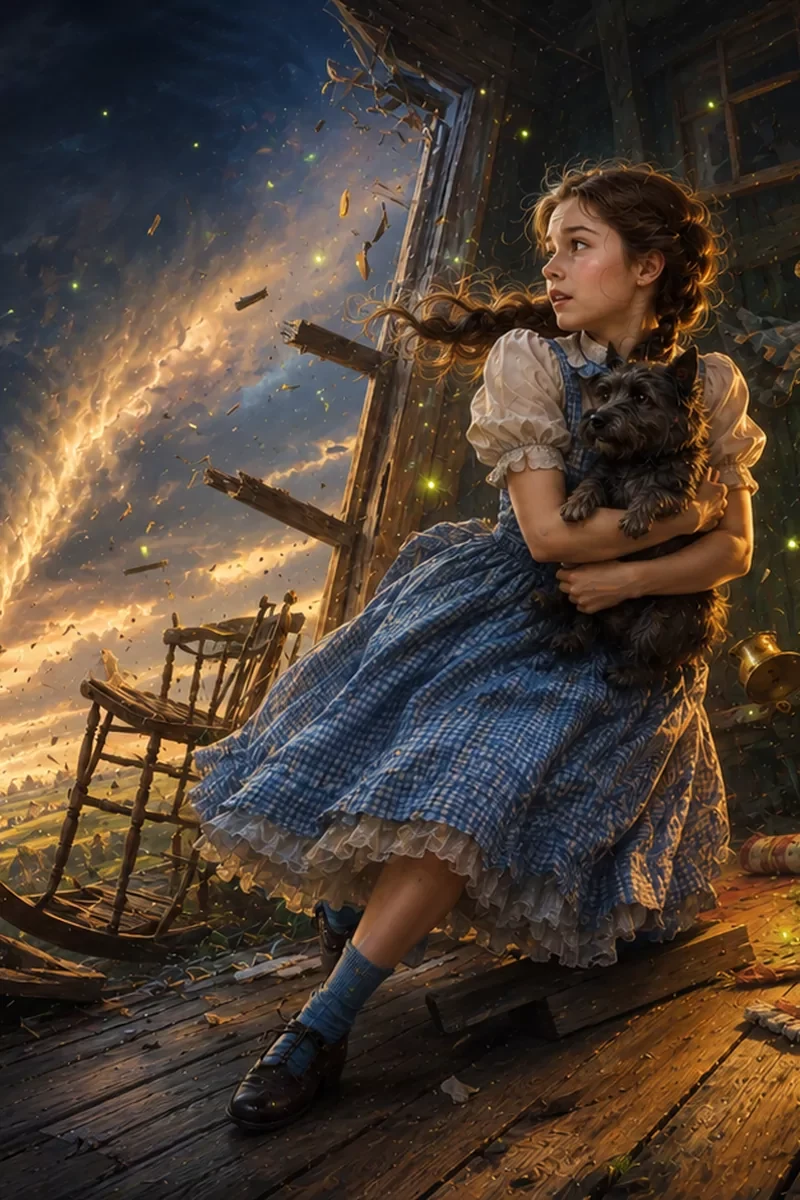
What kind of book“The Wonderful Wizard of Oz” is
Versions of “The Wonderful Wizard of Oz” in English: B2
Same book, adapted to a level you can read without stopping
Pick a version. The bar at the foot of the page opens the one you pick.
Vocabulary by level
- A1 69%
- A2 16%
- B1 7%
- B2 5%
- not in dictionary 1%
A sample from “The Wonderful Wizard of Oz” in English
One passage, the way each version writes it.
Tap any word — we will show the translation
Original · B2.6183 words
Folklore, legends, myths and fairy tales have followed childhood through the ages, for every healthy youngster has a wholesome and instinctive love for stories fantastic, marvelous and manifestly unreal. The winged fairies of Grimm and Andersen have brought more happiness to childish hearts than all other human creations.
Yet the old time fairy tale, having served for generations, may now be classed as “historical” in the children’s library; for the time has come for a series of newer “wonder tales” in which the stereotyped genie, dwarf and fairy are eliminated, together with all the horrible and bloodcurdling incidents devised by their authors to point a fearsome moral to each tale. Modern education includes morality; therefore the modern child seeks only entertainment in its wonder tales and gladly dispenses with all disagreeable incident.
Having this thought in mind, the story of The Wonderful Wizard of Oz was written solely to please children of today. It aspires to being a modernized fairy tale, in which the wonderment and joy are retained and the heartaches and nightmares are left out.
L. Frank Baum
Chicago, April, 1900.
The original language of “The Wonderful Wizard of Oz” and what it gives you
How hard the language is B2.6
The text is about 39,500 words with only about 2,900 different word forms, a very small vocabulary for a book of that size. More than eight words in ten (69% + 16%) are in the A1–A2 band, only 3% fall beyond the 5,000 most frequent words, and 1% are outside the dictionary. The average sentence is 18.2 words, but the sentences are mostly simple clauses joined with 'and'. Our estimate (not measured) for the original is A2, which makes it one of the easiest books to read in the original.
What this means in practice: A small vocabulary and plain sentences make it one of the easiest places to start reading in English.
What to be ready for
How to read it and not quit
- Use the book to practise the simple past: almost every verb is regular or common, and the repetition helps you remember irregular ones.
- Notice how 'and' joins long chains of short clauses; read each clause on its own and the sentence becomes easy.
- Learn the colour words early, since colours organise the whole book: yellow brick road, Emerald City, grey Kansas.
- Do not be misled by the length of a sentence: here a long sentence is usually just several simple ideas in a row.
Contents of “The Wonderful Wizard of Oz” · 25 chapters
- Introductionpage 1
- Ipage 1
- IIpage 5
- IIIpage 13
- IVpage 20
- Vpage 25
All 25 chaptersShow fewer
- VIpage 32
- VIIpage 38
- VIIIpage 45
- IXpage 52
- Xpage 57
- XIpage 64
- XIIpage 77
- XIIIpage 90
- XIVpage 95
- XVpage 101
- XVIpage 111
- XVIIpage 115
- XVIIIpage 119
- XIXpage 123
- XXpage 127
- XXIpage 132
- XXIIpage 136
- XXIIIpage 139
- XXIVpage 144
Reader ratings for “The Wonderful Wizard of Oz”
Nobody has rated it yet. Be the first.
Your rating
Reader reviews of “The Wonderful Wizard of Oz”
No reviews yet.
The story of “The Wonderful Wizard of Oz”
Published in Chicago
The book came out in May 1900 from the George M. Hill Company, with colour illustrations by W. W. Denslow, and sold very well.
Stage musical
A stage musical version opened in Chicago in 1902 and moved to Broadway in 1903, with the Scarecrow and Tin Woodman as stars.
MGM film
The Technicolor film with Judy Garland became far better known than the book.
The populist allegory reading
Henry Littlefield's essay "The Wizard of Oz: Parable on Populism" proposed that the story is an allegory of 1890s politics, a reading still debated.
American Quarterly, 1964
In culture “The Wonderful Wizard of Oz”
8 adaptations and mentions, 1900–2003
In the language "The yellow brick road"
A path to a goal, usually one that turns out to be different from what was promised.
Art W. W. Denslow's illustrations
His colour pictures defined the look of Oz in the first edition.
Stage The Wizard of Oz (1902 musical)
An early stage musical which became a Broadway hit.
Film The Wizard of Oz (MGM)
The best-known screen version, repeated on television every year for decades.
Music "Over the Rainbow"
The song from the 1939 film won the Academy Award for Best Original Song.
In the language "We're not in Kansas anymore"
From the film; used when the surroundings have become strange and unfamiliar.
Stage The Wiz
A Broadway musical retelling with an African American cast, made into a film in 1978.
Stage Wicked
A musical based on Gregory Maguire's novel which retells the story from the Wicked Witch's side.
Questions and answers about “The Wonderful Wizard of Oz” in English
Are Dorothy's shoes really ruby in the book?
No, in the book they are silver. The ruby slippers belong to the 1939 MGM film, which changed the colour to make the most of Technicolor.
Is the 1939 film close to the book?
It follows the main journey but changes a lot. The film adds songs and makes the trip a dream, while in the book Oz is a real place and Dorothy does not wake up. In the book the Wicked Witch of the West also has one eye and is not green.
Is The Wizard of Oz a political allegory?
That is one theory, but it is not a settled fact. It was proposed in the 1960s as a story about American money politics, and Baum never said it was his intention.
Is the Wizard really a wizard?
Not in the way the title suggests, and the book explains this around Chapter 15. Baum's interest is less in the Wizard's magic than in what the four travellers actually find.
Is Emerald City really green?
In the book, everyone who enters is made to wear spectacles with green glass. That detail is part of how the city is presented, and you will see why when you read it.
Is it a children's book?
Baum calls it a modernised fairy tale, written to please children today. In his introduction he says he wanted to leave out the heartaches and nightmares of older tales, though the book still has some violent moments.
Do I need to read the sequels?
No, the first book stands on its own. Baum wrote thirteen more Oz books, beginning with 'The Marvelous Land of Oz' (1904), for readers who want more.
Is it hard to read in English?
No, it is one of the easier classics, with a small vocabulary and mostly simple sentences. The main thing to get used to is the repeated style and some old-fashioned words.
What do the Scarecrow, the Tin Woodman and the Lion want?
The Scarecrow wants a brain, the Tin Woodman wants a heart, and the Lion wants courage. Each of them asks the Wizard for the one thing he believes he lacks.
In brief about “The Wonderful Wizard of Oz”
17 fields of imprint data and measured text characteristics. All of it checkable.
- Original title
- The Wonderful Wizard of Oz
- Author
- L. Frank Baum
- First published
- 1900
- Original language
- English
- Genre
- Fairy tale · Adventure · Classics
- Mood
- Uplifting
- Themes
- Home · Friendship · Courage
- Setting
- Kansas, and the fairy-tale Land of Oz · Around 1900, in an invented fairy-tale world
- Distinct words
- 2,860
- Words per sentence
- 18 words
- Level of the original
- B2.6
- Versions
- B2.6
- Length of the original
- 25 ch. · 39,461 words
- Reading time
- ~3 h 40 min
- Source text
- Standard Ebooks
- Download
- EPUB
Similar what to read after “The Wonderful Wizard of Oz”
Close in spirit
8The same genre and the same register.
Alice's Adventures in Wonderland
Lewis Carroll
C1.2orig.B1B2
~2 h 30 min · Classics
Around the World in Eighty Days
Jules Verne
C2orig.C1
~5 h 50 min · Adventure
Black Beauty
Anna Sewell
C1.4orig.B1
~5 h 30 min · Classics
The Call of the Wild
Jack London
C2orig.B2C1
~3 h · Adventure
A Christmas Carol
Charles Dickens
C2orig.B1C1
~2 h 40 min · Classics
Heart of Darkness
Joseph Conrad
C2orig.
~3 h 30 min · Adventure
Adventures of Huckleberry Finn
Mark Twain
C1.6orig.B1
~10 h 20 min · Adventure
The Jungle Book
Rudyard Kipling
C1.7orig.
~4 h 40 min · Adventure
Book page ≈0.2.0 · Oct 14, 2026