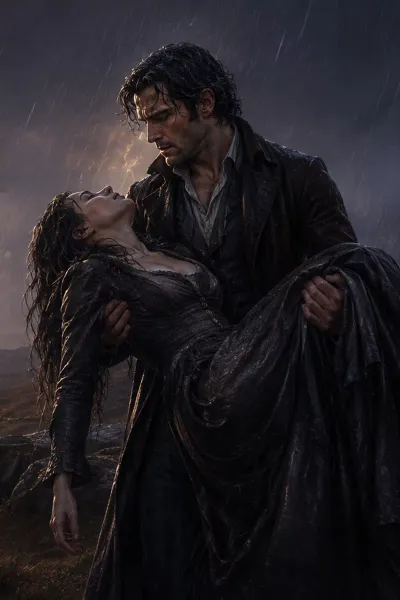
Wuthering Heights in English
A tenant visits his landlord's lonely house on the moors and learns from the housekeeper how the strange household came to be. It starts with a foundling, Heathcliff, brought into a family that is not his own.
The book is a story inside a story. Mr Lockwood writes a diary, and for most of the book he is only listening while Nelly Dean tells him what happened over the previous thirty years. Nelly's account contains letters and other people's tales, so you often hear one voice through another. The book has two halves: the first follows Heathcliff and the first generation of the two families, and the second follows their children. Lockwood writes in a formal, Latinate style, and Nelly is plainer and livelier. Characters' speech moves from educated English to Joseph's broad Yorkshire.
You will like it if
- you like intense, stormy stories of love and revenge
- you enjoy a story told by an unreliable narrator
- you want to meet dialect and old forms in a real classic
- you are drawn to wild landscapes and dark atmospheres
You will not if
- nearly everyone is unkind or selfish, and you may not like anyone
- Joseph's dialect is hard to follow
- the story is heavy, with cruelty and grief
- the first chapters are formal and give little help
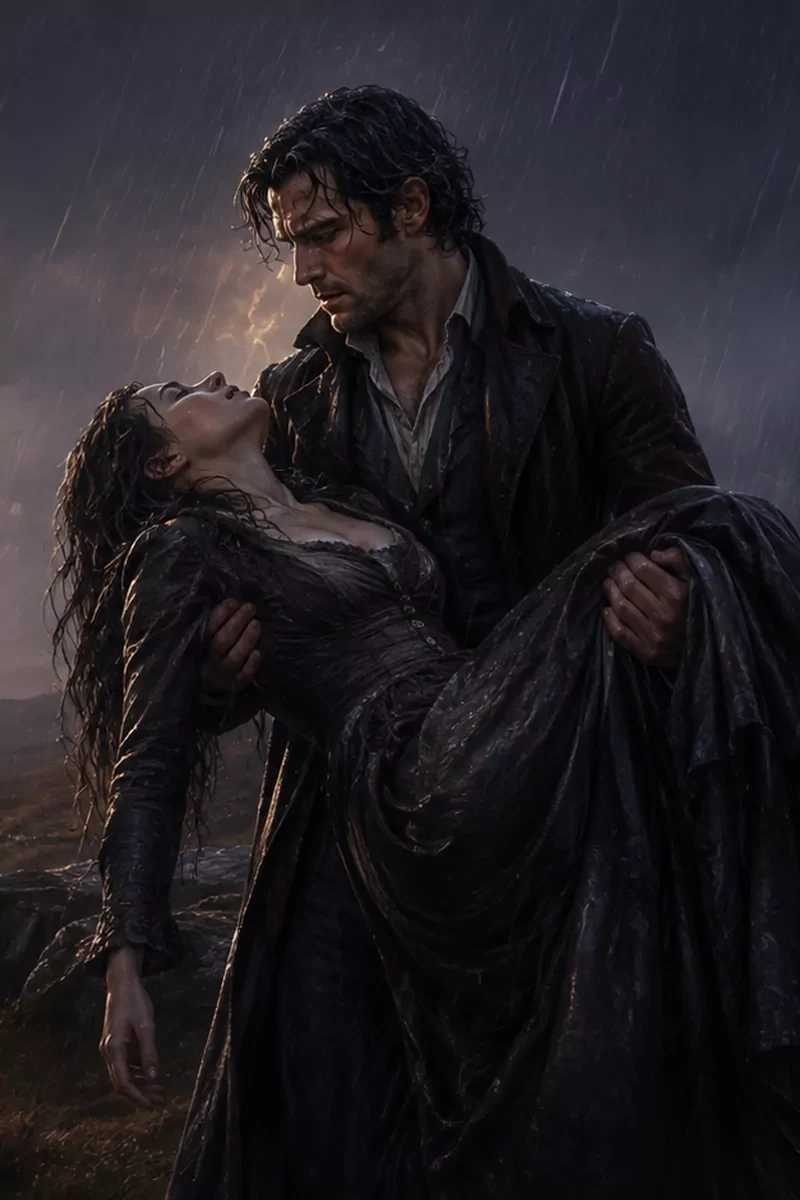
What kind of book“Wuthering Heights” is
Versions of “Wuthering Heights” in English: B1
Same book, adapted to a level you can read without stopping
Pick a version. The bar at the foot of the page opens the one you pick.
Vocabulary by level
- A1 61%
- A2 15%
- B1 9%
- B2 6%
- not in dictionary 4%
A sample from “Wuthering Heights” in English
One passage, the way each version writes it.
Tap any word — we will show the translation
C1.2163 words
“Wretched people!” I said to myself. “You deserve to be shut away from the rest of mankind for your rude lack of hospitality. At least, I would not keep my doors barred in the daytime. I don’t care. I will get in!” With this decision, I took hold of the latch (the metal bar that keeps a door shut) and shook it hard. Joseph, with his sour, vinegar face, pushed his head out of a round window of the barn.
“What do you want?” he shouted. “The master’s down in the pen. Go round by the end of the barn, if you want to speak to him.”
“Is there nobody inside to open the door?” I shouted back.
“There’s only the mistress, and she’ll not open it, not if you make that fearful noise till night.”
“Why? Can you not tell her who I am, eh, Joseph?”
“Not me! I’ll have nowt (nothing) to do with it,” muttered the head, and it vanished.
B1.8175 words
“You miserable people inside!” I said to myself. “You deserve to live alone forever because you are so rude and unfriendly. At least I do not lock my doors during the day. I do not care—I will get in!” With that thought, I took hold of the door handle and shook it hard. Sour-faced Joseph put his head out of a window in the farm building. It was shaped like a circle.
“What do ye (old or northern word for ‘you’) want?” he shouted. “The master (the head of the house) is down in the sheep-yard. Go past the end of this building if you want to speak to him.”
“Is there nobody inside to open the door?” I shouted back.
“There is only the missis (dialect word for ‘mistress’, the lady of the house). She will not open it, even if you make that terrible noise till night.”
“Why? Cannot you tell her who I am, Joseph?”
“Not me! I’ll have nothing to do with it,” Joseph said quietly. Then his head disappeared.
The original language of “Wuthering Heights” and what it gives you
How hard the language is C2
The measured numbers show a book that is harder than its length suggests. 76% of the words are in the A1-A2 bands and the average sentence is 18.5 words, but 4% of the words are outside the dictionary (dialect and old forms) and 6% are beyond the 5,000 most frequent words. Our measurement puts the original at C2. The difficulty comes mostly from the dialect, the Bible language and the formal, Latinate narration of Lockwood.
What this means in practice: A short but demanding classic whose dialect and layers of narration reward patient readers.
What to be ready for
How to read it and not quit
- Do not try to decode every word of Joseph's dialect. His speech is rough and often only adds colour; Nelly and others explain the meaning in standard English around it.
- Learn thee, thou and thy as a singular, informal you, and nay, ere as no and before.
- Keep track of who is speaking: Lockwood is formal and distant, Nelly is closer and gives you the story, and the layers of narration can confuse you.
- Use a family tree: several characters have the same names, such as Catherine, Linton and Hareton.
Contents of “Wuthering Heights” · 34 chapters
- Ipage 1
- IIpage 9
- IIIpage 22
- III (continued)page 36
- IVpage 41
- Vpage 51
All 34 chaptersShow fewer
- VIpage 56
- VIIpage 66
- VII (continued)page 80
- VIIIpage 81
- IXpage 93
- IX (continued)page 105
- Xpage 115
- X (continued)page 129
- XIpage 139
- XI (continued)page 153
- XIIpage 154
- XII (continued)page 169
- XIIIpage 173
- XIII (continued)page 187
- XIVpage 189
- XVpage 201
- XVIpage 213
- XVIIpage 220
- XVII (continued)page 233
- XVIIIpage 246
- XIXpage 260
- XXpage 266
- XXIpage 274
- XXI (continued)page 286
- XXIIpage 297
- XXIIIpage 306
- XXIVpage 317
- XXIV (continued)page 331
- XXVpage 332
- XXVIpage 338
- XXVIIpage 343
- XXVII (continued)page 358
- XXVIIIpage 360
- XXIXpage 370
- XXXpage 379
- XXXIpage 388
- XXXIIpage 396
- XXXII (continued)page 410
- XXXIIIpage 411
- XXXIVpage 423
- XXXIV (continued)page 437
Reader ratings for “Wuthering Heights”
Nobody has rated it yet. Be the first.
Your rating
Reader reviews of “Wuthering Heights”
No reviews yet.
The story of “Wuthering Heights”
Publicada bajo un seudónimo masculino
Cumbres Borrascosas apareció en diciembre de 1847 como los dos primeros volúmenes de un conjunto de tres, acreditada a 'Ellis Bell'; el tercer volumen era Agnes Grey de Anne Brontë.
Publisher Thomas Cautley Newby, London
Las primeras reseñas la llaman salvaje
Las críticas contemporáneas fueron en gran medida hostiles, encontrando la novela tosca, morbosa y moralmente repugnante; Graham's Magazine la llamó 'una historia extraña y poco artística'.
Graham's Magazine and other period reviews
Charlotte Brontë edita el texto
Tras la muerte de Emily, Charlotte Brontë preparó una segunda edición, corrigiendo la puntuación y suavizando parte del dialecto de Joseph, y defendió a su hermana en un prefacio biográfico.
1850 second edition, preface by Charlotte Brontë
La película de Hollywood de Wyler
La película de William Wyler con Laurence Olivier y Merle Oberon ganó el Premio de la Academia a la mejor fotografía y fijó la imagen romántica de la novela para un público masivo.
Academy Awards records; Samuel Goldwyn production
Primer libro de bolsillo de Penguin
Penguin Books publicó Cumbres Borrascosas en su serie de cubiertas naranjas, ayudando a que la novela pasara de clásico escolar a texto popular ampliamente leído.
Penguin Books catalogue
In culture “Wuthering Heights”
11 adaptations and mentions, 1939–2009
Film Cumbres Borrascosas (Wyler)
Laurence Olivier y Merle Oberon protagonizaron la versión definitiva de Hollywood de la Edad de Oro, que termina con la muerte de Catherine y omite la segunda generación.
Samuel Goldwyn / United Artists
Music Kate Bush, 'Wuthering Heights'
El sencillo debut de Bush, escrito desde el punto de vista del fantasma de Catherine, se convirtió en el primer número 1 en el Reino Unido de una mujer con una canción escrita por ella misma y mantiene la novela en la memoria pop.
UK Singles Chart
Music Kate Bush, 'Wuthering Heights'
El sencillo debut de Bush, escrito desde el punto de vista del fantasma de Catherine, se convirtió en el primer número 1 en el Reino Unido de una mujer con una canción escrita por ella misma y mantiene la novela en la memoria pop.
UK Singles Chart
Film Cumbres Borrascosas (Kosminsky)
Ralph Fiennes y Juliette Binoche interpretaron a los amantes en una versión que restauró gran parte de la segunda mitad de la novela y sus narradores marco.
Paramount Pictures
Series Serie de ITV
Tom Hardy y Charlotte Riley protagonizaron una adaptación televisiva en dos partes que enfatizaba la brutalidad de la novela y su trama de segunda generación.
ITV
In the language Wuthering
El adjetivo del título de la novela se usa para lugares y estados de ánimo salvajes, azotados por la tormenta y románticamente melancólicos, especialmente en escritos sobre el clima y el turismo.
In the language Heathcliff
El nombre se convirtió en sinónimo de un amante oscuro, melancólico y peligrosamente apasionado, y más tarde de un antihéroe romántico en la ficción popular.
Stage Adaptaciones de ballet y ópera
La novela se ha convertido repetidamente en danza y ópera, incluida la ópera de 1951 de Bernard Herrmann y varios ballets de larga duración, atraídos por sus escenarios exteriores elementales.
Art Ediciones ilustradas
La novela ha atraído a ilustradores y artistas de portadas desde el propio círculo de los Brontë en adelante, con el páramo, la casa y el fantasma en la ventana como imágenes recurrentes.
Game Juegos de aventura literarios
Adaptaciones interactivas y novelas visuales han utilizado el árbol genealógico de los Earnshaw y los Linton como estructura ramificada, permitiendo a los jugadores elegir entre las dos casas.
In the language Cathy y Heathcliff
Los nombres emparejados representan en el habla común un amor imposible, absoluto y autodestructivo.
Questions and answers about “Wuthering Heights” in English
Is Heathcliff a villain or a romantic hero?
He is neither, and that is why people argue about him. He suffers cruelty as a child and later becomes cruel to others, so the book asks you to understand him without excusing him.
Why is Wuthering Heights told by two narrators?
It lets Emily Brontë show a story through people who do not fully understand it. Lockwood is an outsider who is told the story, and Nelly is a servant who lived through it but has her own opinions.
Is Wuthering Heights a love story?
Not in the usual way. The bond between Catherine and Heathcliff is intense, but it is full of pride, jealousy and harm, and a large part of the book is about what that bond does to the next generation.
Is Wuthering Heights based on a true story?
No known true story lies behind it. Emily Brontë grew up in Haworth, at the edge of the Yorkshire moors, and the wild setting comes from that landscape.
Why are so many characters called Catherine?
The book follows two generations, and the second repeats names from the first. There is Catherine Earnshaw and her daughter Catherine Linton, and Linton is both a family surname and the first name of Heathcliff's son. A family tree helps.
How close are the films to the book?
Many are loose. The 1939 film with Laurence Olivier tells only the first half of the story and leaves out the second generation. If you want the whole book, you have to read it.
Why did Emily Brontë publish under the name Ellis Bell?
The three Brontë sisters used male-sounding pen names. Emily was Ellis Bell, Charlotte was Currer Bell and Anne was Acton Bell, partly because women writers were not always taken seriously.
Is the Kate Bush song about the book?
Yes. Her 1978 song 'Wuthering Heights' is sung from the point of view of Catherine, as a ghost at the window. It helped bring the book to a new audience.
What makes Wuthering Heights hard going?
Joseph's dialect, the story-within-a-story and the unpleasant behaviour of nearly everyone slow readers down. The pages themselves are not long, but the book is emotionally heavy.
Which part of the book do people give up on?
The opening chapters with Lockwood, which are formal and confusing. Once Nelly starts telling the story the book becomes easier to follow.
In brief about “Wuthering Heights”
17 fields of imprint data and measured text characteristics. All of it checkable.
- Original title
- Wuthering Heights
- Author
- Emily Brontë
- First published
- 1847
- Original language
- English
- Genre
- Gothic & mystery · Classics · Romance
- Mood
- Dark
- Themes
- Love · Revenge · Class · Death
- Setting
- The Yorkshire moors, in two isolated houses: Wuthering Heights and Thrushcross Grange · Late 1700s to about 1802
- Distinct words
- 9,383
- Words per sentence
- 19 words
- Level of the original
- C2
- Versions
- C2, C1.2, B1.8
- Length of the original
- 46 ch. · 116,437 words
- Reading time
- ~10 h 50 min
- Source text
- Standard Ebooks
- Download
- EPUB
Similar what to read after “Wuthering Heights”
Close in spirit
8The same genre and the same register.
Jane Eyre
Charlotte Brontë
C2orig.B1C1
~17 h 20 min · Classics
Frankenstein
Mary Shelley
C2orig.B2C1
~7 h 10 min · Gothic & mystery
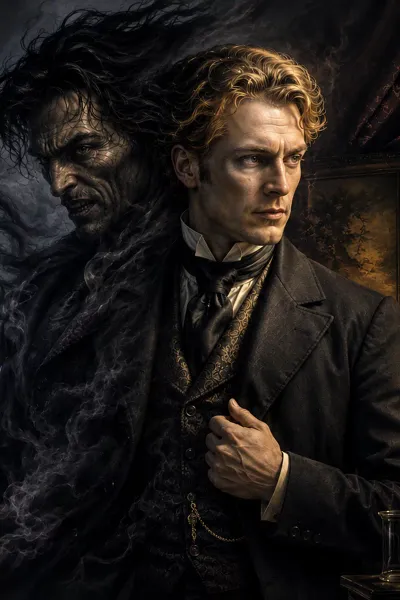
Strange Case of Dr Jekyll and Mr Hyde
Robert Louis Stevenson
C2orig.B1C1
~2 h 20 min · Gothic & mystery
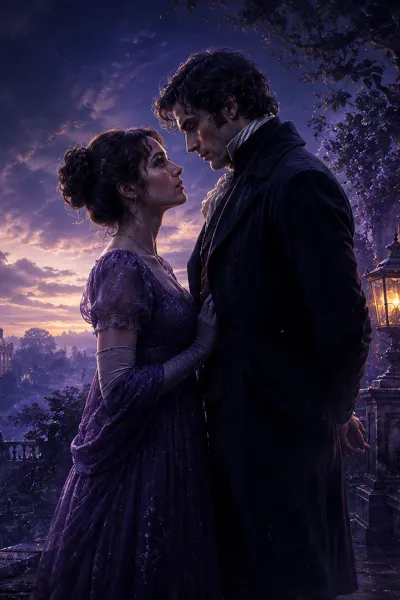
Pride and Prejudice
Jane Austen
C2orig.B1C1
~11 h 20 min · Classics
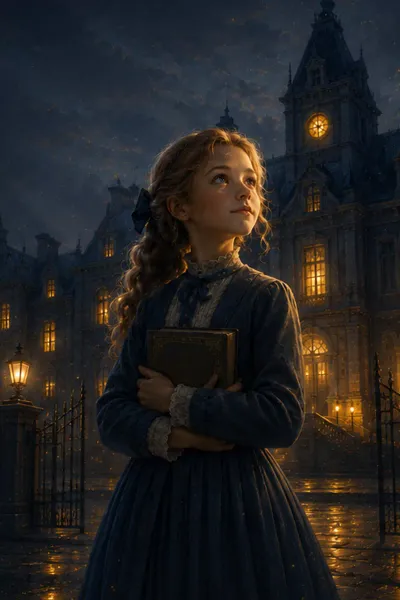
A Little Princess
Frances Hodgson Burnett
C1.4orig.B1
~6 h 10 min · Classics
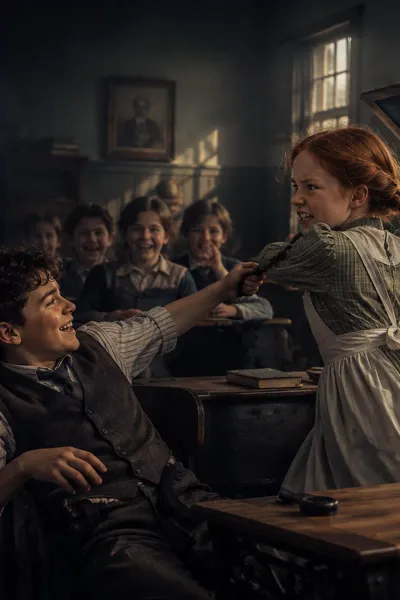
Anne of Green Gables
L. M. Montgomery
C1.6orig.B2
~9 h 30 min · Classics
The Picture of Dorian Gray
Oscar Wilde
C1.8orig.B1C1
~7 h 20 min · Gothic & mystery
Dracula
Bram Stoker
C1.8orig.B1B2
~14 h 50 min · Gothic & mystery
Book page ≈0.2.0 · Oct 14, 2026