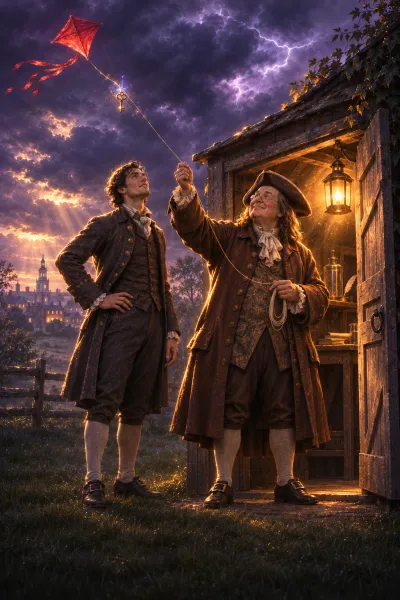
The Autobiography of Benjamin Franklin en anglais
Benjamin Franklin's own account of how a runaway Boston apprentice arrived in Philadelphia with a pocketful of coins and three bread rolls and built himself into a wealthy printer, civic inventor, and colonial statesman—told as a practical blueprint for anyone who wants to do the same.
Written in four separate stretches across nineteen years, the autobiography follows Franklin from his childhood in Boston through his rise in Philadelphia and breaks off in 1757 on a diplomatic trip to London, nearly two decades before the American Revolution begins. The first third moves fast through youth, runaway journeys, London print shops, and bad friends; the middle turns into a manual on habit-tracking and civic organizing; the later chapters follow colonial politics, frontier forts, and British generals. Franklin writes in late-eighteenth-century American prose: long, clear sentences built for business, mixing boyhood memories with household budgets, letters from friends, and committee rules. There is very little intimate confession here—people and events are measured by whether they were useful.
- Dry, self-aware humor from a writer who laughs at his own pride right while bragging about it
- Concrete, step-by-step details of how an eighteenth-century print shop, newspaper, and colonial town actually ran
- The original source of modern habit-tracking, networking tricks, and self-improvement routines
- A front-row look at how one man started a lending library, a fire company, a university, and a militia from scratch
- Stops in 1757, so the Declaration of Independence, the Revolution, and his famous years in Paris are not in the book
- The second half slows down into Pennsylvania Assembly disputes, tax arguments, and military supply wagons
- Almost no private emotion—his wife and children get fewer lines than his printing contracts
- Eighteenth-century sentences average thirty words and pack several clauses into a single breath
Quel genre de livre « The Autobiography of Benjamin Franklin »
L’original de « The Autobiography of Benjamin Franklin » en anglais
Choisis une version. La barre en bas de la page ouvre celle que tu choisis.
Vocabulaire par niveau
- A1 61%
- A2 18%
- B1 9%
- B2 6%
- hors dictionnaire 3%
La langue originale de « The Autobiography of Benjamin Franklin » et ce qu’il t’apporte
Difficulté de la langue C2
Our measurement puts the original text at C2. Most individual words are plain everyday English, not rare academic terms, because Franklin was a practical tradesman who disliked showy writing. What pushes the text to the top level is the architecture of late-eighteenth-century prose: sentences run long, linking three or four thoughts with semicolons and clauses where a modern writer would use full stops. You also meet the working vocabulary of colonial printing, local government, and accounting, alongside letters and public documents pasted straight into the story.
En pratique: Only the original C2 text is available right now; it suits confident advanced readers who are comfortable unpacking long eighteenth-century sentences.
À quoi s’attendre
Comment le lire sans abandonner
- Follow the semicolons as if they were full stops: Franklin often packs a whole chain of cause and effect into one sentence, and breaking it at the punctuation makes the meaning clear immediately.
- Watch out for eighteenth-century false friends among everyday nouns: 'industry' here almost always means hard work rather than factories, 'conversation' often means general social conduct, and 'mean' usually means humble or poor rather than cruel.
- Do not get bogged down in Chapter II when two long warning letters from Franklin's friends are quoted in full before the story resumes—their stiff, preacherly phrasing is harder than Franklin's own voice.
Un extrait de « The Autobiography of Benjamin Franklin » en anglais
Touche un mot — on affiche sa traduction
Les flèches passent d’un mot à l’autre, Entrée affiche la traduction.Original · C2170 mots
I have been the more particular in this description of my journey, and shall be so of my first entry into that city, that you may in your mind compare such unlikely beginnings with the figure I have since made there. I was in my working dress, my best clothes being to come round by sea. I was dirty from my journey; my pockets were stuffed out with shirts and stockings, and I knew no soul nor where to look for lodging. I was fatigued with traveling, rowing, and want of rest, I was very hungry; and my whole stock of cash consisted of a Dutch dollar, and about a shilling in copper. The latter I gave the people of the boat for my passage, who at first refused it, on account of my rowing; but I insisted on their taking it. A man being sometimes more generous when he has but a little money than when he has plenty, perhaps through fear of being thought to have but little.
Illustrations pour « The Autobiography of Benjamin Franklin »
7 scènes de « The Autobiography of Benjamin Franklin », dans l’ordre de l’histoire et sans la fin.








Sommaire de « The Autobiography of Benjamin Franklin » · 21 chapitres
- Introductionpage 1
- Epigraphpage 11
- I: Ancestry and Early Youth in Bostonpage 11
- II: Beginning Life as a Printerpage 25
- III: Arrival in Philadelphiapage 39
- IV: First Visit to Bostonpage 49
Tous les 21 chapitresVoir moins
- V: Early Friends in Philadelphiapage 60
- VI: First Visit to Londonpage 65
- VII: Beginning Business in Philadelphiapage 83
- VIII: Business Success and First Public Servicepage 103
- IX: Plan for Attaining Moral Perfectionpage 118
- X: Poor Richard’s Almanac and Other Activitiespage 135
- XI: Interest in Public Affairspage 146
- XII: Defense of the Provincepage 156
- XIII: Public Services and Duties (1749–1753)page 167
- XIV: Albany Plan of Unionpage 185
- XV: Quarrels with the Proprietary Governorspage 188
- XVI: Braddock’s Expeditionpage 193
- XVII: Franklin’s Defense of the Frontierpage 208
- XVIII: Scientific Experimentspage 219
- XIX: Agent of Pennsylvania in Londonpage 224
Notes des lecteurs pour « The Autobiography of Benjamin Franklin »
Personne ne l’a encore noté. Donne la première note.
Ta note
Avis des lecteurs sur « The Autobiography of Benjamin Franklin »
Aucun avis pour l’instant.
L’histoire de « The Autobiography of Benjamin Franklin » et quand il a été écrit
A letter to the royal governor
While staying at Bishop Jonathan Shipley's estate in Twyford, England, Franklin started his memoir as a long letter to his son William. William was the royal governor of New Jersey at the time, and this first part took the family story and Franklin's own life up to 1730.
The Autobiography of Benjamin Franklin, Part One
Thirteen virtues in a pocket ledger
The American Revolution stopped the writing and permanently split Franklin from his Loyalist son. Urged on by friends Abel James and Benjamin Vaughan, he picked the manuscript up again in Passy, outside Paris, dropping the timeline of his life to explain how he tracked thirteen moral virtues in a pocket ledger.
The Autobiography of Benjamin Franklin, Part Two
Stopping short of the Revolution
Sick and back in Philadelphia, Franklin returned to his story and added a brief fourth part before dying in April 1790. The narrative cuts off in 1757 as he arrives in London for the Pennsylvania Assembly, which means the man most famous for the American Revolution never reached it in his own memoir.
English translated back from French
While Franklin's grandson William Temple Franklin took his time preparing an official edition, an unauthorized French translation of the first part came out in Paris as Mémoires de la vie privée de Benjamin Franklin. The first English readers in 1793 were actually reading a text translated into French and then translated back into English.
The grandson cuts the fourth part
When William Temple Franklin finally brought out his official London edition, he left out the short fourth section and worked from a revised copy rather than the original handwritten pages. Between Franklin's own stiffer revisions on that copy and his grandson's editing, the published voice came out noticeably more formal than the original draft.
The original handwriting bought in France
In 1867, American diplomat John Bigelow tracked down Franklin's original handwritten manuscript in France and bought it. His edition the next year finally gave readers the fourth part of the memoir and restored Franklin's exact, unvarnished wording.
John Bigelow, Autobiography of Benjamin Franklin Edited from His Manuscript (1868)
Dans la culture « The Autobiography of Benjamin Franklin »
6 adaptations et mentions, 1905–1925
Dans la langue Max Weber's exhibit for capitalism
In The Protestant Ethic and the Spirit of Capitalism, Max Weber quoted at length from Advice to a Young Tradesman and other Franklin pieces on time, hard work, frugality, and credit. For Weber, Franklin's maxims were the clearest proof of how making money had become a secular moral duty.
Max Weber, The Protestant Ethic and the Spirit of Capitalism (1905)
Dans la langue D. H. Lawrence mocks the virtue chart
In Studies in Classic American Literature, D. H. Lawrence went after the autobiography's thirteen-virtue chart. He mocked Franklin for trying to fence human morality into a neat, regimented scheme of self-improvement.
D. H. Lawrence, Studies in Classic American Literature (1923)
Dans la langue Young Jay Gatsby's Hopalong Cassidy schedule
Near the end of F. Scott Fitzgerald's The Great Gatsby, Gatsby's father opens a ragged copy of Hopalong Cassidy to show Nick Carraway a boyhood schedule and a list of 'General Resolves.' Fitzgerald modeled the page directly on the daily timetable and moral ledger in Franklin's memoir.
F. Scott Fitzgerald, The Great Gatsby (1925)
Dans la langue Black spots in a weekly grid
To practice thirteen virtues ranging from Temperance and Silence to Humility, Franklin ruled a small notebook into a weekly table and marked every daily slip with a black spot. If you have ever used a habit tracker, you are using his notebook.
The Autobiography of Benjamin Franklin, Part Two
Dans la langue Winning an enemy by borrowing a book
To win over a rival in the Pennsylvania Assembly, Franklin did not do the man a favor; he asked to borrow a rare book from his library. He followed the rule that someone who has done you a kindness is more ready to do you another than someone who owes you one, a quirk of human psychology that twentieth-century psychologists named the Ben Franklin effect.
The Autobiography of Benjamin Franklin, Part Three
Dans la langue Life's mistakes as printer's errata
A printer by trade, Franklin called his worst moral failures 'errata'—whether he was spending money that was not his or neglecting his commitment to Deborah Read. The word turned sins into typographical errors: things you admit on the page and fix in the next edition of your life.
The Autobiography of Benjamin Franklin, Part One
Questions et réponses sur « The Autobiography of Benjamin Franklin » en anglais
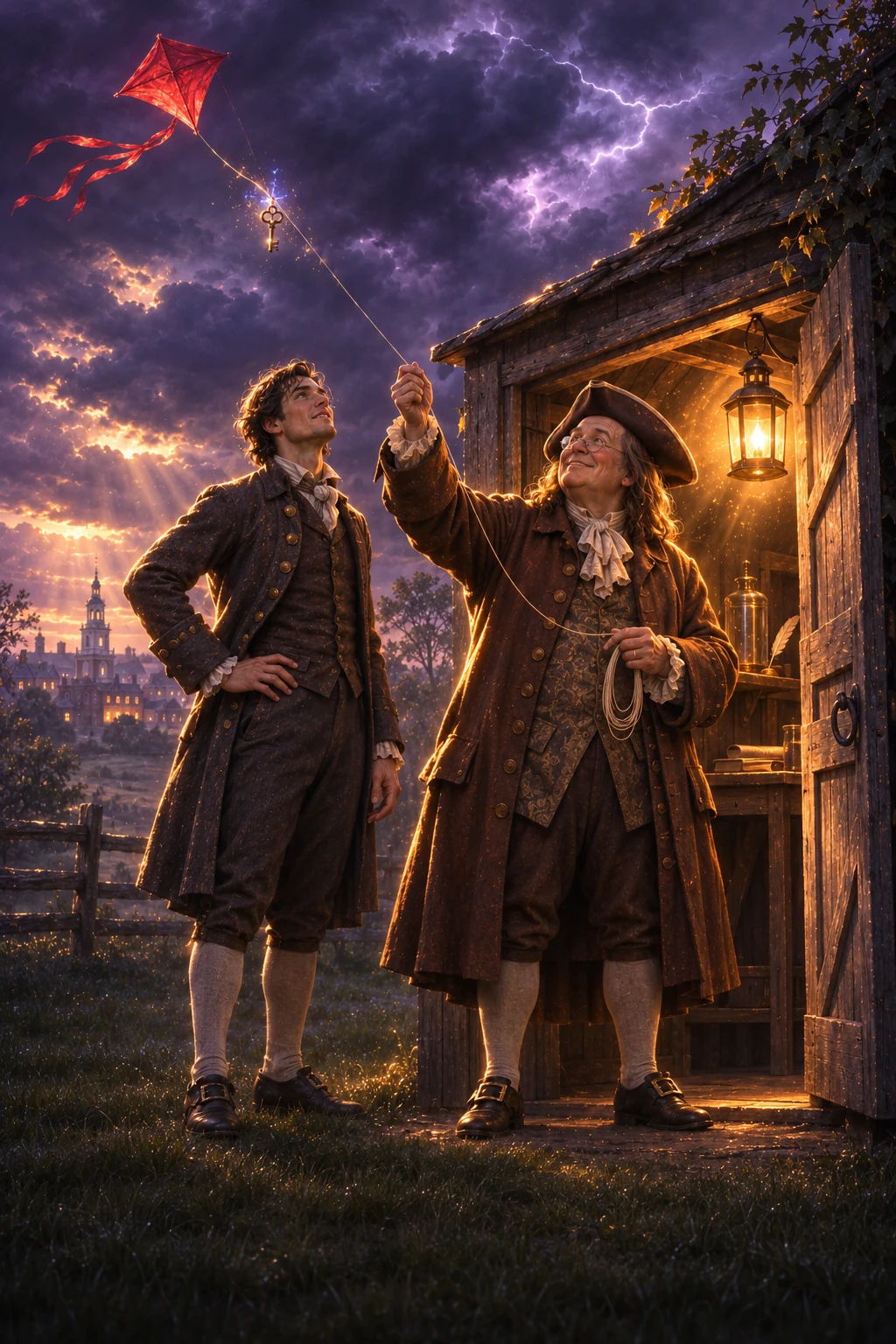
Does the book include the famous kite and key lightning experiment?
Franklin mentions the kite only in passing and does not describe the experiment. He tells how his letters to Peter Collinson were read at the Royal Society and at first not printed in its Transactions, how one paper was laughed at by the connoisseurs, how the papers were published in London and translated in France, and how Dalibard and De Lor drew lightning from the clouds at Marly. He then says he will not enlarge on that experiment, or on a similar one he soon made with a kite at Philadelphia, because both were already in the histories of electricity.
What does 'indenture' mean in the early chapters with his brother James?
An indenture was a binding legal contract that tied a young apprentice to a master craftsman until the age of twenty-one in exchange for learning a trade and receiving food and lodging. When twelve-year-old Benjamin signed his indenture to his older brother James, he became legally unable to quit the print shop or take wages elsewhere, which is why running away to Philadelphia at seventeen made him a fugitive.
Who was 'Poor Richard' and why did Franklin write under his name?
Poor Richard was the fictional character—named Richard Saunders—whom Franklin invented in 1732 as the author of his annual almanac. Buyers expected a calendar of weather predictions and astrology alongside practical household tips, and Franklin filled the tiny blank spaces between the calendar days with proverbs about saving money and working hard so that ordinary colonists would memorize them.
Is the quote 'Early to bed and early to rise' in the autobiography?
That exact proverb does not appear in the autobiography. Franklin says he filled the blank spaces of Poor Richard's Almanack with proverbs on industry and frugality, quotes one of them—that it is hard for an empty sack to stand upright—and explains that he later gathered the sayings into the harangue of a wise old man, Father Abraham, prefixed to the almanac for 1758, the piece now called The Way to Wealth. His daily virtue schedule begins at five in the morning with rising, washing, and planning the day.
What happened between Franklin and Deborah Read while he was in London?
Before he sailed for London at eighteen, Franklin and Deborah Read, his landlady's daughter, had an understanding that marriage should wait until he returned and was set up in business; her mother had kept them from going further. During about eighteen months in England he wrote her only once, to say he was not likely to return soon. Friends persuaded her to marry a potter, Rogers, who proved worthless, ran into debt, and in 1727 or 1728 went to the West Indies. A later report said he had died; Franklin writes that they knew the report was not true, and on 1 September 1730 they began the common-law marriage that lasted until her death.
What was the Junto club that Franklin started in Philadelphia?
The Junto was a Friday-evening discussion club of twelve young Philadelphia tradesmen—including a shoemaker, a joiner, a surveyor, and fellow printers—that Franklin organized in 1727. Members had to bring essays or questions on morals, politics, or natural science and answer a checklist of practical queries, such as who had recently succeeded in business and why, or whether any member needed help defending his reputation.
En bref sur « The Autobiography of Benjamin Franklin »
14 champs de données éditoriales et de caractéristiques mesurées du texte. Tout est vérifiable.
- Titre original
- The Autobiography of Benjamin Franklin
- Auteur
- Benjamin Franklin · 1706–1790
- Première publication
- 1791
- Langue originale
- Anglais
- Genre
- Mémoires · Développement personnel · Histoire
- Ambiance
- Lumineuse
- Thèmes
- Ambition · Passage à l’âge adulte · Société · Science
- Mots distincts
- 6 134
- Mots par phrase
- 30 mots
- Niveau de l’original
- C2Comment nous mesurons
- Versions
- C2
- Longueur de l’original
- 21 chap. · 67 353 mots
- Temps de lecture
- ~6 h 10 min
- Télécharger
- EPUB
Livres similaires que lire après « The Autobiography of Benjamin Franklin »
Dans le même esprit
8Le même genre et le même registre.
How to Live on 24 Hours a Day
Arnold Bennett
C2orig.
~1 h 10 min · Développement personnel

Meditations
Marcus Aurelius
C2orig.
~4 h 40 min · Philosophie

Walden ou la Vie dans les bois
Henry David Thoreau
C2orig.B2
~9 h 50 min · Philosophie

Douze ans d'esclavage
Solomon Northup
C2orig.B1B2
~7 h 30 min · Mémoires
The Art of Public Speaking
J. Berg Esenwein, Dale Carnegie
C2orig.
~14 h 40 min · Développement personnel

Short Works
Epictetus
C2orig.
~1 h 50 min · Philosophie
Récit de la vie de Frederick Douglass, un esclave américain
Frederick Douglass
C2orig.
~3 h 50 min · Mémoires
Self Help; with Illustrations of Conduct and Perseverance
Samuel Smiles
C2orig.
~12 h 50 min · Développement personnel