The Jungle Book in English
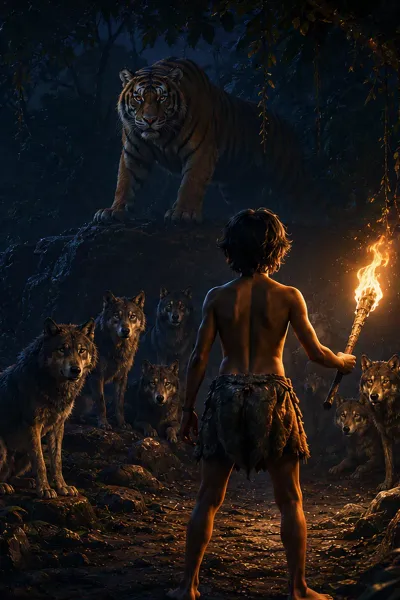
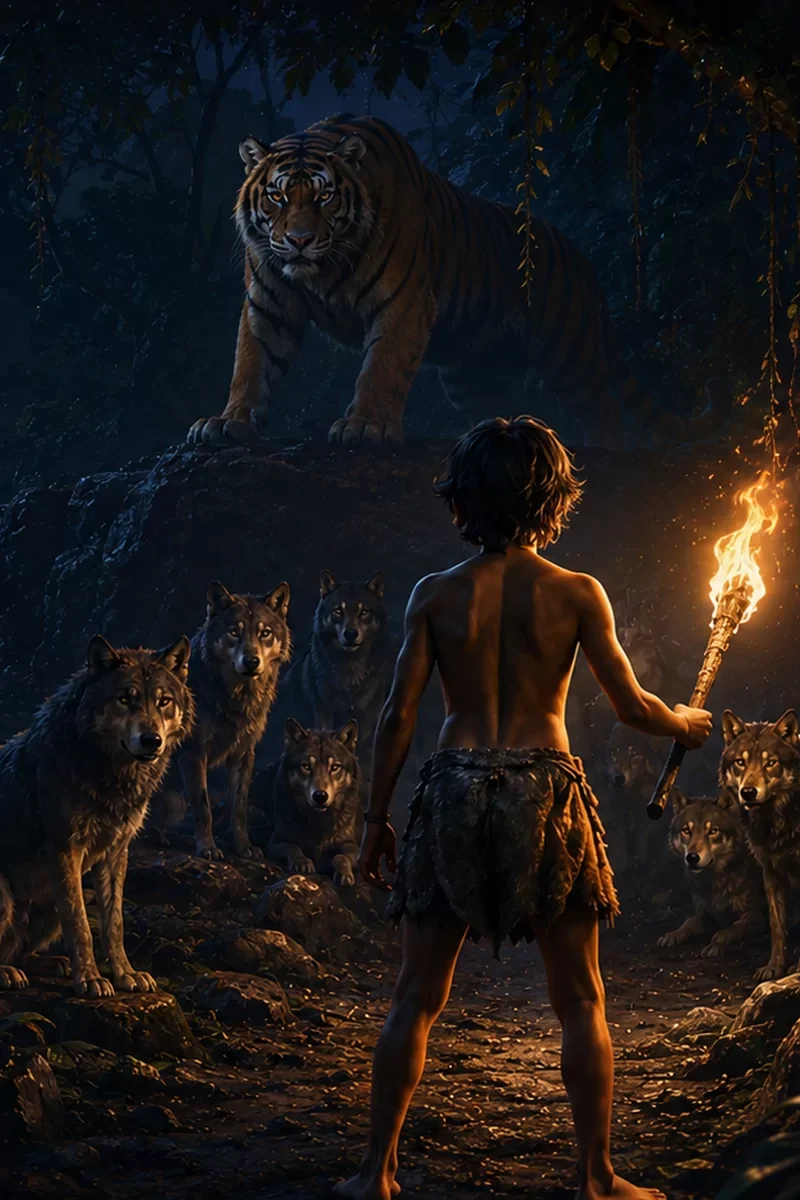
A human child is raised by wolves in the jungle, and has to learn its laws while the tiger Shere Khan hunts him. Other stories in the book are about different animals.
The book is a set of separate stories, not a single novel. Three of them tell Mowgli's life in order, and the others are independent tales about a mongoose, a seal, an elephant and a boy, and the animals of an army camp. Most stories begin or end with a short verse, which gives the book a rhythm like a song. The chapters are short, so you can read one in a sitting. Kipling writes in plain, rhythmic sentences, and the animals speak a formal, slightly old-fashioned English.
You will like it if
- you like animal characters that act like people but still behave like animals
- you want short stories you can read one at a time
- you enjoy adventure and danger in a wild setting
- you would like to read the original behind the films
You will not if
- you expect the cheerful tone of the Disney film, since the book is harder and darker
- you need one connected plot: only some of the stories follow Mowgli
- the old-fashioned "thou" and "ye" in the animals' speech slow you down
- you dislike descriptions of hunting and fights between animals
What kind of book“The Jungle Book” is
Versions of “The Jungle Book” in English: C1
Same book, adapted to a level you can read without stopping
Pick a version. The bar at the foot of the page opens the one you pick.
Vocabulary by level
- A1 65%
- A2 14%
- B1 8%
- B2 7%
- not in dictionary 3%
A sample from “The Jungle Book” in English
One passage, the way each version writes it.
Tap any word — we will show the translation
Original · C1.7298 words
Now Rann, the Kite, brings home the night That Mang, the Bat, sets free — The herds are shut in byre and hut, For loosed till dawn are we. This is the hour of pride and power, Talon and tush and claw. Oh, hear the call! —Good hunting all That keep the Jungle Law!
It was seven o’clock of a very warm evening in the Seeonee hills when Father Wolf woke up from his day’s rest, scratched himself, yawned, and spread out his paws one after the other to get rid of the sleepy feeling in the tips. Mother Wolf lay with her big gray nose dropped across her four tumbling, squealing cubs, and the moon shone into the mouth of the cave where they all lived. “Augrh!” said Father Wolf, “it is time to hunt again”; and he was going to spring downhill when a little shadow with a bushy tail crossed the threshold and whined: “Good luck go with you, O Chief of the Wolves; and good luck and strong white teeth go with the noble children, that they may never forget the hungry in this world.”
It was the jackal —Tabaqui, the Dish-licker —and the wolves of India despise Tabaqui because he runs about making mischief, and telling tales, and eating rags and pieces of leather from the village rubbish-heaps. They are afraid of him too, because Tabaqui, more than anyone else in the jungle, is apt to go mad, and then he forgets that he was ever afraid of anyone, and runs through the forest biting everything in his way. Even the tiger hides when little Tabaqui goes mad, for madness is the most disgraceful thing that can overtake a wild creature. We call it hydrophobia, but they call it dewanee —the madness —and run.
The original language of “The Jungle Book” and what it gives you
How hard the language is C1.7
This is a fairly easy classic. The average sentence is 17.3 words, and 79% of the words are in the A1–A2 bands (65% + 14%). Only 4% of the words are beyond the 5000 most frequent and 3% are outside the dictionary, mostly animal names, Hindi words and names of places. We estimate the original at B1. There is no adaptation yet, so you read the original.
What this means in practice: A good classic for the B1 reader: short stories and plain words, with a little old-fashioned speech to get used to.
What to be ready for
How to read it and not quit
- Learn the older pronouns "thou", "thee" and "thy": they mean "you" and "your", and they come with verb endings such as "art" and "hast".
- Notice how often Kipling joins short clauses with "and"; the rhythm helps you read sentences that would otherwise be long.
- Do not look up every animal word: most are pictures you can guess, and the stories repeat them.
- Read the verses aloud once; their rhythm is easier to catch by sound than by reading.
Contents of “The Jungle Book” · 2 chapters
- Beginningpage 1
- Mowgli’s Brotherspage 1
- Mowgli’s Brothers (continued)page 15
- Mowgli’s Brothers (continued)page 28
- Mowgli’s Brothers (continued)page 43
- Mowgli’s Brothers (continued)page 57
All 2 chaptersShow fewer
- Mowgli’s Brothers (continued)page 61
- Mowgli’s Brothers (continued)page 76
- Mowgli’s Brothers (continued)page 87
- Mowgli’s Brothers (continued)page 101
- Mowgli’s Brothers (continued)page 113
- Mowgli’s Brothers (continued)page 127
- Mowgli’s Brothers (continued)page 134
- Mowgli’s Brothers (continued)page 149
- Mowgli’s Brothers (continued)page 161
- Mowgli’s Brothers (continued)page 176
Reader ratings for “The Jungle Book”
Nobody has rated it yet. Be the first.
Your rating
Reader reviews of “The Jungle Book”
No reviews yet.
The story of “The Jungle Book”
First Mowgli story
The first story about Mowgli, 'In the Rukh', appeared in Kipling's collection 'Many Inventions'.
The Jungle Book is published
Kipling published the book, partly written in Vermont, USA, after several of the stories had appeared in magazines. Kipling's father, John Lockwood Kipling, was among the illustrators.
The Second Jungle Book
A second collection followed, with more Mowgli stories and the poem 'The Law of the Jungle'.
Cub Scouts
Robert Baden-Powell started the Wolf Cubs, a section of the Scout movement built on the Jungle Book, with Kipling's permission.
Disney animated film
Disney's animated version, the last Walt Disney worked on, became the way most people first met the story.
In culture “The Jungle Book”
9 adaptations and mentions, 1894–2016
Art Original illustrations
The first edition carried illustrations by John Lockwood Kipling, the author's father, among others.
In the language 'The law of the jungle'
Now used for a cut-throat world where the strongest wins, which is nearly the opposite of Kipling's Law, a code of mutual duty and restraint.
In the language Akela, Baloo and Bagheera
Cub Scout leaders still take their names from the animals of the book.
Film Rudyard Kipling's Jungle Book (Zoltan Korda)
A live-action Technicolor film with the actor Sabu as Mowgli.
Film The Jungle Book (Disney)
The animated musical with 'The Bare Necessities'; it made Baloo, a lazy singing bear, the popular face of the story.
Film Mowgli (Soviet animated films)
A series of animated films from Soyuzmultfilm that follow the books more closely than the Disney film.
Film Rikki-Tikki-Tavi (Chuck Jones)
A television special based on the mongoose story from the book.
Film Rudyard Kipling's The Jungle Book (Disney, live action)
A live-action Disney version with Jason Scott Lee.
Film The Jungle Book (Jon Favreau)
A Disney film that combines live action and computer-made animals.
Questions and answers about “The Jungle Book” in English
Is The Jungle Book the same as the Disney film?
No, the film is lighter and funnier, and it changes characters and events. In the book the tone is more serious, Mowgli's story is told across several tales, and not all the stories are about him.
Who is Mowgli?
Mowgli is a human boy raised by a wolf pack in the Indian jungle. He is called the "man-cub", and the stories follow him as he learns the jungle's rules and is pulled between the animals and the human village.
Are all the stories about Mowgli?
No, only three of the seven stories in this book are about Mowgli. The others are separate tales about a mongoose, a white seal, an elephant handler's son and the animals of an army camp.
What is the Law of the Jungle?
It is the set of rules that the animals follow to live together, such as respecting the hunting of others and not killing during the water truce. Baloo teaches it to Mowgli, and the idea runs through the whole book.
Is The Jungle Book a children's book?
It was written to be read by children, but it is not a simple book. It has fights, deaths and a clear sense of danger, so it works well for adults too.
Is Rikki-Tikki-Tavi in The Jungle Book?
Yes, it is one of the stories in the collection. It tells how a pet mongoose protects a family from two cobras.
Do I need to read The Second Jungle Book?
No, this book stands on its own. The Second Jungle Book is a later sequel with more Mowgli stories and other tales, and you can read it afterwards if you want more.
Is the book set in a real place?
Yes, it is set in India, but the jungle in the Mowgli stories is an imagined one. Kipling was born in India and drew on what he knew of the country, though he wrote the book while living in the United States.
Why do some people criticise Kipling?
Kipling supported the British Empire, and some readers object to the way he writes about India and its people. The Jungle Book is mostly about animals, but readers still often discuss this background.
Is it hard to read in English?
No, it is one of the easier classics: the sentences are medium length and the vocabulary is mostly everyday. The old pronouns in the animals' speech are the main new thing.
In brief about “The Jungle Book”
17 fields of imprint data and measured text characteristics. All of it checkable.
- Original title
- The Jungle Book
- Author
- Rudyard Kipling
- First published
- 1894
- Original language
- English
- Genre
- Adventure · Animals · Classics
- Mood
- Uplifting
- Themes
- Nature · Identity · Family
- Setting
- The jungles of India, with one story on a seal beach in the north Pacific · British India in the 19th century
- Distinct words
- 4,497
- Words per sentence
- 17 words
- Level of the original
- C1.7
- Versions
- C1.7
- Length of the original
- 16 ch. · 50,388 words
- Reading time
- ~4 h 40 min
- Source text
- Standard Ebooks
- Download
- EPUB
Similar what to read after “The Jungle Book”
By the same author
1The same hand, a different story.
Close in spirit
7The same genre and the same register.
Black Beauty
Anna Sewell
C1.4orig.B1
~5 h 30 min · Classics
The Call of the Wild
Jack London
C2orig.B2C1
~3 h · Adventure
Aesop's Fables
Aesop
C1.2orig.
~3 h 40 min · Fables & parables
Alice's Adventures in Wonderland
Lewis Carroll
C1.2orig.B1B2
~2 h 30 min · Classics
Adventures of Huckleberry Finn
Mark Twain
C1.6orig.B1
~10 h 20 min · Adventure
The Secret Garden
Frances Hodgson Burnett
C1.2orig.B1
~7 h 30 min · Classics
Around the World in Eighty Days
Jules Verne
C2orig.C1
~5 h 50 min · Adventure
Book page ≈0.2.0 · Oct 14, 2026