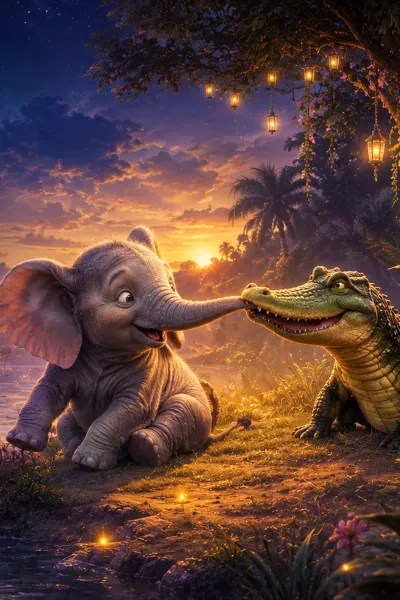
Just So Stories in English
Funny made-up stories about how animals came to look and behave the way they do, told as if to a child at bedtime.
The book is a collection of separate stories, and they can be read in any order. Most explain one animal feature, and they follow a similar pattern: a curious or lazy animal in the first days of the world, a mistake or a cheeky question, and a result that stays with the animal for ever. Some stories are followed by a short poem. The language is written for the ear: it repeats phrases, plays with sounds and uses very long compound names. Kipling also drew the pictures for the first edition himself. The voice is a storyteller's voice, warm and teasing, and it talks to the listener directly.
You will like it if
- you want short stories that are fun to read aloud
- you like humour that does not need much cultural background
- you want simple, repeated phrases that stay in your head
- you like stories about animals and made-up explanations
You will not if
- you find baby-talk or a bedtime-story voice annoying
- the long invented names and coined words slow you down
- you want a plot that grows from story to story
- some details reflect the attitudes of 1902, and a few passages about people from other countries read as dated
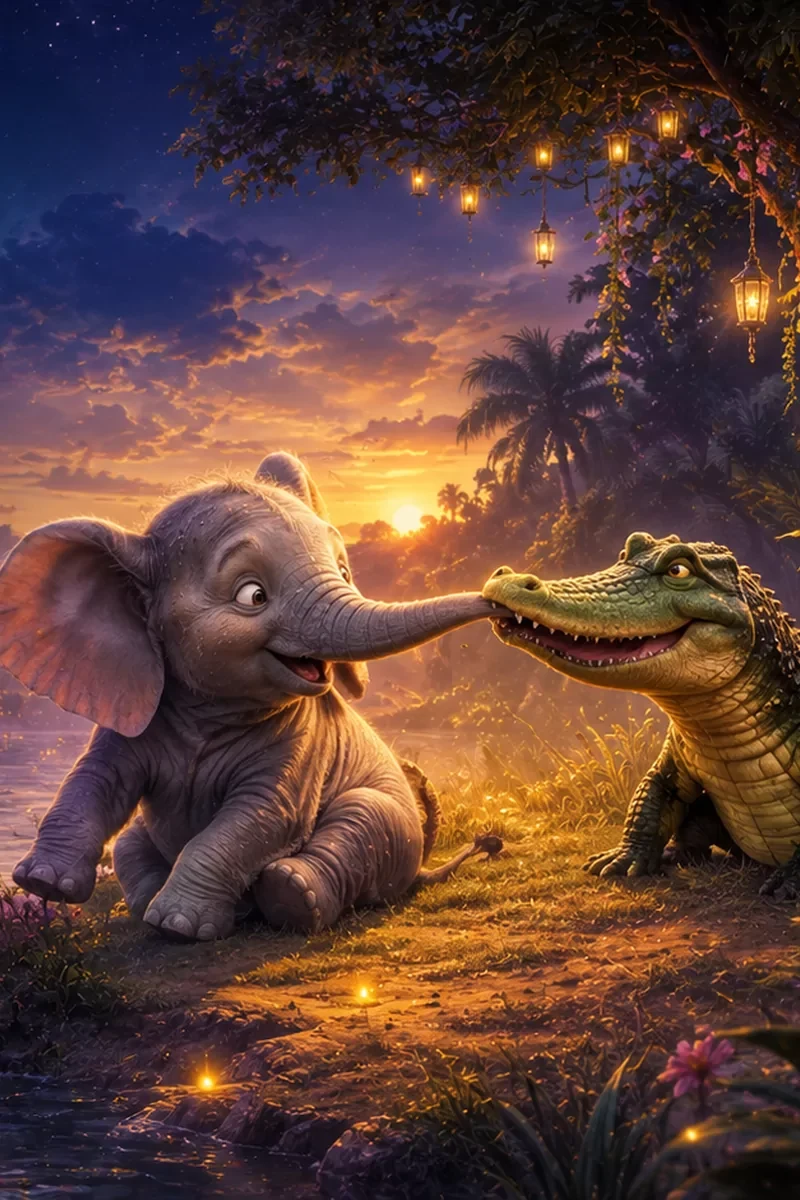
What kind of book“Just So Stories” is
Versions of “Just So Stories” in English: B1
Same book, adapted to a level you can read without stopping
Pick a version. The bar at the foot of the page opens the one you pick.
Vocabulary by level
- A1 67%
- A2 14%
- B1 6%
- B2 7%
- not in dictionary 4%
A sample from “Just So Stories” in English
One passage, the way each version writes it.
Tap any word — we will show the translation
Original · C1.1254 words
In the sea, once upon a time, O my Best Beloved, there was a Whale, and he ate fishes. He ate the starfish and the garfish, and the crab and the dab, and the plaice and the dace, and the skate and his mate, and the mackereel and the pickereel, and the really truly twirly-whirly eel. All the fishes he could find in all the sea he ate with his mouth —so! Till at last there was only one small fish left in all the sea, and he was a small ’Stute Fish, and he swam a little behind the Whale’s right ear, so as to be out of harm’s way. Then the Whale stood up on his tail and said, “I’m hungry.” And the small ’Stute Fish said in a small ’stute voice, “Noble and generous Cetacean, have you ever tasted Man?”
“No,” said the Whale. “What is it like?”
“Nice,” said the small ’Stute Fish. “Nice but nubbly.”
“Then fetch me some,” said the Whale, and he made the sea froth up with his tail.
“One at a time is enough,” said the ’Stute Fish. “If you swim to latitude Fifty North, longitude Forty West (that is magic), you will find, sitting on a raft, in the middle of the sea, with nothing on but a pair of blue canvas breeches, a pair of suspenders (you must not forget the suspenders, Best Beloved), and a jackknife, one shipwrecked Mariner, who, it is only fair to tell you, is a man of infinite-resource-and-sagacity.”
B1.8220 words
In the sea, a long time ago, there was a Whale. He ate all the fishes. He ate starfish and garfish, crab and dab, plaice and dace, skate and his mate, mackerel and pickerel, and the twirly-whirly eel. He ate every fish in the sea with his mouth — so! At last, only one small fish was left. It was a small 'Stute Fish. It swam behind the Whale's right ear to be safe. Then the Whale stood on his tail and said, "I'm hungry." The small 'Stute Fish said in a small voice, "Noble and generous Whale, have you ever tasted Man?"
"No," said the Whale. "What is it like?"
"Nice," said the small 'Stute Fish. "Nice but nubbly."
"Then bring me some," said the Whale. He made the sea foam with his tail.
"One at a time is enough," said the 'Stute Fish. "If you swim to latitude Fifty North, longitude Forty West, you will find a shipwrecked Mariner on a raft. He wears blue canvas breeches and suspenders, and he has a jackknife. He is a man of infinite-resource-and-sagacity."
So the Whale swam fast to latitude Fifty North, longitude Forty West. He found the Mariner on a raft. The Mariner wore blue canvas breeches and suspenders, and he had a jackknife. He trailed his toes in the water.
The original language of “Just So Stories” and what it gives you
How hard the language is C1.1
The vocabulary is easy: 67% of the words are in the A1 band and another 14% in A2, and only 3% fall beyond the 5,000 most frequent words. Sentences average 16.8 words, which is medium length, and many are chains of short clauses joined by "and". The 4% of words outside the dictionary are mostly invented names and coined words, not hard vocabulary. We estimate the original at B1; the repetition and the rhythm make it easier than that number suggests.
What this means in practice: Simple words and a strong rhythm make this one of the friendliest classics for a learner, once you get used to the invented names.
What to be ready for
How to read it and not quit
- Read it aloud, or listen while you read. The language was written to be heard, and the rhythm helps you remember phrases.
- Do not look up the invented names: they are one long label for an animal, and the context makes the meaning clear.
- Watch the capital letters. Animals are often called the Elephant's Child or the Whale, and the article the is part of the name, so do not drop it.
- Notice the long chains with "and" and the repeated past-tense verbs; they show you how to join ideas in English without semicolons or subordinate clauses.
Contents of “Just So Stories” · 12 chapters
- How the Whale Got His Throatpage 1
- How the Camel Got His Humppage 3
- How the Rhinoceros Got His Skinpage 6
- How the Leopard Got His Spotspage 7
- The Elephant’s Childpage 12
- The Singsong of Old Man Kangaroopage 18
All 12 chaptersShow fewer
- The Beginning of the Armadillospage 22
- How the First Letter Was Writtenpage 30
- How the Alphabet Was Madepage 38
- The Crab That Played with the Seapage 47
- The Cat That Walked by Himselfpage 58
- The Cat That Walked by Himself (continued)page 68
- The Butterfly That Stampedpage 68
Reader ratings for “Just So Stories”
Nobody has rated it yet. Be the first.
Your rating
Reader reviews of “Just So Stories”
No reviews yet.
The story of “Just So Stories”
Published as Just So Stories for Little Children
The collection came out in 1902 from Macmillan in London, with Kipling's own pen drawings and captions.
Kipling's own illustrations
Kipling drew the pictures himself, and wrote long captions to go with them, so the book is meant to be looked at as well as read.
Told first to Kipling's daughter
Kipling told the stories aloud to his young daughter Josephine, who insisted they be repeated exactly. She died in 1899, and the reader addressed as "Best Beloved" in the stories is usually associated with her.
Magazine printing before the book
Several of the tales appeared in children's magazines, among them St. Nicholas, before they were collected.
In culture “Just So Stories”
8 adaptations and mentions, 1902–1977
Art Kipling's own pictures
The author's drawings of the Whale, the Camel and the Rhinoceros are part of the work and are reproduced in most editions.
Film How the Camel Got His Hump (Chuck Jones)
Chuck Jones's animated television version, narrated by Orson Welles, turned one of the tales into a short film for a wide audience.
In the language A "just-so story"
Scientists and philosophers use this for an explanation that sounds neat and fits the facts but cannot be tested, especially in evolutionary biology.
In the language "Satiable curtiosity"
The Elephant's Child's "satiable curtiosity" is Kipling's version of insatiable curiosity, and the line is still quoted for a child who asks too many questions.
In the language The Cat that walked by himself
The independent cat who "walked by himself, and all places were alike to him" is used for a person who keeps their own company and will not be tamed.
In the language The great, grey-green, greasy Limpopo River
Kipling's line about the river on whose banks the Elephant's Child meets the Crocodile is among the most quoted in the book.
In the language "O Best Beloved"
The storyteller's address to a single listener became a signature of the book and of the read-aloud tradition around it.
Stage Just So (musical)
A stage musical by George Stiles and Anthony Drewe built from the stories.
Questions and answers about “Just So Stories” in English
Is Just So Stories a children's book?
Yes, it was written for young children, as bedtime stories, and many were first told aloud. Adults read it for the humour and the language, and it works well for learners because the style is repetitive and clear.
What does "just so" mean in the title?
It means "exactly like that, and no other way". The phrase suggests that the explanation in each story is the only possible one, which is part of the joke. The term "just-so story" is now used for any neat but unproven explanation.
Are the stories based on real folk tales?
No, they are Kipling's own inventions, written in the style of an origin story. They borrow the form of old tales about how things came to be, but the animals and their adventures are his.
What is the most famous story in the book?
The Elephant's Child, which explains how the elephant got his trunk, is probably the best known. How the Leopard Got His Spots and The Cat That Walked by Himself are also read often.
Who is the Best Beloved?
The child the narrator is talking to. In the stories it works like a name for any listener, and it gives the book its affectionate, bedtime-story voice.
Do I have to read the stories in order?
No. Each story stands alone, so you can start with any of them. Some readers begin with the Elephant's Child because it is a good example of the style.
How is it different from The Jungle Book?
Both are by Kipling and both feature animals, but The Jungle Book is an adventure story around a boy raised by wolves, while Just So Stories is made of short, silly tales about how animals got their features. The tone here is lighter and the language more playful.
Is Just So Stories hard to read in English?
No, the vocabulary is mostly simple and the repetition helps you guess what comes next. The main obstacles are the invented names and a few playful spellings. We estimate the original at around B1.
Are there parts that feel outdated?
A few. The book was written in 1902, and some stories describe people from other countries in ways that are not how a writer would do it today. They are a small part of the book, but expect them.
In brief about “Just So Stories”
17 fields of imprint data and measured text characteristics. All of it checkable.
- Original title
- Just So Stories
- Author
- Rudyard Kipling
- First published
- 1902
- Original language
- English
- Genre
- Fairy tale · Animals · Humor
- Mood
- Funny
- Themes
- Childhood · Nature · Identity
- Setting
- Invented, story-book versions of the Limpopo River in Africa, the Red Sea, India, Australia and other far-off places · "The High and Far-Off Times": the beginning of the world, long before people had towns
- Distinct words
- 2,807
- Words per sentence
- 17 words
- Level of the original
- C1.1
- Versions
- C1.1, B1.8
- Length of the original
- 14 ch. · 33,573 words
- Reading time
- ~3 h 10 min
- Source text
- Standard Ebooks
- Download
- EPUB
Similar what to read after “Just So Stories”
By the same author
1The same hand, a different story.
Close in spirit
7The same genre and the same register.
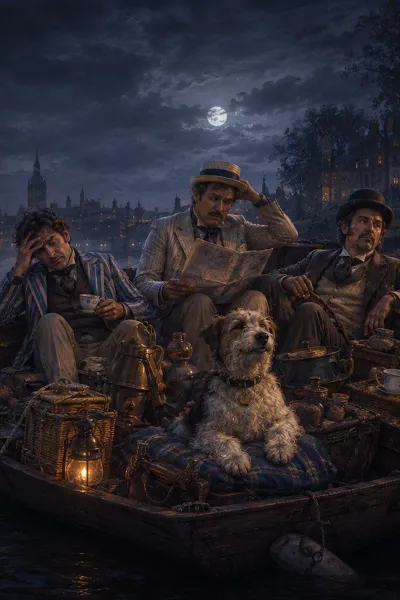
Three Men in a Boat (To Say Nothing of the Dog)
Jerome K. Jerome
C1.7orig.B1B2C1
~6 h 10 min · Humor
Aesop's Fables
Aesop
C1.2orig.
~3 h 40 min · Fables & parables
Alice's Adventures in Wonderland
Lewis Carroll
C1.2orig.B1B2
~2 h 30 min · Classics
Through the Looking-Glass
Lewis Carroll
C1.1orig.B2
~2 h 50 min · Fairy tale
Adventures of Huckleberry Finn
Mark Twain
C1.6orig.B1
~10 h 20 min · Adventure
Black Beauty
Anna Sewell
C1.4orig.B1
~5 h 30 min · Classics
White Fang
Jack London
C2orig.B1B2
~6 h 40 min · Adventure
Book page ≈0.2.0 · Oct 14, 2026