
The Crowd auf Englisch
Why do reasonable people do unreasonable things the moment they are part of a group? Le Bon argues that a crowd is not an average of the minds inside it, but a new, suggestible creature that trades conscious thought for impulse and images.
Le Bon builds his treatise in three clean parts. First, he dissects the mind of a crowd itself — how anonymity, emotional contagion, and suggestibility strip away personal judgment and leave people thinking in pictures and religious-style certainties. Second, he looks at where a crowd's opinions come from, splitting deep cultural habits from the immediate tools a leader uses to steer a room. Finally, he walks his theory through specific institutions, testing it on street mobs, criminal juries, voters, and parliaments. The 1896 English translation moves in formal, late-Victorian prose: long, balanced sentences that lay down bold general laws and illustrate them with episodes from the French Revolution and nineteenth-century French politics.
- Sharp, quotable claims that never hide behind academic hedging
- Concrete examples drawn from French courtrooms, elections, and the Revolution
- Short chapters divided into clear, methodical sections
- Eerily recognizable descriptions of how slogans and panics spread
- Rests on outdated nineteenth-century notions of 'race' and hypnotic suggestion
- Openly elitist and deeply cynical about democracy, voters, and working-class movements
- States sweeping psychological 'laws' from historical anecdotes rather than controlled experiments
- Formal late-Victorian sentences that pack several abstract nouns into every clause

Was für ein Buch „The Crowd“ ist
Das Original von „The Crowd“ auf Englisch
Wähle eine Version. Über die Leiste unten auf der Seite öffnest du deine Auswahl.
Wortschatz nach Niveau
- A1 55%
- A2 19%
- B1 11%
- B2 7%
- nicht im Wörterbuch 4%
Die Originalsprache von „The Crowd“ und was sie dir bringt
Wie schwer die Sprache ist C2
Our measurement puts the original text at C2, the top of the scale. Most individual words are familiar everyday or school-level English, and there is no slang or regional dialect to decode. What pushes the text to C2 is its late-Victorian academic architecture: long, multi-clause sentences packed with abstract nouns about psychology, law, and politics. You are not hunting for rare words in the dictionary so much as holding a long, formal train of thought together from the capital letter to the full stop.
Was das praktisch heißt: Read the original if you are comfortable with C2-level formal nonfiction and want to practice reading classic political and social theory.
Worauf du dich einstellen solltest
Wie du es liest und nicht aufhörst
- Watch out for French-rooted false friends: when Le Bon writes 'race', he usually means national culture or historical character rather than biological race, and 'prestige' means an almost hypnotic spell of authority, not just a good reputation.
- Do not let the passive voice and double negatives throw you off — phrases like 'it is not without reason that' or 'scarcely less important' are standard 1890s emphasis; mentally flip them into a simple positive statement.
- When a thirty-word sentence tangles, find the main subject and verb first and treat the interrupting clauses between commas as side notes.
Was du lernst aus „The Crowd“
A crowd forms a single new mind, not an average of its members
When people gather into a psychological crowd, their individual skills cancel out and they drop to a shared baseline of instinct, anonymity, and emotion.
Crowds think in vivid images, never in chains of logic
Because a group mind cannot follow step-by-step reasoning, it only responds to stark pictures, theatrical slogans, and sweeping promises.
Every deep conviction in a crowd takes a religious shape
Even when a mass movement is strictly political or secular, its members treat their leader and their cause with the blind devotion and intolerance of zealots.
Juries and parliaments obey the same laws as street mobs
Education and social standing do not protect a group from crowd psychology: a panel of magistrates or elected deputies can be swept by the very same emotional contagion.
Für wen es ist
- You work in politics, media, or marketing and want to read the 1895 blueprint behind modern theories of persuasion and spin.
- You watch online outrage or mass movements and want a cold, structural model of how group emotions spread.
- You need practice reading formal, abstract English social science without drowning in modern academic jargon.
Leseprobe aus „The Crowd“ auf Englisch
Tippe auf ein Wort – wir zeigen dir die Übersetzung
Mit den Pfeiltasten wechselst du zwischen Wörtern, Enter zeigt die Übersetzung.Original · C2162 Wörter
The most striking peculiarity presented by a psychological crowd is the following: Whoever be the individuals that compose it, however like or unlike be their mode of life, their occupations, their character, or their intelligence, the fact that they have been transformed into a crowd puts them in possession of a sort of collective mind which makes them feel, think, and act in a manner quite different from that in which each individual of them would feel, think, and act were he in a state of isolation. There are certain ideas and feelings which do not come into being, or do not transform themselves into acts except in the case of individuals forming a crowd. The psychological crowd is a provisional being formed of heterogeneous elements, which for a moment are combined, exactly as the cells which constitute a living body form by their reunion a new being which displays characteristics very different from those possessed by each of the cells singly.
Illustrationen zu „The Crowd“
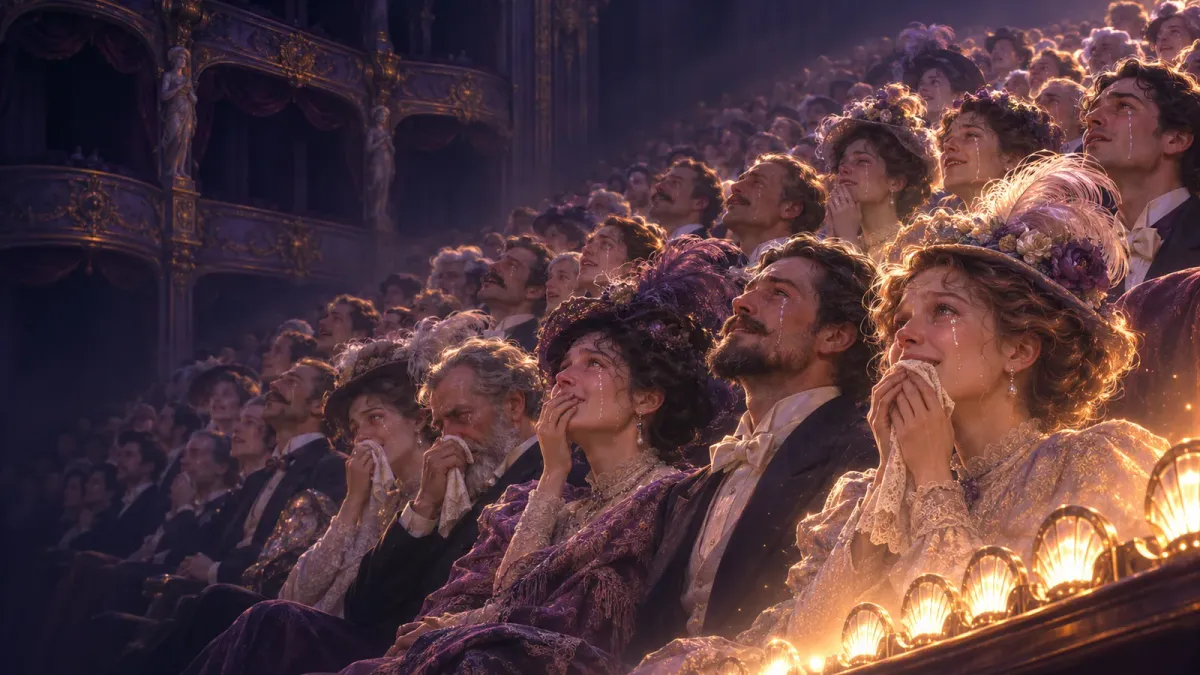
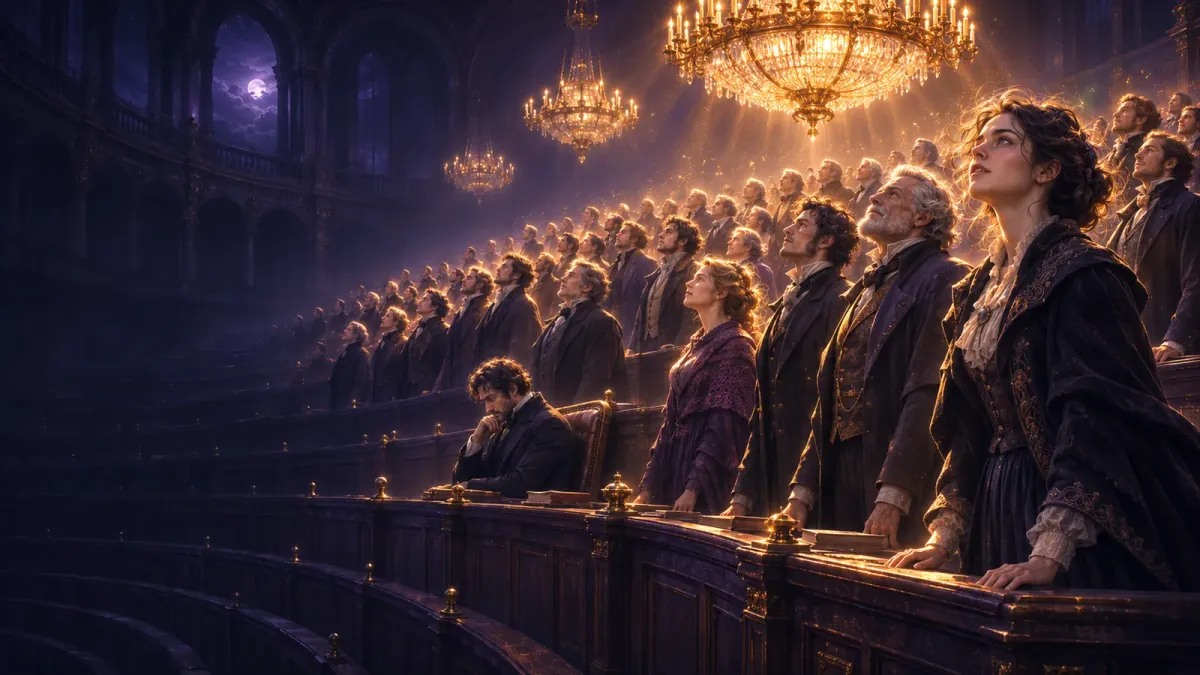
7 Szenen aus „The Crowd“, in der Reihenfolge der Geschichte und ohne das Ende.






Inhalt von „The Crowd“ · 15 Kapitel
- PrefaceSeite 1
- Introduction: The Era of CrowdsSeite 5
- I: General Characteristics of Crowds—Psychological Law of Their Mental UnitySeite 15
- II: The Sentiments and Morality of CrowdsSeite 26
- III: The Ideas, Reasoning Power, and Imagination of CrowdsSeite 52
- IV: A Religious Shape Assumed by All the Convictions of CrowdsSeite 63
Alle 15 KapitelWeniger anzeigen
- I: Remote Factors of the Opinions and Beliefs of CrowdsSeite 70
- II: The Immediate Factors of the Opinions of CrowdsSeite 93
- III: The Leaders of Crowds and Their Means of PersuasionSeite 109
- IV: Limitations of the Variability of the Beliefs and Opinions of CrowdsSeite 134
- I: The Classification of CrowdsSeite 148
- II: Crowds Termed Criminal CrowdsSeite 152
- III: Criminal JuriesSeite 157
- IV: Electoral CrowdsSeite 166
- V: Parliamentary AssembliesSeite 178
Bewertungen für „The Crowd“
Noch keine Bewertungen. Gib die erste ab.
Deine Bewertung
Rezensionen zu „The Crowd“
Noch keine Rezensionen.
Die Geschichte hinter „The Crowd“ und wann es geschrieben wurde
Where the individual disappears
Felix Alcan brought out this study of social psychology in Paris as Psychologie des foules, written in the shadow of the Paris Commune and the new mass politics of the Third Republic. Le Bon's central claim was blunt: step into a crowd, and your conscious personality gives way to a shared mind wide open to suggestion.
First edition, Félix Alcan (1895)
An anonymous translator, a global hit
Within a year of the French edition, T. Fisher Unwin published an anonymous English translation in London called The Crowd: A Study of the Popular Mind. Multiple other translations followed right behind it, turning a slim treatise into one of the best-selling scientific books of its era.
T. Fisher Unwin edition (1896)
Freud argues with Le Bon
Sigmund Freud gave Le Bon a whole chapter in Group Psychology and the Analysis of the Ego, quoting at length his account of how a crowd wipes out individual awareness. He called the description brilliant, then disagreed on the mechanism: for Freud, a crowd holds together not by mere hypnotic contagion, but through libido and emotional ties to a leader.
Sigmund Freud, Massenpsychologie und Ich-Analyse (1921)
On a dictator's bedside table
Benito Mussolini told a French journalist that he had read everything Le Bon wrote and had lost count of how many times he had reread Psychologie des foules. The Italian dictator called the book a capital work and said he kept coming back to it.
Interview in Le Figaro (1926)
Madison Avenue reads the crowd
In the United States, Edward Bernays built his manual Propaganda directly on Le Bon's ideas about the group mind. Where Le Bon saw street mobs thinking in images and slogans, Bernays saw a method for peacetime democratic politics and commercial advertising.
Edward Bernays, Propaganda (1928)
The loud borrower wins
Social historian Robert A. Nye and other scholars later showed how much of the book was taken without full credit from Scipio Sighele's 1891 Italian work La folla delinquente and from the French criminologist Gabriel Tarde. Sighele protested while he was alive, but Le Bon's brisk synthesis completely overshadowed the men he borrowed from.
Robert A. Nye, The Origins of Crowd Psychology (1975)
In der Kultur „The Crowd“
2 Adaptionen und Erwähnungen, 1895–1895
In der Sprache One mind out of many
Le Bon coined the 'law of the mental unity of crowds' to explain how people of any intelligence or background merge into a single impulsive mind the moment they gather. When people talk today about 'herd mentality' or 'mob psychology', they are working from the blueprint he drew here.
Gustave Le Bon, Psychologie des foules (1895)
In der Sprache Say it, repeat it, spread it
Looking at how leaders move a crowd, Le Bon reduced their tools to three steps: affirmation, repetition, and contagion. That three-part formula for getting an idea past reason and straight into public belief became a standard playbook for twentieth-century politicians and advertisers.
Gustave Le Bon, Psychologie des foules, Book II, Chapter 3 (1895)
Fragen und Antworten zu „The Crowd“ auf Englisch
Does a 'crowd' in the book only mean people standing together in the same street?
No — for Le Bon, a 'psychological crowd' does not always require people to be packed into the same square. What makes a crowd is a shared mental state in which individual judgment disappears and everyone's attention locks onto the same event or idea. By that definition, a whole social class or an entire nation reading the same news can act as a crowd without ever meeting face to face.
Does modern social psychology still agree with Le Bon's view of crowds?
Modern researchers treat Le Bon's book as a historical starting point rather than good science. Later psychologists showed that people in crowds rarely lose their minds to 'hypnotic contagion'; instead, they act according to the shared rules and values of the specific group they identify with. While Le Bon's observations about slogans and visual thinking remain sharp, his claim that every crowd regresses into a mindless savage state has been largely rejected.
What does Le Bon mean by 'race' throughout the book?
He uses the word primarily to mean a nation's inherited historical culture — the deep habits, traditions, and institutions of the French, the English, or the Spanish — rather than strictly biological categories. In his argument, this 'racial' spirit is the slow-moving foundation that limits how far any sudden political revolution can actually change a country. Still, his writing carries the nineteenth-century hierarchy that ranked European peoples above others and men above women.
What does Le Bon mean by 'prestige' when he talks about leaders?
In this book, 'prestige' is not just a good reputation; it is an almost hypnotic dominance that an idea, a title, or a person holds over other minds. Le Bon argues that prestige paralyzes our critical faculties and fills us with awe, making it the main source of any leader's power. He splits it into 'acquired prestige', which comes from a uniform, wealth, or a judicial robe, and 'personal prestige', the rare magnetism of figures like Napoleon.
Are crowds only capable of crime, or can they be heroic in Le Bon's view?
Le Bon insists that crowds are just as capable of extreme self-sacrifice as they are of lynching and looting. Because an individual in a crowd loses self-interest along with personal responsibility, a well-led crowd will march to its death for a flag or a creed that a lone, calculating citizen would never risk a scratch for. In his view, crowds are not inherently criminal, only extreme in whichever direction they are pushed.
Steckbrief zu „The Crowd“
14 Angaben zu Ausgabedaten und gemessenen Textmerkmalen. Alles nachprüfbar.
- Originaltitel
- The Crowd
- Autor
- Gustave Le Bon · 1841–1931
- Ersterscheinung
- 1895
- Originalsprache
- Englisch
- Genre
- Philosophie · Psychologie · Gesellschaft
- Themen
- Gesellschaft · Macht · Identität · Schichten
- Verschiedene Wörter
- 5.664
- Wörter pro Satz
- 26 Wörter
- Niveau des Originals
- C2So messen wir
- Versionen
- C2
- Umfang des Originals
- 15 Kap. · 54.727 Wörter
- Lesezeit
- ~5 Std.
- Übersetzer
- T. Fisher Unwin Ltd.
- Herunterladen
- EPUB
Ähnliche Bücher was du nach „The Crowd“ lesen kannst
Ähnlich im Geist
8Dasselbe Genre und dieselbe Stilebene.

On Liberty
John Stuart Mill
C2Orig.
~4 Std. 50 Min. · Philosophie

The Republic
Plato
C2Orig.
~20 Std. 10 Min. · Philosophie

The Interpretation of Dreams
Sigmund Freud
C2Orig.
~18 Std. 50 Min. · Psychologie

How to Live on 24 Hours a Day
Arnold Bennett
C2Orig.
~1 Std. 10 Min. · Selbsthilfe

Meditations
Marcus Aurelius
C2Orig.
~4 Std. 40 Min. · Philosophie

Eine Weihnachtsgeschichte
Charles Dickens
C2Orig.B1C1
~2 Std. 40 Min. · Klassiker

Tao Te King
Laozi
C2Orig.B1B2
~3 Std. 40 Min. · Philosophie

The Man Who Was Thursday
G. K. Chesterton
C2Orig.
~5 Std. 20 Min. · Detektivgeschichten