The Turn of the Screw in English
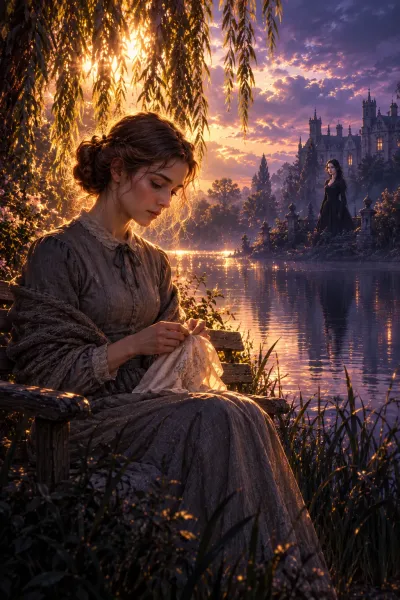
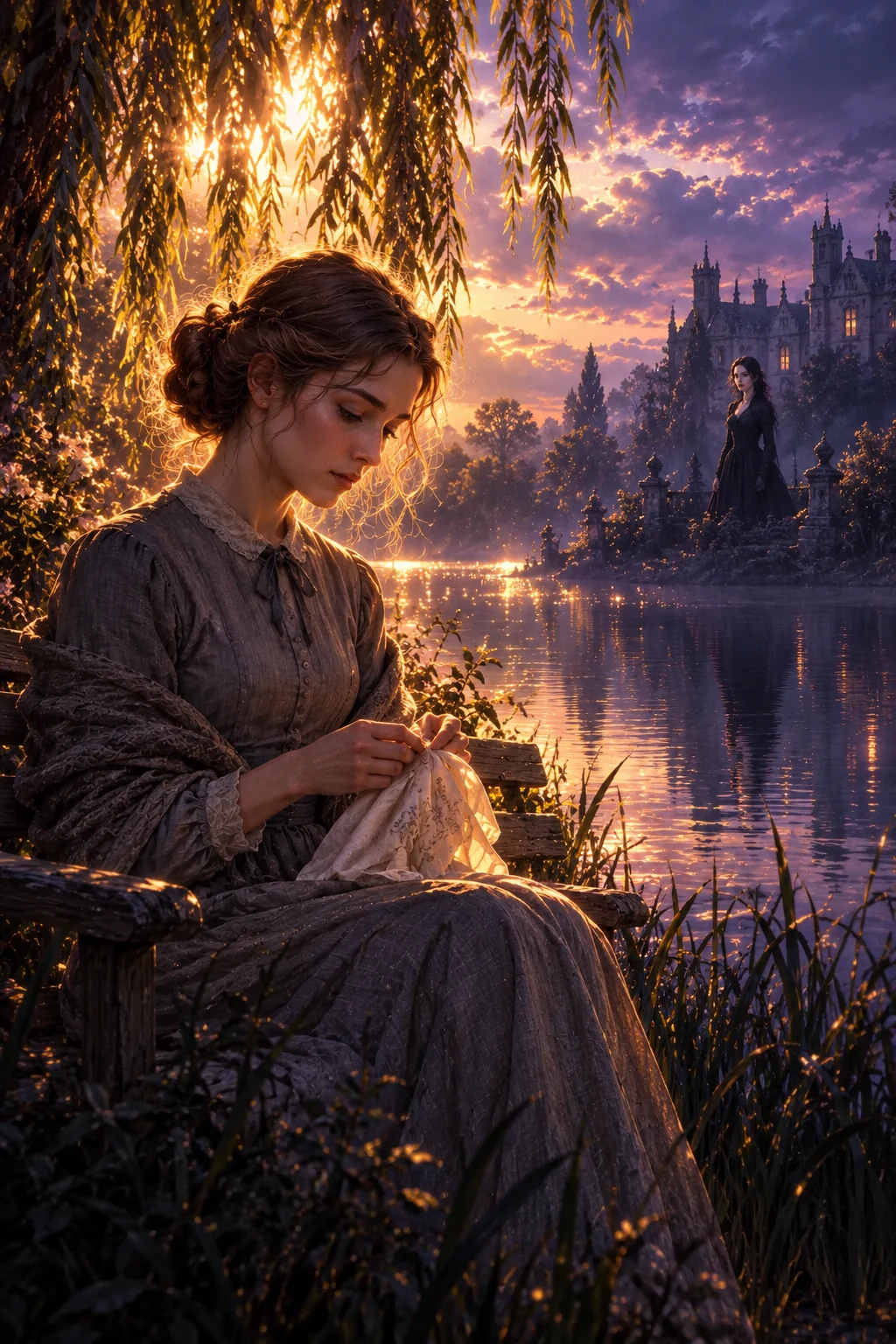
A young governess takes charge of two orphaned children at an isolated country estate, under strict orders never to contact their absent uncle. Soon she begins seeing the figures of two dead former servants watching the children.
The book opens with a short frame story at a Christmas gathering, where a man reads aloud from a dead woman's written manuscript. The rest of the novella is that unbroken first-person confession from the governess, divided into twenty-four short sections. Almost the entire story happens inside the house and gardens of Bly, alternating between the governess's silent observations and her long, probing talks with the housekeeper, Mrs. Grose. The prose is formal late-19th-century literary English, built around careful qualifications, indirect statements, and reported speech rather than physical action.
You will like it if
- Psychological tension where you have to judge the narrator's honesty for yourself
- A single, claustrophobic country-house setting with only four main characters
- Ghost stories that rely on quiet dread rather than gore or jump scares
- Subtle conversations where what is left unsaid matters more than what is spoken
You will not if
- Henry James's sentences are winding, heavily punctuated, and often delay the main point
- The plot refuses to give clear answers about what is really happening
- Very little physical action; most of the book consists of the governess analyzing her own thoughts
- The opening frame story is dense and takes several pages before the main plot starts
What kind of book “The Turn of the Screw” is
Versions of “The Turn of the Screw” in English: B1
Same book, adapted to a level you can read without stopping
Pick a version. The bar at the foot of the page opens the one you pick.
?
The decimal shows where the book sits within the level: B2.0 is the start of B2, B2.9 is nearly C1
Vocabulary by level
- A1 72%
- A2 16%
- B1 7%
- B2 4%
About this edition B1.9
This edition is at level B1.9 for independent readers. You can follow a long story in clear English. It keeps every event and character and line of dialogue. The average sentence length fell from 17.2 words to 7.7 words. Hard words are words at B2 and above. Their share fell from 7.4 percent to 1.3 percent. 41 rare words are explained in round brackets where they first appear. You can read it in about five and a half hours. NewGen Books adapted this edition with the help of AI.
About the level
This edition is B1.9 on the NewGen Books scale (version 1.2) and the original C2; both are measured from the text itself. On the Flesch–Kincaid formula's US school scale the edition reads at grade 1 and the original at grade 7. In the CEFR's words, a B1 reader “can follow the plot of stories, simple novels and comics with a clear linear storyline and high frequency everyday language, given regular use of a dictionary.”
Adaptation 0.3.3 · Oct 23, 2026
A sample from “The Turn of the Screw” in English
One passage, the way each version writes it.
Tap any word — we will show the translation
Arrow keys move between words, Enter shows the translation.Original · C2182 words
Nonetheless, the rest of the day I watched for further occasion to approach my colleague, especially as, toward evening, I began to fancy she rather sought to avoid me. I overtook her, I remember, on the staircase; we went down together, and at the bottom I detained her, holding her there with a hand on her arm. “I take what you said to me at noon as a declaration that you’ve never known him to be bad.”
She threw back her head; she had clearly, by this time, and very honestly, adopted an attitude. “Oh, never known him—I don’t pretend that!”
I was upset again. “Then you have known him—?”
“Yes indeed, miss, thank God!”
On reflection I accepted this. “You mean that a boy who never is—?”
“Is no boy for me!”
I held her tighter. “You like them with the spirit to be naughty?” Then, keeping pace with her answer, “So do I!” I eagerly brought out. “But not to the degree to contaminate—”
“To contaminate?”—my big word left her at a loss. I explained it. “To corrupt.”
B1.9175 words
For the rest of the day I watched. I wanted time to talk to her. Toward evening I began to think she tried to keep away from me. I met her, I remember, on the stairs. We went down together, and at the bottom I held her. I kept her there with a hand on her arm. “You spoke to me at noon. I take it as a word that you never knew him to be bad.”
She threw back her head. By this time she had clearly made up her mind. “Oh, never knew him — I do not say that!”
I was upset again. “Then you have known him —?”
“Yes indeed, miss, thank God!”
After thought I took her meaning. “You mean that a boy who never is —?”
“Is no boy for me!”
I held her tighter. “You like them with the heart to be naughty?” Then I said at once, “So do I! But not so as to soil —”
“To soil?” — my big word left her lost. I explained it. “To make bad.”
The original language of “The Turn of the Screw” and what it gives you
How hard the language is C2
We measure the original text at C2. On the surface, the vocabulary looks manageable: 79% of the words belong to the basic A1–A2 bands, only 4% fall outside the 5,000 most common English words, and the average sentence is a moderate 17.1 words. However, the C2 rating comes from how Henry James puts those simple words together. Because dialogue is mixed with long stretches of reflection, the narrative passages contain very long, nested sentences where ordinary words are used with abstract, indirect meanings.
What this means in practice: Everyday words arranged in complex, indirect late-Victorian grammar; a true C2 test of reading between the lines.
What to be ready for
How to read it and not quit
- Look for the main subject and verb first when a sentence is split by dashes or commas; James often puts two or three side-thoughts between a pronoun and its action.
- Keep track of pronouns like 'it', 'that', and 'this' across paragraphs, because the characters politely avoid naming ugly ideas directly.
- Pay close attention to modal verbs and past conditionals ('might have been', 'would have known'), which separate what the governess actually saw from what she only concluded later.
- Do not expect the opening chapter to be the easiest; the frame narrator's sentences are some of the densest in the book, and the style becomes more direct once the governess begins her story.
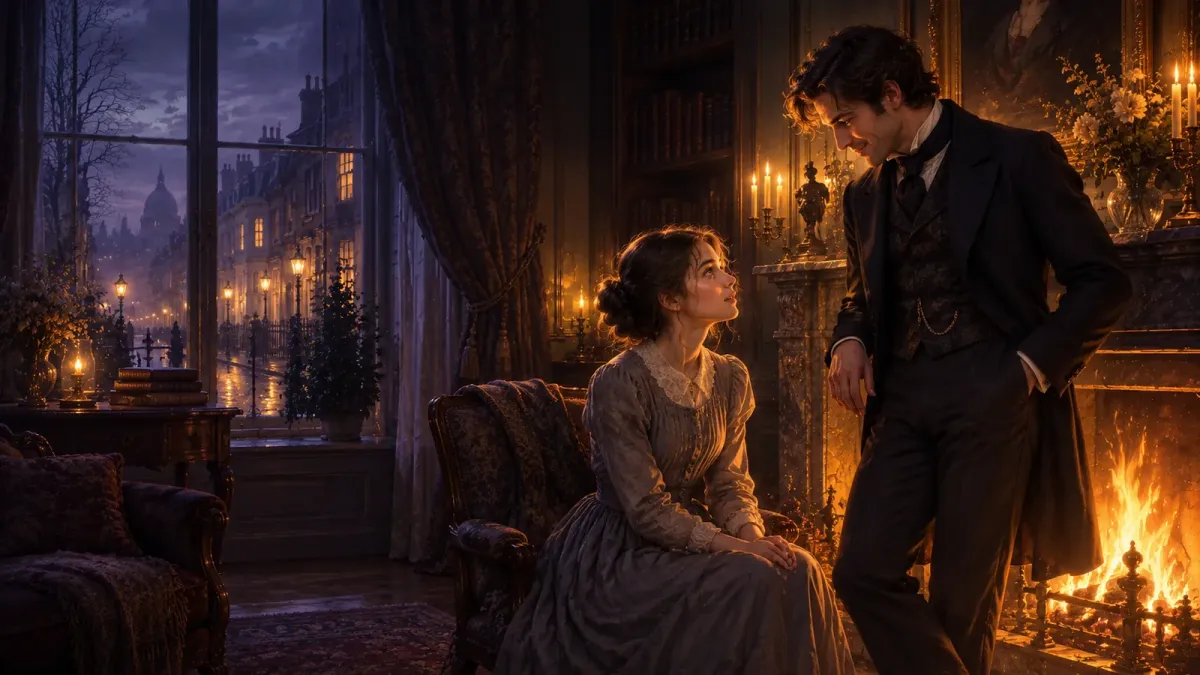
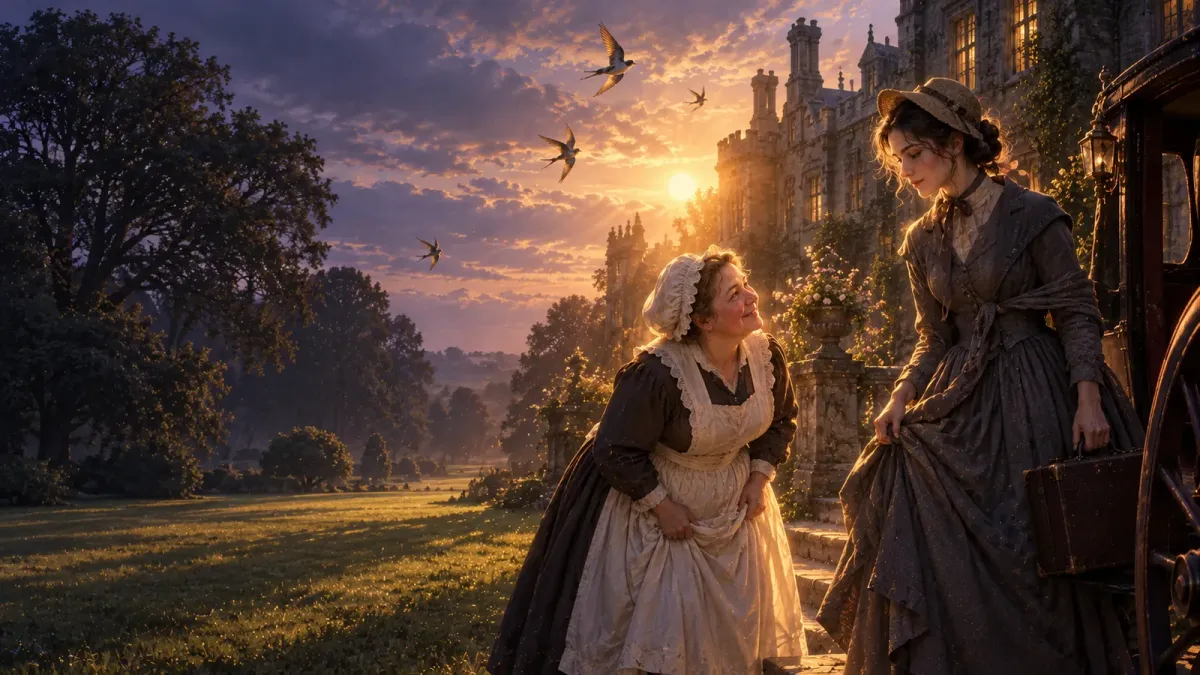
Illustrations for “The Turn of the Screw”
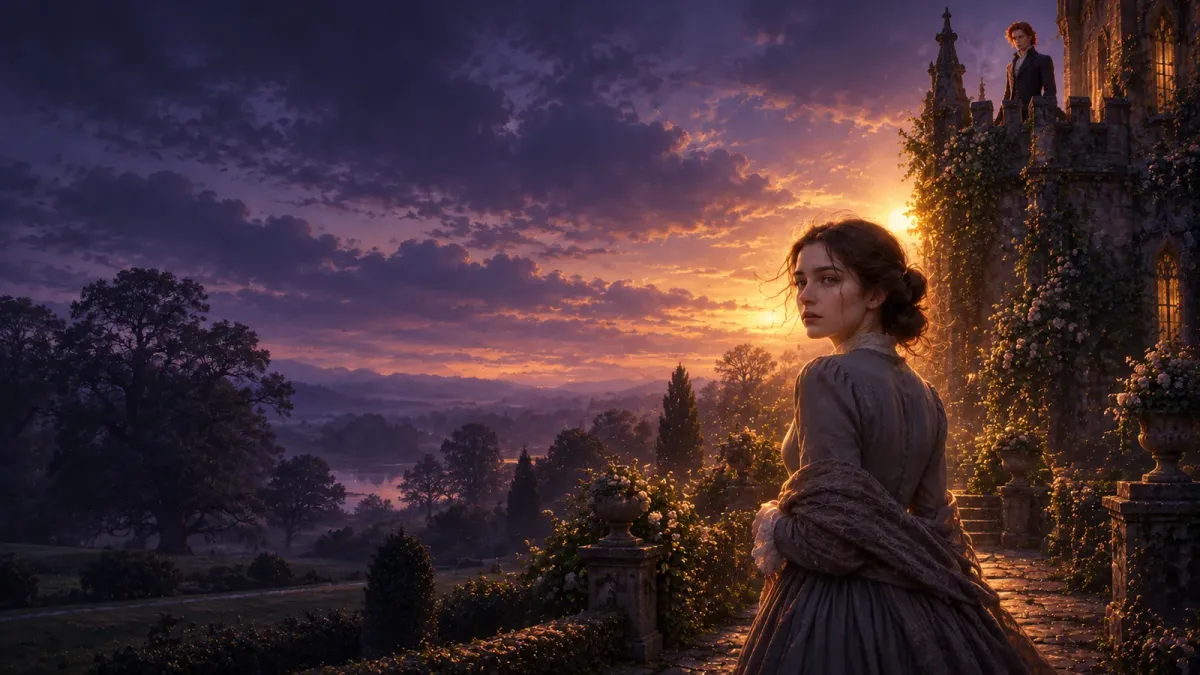
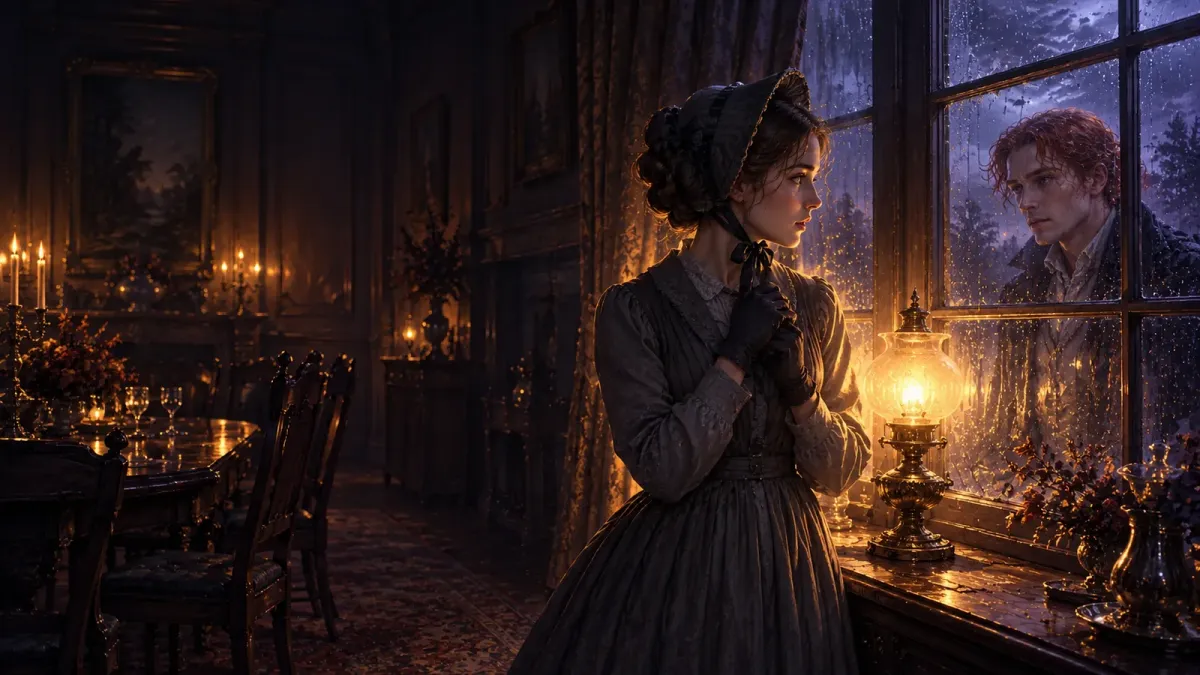
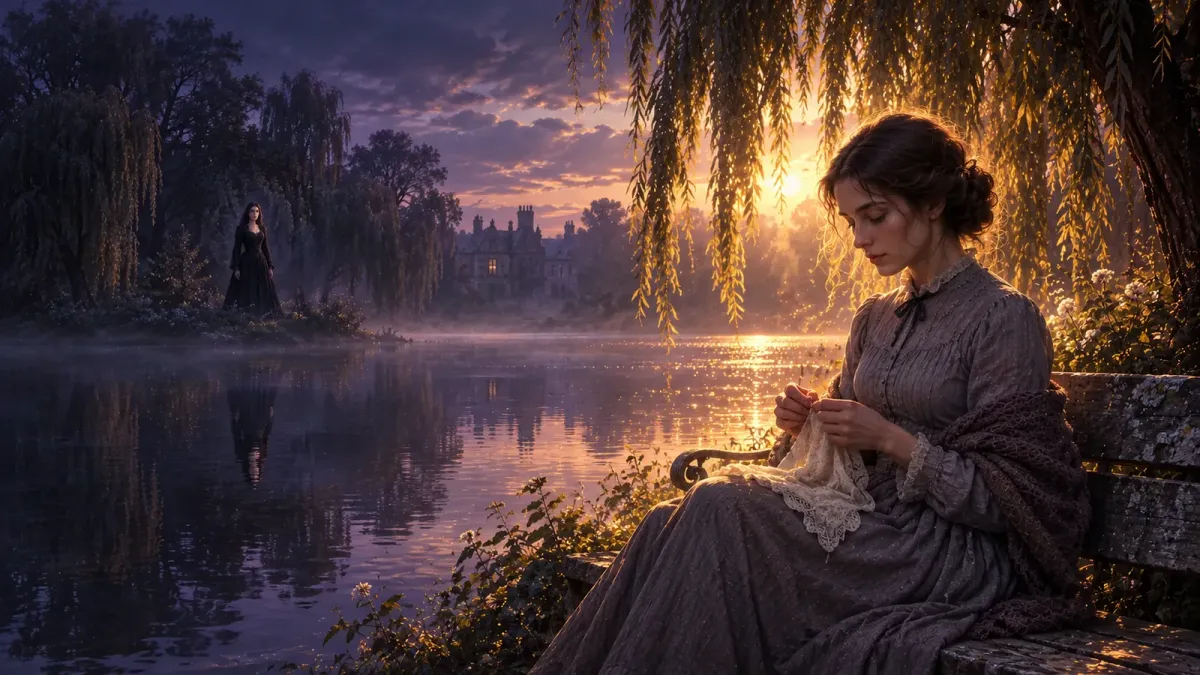
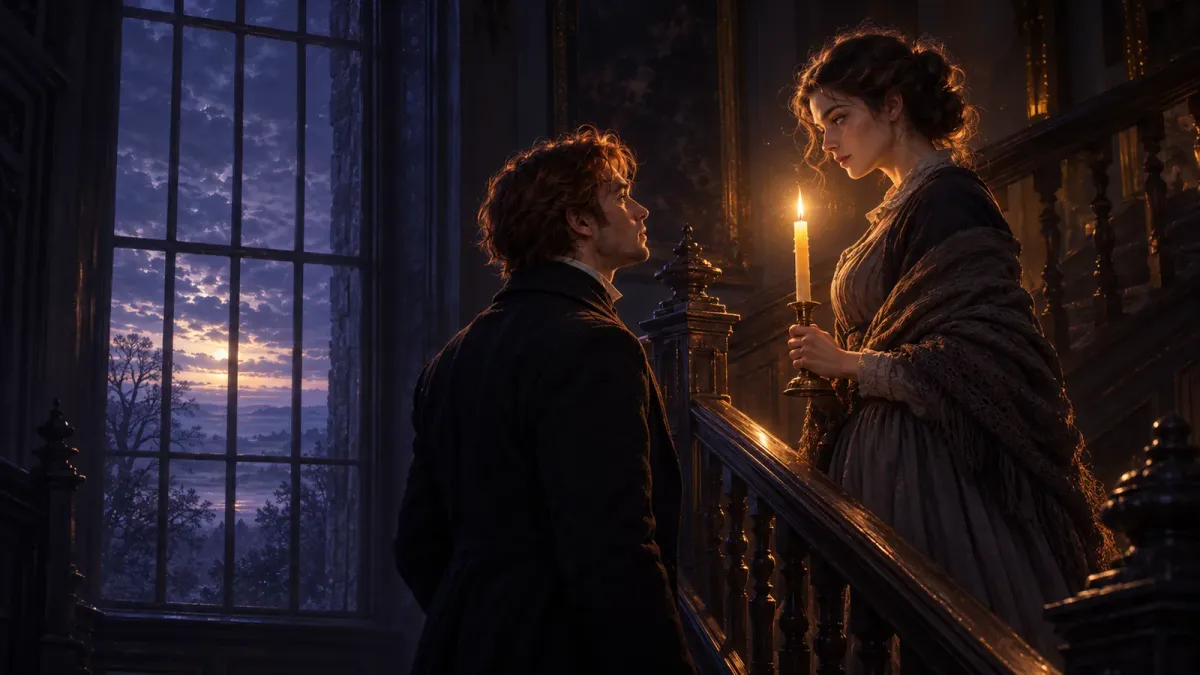
5 scenes from “The Turn of the Screw”, in story order and without the ending.
Contents of “The Turn of the Screw” · 25 chapters
- Prologuepage 1
- Ipage 11
- IIpage 17
- IIIpage 22
- IVpage 29
- Vpage 35
All 25 chaptersShow fewer
- VIpage 39
- VIIpage 48
- VIIIpage 54
- IXpage 60
- Xpage 66
- XIpage 73
- XIIpage 78
- XIIIpage 82
- XIVpage 88
- XVpage 92
- XVIpage 96
- XVIIpage 99
- XVIIIpage 105
- XIXpage 109
- XXpage 114
- XXIpage 119
- XXIIpage 126
- XXIIIpage 131
- XXIVpage 135
Reader ratings for “The Turn of the Screw”
Nobody has rated it yet. Be the first.
Your rating
Reader reviews of “The Turn of the Screw”
No reviews yet.
The story of “The Turn of the Screw”
Archbishop Benson's Fireside Ghost Story
While visiting Addington Palace in January, Henry James heard Edward White Benson, the Archbishop of Canterbury, recount a fragmentary anecdote about two small children haunted by the ghosts of corrupt servants.
The Notebooks of Henry James
Dictated at Lamb House
Suffering from wrist pain and having recently leased Lamb House in Rye, James dictated the novella to his Scottish typist William MacAlpine, who took the story down directly on a Remington typewriter.
Preface to the New York Edition (1908)
Serialisation and Book Release
The story first ran in twelve weekly instalments in Collier's Weekly from January to April with illustrations by John La Farge and Eric Pape, before appearing in the two-story volume The Two Magics in October.
Collier's Weekly / Macmillan and Co.
The New York Edition Preface
Revising the text for Volume XII of his collected works, James described the novella as an 'amusette to catch those not easily caught' and explained that leaving the precise nature of the evil blank forced the reader's imagination to supply the worst.
The Novels and Tales of Henry James, Vol. XII
Edmund Wilson's Psychoanalytic Debate
Critic Edmund Wilson published a landmark essay arguing that the ghosts were the neurotic hallucinations of a sexually repressed governess, sparking one of the twentieth century's fiercest critical debates between 'apparitionists' and 'non-apparitionists'.
Hound & Horn ('The Ambiguity of Henry James')
In culture “The Turn of the Screw”
10 adaptations and mentions, 1898–2020
In the language Another turn of the screw
Drawn from the prologue's discussion of how a ghost story involving one child can be given a heightened twist by adding a second, the phrase entered common usage to mean an incremental, deliberate tightening of pressure.
Art Charles Demuth's Watercolour Illustrations
American Precisionist painter Charles Demuth created a celebrated suite of five modernist watercolours depicting key psychological confrontations in the novella, now held in major American museum collections.
Stage The Innocents on Broadway
Playwright William Archibald adapted the novella into a successful two-act Broadway play at the Playhouse Theatre, bringing the isolated corridors of Bly to the stage with Beatrice Straight as the Governess.
Stage Benjamin Britten's Chamber Opera
Composer Benjamin Britten and librettist Myfanwy Piper premiered their two-act chamber opera at the Teatro La Fenice in Venice, structuring the score around a twelve-note theme that tightens through fifteen orchestral variations—explicitly named 'Turns'—while giving the ghosts hypnotic singing roles.
Series Ingrid Bergman's Television Debut
Director John Frankenheimer staged a live prestige broadcast for the anthology series Startime starring Ingrid Bergman as the Governess, earning Bergman an Emmy Award in her first dramatic role on American television.
Film Jack Clayton's The Innocents
Co-written by Truman Capote and shot in stark black-and-white CinemaScope by Freddie Francis, Jack Clayton's film starring Deborah Kerr became a benchmark of psychological horror for preserving James's ambiguity through lighting and sound design.
Film The Nightcomers
Director Michael Winner and screenwriter Michael Hastings crafted a theatrical prequel starring Marlon Brando as Peter Quint and Stephanie Beacham as Miss Jessel, imagining how their sadomasochistic relationship shaped the children before the Governess arrived.
In the language Shoshana Felman's Critical Trap
Literary theorist Shoshana Felman's influential essay 'Turning the Screw of Interpretation' turned the novella into the quintessential textbook case for how an unreliable text traps its own readers and critics into repeating the narrator's paranoia.
Yale French Studies
Music Kate Bush's 'The Infant Kiss'
Inspired directly by watching The Innocents, Kate Bush wrote and recorded the haunting piano track 'The Infant Kiss' on her 1980 album Never for Ever, exploring the Governess's terrified reaction to an adult spirit possessing a young boy.
Series The Haunting of Bly Manor
Creator Mike Flanagan used the novella as the backbone of his nine-episode Netflix Gothic romance series, weaving characters and plots from several other Henry James ghost stories into the estate's history.
Questions and answers about “The Turn of the Screw” in English
are the ghosts real in The Turn of the Screw or is she crazy
The book is deliberately written so that both readings fit the facts on the page. Everything is told through the governess's own manuscript, and while she describes the apparitions in exact detail, no other character ever clearly admits to seeing them at the same time. Readers and critics have argued over whether it is a real haunting or a case of delusion since 1898, and James designed the text to keep both possibilities open.
why did Miles get expelled from school in The Turn of the Screw
The headmaster's letter never states the exact offense, saying only that Miles is an injury to his classmates. Later in the book, the reason is hinted at only in a single, unfinished phrase about things Miles said to a few boys, who then repeated them to others. James leaves the details blank so the reader's imagination supplies something worse than any specific rule-breaking.
how similar is The Haunting of Bly Manor to The Turn of the Screw
The Netflix series uses the setting, the characters' names, and the basic premise of the novella, but changes the plot and tone completely. The show combines several other Henry James short stories, invents full backstories for the ghosts, and turns the story into a gothic romance. The book is much shorter, stays strictly inside the governess's head, and explains almost nothing about the dead servants' past lives.
what is the best movie adaptation of The Turn of the Screw
The 1961 black-and-white film *The Innocents*, directed by Jack Clayton and starring Deborah Kerr, is widely considered the closest and most effective adaptation. It keeps the period setting, preserves the psychological ambiguity of the book, and captures the quiet tension of the prose without adding modern subplots.
why is Henry James so hard to read
James writes the way an anxious, polite person thinks when trying to explain a complicated social situation. Instead of stating an action plainly, he interrupts his sentences with parenthetical clauses, qualifiers, and second thoughts, using simple words in abstract ways. If you rush, you lose the thread of who is doing what, so you have to read his sentences at speaking speed.
who is Douglas at the beginning of The Turn of the Screw
Douglas is a guest at a country-house Christmas party who owns the dead governess's written manuscript. Decades before the story opens, she was his younger sister's governess, and he liked and trusted her enough that she sent him her private diary before she died. Once he begins reading her pages aloud at the end of the introduction, he never interrupts the story again.
do we ever learn the governess's name in The Turn of the Screw
No, her name is never given anywhere in the book. In the opening frame story Douglas refers to her only as a woman he knew when he was a young man, and in the manuscript itself she writes purely in the first person. Leaving her nameless keeps the focus entirely on her role at the estate and her isolated point of view.
is The Turn of the Screw actually scary
It is unsettling and tense rather than graphic or violent. There is no blood or physical gore; the fear comes from the silent appearances of the figures in broad daylight and the growing doubt about whether the children are in danger from the ghosts or from their caretaker. If you want modern horror tropes, you will find it quiet, but if you like psychological dread, it works very well.
was The Turn of the Screw based on a real story
It grew out of a brief anecdote told to Henry James in January 1895 by Edward White Benson, the Archbishop of Canterbury. Benson remembered a vague, half-forgotten story about two small orphaned children in an old house who were haunted by the spirits of bad servants trying to ruin them. James recorded the two-sentence idea in his notebook and built the entire novella from that starting point.
did Jane Eyre inspire The Turn of the Screw
Yes, the book consciously echoes *Jane Eyre* and even alludes to Brontë's novel inside the text. Both books feature a poor, sheltered young woman who travels to an isolated estate to teach a wealthy man's ward and hopes to win her absent employer's approval. James takes that familiar Victorian romance setup and turns the governess's romantic daydream into a nightmare.
In brief about “The Turn of the Screw”
15 fields of imprint data and measured text characteristics. All of it checkable.
- Original title
- The Turn of the Screw
- Author
- Henry James · 1843–1916
- First published
- 1898
- Original language
- English
- Genre
- Gothic & mystery · Classics
- Mood
- Unsettling
- Themes
- Childhood · Duty · Class · Power
- Setting
- Bly, an isolated country estate in Essex, England · Mid-19th century
- Distinct words
- 4,406
- Words per sentence
- 17 words
- Level of the original
- C2
- Versions
- C2, B2.9, B1.9
- Length of the original
- 25 ch. · 42,770 words
- Reading time
- ~4 h
- Download
- EPUB
Similar what to read after “The Turn of the Screw”
Close in spirit
8The same genre and the same register.
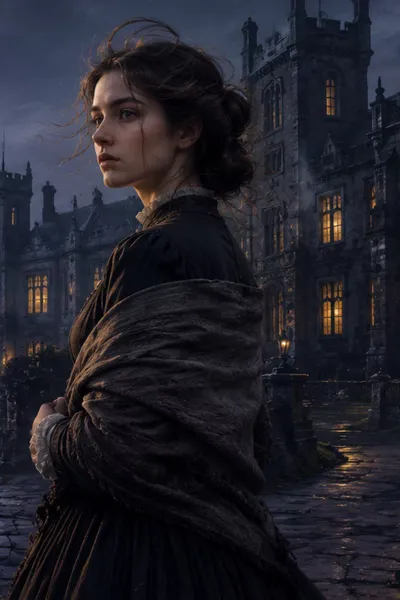
Jane Eyre
Charlotte Brontë
C2orig.B1C1
~17 h 20 min · Classics

Tao Te Ching
Laozi
C2orig.B1
~3 h 40 min · Philosophy

White Fang
Jack London
C2orig.B1B2
~6 h 40 min · Adventure
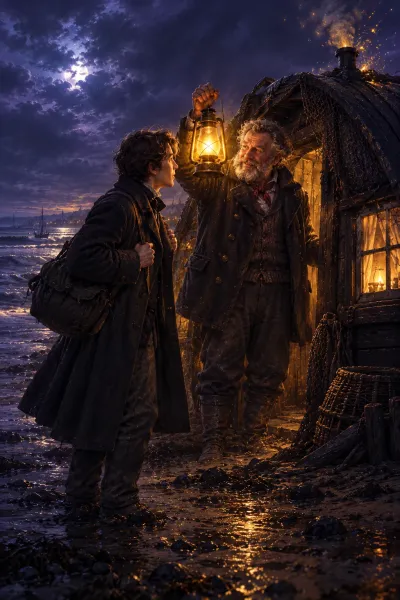
David Copperfield
Charles Dickens
C2orig.B1
~33 h · Classics
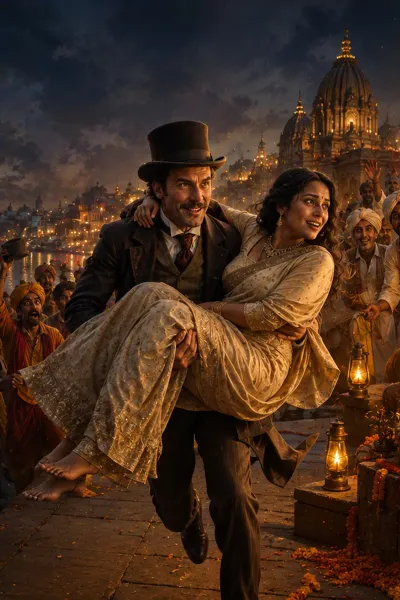
Around the World in Eighty Days
Jules Verne
C2orig.B1B2
~5 h 50 min · Adventure
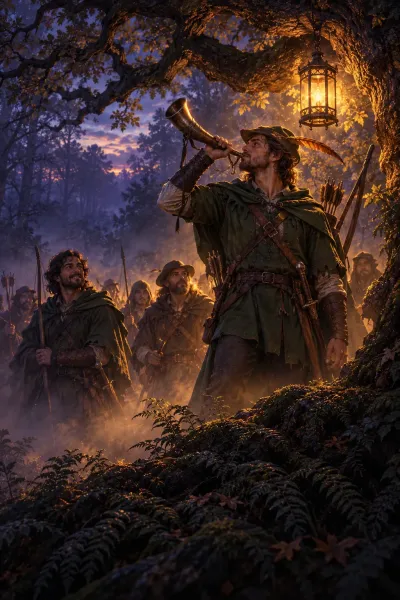
The Merry Adventures of Robin Hood
Howard Pyle
C2orig.
~10 h 20 min · Adventure
The Story of King Arthur and his Knights
Howard Pyle
C2orig.
~10 h 30 min · Classics
The Scarlet Letter
Nathaniel Hawthorne
C2orig.B2
~7 h 50 min · Classics
Book page 0.2.0 · Oct 23, 2026