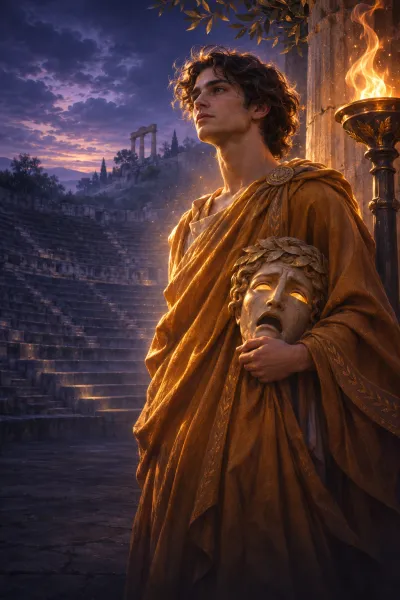
Short Works v angličtině
How do you stay free and calm when you cannot control your health, your reputation, or the people around you? Epictetus answers by drawing a hard line between your own mind and everything else in the world, then training you to stop bargaining with the wrong side of the line.
The book is divided into two distinct parts: the Enchiridion (or Manual), a numbered sequence of fifty-three short chapters, and the Fragments, a collection of stray quotes and anecdotes salvaged from later ancient writers. The Enchiridion opens with its fundamental rule about what is and is not in our power, and then tests that rule against everyday annoyances—going to the public baths, attending banquets, losing property, or facing bereavement. The Fragments follow no single plan, jumping from sharp one-liners about greed to short exchanges with stubborn students. Because these were classroom remarks compiled by his pupil Arrian, the tone is direct and urgent, more like a coach barking instructions from the sidelines than a professor writing a treatise. In this 1877 British translation, that blunt ancient voice is dressed in crisp, formal late-Victorian prose.
- Short, punchy sections that get straight to the point without long introductions
- Concrete analogies drawn from Roman daily life—public baths, athletic games, dinner parties, and sea voyages
- Brutally honest advice that refuses to flatter the reader or offer easy comfort
- Ideas you can test immediately the next time you are stuck in traffic or criticized at work
- No overarching narrative and very little sustained argument—it reads like a list of strict rules and reminders
- The emotional detachment can feel harsh, especially when Epictetus compares losing a child or spouse to returning a borrowed cup
- The second half (the Fragments) consists of disconnected scraps that lack the structure of the opening manual
- The late-Victorian translation uses formal, slightly stiff grammar that adds distance to what was originally rough spoken Greek
Jaká je to kniha „Short Works“
Originál knihy „Short Works“ (angličtině)
Vyber verzi. Lišta dole na stránce otevře tu vybranou.
Slovní zásoba podle úrovní
- A1 64%
- A2 15%
- B1 8%
- B2 5%
- mimo slovník 5%
Původní jazyk knihy „Short Works“ a co ti dá
Jak náročný je jazyk C2
Our measurement puts the original text at C2, meaning it asks for a full command of formal, literary English. Most of the individual words are common everyday ones, and the sentences run at a moderate pace rather than stretching across whole pages. What pushes the text to the top of the scale is the combination of compressed philosophical thought and late-Victorian syntax, where a short paragraph can pack three clauses of abstract advice about duty and the human will into a tight space. You will also meet occasional nineteenth-century phrasing and words from Roman antiquity that do not appear in modern conversation.
Co to znamená v praxi: The original suits advanced readers comfortable with formal nineteenth-century British prose; no adapted editions are available yet.
Na co se připravit
Jak číst a nevzdat to
- Watch out for the word 'appearances' (or 'impressions'): Epictetus does not mean how you look in the mirror, but how outside events first present themselves to your mind before you judge them.
- Do not let inverted negative commands like 'laugh not much' or 'swear not at all' slow you down; simply read them as 'do not laugh' and 'do not swear'.
- Pay close attention to the small pronouns 'it' and 'that' in the longer fragments, as Victorian translators often link several clauses back to a single noun mentioned three lines earlier.
Co se dozvíš z knihy „Short Works“
Only your own judgments belong to you
Your desires, impulses, and opinions are under your command, while your body, wealth, and status belong to fortune; confusing the two is the root of all human misery.
Our opinions trouble us, not things themselves
An insult, an illness, or even death has no power to hurt you until you agree to call it terrible, meaning you should blame your own interpretation rather than the person who offended you.
Wish for events to happen as they do
Demanding that the world bend to your preferences guarantees frustration, whereas accepting events as they actually unfold makes your life run smoothly.
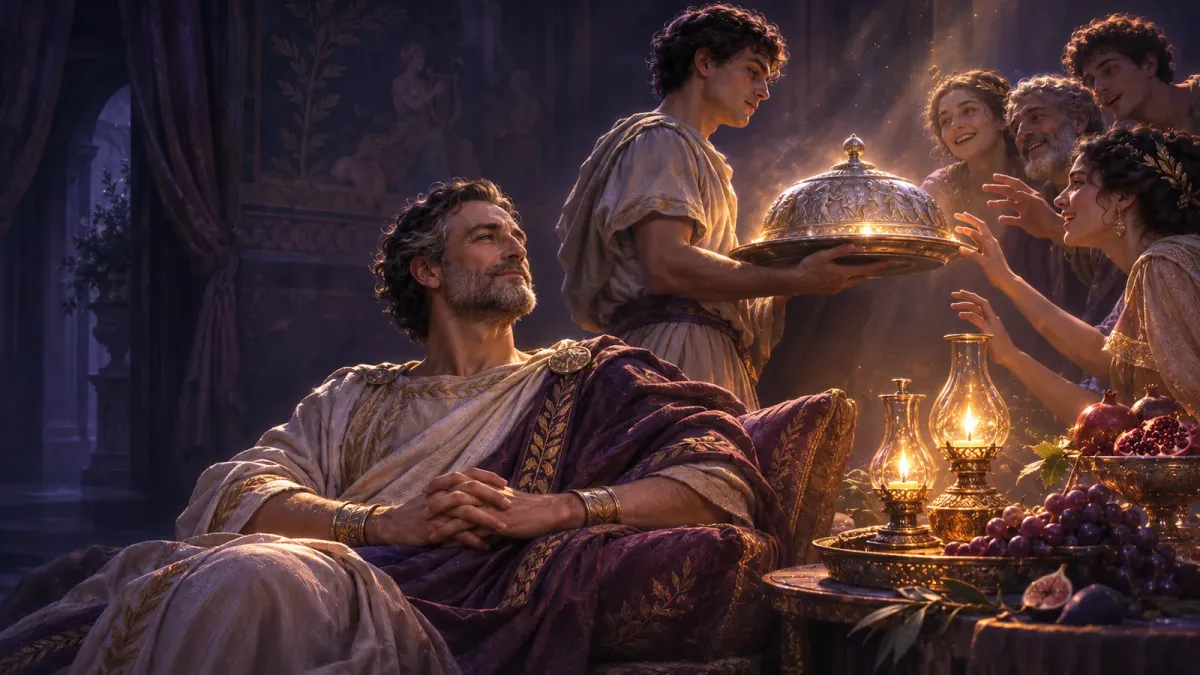
Behave in life as at a banquet
Take your polite share of whatever reaches you, do not grab for the platter while it is still far off, and let things go without complaint when the host takes them away.
Show your philosophy in action, not talk
Just as sheep do not vomit up their grass to prove to the shepherd how much they have eaten, you should digest your principles and show them in your daily behavior rather than reciting books to impress people.
Pro koho je
- You want to read the actual ancient source behind modern books on Stoicism and cognitive therapy.
- You prefer philosophy in short, self-contained paragraphs that you can read and think over on a twenty-minute commute.
- You find yourself losing sleep over office politics, bad news, or other people's opinions and want a cold splash of perspective.
Ukázka z knihy „Short Works“ v angličtině
Klepni na libovolné slovo – ukážeme ti překlad
Šipkami přecházíš mezi slovy, Enter zobrazí překlad.Originál · C2161 slov
Remember that in life you ought to behave as at a banquet. Suppose that something is carried round and is opposite to you. Stretch out your hand and take a portion with decency. Suppose that it passes by you. Do not detain it. Suppose that it is not yet come to you. Do not send your desire forward to it, but wait till it is opposite to you. Do so with respect to children, so with respect to a wife, so with respect to magisterial offices, so with respect to wealth, and you will be some time a worthy partner of the banquets of the gods. But if you take none of the things which are set before you, and even despise them, then you will be not only a fellow banqueter with the gods, but also a partner with them in power. For by acting thus Diogenes and Heracleitus and those like them were deservedly divine, and were so called.
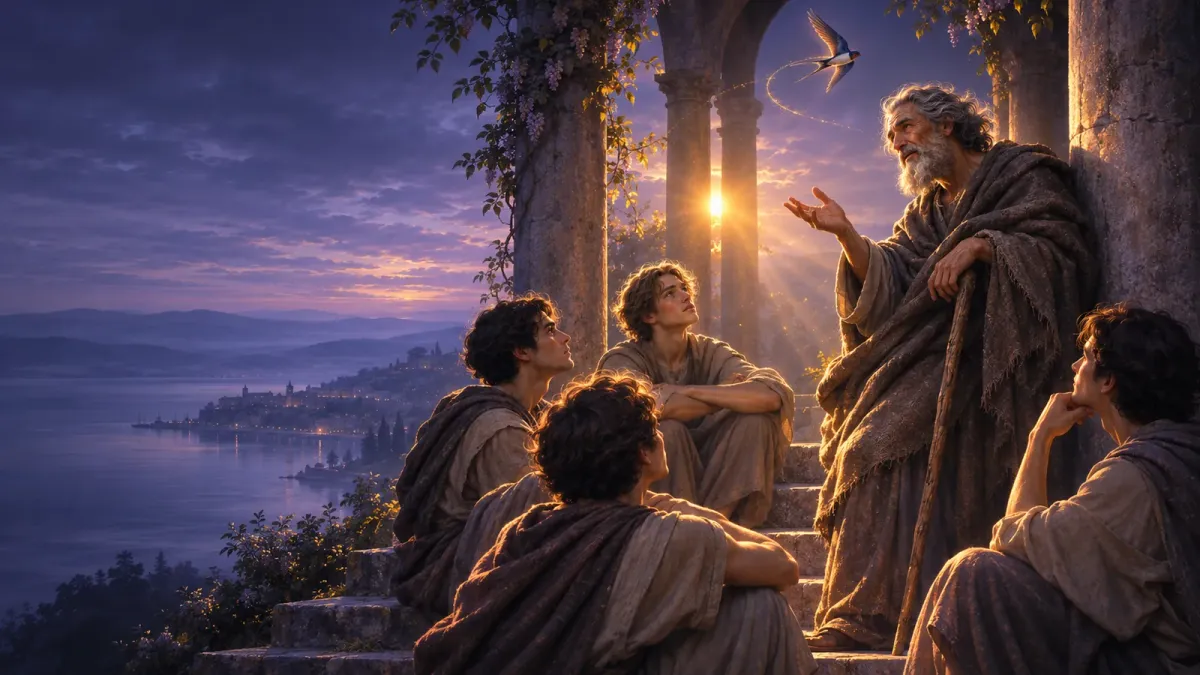
Ilustrace ke knize „Short Works“
7 scén z knihy „Short Works“, v pořadí podle příběhu a bez konce.






Obsah knihy „Short Works“ · 2 kapitoly
Hodnocení čtenářů knihy „Short Works“
Zatím žádné hodnocení. Přidej první.
Tvoje hodnocení
Recenze čtenářů knihy „Short Works“
Zatím žádné recenze.
Historie knihy „Short Works“ a kdy vznikla
Notes from a banished classroom
Epictetus never wrote a book; after Emperor Domitian kicked philosophers out of Rome, he simply talked to students at his school in Nicopolis. One student, Arrian of Nicomedia, wrote those classroom talks down in everyday Koine Greek. Four of his eight books of Discourses survive, along with the Enchiridion, a short handbook Arrian pulled together from the sharpest passages.
Arrian, Dedicatory Letter to Lucius Gellius (prefaced to the Discourses)
Latin first, from broken Greek
Western Europe met the Enchiridion in print in Latin before it ever appeared in Greek. The humanist Angelo Poliziano had translated it in 1479 for his patron Lorenzo de' Medici, piecing the text together from damaged Greek manuscripts, and a Bologna press finally printed his work nearly forty years before the original Greek was printed.
Niccolò Perotti and Angelo Poliziano editions; Boter (1999)
Arrian's Greek reaches the press
Renaissance readers finally got the original Koine Greek when the scholar Vettor Trincavelli edited the first printed edition in Venice. Brought out by the printer Bartolomeo Zanetti, the volume paired the Discourses and the Enchiridion with a sixth-century commentary by Simplicius.
Trincavelli edition, Venice (1535)
A thousand pounds for Greek
Elizabeth Carter, a classicist and Bluestocking writer, produced the first complete English translation taken straight from the Greek, All the Works of Epictetus, Which Are Now Extant. Sold by subscription in London, the book made her roughly a thousand pounds and held its place as the standard English text for over a hundred years.
Montagu Pennington, Memoirs of the Life of Mrs. Elizabeth Carter (1807)
When Socrates became Saint Paul
Christian monks in late antiquity liked the handbook's practical ethics so much that they adopted it as a manual for monastic life. In versions like the Paraphrasis Christiana, attributed to Nilus of Ancyra, the editors kept the advice but swapped out the pagan furniture: Socrates became Saint Paul, many gods became one, and the Stoic view on suicide was quietly toned down.
Gerard Boter, The Encheiridion of Epictetus and Its Three Christian Adaptations (1999)
V kultuře „Short Works“
4 adaptace a zmínky, 1955–1998
V jazyce Ancient Greek in the therapist's office
In Chapter 5 of the Enchiridion, Epictetus says that people are upset not by things, but by the views they take of things. The psychologist Albert Ellis built Rational Emotive Behavior Therapy—a direct ancestor of modern cognitive behavioral therapy (CBT)—around that single sentence, quoting it across his clinical manuals.
Albert Ellis, Reason and Emotion in Psychotherapy (1962)
V jazyce A handbook memorized before captivity
U.S. Navy pilot James Stockdale had memorized the Enchiridion as a philosophy student at Stanford before his plane was shot down over North Vietnam. Through more than seven years of captivity and torture in the Hoa Lo Prison, he ran his days by Epictetus's rule not to care about what lies beyond one's control, a story he later told in his 1993 essay Courage Under Fire.
James Bond Stockdale, Courage Under Fire: Testing Epictetus's Doctrines in a Laboratory of Human Behavior (1993)
V jazyce The wrong book in prison
Having heard about Epictetus from Admiral James Stockdale, Tom Wolfe built the moral turn of his novel A Man in Full around the philosopher. A jailed young warehouse worker named Conrad Hensley orders a thriller, gets the works of Epictetus by mistake, and walks out of the pages a Stoic.
Tom Wolfe, A Man in Full (1998)
V jazyce What is up to us
The very first sentence of the Enchiridion splits the world in two: our own judgments, impulses, and desires are 'up to us,' while our body, property, reputation, and office are not. Modern Stoics and psychologists call this split the 'dichotomy of control' and use it as the starting exercise for mental resilience.
Epictetus, Enchiridion 1.1
Otázky a odpovědi o knize „Short Works“ v angličtině
What does the word 'Enchiridion' actually mean?
In Greek, 'enchiridion' literally means something held 'in the hand'. The same word could mean a short dagger, and philosophers used it for a ready handbook rather than a heavy reference scroll. Epictetus's manual was meant to be kept mentally at your fingertips, ready to use the moment anger, fear, or grief struck.
Does Epictetus really tell you not to love your family or care if your child dies?
No, he argues for affection without the illusion of ownership, though his examples shock many modern readers. When he tells you to remind yourself when kissing your child that you are kissing a mortal human being, he is not asking you to be cold, but to remember that life is fragile and loaned to us briefly. In his view, acknowledging mortality now stops grief from destroying your capacity to function later.
What does Epictetus mean when he tells you to 'live according to nature'?
He does not mean moving to the woods or living like an animal, which is what modern readers usually picture. For ancient Stoics, a creature's 'nature' is its highest distinctive ability, and for human beings that ability is reason and social cooperation. Living according to nature therefore means acting rationally, accepting how the physical universe works without complaint, and doing your duty toward other people.
Where do the 'Fragments' in the second half of the book come from?
They are surviving quotations from the four lost books of Epictetus's Discourses and other recorded remarks that did not make it into the surviving manuscripts. Later ancient writers—most notably the fifth-century anthologist Stobaeus, along with Marcus Aurelius and Aulus Gellius—copied these passages into their own books. Modern editors gathered those scattered quotes together to form the Fragments section.
Why does Epictetus talk about both 'God' and 'the gods'?
Stoics believed in a single rational divine principle that steers the universe, which allowed Epictetus to speak interchangeably of 'Zeus', 'God', 'Nature', and the traditional 'gods'. He viewed the universe as a single living city governed by divine providence, and our own minds as small fragments of that same reason. When he tells you to obey God, he is not preaching a modern church creed, but urging you to accept the rational order of the cosmos.
How did Epictetus become lame?
Ancient accounts give two different explanations for his permanent limp, and historians are not sure which one is true. One tradition, recorded by the Christian writer Origen and the philosopher Celsus, says his cruel Roman master twisted his leg, and Epictetus calmly warned him it would break before it actually snapped. Another ancient source, Simplicius, states simply that he suffered from rheumatism or a weakness in the leg from an early age.
Which English translation of Epictetus is this?
This edition uses the 1877 translation by the English scholar George Long. Long translated the Greek text directly into clear, formal Victorian English, and his version became the standard public-domain text in the late nineteenth and twentieth centuries.
Ve zkratce o knize „Short Works“
14 polí tirážních údajů a naměřených vlastností textu. Vše si lze ověřit.
- Původní název
- Short Works
- Autor
- Epictetus
- První vydání
- 125
- Původní jazyk
- Angličtina
- Žánr
- Filozofie · Eseje · Osobní rozvoj
- Témata
- Svoboda · Povinnost · Odvaha · Příroda
- Různých slov
- 2 672
- Slov na větu
- 18 slovo
- Úroveň originálu
- C2Jak měříme
- Verze
- C2
- Rozsah originálu
- 2 kap. · 19 193 slovo
- Doba čtení
- ~1 h 50 min
- Překladatel
- George Long
- Stáhnout
- EPUB
Podobné co číst po knize „Short Works“
Podobné ladění
8Stejný žánr a stejný tón.

How to Live on 24 Hours a Day
Arnold Bennett
C2orig.
~1 h 10 min · Osobní rozvoj

Meditations
Marcus Aurelius
C2orig.
~4 h 40 min · Filozofie

Vladař
Niccolò Machiavelli
C2orig.C1
~4 h 40 min · Filozofie

Walden aneb Život v lesích
Henry David Thoreau
C2orig.B2
~9 h 50 min · Filozofie

On Liberty
John Stuart Mill
C2orig.
~4 h 50 min · Filozofie
The Art of Public Speaking
J. Berg Esenwein, Dale Carnegie
C2orig.
~14 h 40 min · Osobní rozvoj

The Republic
Plato
C2orig.
~20 h 10 min · Filozofie

Eseje
Ralph Waldo Emerson
C2orig.C1
~12 h 10 min · Filozofie