The Republic v angličtině
Why be a good person if you could fake it, never get caught, and get everything you want? Plato answers by designing an entire city from scratch just to show what dishonesty does to the inside of a human head.
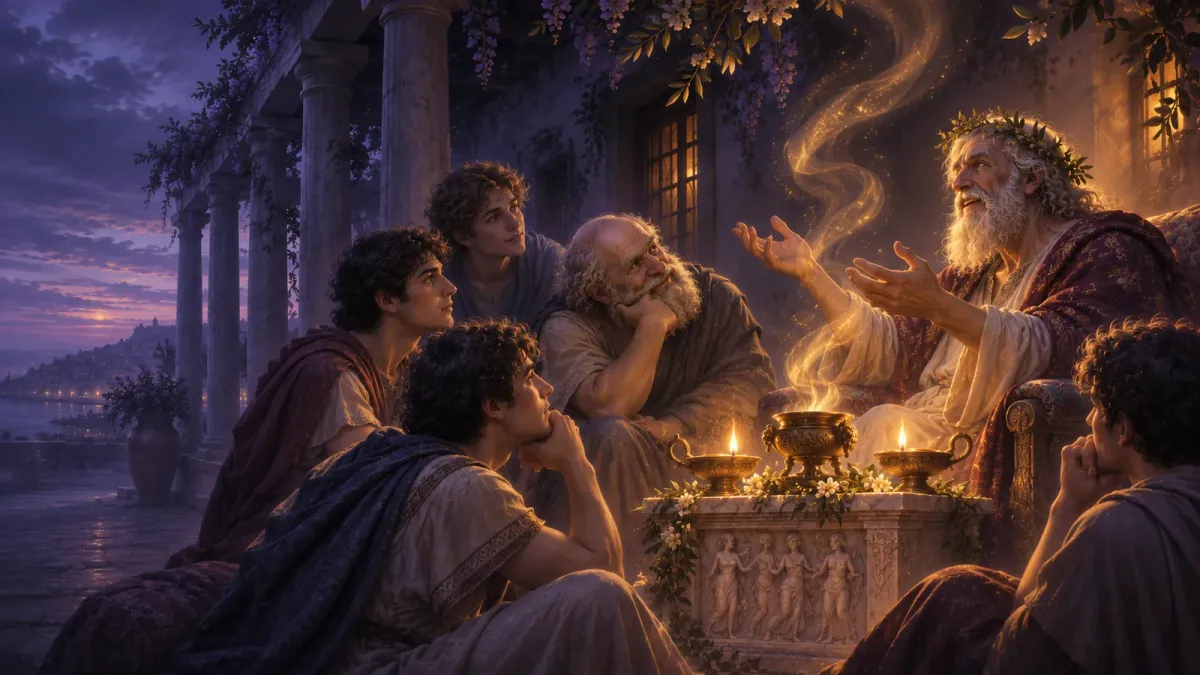
Written as a dramatic conversation across ten books, the text begins after an analytical introduction with Socrates debating friends and rivals in a rich merchant's house. Book I works like a courtroom cross-examination, knocking down everyday definitions of justice one by one. From Book II onward, Socrates takes the floor to construct his ideal state across Books II to V, turns to high metaphysics and the education of rulers in Books VI and VII, diagnoses how governments and personalities rot in Books VIII and IX, and closes in Book X with poetry and the afterlife. The argument moves by analogy — zooming out from a single person's mind to a whole society and back again — while the 1871 Victorian translation alternates between brisk question-and-answer and long, formal speeches studded with quotes from Greek poets.
- Big political and psychological claims tested through memorable thought experiments
- Lively opening clashes where Socrates dismantles a furious, cynical rival
- A dry, ironic sense of humour running beneath the serious debate
- Surprisingly modern psychological portraits of the oligarchic, democratic, and tyrannical personalities
- This edition opens with a massive analytical introduction before the dialogue itself even starts
- After Book I, the other speakers mostly say 'Yes, Socrates' and 'How could it be otherwise?'
- The ideal city relies on censorship, eugenics, and a rigid class system that disturb modern readers
- Long stretches dissect ancient Greek music theory, geometry, and lines from Homer
Jaká je to kniha „The Republic“
Originál knihy „The Republic“ (angličtině)
Vyber verzi. Lišta dole na stránce otevře tu vybranou.
Slovní zásoba podle úrovní
- A1 65%
- A2 15%
- B1 9%
- B2 6%
- mimo slovník 3%
Původní jazyk knihy „The Republic“ a co ti dá
Jak náročný je jazyk C2
Our measurement puts the original text at C2, the highest band, because of its sheer length and the density of its abstract reasoning. Much of the core vocabulary consists of ordinary everyday words, as Socrates illustrates high philosophy with shoes, dogs, horses, and doctors. The difficulty comes from the 1871 Victorian translation's long, winding sentences, which stack clauses inside clauses to follow every step of a logical proof. You also have to navigate the lengthy analytical preface before reaching the more conversational rhythm of the dialogue.
Co to znamená v praxi: The original suits confident C2 readers ready for formal Victorian argument; no adapted editions are available yet.
Na co se připravit
Jak číst a nevzdat to
- Skip or skim the long 'Introduction and Analysis' on your first pass and start directly at 'Book I' — the dialogue itself is much easier to follow than the translator's Victorian essay.
- Watch for Everyday English words used as strict technical terms: here 'music' means all arts and literature, 'gymnastic' means physical training, and 'spirited' refers to a specific part of the soul.
- In the rapid question-and-answer passages, verb phrases are often dropped ('Certainly not', 'By all means', 'And rightly so') — always keep the previous question's main verb in mind.
Co se dozvíš z knihy „The Republic“
Justice is internal harmony, not a social bargain
Plato argues that doing right is not a compromise people make because they are too weak to steal, but the natural health of a mind whose parts work in balance.
The soul and the city share a three-part structure
Just as a stable state needs rulers, soldiers, and producers doing their own jobs, a sane person needs reason to rule over spirit and appetite.
Political power belongs to those who do not want it
Only philosophers trained to care about eternal truths rather than wealth or status can govern without turning the state into a racket for their own benefit.
Every regime collapses through its own favourite virtue
Honour-rule decays into wealth-rule, wealth-rule into unbridled democracy, and democracy into tyranny when the demand for total freedom destroys all self-control.
Pro koho je
- You keep hearing about the Cave, the Ring of Gyges, or Philosopher Kings and want to read them in context.
- You enjoy watching a sharp questioner back an overconfident opponent into a logical corner.
- You want to practise reading formal, abstract English argument at full stretch.
Ukázka z knihy „The Republic“ v angličtině
Klepni na libovolné slovo – ukážeme ti překlad
Šipkami přecházíš mezi slovy, Enter zobrazí překlad.Originál · C2148 slov
‘To do injustice is said to be a good; to suffer injustice an evil. As the evil is discovered by experience to be greater than the good, the sufferers, who cannot also be doers, make a compact that they will have neither, and this compact or mean is called justice, but is really the impossibility of doing injustice. No one would observe such a compact if he were not obliged. Let us suppose that the just and unjust have two rings, like that of Gyges in the well-known story, which make them invisible, and then no difference will appear in them, for every one will do evil if he can. And he who abstains will be regarded by the world as a fool for his pains. Men may praise him in public out of fear for themselves, but they will laugh at him in their hearts (Cp. Gorgias.)
Ilustrace ke knize „The Republic“
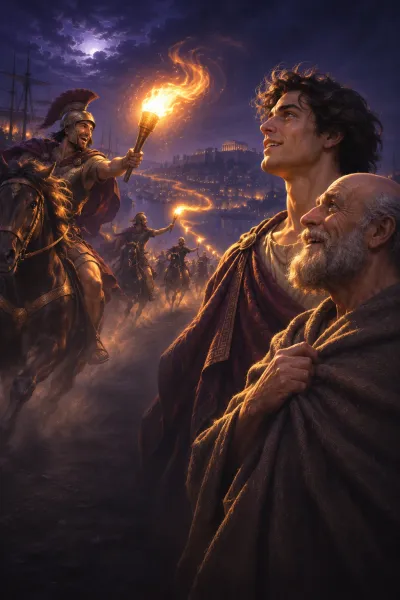
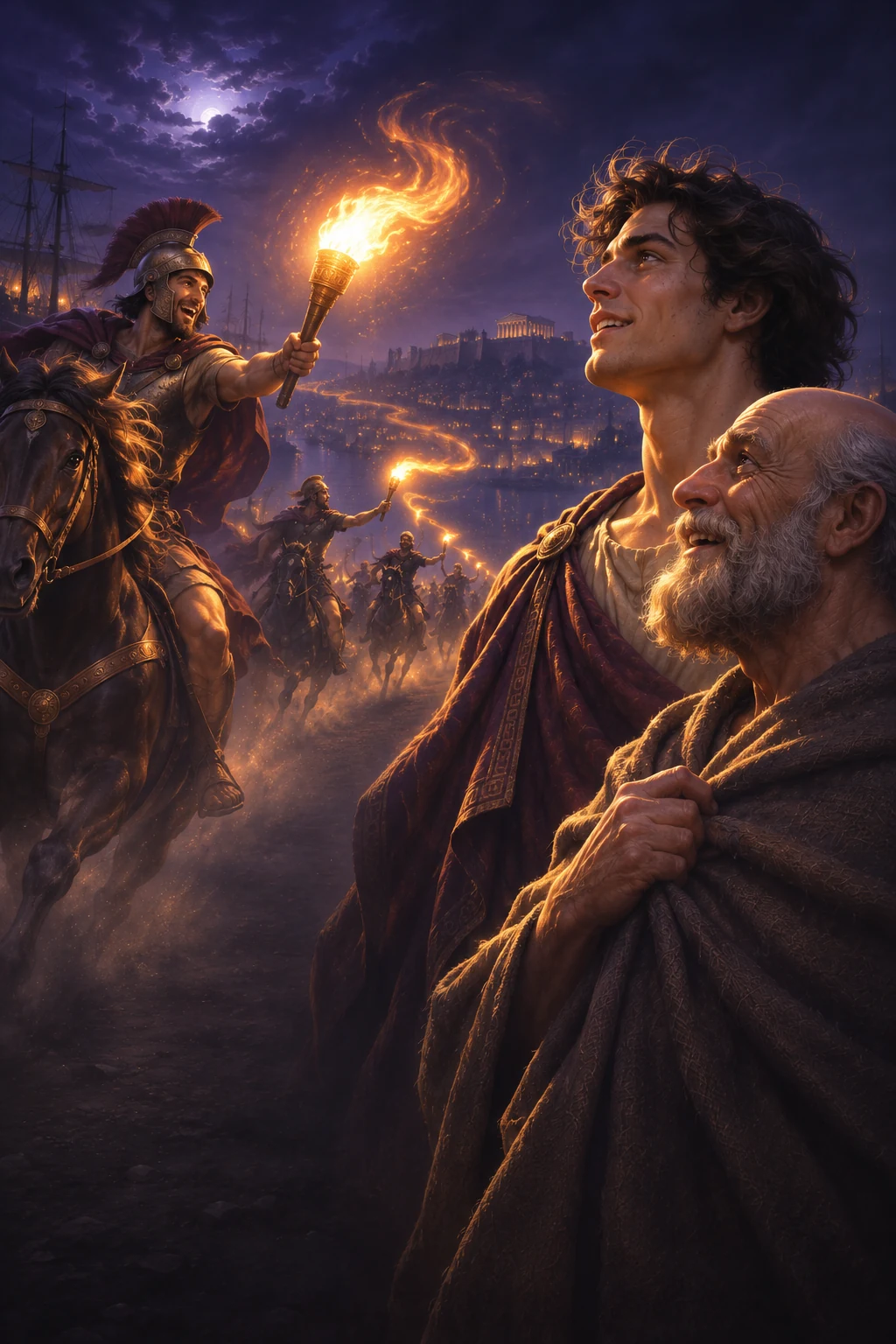
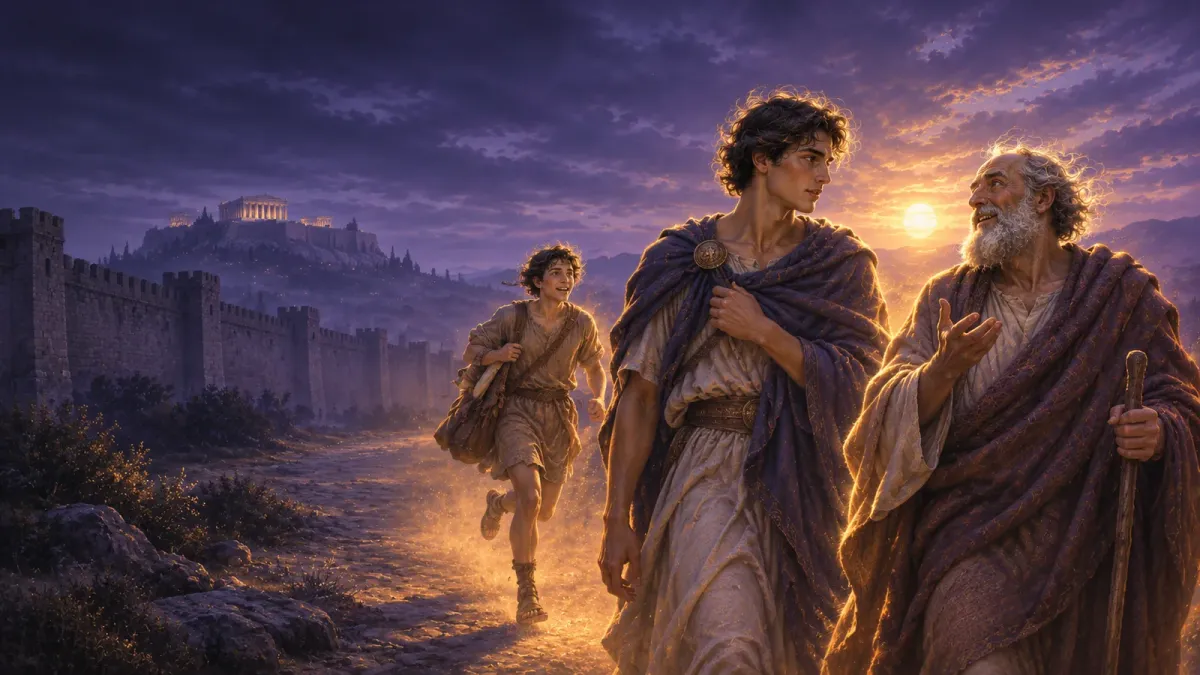
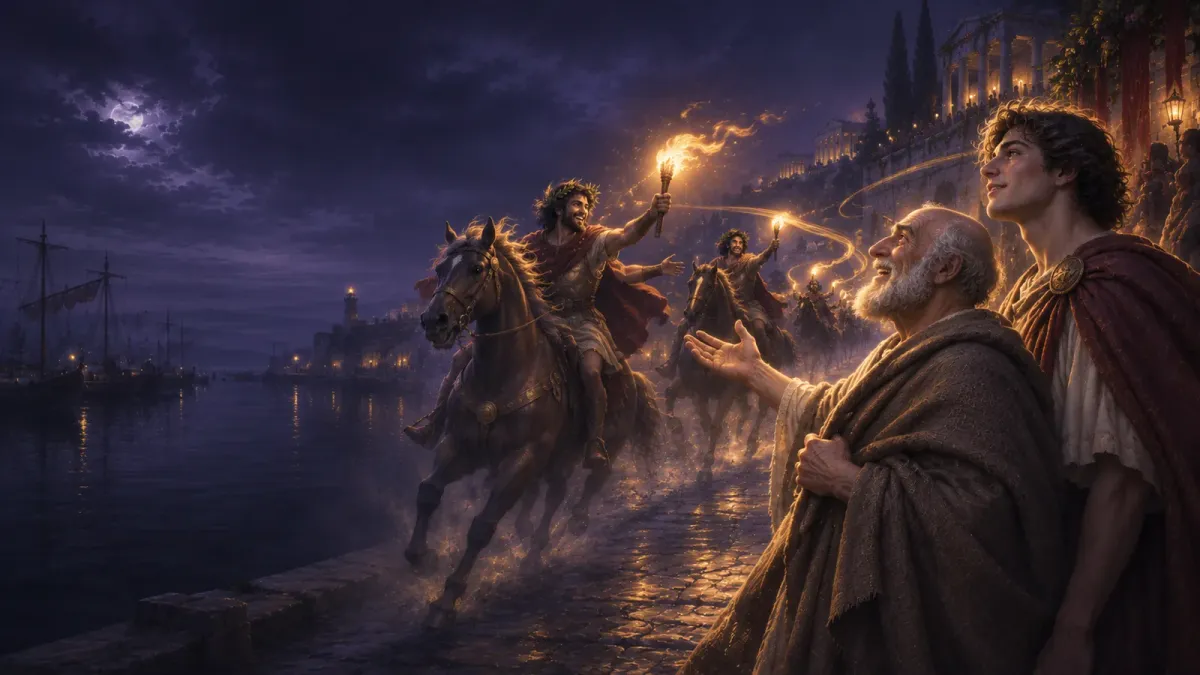
7 scén z knihy „The Republic“, v pořadí podle příběhu a bez konce.

Obsah knihy „The Republic“ · 12 kapitol
- INTRODUCTION AND ANALYSIS.strana 1
- PERSONS OF THE DIALOGUE.strana 358
- BOOK I.strana 358
- BOOK II.strana 403
- BOOK III.strana 445
- BOOK IV.strana 496
Všech 12 kapitolZobrazit méně
Hodnocení čtenářů knihy „The Republic“
Zatím žádné hodnocení. Přidej první.
Tvoje hodnocení
Recenze čtenářů knihy „The Republic“
Zatím žádné recenze.
Historie knihy „The Republic“ a kdy vznikla
A cup of hemlock
An Athenian jury sentenced Plato's teacher Socrates to die by drinking hemlock. He was convicted of impiety and corrupting the youth. Watching Athenian democracy execute his teacher broke Plato's faith in the system, and he wrote this book to work out how a genuinely just city and human soul ought to be arranged.
Plato, Seventh Letter
Ten books outside Athens
About a decade after founding his philosophical school, the Academy, outside the city walls of Athens, Plato wrote this ten-book dialogue. He gave the leading role to his dead teacher Socrates, setting him in an argument over justice with Glaucon, Adeimantus, and the sophist Thrasymachus.
Testing the theory in Sicily
Dion, advisor to the young ruler Dionysius II of Syracuse, invited Plato to Sicily in the hope that he could train the prince according to the dialogue's principles. Theory met court politics quickly: Dion was exiled, and Plato found himself practically held prisoner before finally getting leave to go back to Athens.
Plato, Seventh Letter
Back into European hands
Commissioned by Cosimo de' Medici, the Florentine humanist Marsilio Ficino included the work in his complete Latin translation of Plato's dialogues, printed in Florence. Western Europe had been cut off from the full Greek text all through the Middle Ages, so Ficino's press put the dialogue back into European political argument.
Marsilio Ficino, Platonis Opera Omnia (1484)
Five letters in the margin
In Geneva, the printer Henri Estienne brought out a three-volume Greek and Latin edition of Plato, laying out the text in numbered columns divided by the letters A to E. If you see numbers and letters in the margin of any translation today, that is Estienne's layout, still used by scholars everywhere to point to the exact same line.
Henricus Stephanus, Platonis opera quae extant omnia (1578)
Karl Popper's wartime attack
Writing in exile during the Second World War, Karl Popper spent the whole first volume of 'The Open Society and Its Enemies' dismantling Plato's ideal city. Where earlier readers saw a model of reason, Popper saw a strict class system, state censorship, and an unchecked ruling elite that laid the groundwork for modern totalitarian states.
Karl Popper, The Open Society and Its Enemies (1945)
V kultuře „The Republic“
9 adaptací a zmínek, -375–2013
V jazyce Chained before the shadows
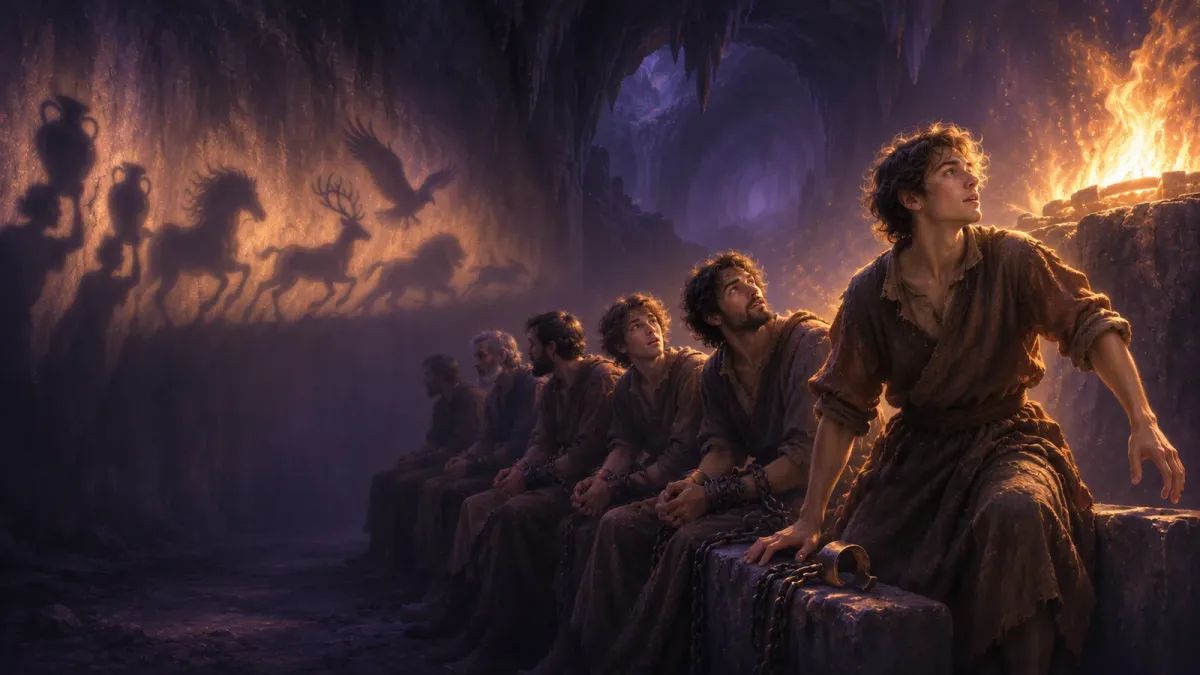
In Book VII, Socrates asks you to picture prisoners chained in an underground cave since childhood, taking shadows on a stone wall for the whole of reality. Western culture never let the image go: it remains our standard shorthand for ignorance, ideological illusion, and how much it hurts to wake up from either.
Republic 514a–520a
V jazyce When philosophers become kings
Socrates states in Book V that cities will get no rest from evil until philosophers become kings, or kings start genuinely doing philosophy. Political language kept the phrase 'philosopher king' for the rare ruler supposed to govern by wisdom and reason rather than personal ambition.
Republic 473c–e
V jazyce The gold and iron myth
To keep his citizens content with their station, Socrates in Book III suggests telling them they were born from the earth with gold, silver, or iron and bronze mixed into their souls. When modern political writers call something a 'noble lie', they mean this kind of myth told from above to keep a hierarchy standing.
Republic 414b–415d
V jazyce Mutiny on the state's deck
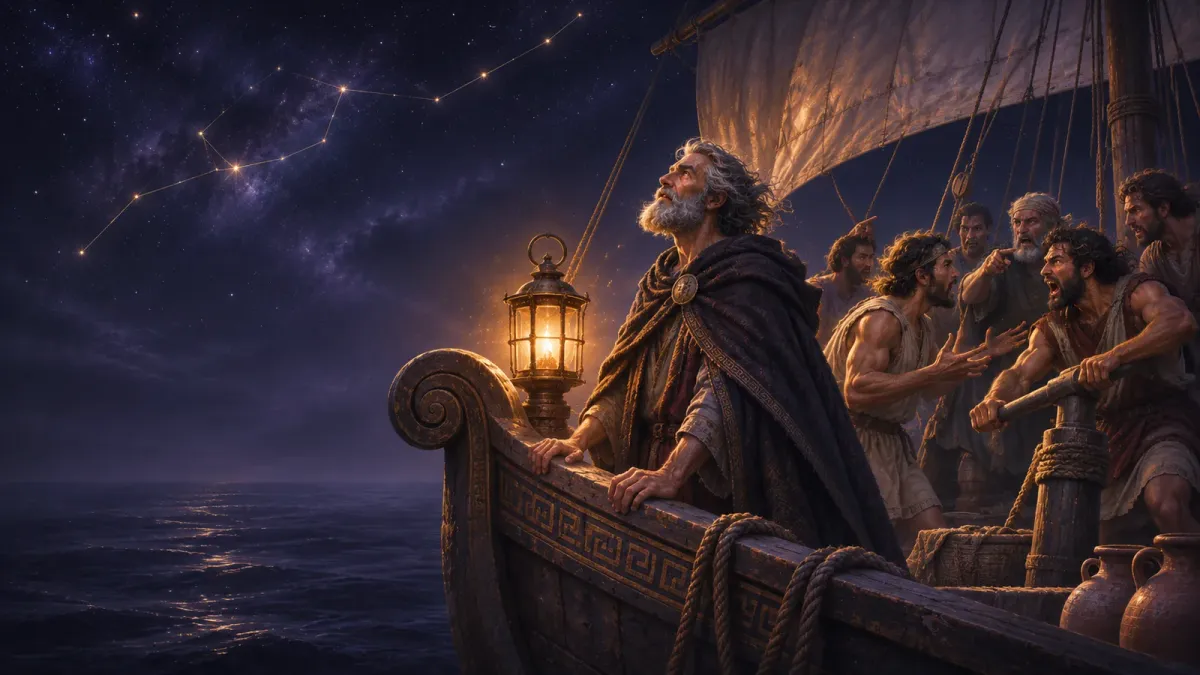
Book VI compares a badly run city to a ship where squabbling sailors drug the captain, grab the wheel without knowing how to steer, and dismiss the actual navigator as a useless stargazer. Plato did not invent the Greek comparison of a state to a ship, but his version became the one later political writers kept returning to.
Republic 488a–489d
V jazyce The shepherd's invisible ring
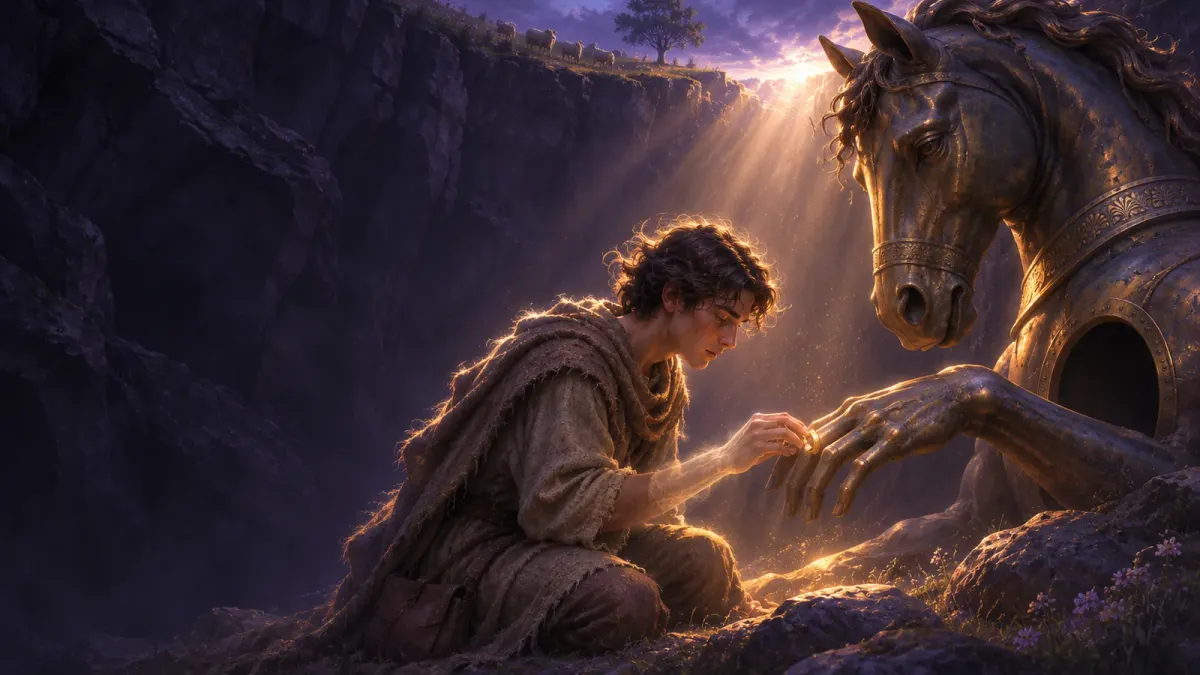
In Book II, Plato's brother Glaucon tells of a shepherd who finds a gold ring that turns him invisible, promptly seduces the queen, kills the king, and takes the throne without consequence. Moral philosophy still uses his question—whether anyone stays good when nobody can see them—and fiction has been borrowing the corrupting ring ever since.
Republic 359a–360d
Umění Engraving the underground fire
Working after a painting by Cornelis van Haarlem, the Dutch mannerist printmaker Jan Saenredam turned Book VII into a single crowded engraving. You can trace the whole argument in one look: the chained prisoners, the fire on the ledge, the puppet-bearers throwing shadows, and the lone philosopher climbing out toward the sun.
Hudba Chanting Plato's warning
The Dutch composer Louis Andriessen built his 40-minute ensemble piece 'De Staat' around original Greek passages from the dialogue on how musical modes can unsettle a city's laws. Over driving, dissonant wind and brass chords, four female voices chant Plato's strict warning against musical innovation.
Film A cave built by machines
The Wachowskis' science-fiction film 'The Matrix' reworks the cave allegory into a simulated world projected by machines to keep humanity quiet in its pods. Pulled out into a dark underground reality, the protagonist Neo has to make the philosopher's trip back into the illusion to free the people still watching the screen.
Divadlo Marathon debate at Avignon
A year after the philosopher Alain Badiou published 'La République de Platon', his contemporary French reworking of the dialogue, the text went on stage at the Avignon Festival. Directors Valérie Dréville, Didier Galas, and Grégoire Ingold put professional actors together with amateur citizens to argue through the philosophy in marathon sessions.
Otázky a odpovědi o knize „The Republic“ v angličtině
Why is the book called The Republic if Plato is against democracy?
The English title comes from the traditional Latin name 'Res Publica' (public affairs or commonwealth). Plato's original Greek title is 'Politeia', which simply means the constitution, regime, or way of life of a city-state. Plato is not describing a modern representative republic; he is asking how a community should be organized and governed. In Book VIII, he actually ranks democracy as the second-worst form of government, just one step above tyranny.
Why does Plato ban poets and artists from his ideal city?
Socrates argues in Books II, III, and X that traditional poets like Homer corrupt citizens by showing gods and heroes lying, weeping, and losing control of their passions. On a deeper philosophical level, Plato views physical objects as mere copies of eternal Forms, which makes a painting or a tragic poem an imitation of an imitation — three steps removed from truth. Because poetry appeals to the emotional, irrational part of the soul rather than to reason, only strict hymns to the gods and praises of good people are allowed in the city.
Does Plato really argue that women should be equal rulers with men?
In Book V, Socrates shocks his listeners by proposing that women in the ruling guardian class should receive the exact same intellectual and military training as men, stripping naked to exercise in the gymnasia and holding the highest political offices. He compares men and women to male and female watchdogs: since both guard the flock equally well despite biological differences in reproduction, gender has nothing to do with a soul's capacity to rule. While he still remarks that men are generally stronger than women as a group, he insists that individual talent is distributed across both sexes.
Did Socrates really say everything in the book, or is it Plato's own ideas?
Scholars generally agree that while Book I reflects the historical Socrates — who questioned fellow Athenians about virtue and claimed to know nothing himself — Books II through X use Socrates as a mouthpiece for Plato's own positive philosophy. The real Socrates never wrote anything down and did not teach an elaborate theory of eternal Forms or design a three-class utopian state. Plato kept his late teacher as the main speaker out of tribute and to show how true philosophical inquiry works in conversation.
What does Socrates mean by 'guardians' in the book?
'Guardians' (phylakes in Greek) is Plato's term for the military and ruling class trained to protect and govern the ideal city. Near the end of Book III, Socrates splits this group into two: the older, wisest members who actually make the laws are called 'complete guardians' (later the Philosopher Kings), while the younger soldiers who enforce their decisions are called 'auxiliaries'. To prevent corruption, neither group is allowed to own private houses, land, gold, or silver, and they live together in common barracks.
Why does Socrates spend so much time talking about dogs, horses, and shoemakers?
This habit was famous even in ancient Athens: Socrates constantly uses everyday trades and animals to test grand, abstract claims about justice and politics. Because everyone agrees on what makes a good shoemaker, ship pilot, or watchdog — specialized skill and knowledge of the craft's purpose — he uses those clear cases to expose how little politicians actually know about improving human souls. For a language learner, these passages provide welcome breathing room with concrete, familiar vocabulary between stretches of dense theory.
What is the 'Myth of Er' at the very end of Book X?
The dialogue closes with the story of a soldier named Er who dies in battle, wakes up on his funeral pyre twelve days later, and reports what he saw in the afterlife. Er describes souls being rewarded or punished for a thousand years before choosing their next reincarnated lives, the order of choice fixed by lot — and a soul that had lived decently only out of habit in a well-ordered city foolishly picks the life of a tyrant. Plato ends with this myth to show that only philosophy teaches a soul how to choose wisely, both in this life and the next.
Ve zkratce o knize „The Republic“
14 polí tirážních údajů a naměřených vlastností textu. Vše si lze ověřit.
- Původní název
- The Republic
- Autor
- Plato
- První vydání
- -375
- Původní jazyk
- Angličtina
- Žánr
- Filozofie · Společnost · Eseje
- Témata
- Spravedlnost · Společnost · Moc · Povinnost
- Různých slov
- 9 883
- Slov na větu
- 24 slovo
- Úroveň originálu
- C2Jak měříme
- Verze
- C2
- Rozsah originálu
- 12 kap. · 217 074 slovo
- Doba čtení
- ~20 h 10 min
- Překladatel
- Benjamin Jowett
- Stáhnout
- EPUB
Podobné co číst po knize „The Republic“
Podobné ladění
8Stejný žánr a stejný tón.
On Liberty
John Stuart Mill
C2orig.
~4 h 50 min · Filozofie

How to Live on 24 Hours a Day
Arnold Bennett
C2orig.
~1 h 10 min · Osobní rozvoj

Vladař
Niccolò Machiavelli
C2orig.C1
~4 h 40 min · Filozofie

Walden aneb Život v lesích
Henry David Thoreau
C2orig.B2
~9 h 50 min · Filozofie

Eseje
Ralph Waldo Emerson
C2orig.C1
~12 h 10 min · Filozofie
Short Works
Epictetus
C2orig.
~1 h 50 min · Filozofie
The Crowd
Gustave Le Bon
C2orig.
~5 h · Filozofie
Meditations
Marcus Aurelius
C2orig.
~4 h 40 min · Filozofie