
On Liberty v angličtině
Where does society's right to boss you around end, and your right to be left alone begin? Mill answers with one sharp rule: other people may interfere with your choices only to stop you from harming somebody else—never for your own good.
The essay moves in five clean steps from a single principle to real-world test cases. After an introductory chapter that shifts the problem of liberty from kings to the majority, Chapter II defends absolute freedom of speech and thought, while Chapter III argues that society needs eccentric people and varied ways of living. Chapter IV draws the border between what concerns only the individual and what hurts others, and Chapter V tests the rule on hard cases like poison sales, drunkenness, gambling houses, and schooling. Mill builds each chapter like a courtroom speech, stating the strongest objections to his own view before taking them apart. His mid-Victorian prose uses everyday core words, but stacks them into long, tightly bolted periodic sentences that reward slow reading.
- One clear central rule tested from every angle
- An author who steel-mans the arguments against him before answering them
- Concrete Victorian test cases—from Mormon polygamy to selling poison and taxing gin
- Short enough to read in full, dense enough to chew on for weeks
- Very long mid-Victorian sentences where the main verb waits near the end
- Almost no humour or personal storytelling
- Historical examples require you to follow nineteenth-century politics and religion
- Chapter IV's distinction between harming yourself and harming others gets hair-splitting

Jaká je to kniha „On Liberty“
Originál knihy „On Liberty“ (angličtině)
Vyber verzi. Lišta dole na stránce otevře tu vybranou.
Slovní zásoba podle úrovní
- A1 57%
- A2 19%
- B1 10%
- B2 6%
- mimo slovník 4%
Původní jazyk knihy „On Liberty“ a co ti dá
Jak náročný je jazyk C2
Our measurement puts the original text at C2, the top of the scale. Most of the individual words sit in the everyday dictionary, so you will not be looking up rare nouns on every line. What makes the English C2 is the architecture: Mill writes in long mid-Victorian periodic sentences packed with 'although', 'insofar as', and nested qualifications that hold the main point back until the final clause. You have to keep three or four logical conditions in your head at once before the full stop arrives.
Co to znamená v praxi: Take the original only if you already read C2 English comfortably and enjoy unpacking complex nineteenth-century sentences; no adapted editions are available on the page yet.
Na co se připravit
Jak číst a nevzdat to
- When a sentence runs across ten lines, find the main subject and verb first, then read the 'although' and 'unless' clauses as brackets around it.
- Watch for double negatives—phrases like 'not unfrequently', 'not without reason', or 'far from being impossible' are Mill's polite way of saying 'often', 'justifiably', or 'very likely'.
- Do not read 'peculiar' or 'eccentric' as insults: in 1859 English, 'peculiar' often just means 'belonging to one person alone', and for Mill, eccentricity is a compliment.
Co se dozvíš z knihy „On Liberty“
Power is rightful only to prevent harm to others
Neither the law nor public opinion may force an adult to do something—or stop doing it—simply because it would be better, wiser, or healthier for that person.
Silencing an opinion robs everyone, even if it is wrong
If a banned view is true, people lose the chance to swap error for truth; if it is false, they lose the live debate that stops their own true beliefs from turning into dead, unthinking habit.
Conformity starves human nature unless people try different lives
People grow by making their own choices rather than copying custom, so a healthy society needs room for eccentric characters and varied experiments in how to live.
Private vices are for persuasion, public harms are for law
When someone's conduct damages only their own life without breaking a duty to others, neighbours may advise, argue, or avoid them, but must never punish them.
Pro koho je
- You argue about free speech, censorship, or public health rules and want to read the book both sides still quote.
- You read law, politics, or ethics in English and want practice following a long, disciplined nineteenth-century argument.
- You are tired of modern opinion pieces that straw-man their opponents and want to watch a writer state the rival case better than his critics could.
Ukázka z knihy „On Liberty“ v angličtině
Klepni na libovolné slovo – ukážeme ti překlad
Šipkami přecházíš mezi slovy, Enter zobrazí překlad.Originál · C2166 slov
If, however, the mischievous operation of the absence of free discussion, when the received opinions are true, were confined to leaving men ignorant of the grounds of those opinions, it might be thought that this, if an intellectual, is no moral evil, and does not affect the worth of the opinions, regarded in their influence on the character. The fact, however, is, that not only the grounds of the opinion are forgotten in the absence of discussion, but too often the meaning of the opinion itself. The words which convey it, cease to suggest ideas, or suggest only a small portion of those they were originally employed to communicate. Instead of a vivid conception and a living belief, there remain only a few phrases retained by rote; or, if any part, the shell and husk only of the meaning is retained, the finer essence being lost. The great chapter in human history which this fact occupies and fills, cannot be too earnestly studied and meditated on.
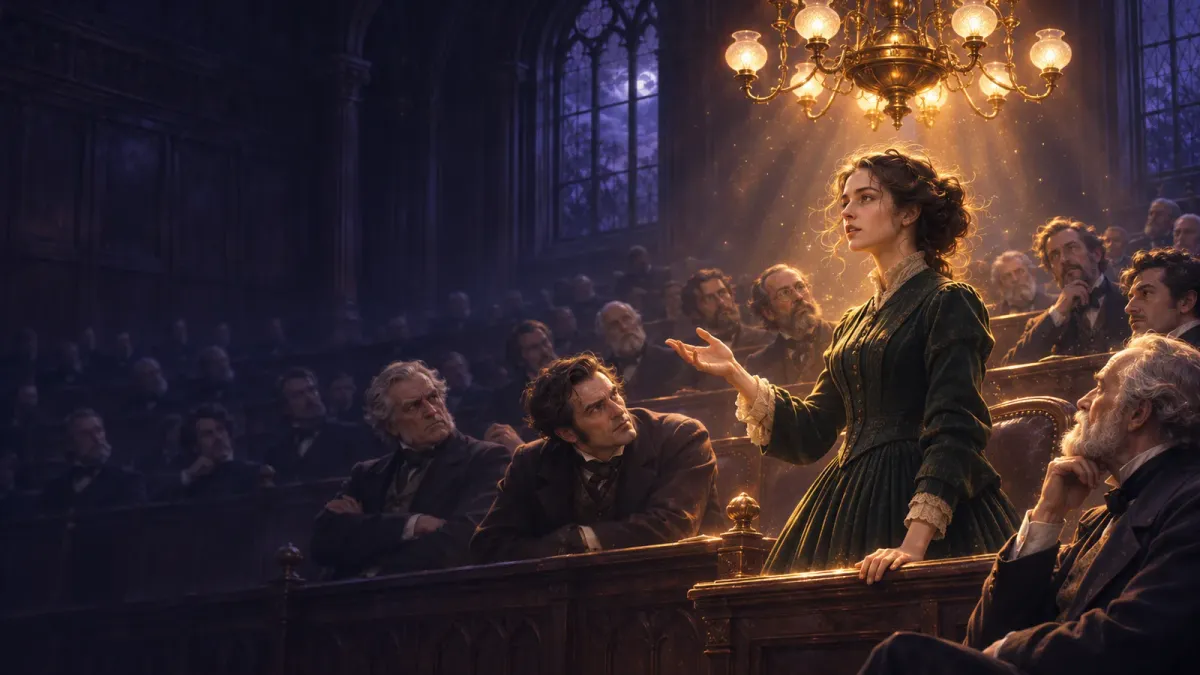
Ilustrace ke knize „On Liberty“
7 scén z knihy „On Liberty“, v pořadí podle příběhu a bez konce.







Obsah knihy „On Liberty“ · 8 kapitol
- Introductionstrana 1
- Dedicationstrana 15
- Epigraphstrana 16
- I: Introductorystrana 16
- II: Of the Liberty of Thought and Discussionstrana 36
- III: Of Individuality, as One of the Elements of Well-Beingstrana 97
Všech 8 kapitolZobrazit méně
Hodnocení čtenářů knihy „On Liberty“
Zatím žádné hodnocení. Přidej první.
Tvoje hodnocení
Recenze čtenářů knihy „On Liberty“
Zatím žádné recenze.
Historie knihy „On Liberty“ a kdy vznikla
Every sentence read twice together
John Stuart Mill started the book as a short essay, then expanded it alongside his wife, Harriet Taylor Mill. In his autobiography, he recalls that the two of them went over every single sentence of the manuscript together several times.
John Stuart Mill, Autobiography (1873)
A text frozen at Avignon
While travelling to the south of France in November, Harriet Taylor Mill died of pulmonary congestion at Avignon. Mill dedicated the finished book to her memory and sent the text to the printer without changing a word.
John Stuart Mill, Autobiography (1873)
Out from a London press
In February, John W. Parker and Son brought the treatise out in London. The short essay Mill and his wife had worked over line by line was now in the hands of the public.
The judge who wanted force
The jurist James Fitzjames Stephen answered Mill with a whole book of his own, 'Liberty, Equality, Fraternity'. Where Mill thought progress makes force less necessary, Stephen argued that human behaviour still needs the hard curb of legal force and moral coercion.
James Fitzjames Stephen, Liberty, Equality, Fraternity (1873)
Drawing the boundary in Chinese
Scholar Yan Fu translated the treatise into Classical Chinese as 'Qunji quanjie lun'—'On the Boundary between the Rights of Society and the Rights of the Individual'. Through his version, intellectuals and reformers in the late Qing dynasty met Mill's liberal arguments for the first time.
Mill enters British law reform
A British committee on homosexual offences and prostitution reached back to Mill's line between private morals and public harm to recommend decriminalising private homosexual acts between consenting adults. That report set off the famous Hart–Devlin debate over whether the law has any business enforcing morality.
Report of the Committee on Homosexual Offences and Prostitution (1957)
V kultuře „On Liberty“
4 adaptace a zmínky, 1859–1859
V jazyce Where your freedom stops
Mill drew one clear line: society may force a person against their will only to keep them from harming others. Philosophers and lawyers call this 'the harm principle', and it is still the first rule cited in arguments over censorship, paternalism, and victimless crimes.
V jazyce When the neighbours become the police
Alexis de Tocqueville had already brought the phrase 'tyranny of the majority' into English, and Mill picked it up for his own book. He looked past the ballot box to show how public opinion alone can force people to conform and silence dissent before the law even steps in.
V jazyce Life as an open laboratory
So long as nobody else gets hurt, Mill argued, people need room for different 'experiments of living' so society can find out which ways of life actually work. The phrase has stayed in philosophy and everyday speech as a straightforward defence of unconventional lives.
V jazyce Why bad ideas stay open
In Chapter II, Mill warns that silencing a view robs everyone: a wrong opinion might hold a piece of the truth, and a right one turns into dead dogma if nobody argues against it. Free-speech law later built the 'marketplace of ideas' on top of this exact chapter.
Otázky a odpovědi o knize „On Liberty“ v angličtině
Does Mill actually use the phrase 'marketplace of ideas' in the book?
No, that exact phrase never appears in On Liberty. Mill's argument in Chapter II that truths must collide with error in open discussion inspired the metaphor, which American judges and legal writers coined in the twentieth century.
Does Mill think children and all societies get full liberty?
No, he explicitly limits his principle to adults with mature faculties and to what he calls civilised communities. In Chapter I, he states that children require protection from their own actions, and he makes the controversial nineteenth-century imperialist claim that 'backward' societies may be ruled by a benevolent despot until they can improve through free discussion.
How can Mill defend absolute individual rights if he is a utilitarian?
Mill explicitly refuses to base his argument on abstract 'natural rights' and grounds everything in utility instead. He argues that utility must be understood in the largest sense—grounded on the permanent interests of human beings as progressive creatures—which makes long-term freedom of thought and individuality the best path to general human well-being.
Can you sell yourself into slavery under Mill's liberty principle?
No, Mill argues in Chapter V that the principle of freedom cannot be used to justify giving up freedom itself. By selling yourself as a slave, you abdicate every future use of your liberty, defeating the very purpose that justifies letting people make their own choices.
Does Mill's rule mean the state cannot require education or stop someone walking onto an unsafe bridge?
No, Mill allows both in Chapter V. A public officer may grab someone stepping onto a dangerous bridge if there is no time to warn them, because nobody actually wants to fall into a river; and the state must compel parents to educate their children, because failing to do so harms the child and society, though Mill insists the state should enforce that duty by public examinations and may help pay school fees for the poor, rather than run all the schools itself.
Why does Mill bring up Mormons and polygamy in Chapter IV?
He uses Mormon polygamy in Utah as an extreme test case for whether a deeply disapproving public has the right to force a minority to change its way of life. Even though Mill personally hates the practice and calls it a direct infraction of liberty that rivets the chains of one half of the community, he argues that so long as the women enter it voluntarily and are free to leave, outside countries have no right to march in and suppress it by force.
Does On Liberty argue for laissez-faire free trade?
No, in Chapter V Mill states that the doctrine of Free Trade rests on different grounds from the principle of individual liberty. Because buying and selling is a social act that directly affects other people, society has the right to regulate trade, prevent fraud, and enforce safety rules, even if free markets usually work better for economic reasons.
Ve zkratce o knize „On Liberty“
13 polí tirážních údajů a naměřených vlastností textu. Vše si lze ověřit.
- Původní název
- On Liberty
- Autor
- John Stuart Mill · 1806–1873
- První vydání
- 1859
- Původní jazyk
- Angličtina
- Žánr
- Filozofie · Eseje · Společnost
- Témata
- Svoboda · Společnost · Moc · Spravedlnost
- Různých slov
- 5 475
- Slov na větu
- 37 slovo
- Úroveň originálu
- C2Jak měříme
- Verze
- C2
- Rozsah originálu
- 8 kap. · 51 948 slovo
- Doba čtení
- ~4 h 50 min
- Stáhnout
- EPUB
Podobné co číst po knize „On Liberty“
Podobné ladění
8Stejný žánr a stejný tón.

The Republic
Plato
C2orig.
~20 h 10 min · Filozofie

How to Live on 24 Hours a Day
Arnold Bennett
C2orig.
~1 h 10 min · Osobní rozvoj

Vladař
Niccolò Machiavelli
C2orig.C1
~4 h 40 min · Filozofie

Walden aneb Život v lesích
Henry David Thoreau
C2orig.B2
~9 h 50 min · Filozofie

Eseje
Ralph Waldo Emerson
C2orig.C1
~12 h 10 min · Filozofie

Short Works
Epictetus
C2orig.
~1 h 50 min · Filozofie

The Crowd
Gustave Le Bon
C2orig.
~5 h · Filozofie

Meditations
Marcus Aurelius
C2orig.
~4 h 40 min · Filozofie