The Island of Doctor Moreau en anglais
A shipwrecked Englishman is rescued by a trader carrying a cargo of wild animals to an uncharted Pacific island, where a disgraced London biologist has spent ten years trying to carve beasts into men with a scalpel.
The story is framed as a manuscript found among Edward Prendick's papers by his nephew, who checks the ship names and dates against naval records and notes that the island itself was never recorded. The first half works like a detective story: Prendick hears the screams of a vivisected puma through a locked door, sees strange shapes in the forest, and completely misreads what Moreau is doing until the doctor sits him down and explains his work as calmly as a lecturer at the Royal Institution. Once the secret is out, the book turns into a siege and survival tale as the surgical conditioning begins to fail. Wells writes in crisp, matter-of-fact late-Victorian prose, pairing tropical heat and biological horror with the dry precision of a laboratory report.
- a short, fast-moving story locked onto one island and four days of setup
- science fiction that argues about evolution, pain, and religion without stopping the action
- a cool, scientific narrator whose calm makes the horror hit harder
- monsters that are tragic and frightened rather than simple villains
- repeated descriptions of animal vivisection, blood, and protracted screaming behind locked doors
- almost no humour and a bleak ending that leaves the narrator rattled even back in London
- no female characters except the animals Moreau operates on
- Victorian anatomy and natural-history vocabulary in the middle chapters
Quel genre de livre « The Island of Doctor Moreau »
L’original de « The Island of Doctor Moreau » en anglais
Choisis une version. La barre en bas de la page ouvre celle que tu choisis.
Vocabulaire par niveau
- A1 61%
- A2 14%
- B1 9%
- B2 7%
- hors dictionnaire 5%
La langue originale de « The Island of Doctor Moreau » et ce qu’il t’apporte
Difficulté de la langue C2
Our measurement puts the original at C2, even though the sentences are fairly short for a Victorian novel and most of the running text uses everyday words. The high level comes from the dense clusters of medical, anatomical, and natural-history terms whenever Prendick describes the laboratory or the tropical forest, along with nineteenth-century shipboard vocabulary in the opening chapters. The Beast Folk speak a broken, repetitive chant, while Moreau and Prendick argue in formal educated British English of the 1890s.
En pratique: Only the original C2 text is available right now; it suits advanced readers or strong upper-intermediate learners who do not mind tapping a dictionary for medical and nautical words.
À quoi s’attendre
Comment le lire sans abandonner
- Do not stop to look up every part of the ship in chapters one to three; once Prendick lands on the island, the sailing vocabulary largely disappears.
- Notice how the Beast Folk call themselves by compound names like 'Swine-Man', 'Ape-Man', and 'Dog-Man' — the hyphen tells you both their original animal and their hybrid state.
- Watch for late-Victorian British spellings and word choices ('gaol' for jail, 'fancy' meaning to imagine or suppose, 'presently' meaning soon rather than now).
Un extrait de « The Island of Doctor Moreau » en anglais
Touche un mot — on affiche sa traduction
Les flèches passent d’un mot à l’autre, Entrée affiche la traduction.Original · C2153 mots
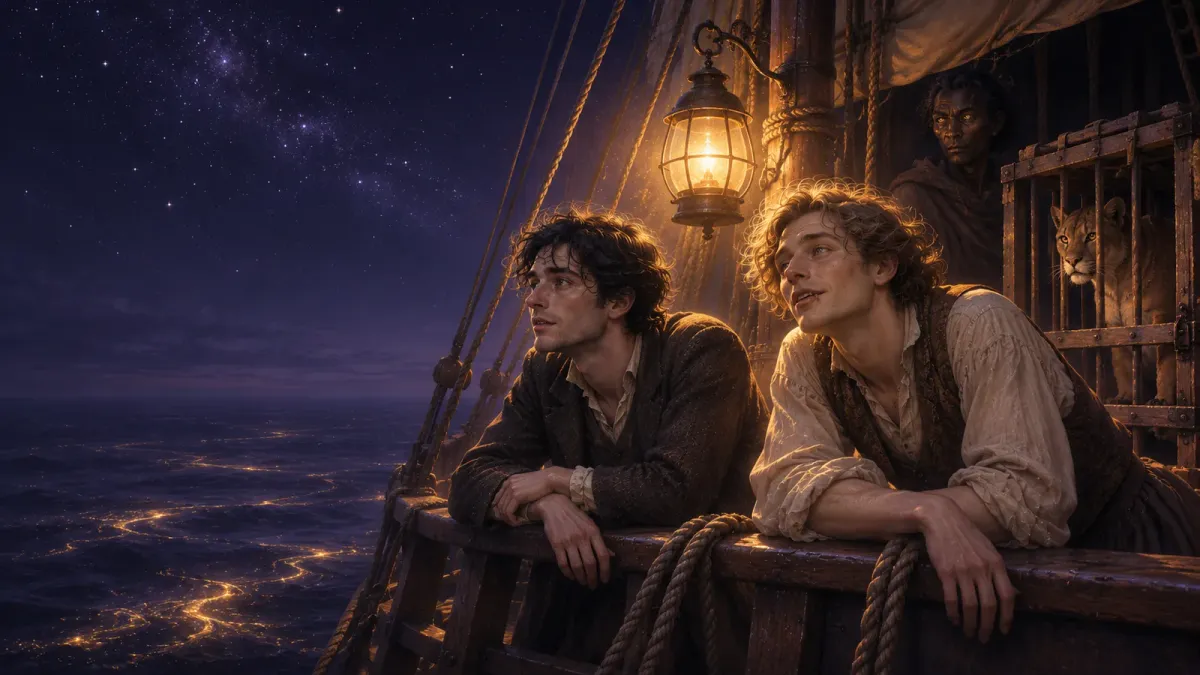
Montgomery’s movement to follow me released my attention, and I turned and looked about me at the flush deck of the little schooner. I was already half prepared by the sounds I had heard for what I saw. Certainly I never beheld a deck so dirty. It was littered with scraps of carrot, shreds of green stuff, and indescribable filth. Fastened by chains to the mainmast were a number of grisly staghounds, who now began leaping and barking at me, and by the mizzen a huge puma was cramped in a little iron cage far too small even to give it turning room. Farther under the starboard bulwark were some big hutches containing a number of rabbits, and a solitary llama was squeezed in a mere box of a cage forward. The dogs were muzzled by leather straps. The only human being on deck was a gaunt and silent sailor at the wheel.
Illustrations pour « The Island of Doctor Moreau »
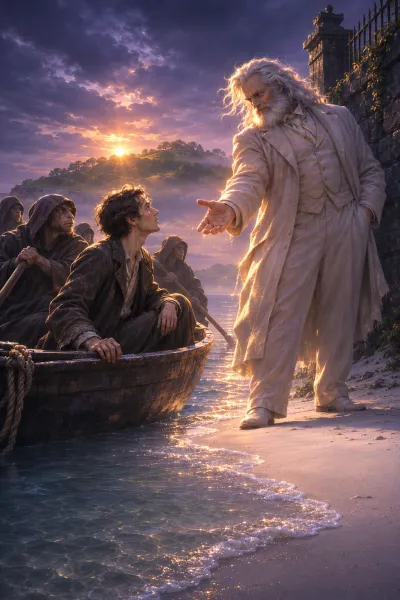
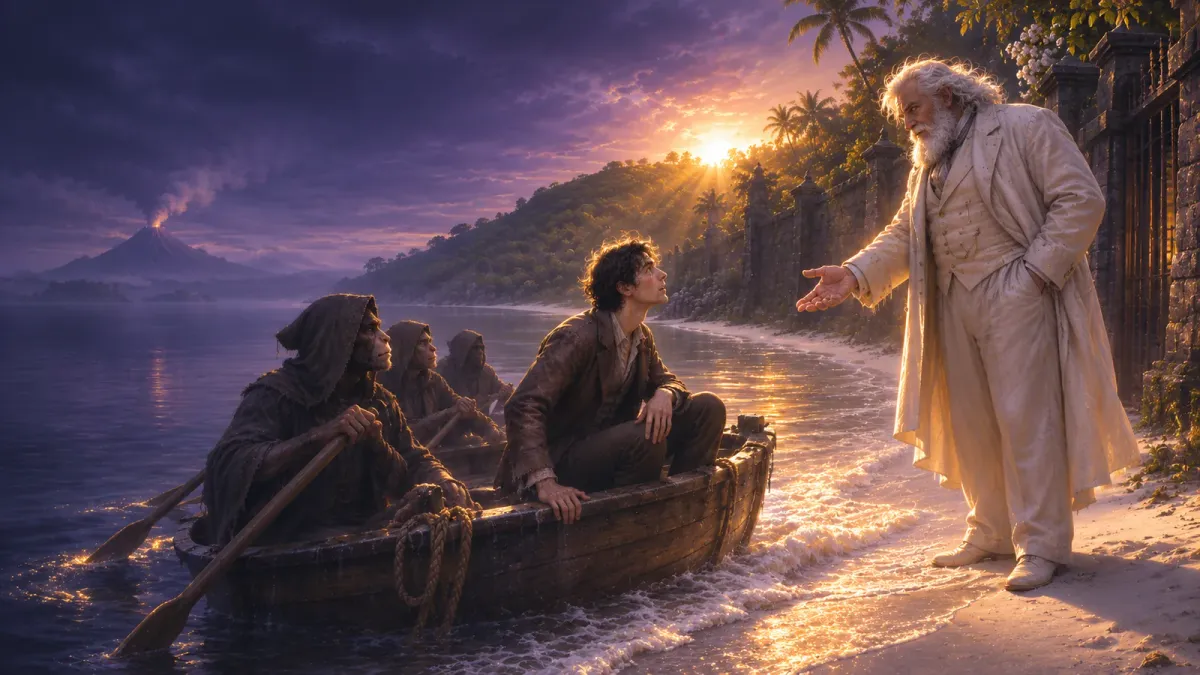
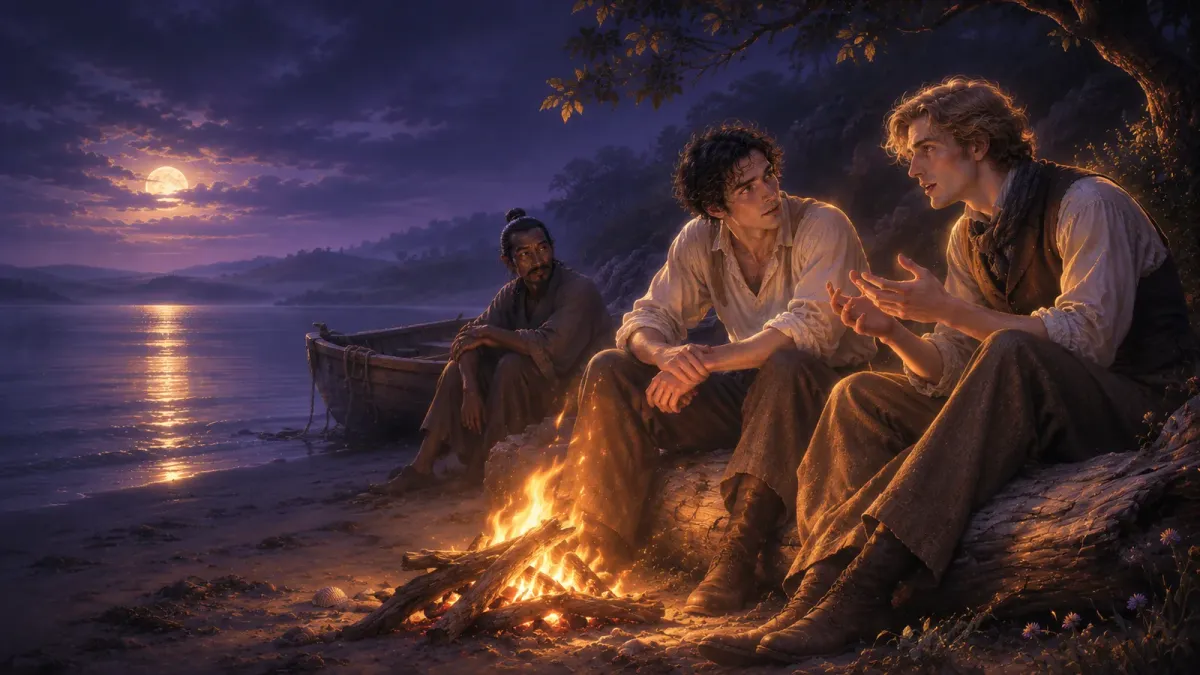
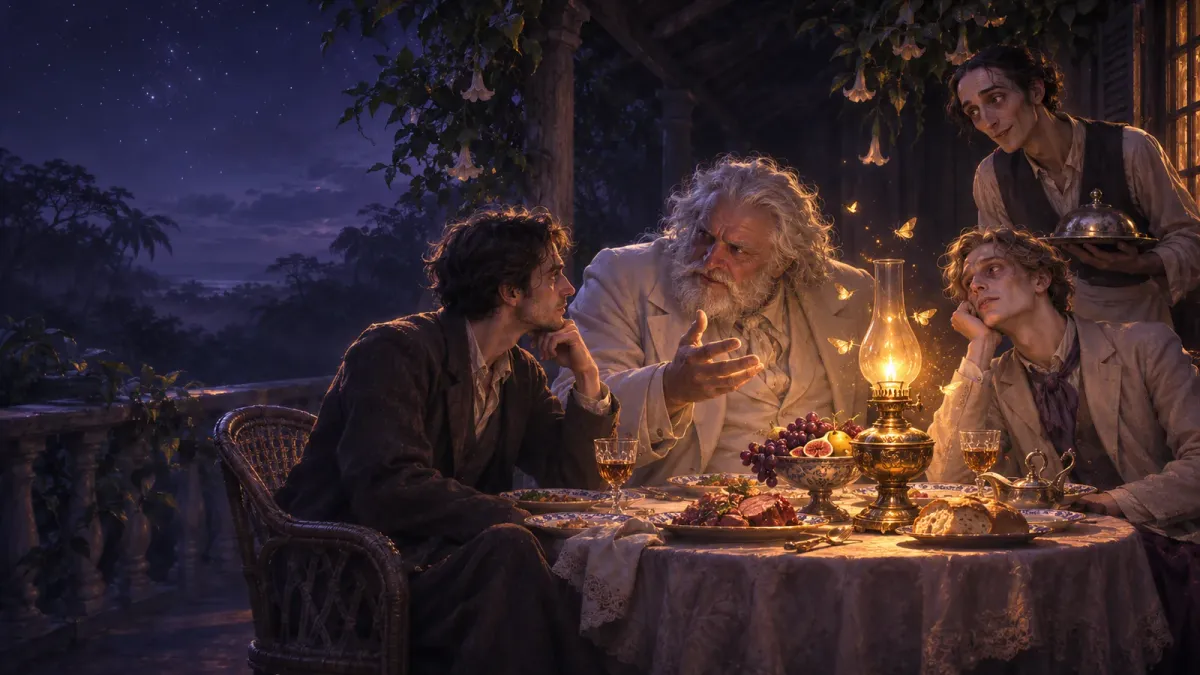
7 scènes de « The Island of Doctor Moreau », dans l’ordre de l’histoire et sans la fin.
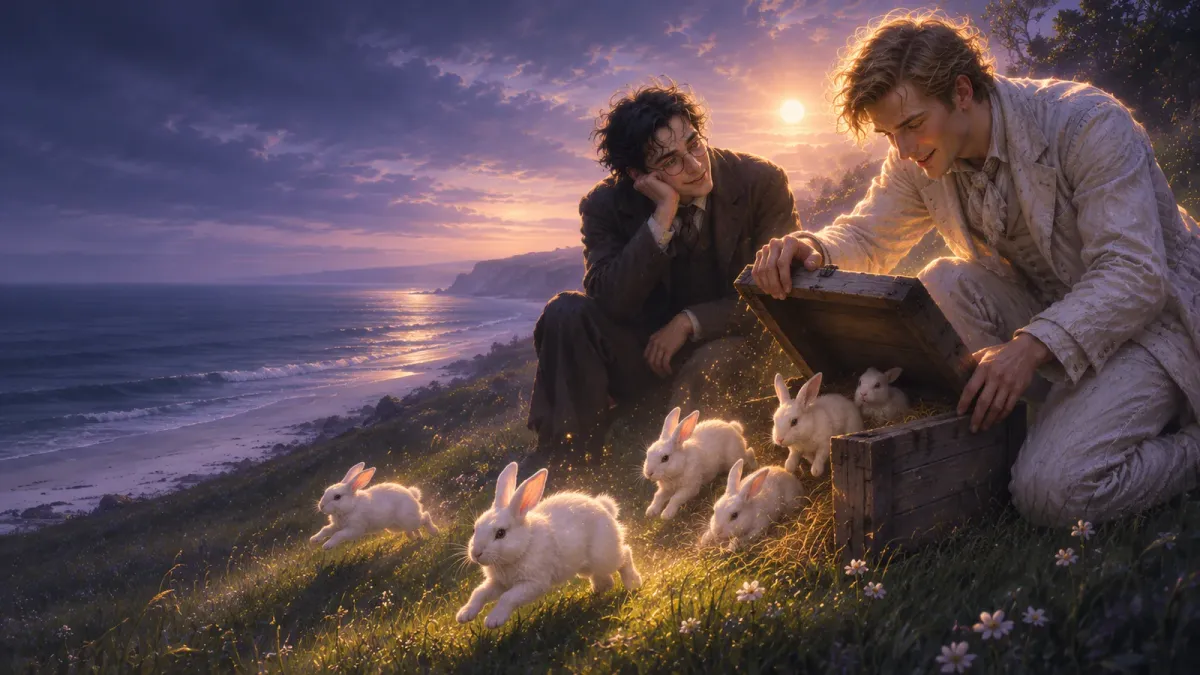
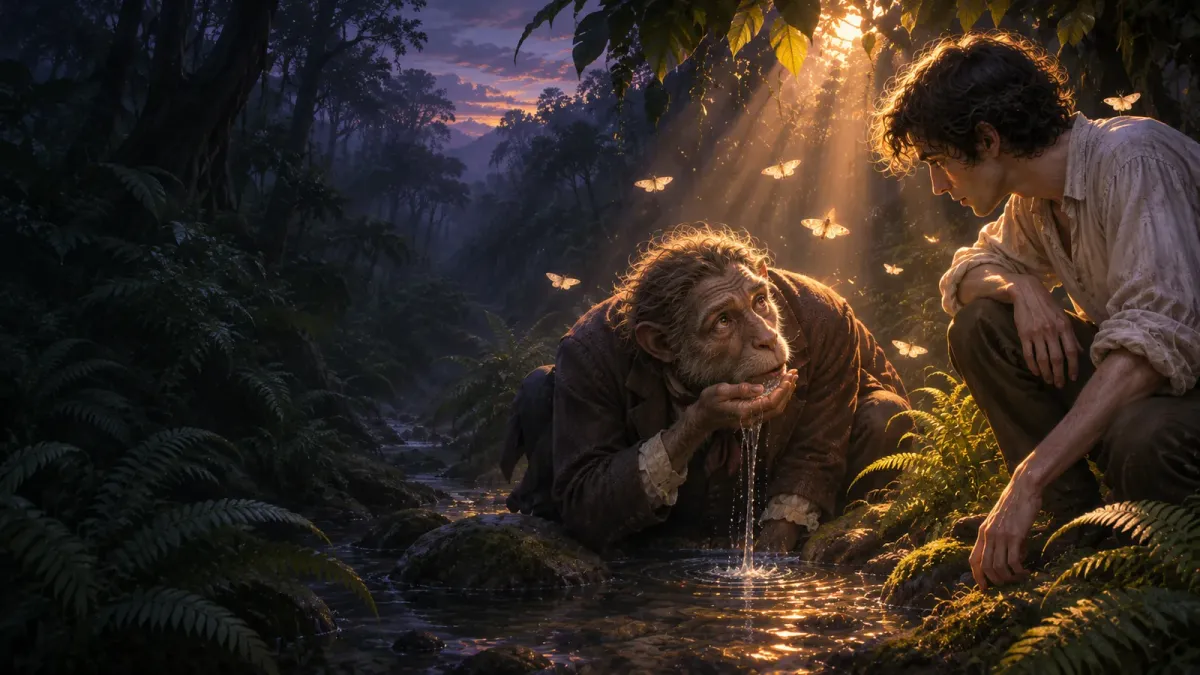
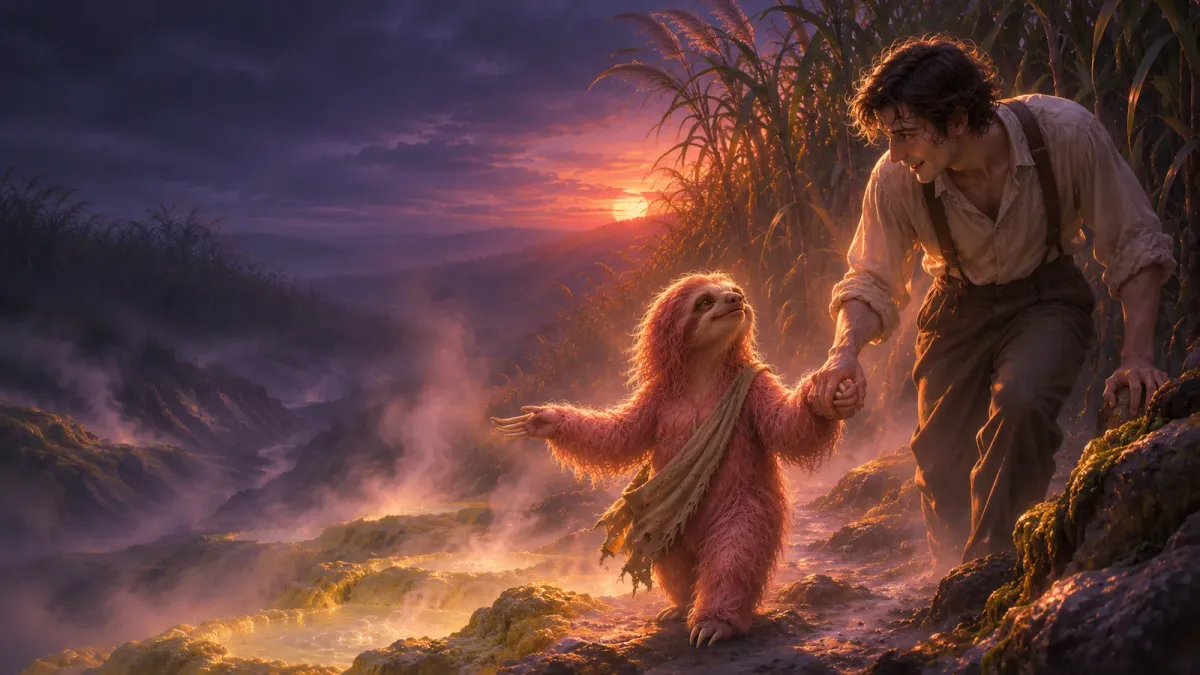
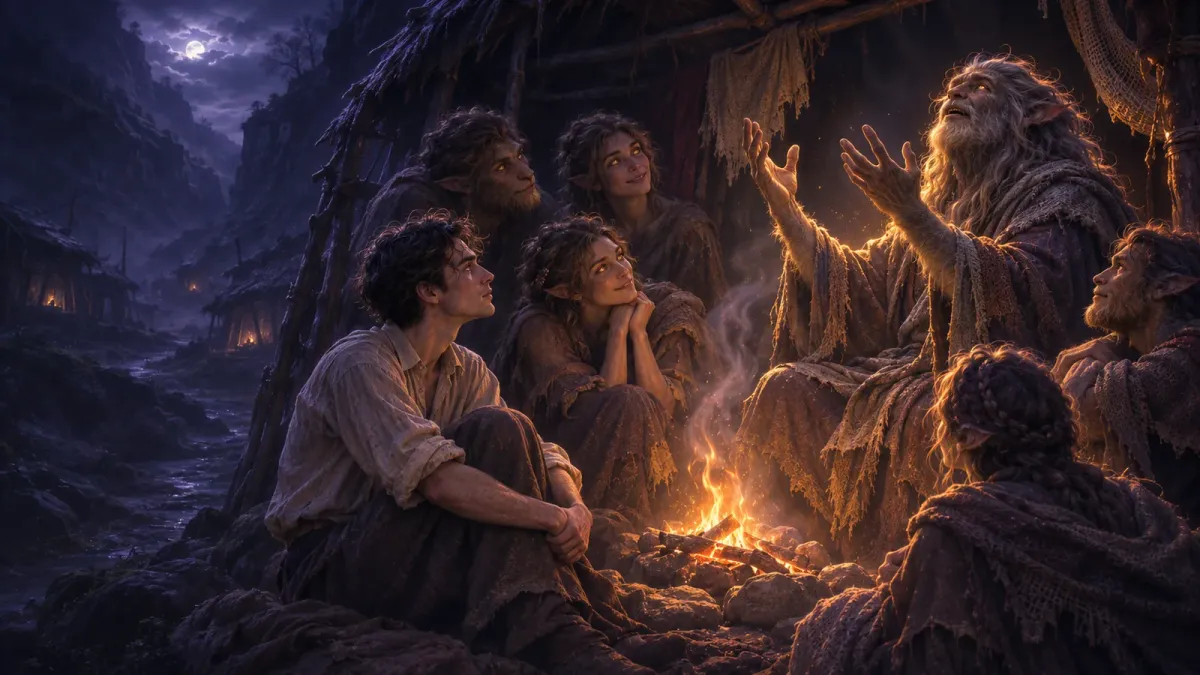
Sommaire de « The Island of Doctor Moreau » · 23 chapitres
- Introductionpage 1
- I: In the Dingey of the Lady Vainpage 2
- II: The Man Who Was Going Nowherepage 6
- III: The Strange Facepage 9
- IV: At the Schooner’s Railpage 16
- V: The Man Who Had Nowhere to Gopage 20
Tous les 23 chapitresVoir moins
- VI: The Evil-Looking Boatmenpage 24
- VII: The Locked Doorpage 30
- VIII: The Crying of the Pumapage 36
- IX: The Thing in the Forestpage 40
- X: The Crying of the Manpage 52
- XI: The Hunting of the Manpage 56
- XII: The Sayers of the Lawpage 63
- XIII: A Parleypage 73
- XIV: Doctor Moreau Explainspage 78
- XV: Concerning the Beast Folkpage 92
- XVI: How the Beast Folk Taste Bloodpage 99
- XVII: A Catastrophepage 114
- XVIII: The Finding of Moreaupage 120
- XIX: Montgomery’s Bank Holidaypage 124
- XX: Alone with the Beast Folkpage 133
- XXI: The Reversion of the Beast Folkpage 140
- XXII: The Man Alonepage 155
Notes des lecteurs pour « The Island of Doctor Moreau »
Personne ne l’a encore noté. Donne la première note.
Ta note
Avis des lecteurs sur « The Island of Doctor Moreau »
Aucun avis pour l’instant.
L’histoire de « The Island of Doctor Moreau »
A castaway's diary of vivisection
Britain was in the middle of fierce public arguments over cutting into live animals for science when Wells sat down to write this story. To make the nightmare feel real, he framed it as the papers of a castaway named Edward Prendick, found only after the man's death.
Out in London and America
William Heinemann brought the book out in London in April. Stone & Kimball followed soon after with an edition for American readers.
Revolting, morbid, and shocking
London critics were horrified by the scenes of surgical torture. What bothered reviewers in several periodicals just as much was the way the book made religious commandments look suspiciously like animal training, and they condemned the whole thing as morbid and revolting.
Wells calls it youthful blasphemy
Looking back in the preface to the Atlantic Edition of his works, an older Wells called the book a piece of "youthful blasphemy" and a "theological grotesque." He admitted the whole point was to remind us how thin the wall really is between human beings and beasts.
Preface to Volume II of the Atlantic Edition of the Works of H. G. Wells
Dans la culture « The Island of Doctor Moreau »
10 adaptations et mentions, 1896–2002
Dans la langue "Are we not Men?"
In their dark hut, the Beast Folk chant the Law they have been beaten into obeying: "Not to go on all-Fours; that is the Law. Are we not Men?" The line escaped the book to become an ironic question in English for moments when our civilized rules barely cover up basic animal instincts.
Dans la langue "The House of Pain"
Doctor Moreau's locked laboratory, where he operates without anaesthesia, is known to the terrified Beast Folk simply as the House of Pain. The phrase stuck in the language as a shorthand for cruel, unethical experiments done in the name of science.
Film Banned in Britain for decades
Paramount's adaptation, Island of Lost Souls, put a whip-cracking Charles Laughton in Moreau's boots and Bela Lugosi in the fur of the Sayer of the Law. Wells disliked the film for trading his philosophical allegory for straight horror, and British censors were so rattled by the vivisection theme that they banned it until 1958.
Film Turning the castaway into a beast
Director Don Taylor brought the story back to the screen with Burt Lancaster as Moreau and Michael York as the shipwrecked visitor, renamed Andrew Braddock. This version flips Wells's setup on its head: Moreau injects his human guest with a serum that starts turning him into an animal.
Musique Devo answers the Sayer's question
The American new wave band Devo lifted the call-and-response chorus of their signature song "Jocko Homo" straight from the 1932 film version of the book. When they sing "Are we not men?" the band shouts back their own philosophy of human de-evolution: "We are Devo!"
Musique Rocking out to the Law
On their album Good for Your Soul, Danny Elfman's band Oingo Boingo turned the Beast Folk's rules into the song "No Spill Blood." The lyrics and chorus are built directly out of the commandments of the Law and the terror of the House of Pain.
Film A shoot as chaotic as the island
New Line Cinema's adaptation with Marlon Brando and Val Kilmer went so badly off the rails in Queensland that director Richard Stanley was replaced mid-shoot by John Frankenheimer. The production's troubles became more famous than the film itself, eventually spawning the 2014 documentary Lost Soul: The Doomed Journey of Richard Stanley's Island of Dr. Moreau.
Art Moreau moves to the English countryside
In the second volume of their comic series The League of Extraordinary Gentlemen, Alan Moore and Kevin O'Neill retired the doctor to the English countryside. He works secretly for the British government, breeding animal hybrids that turn out to be familiar characters from classic children's books.
Série Dr. Hibbert's tropical resort
The Simpsons took on the book in "Treehouse of Horror XIII" with a segment called "The Island of Dr. Hibbert." Springfield's cheerful town doctor plays the mad scientist, luring his neighbors to a tropical resort and surgically turning them into half-animal creatures.
Jeu Fighting the hybrids on PC
Action Forms turned the novel's premise into a PC first-person shooter called Vivisector: Beast Within. Instead of debating a rogue scientist, the player has to fight through his army of biologically engineered animal-human creatures.
Questions et réponses sur « The Island of Doctor Moreau » en anglais
Does Doctor Moreau use genetics or surgery to make the Beast Folk?
He uses surgery, tissue grafting, and hypnosis. Wells wrote the book in 1895, before modern genetics existed, so Moreau reshapes living animals with a knife on the operating table rather than breeding them or altering their DNA. In a famous chapter, Moreau argues that living tissue, including the brain, can be remoulded far more extensively than nineteenth-century doctors believed, and that hypnotism can fix the creatures' new habits of mind.
Is the Panther Woman Lota in the original book?
No, Lota the Panther Woman was invented for the 1932 film adaptation Island of Lost Souls to give the story a romantic subplot. The 1996 film likewise added a feline woman, and the 1977 film added a romance with one of Moreau's creations. In Wells's novel there is no romance at all: the closest figure is a puma that Moreau is still operating on inside the laboratory and that never becomes a speaking companion to Prendick.
Why was Doctor Moreau forced to leave England?
A journalist took a job as his laboratory assistant in London and published a sensational pamphlet exposing his vivisection experiments. A flayed dog escaped from Moreau's house on the day the pamphlet came out, and public outrage drove him from the country. Rather than give up his research, Moreau left with his instruments and set up an isolated compound in the Pacific.
Why do the Beast Folk turn back into animals?
Moreau's surgery only reshapes an individual animal's body and larynx, without changing its underlying animal nature. What Moreau calls the 'stubborn beast flesh' slowly pulls the creatures back toward four-legged movement, hunting, and losing their speech. The chanted Law and the threat of the whip are meant to delay a reversion that Moreau admits he has never been able to stop.
Who is Montgomery and why is he on the island?
Montgomery is Moreau's alcoholic assistant, a former medical student who rescues Prendick at sea. Eleven years before the story begins, he ruined his medical career in a few minutes on a foggy night in London and fled England rather than face the consequences. Caught between the cold, teetotal Moreau and the half-human Beast Folk, he treats the creatures half as servants and half as companions.
What is the Kanaka that the characters talk about?
In the nineteenth century, European sailors used the word 'Kanaka' (from the Hawaiian word for a person) for Pacific Island labourers hired to work on ships and plantations. Before Prendick arrives, Moreau and Montgomery had employed Kanaka workmen on the island; they died or disappeared. Learners should know it is a colonial-era historical term, not the name of one of Moreau's hybrids.
En bref sur « The Island of Doctor Moreau »
15 champs de données éditoriales et de caractéristiques mesurées du texte. Tout est vérifiable.
- Titre original
- The Island of Doctor Moreau
- Auteur
- H. G. Wells · 1866–1946
- Première publication
- 1896
- Langue originale
- Anglais
- Genre
- Science-fiction · Gothique et mystère · Classiques
- Ambiance
- Troublante
- Thèmes
- Science · Nature · Société · Survie
- Cadre
- an unnamed volcanic island in the South Pacific · 1887–1888
- Mots distincts
- 5 307
- Mots par phrase
- 16 mots
- Niveau de l’original
- C2Comment nous mesurons
- Versions
- C2
- Longueur de l’original
- 23 chap. · 43 513 mots
- Temps de lecture
- ~4 h
- Télécharger
- EPUB
Livres similaires que lire après « The Island of Doctor Moreau »
Du même auteur
2La même plume, une autre histoire.
Dans le même esprit
6Le même genre et le même registre.
Vingt mille lieues sous les mers
Jules Verne
C2orig.B1B2
~9 h 40 min · Aventure
Captain Blood
Rafael Sabatini
C2orig.
~10 h 30 min · Aventure
Le Tour du monde en quatre-vingts jours
Jules Verne
C2orig.B1B2
~5 h 50 min · Aventure

Croc-Blanc
Jack London
C2orig.B1B2
~6 h 40 min · Aventure

Le Lagon bleu
H. de Vere Stacpoole
C2orig.B1B2
~5 h 50 min · Aventure
Un chant de Noël
Charles Dickens
C2orig.B1C1
~2 h 40 min · Classiques