Easy English books: the simplest classics, with a measured level
The easiest book in our catalog is Tao Te Ching in a B1.0 edition: 47 minutes of reading and sentences of seven words on average. The easiest book with a story is The Wonderful Wizard of Oz, B1.2, 3 h 40 min.
Short sentences and common words make every book below easy, while the plot and the characters stay as in the original. You can open any of them now, in the browser, with no sign-up.
The easiest books in the catalog

Tao Te Ching
Laozi
C2orig.B1.0B1.8
The Wonderful Wizard of Oz
L. Frank Baum
B2.6orig.B1.2
Just So Stories
Rudyard Kipling
C1.1orig.B1.4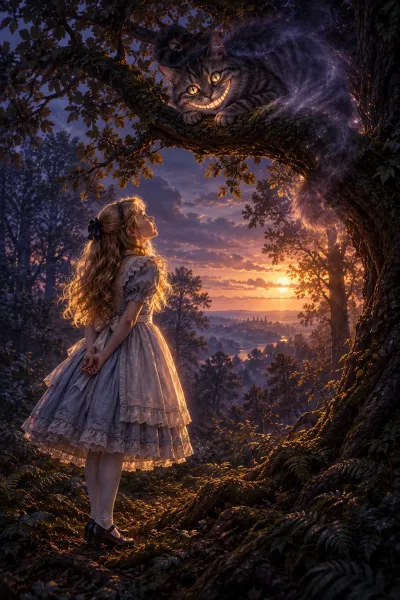
Alice's Adventures in Wonderland
Lewis Carroll
C1.2orig.B1.5B2.1
The Secret Garden
Frances Hodgson Burnett
C1.2orig.B1.4
A Little Princess
Frances Hodgson Burnett
C1.4orig.B1.4
Black Beauty
Anna Sewell
C1.4orig.B1.5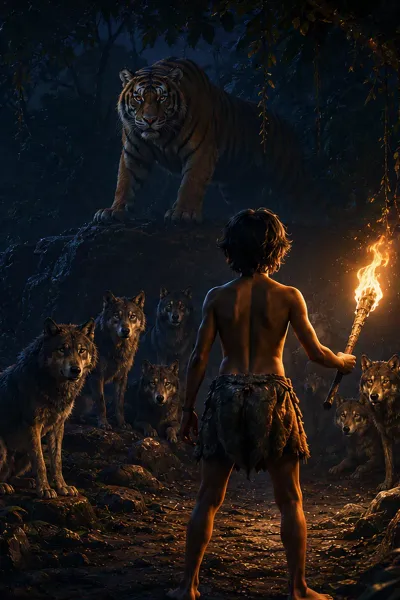
The Jungle Book
Rudyard Kipling
C1.7orig.B1.6B2.8
In the original, Alice's Adventures in Wonderland reads at C1.2. In the edition below it reads at B1.5, and the story is the same. That is true of all eleven books on this list: they are adapted editions of classics. The eight best known are on the covers above, and the whole list is in the table.
| Book | Level | Time | Beyond A1–B2 |
|---|---|---|---|
| Tao Te Ching | B1.0 | 47 min | 3 |
| The Wonderful Wizard of Oz | B1.2 | 3.7 h | 6 |
| Just So Stories | B1.4 | 3.2 h | 8 |
| A Little Princess | B1.4 | 6 h | 6 |
| The Secret Garden | B1.4 | 7.3 h | 6 |
| The Story of King Arthur and his Knights | B1.4 | 9.3 h | 8 |
| Alice's Adventures in Wonderland | B1.5 | 1.8 h | 10 |
| The Jungle Book | B1.5 | 4.8 h | 6 |
| Black Beauty | B1.5 | 5.5 h | 6 |
| The Railway Children | B1.5 | 5.7 h | 6 |
| Three Men in a Boat (To Say Nothing of the Dog) | B1.5 | 6 h | 7 |
Books run from the easiest label to a slightly harder one; inside one label the order is arbitrary. Time is counted at a standard speed of 180 words a minute. Yours may be twice as long, and that is normal. The last column shows how many words on a standard page of 275 words fall outside the basic A1–B2 word list. That is not the same as words you do not know, but it works for comparing books with each other. Labels and numbers are as of 16 November 2026.
One more honest limit: there are no modern books in the catalog. We have only classics whose copyright has expired, which is why you can read and download them for free. If you need a recent book, look elsewhere: sites are compared in the article on where to read English books online.
Which easy English book to start with
Start with a short book that has simple language and a story you may know: The Wonderful Wizard of Oz (B1.2, 3 h 40 min), Kipling's Just So Stories (B1.4, 3 h 10 min) or Alice's Adventures in Wonderland (B1.5, 1 h 50 min). The first book is not there to be a great read. It is there to be finished. For all three, the finish line is in sight on the first evening.
Three books to start with
1
The Wonderful Wizard of Oz, B1.2, 3 h 40 min
The easiest language among books with a full plot: about six words per page outside the basic word list.
2
Just So Stories, B1.4, 3 h 10 min
Separate tales about how the elephant got its trunk and the camel its hump. Each can be finished in an evening, and if one does not work, the next starts with a clean page.
3
Alice's Adventures in Wonderland, B1.5, 1 h 50 min
The shortest book with a story: twenty minutes a day, about six evenings. It has more words outside the list, around ten per page, so take it if you already know the story.
Cannot choose between the three? Take the one whose story you know from a film or a cartoon. Then your effort goes into the language, not into working out who all these people are.
Four books on the list are the shortest: Tao Te Ching, Alice, Just So Stories and The Wonderful Wizard of Oz. Each is under four hours at the standard speed, so you can finish it in a week.
Check yourself on the first page
The label tells you how easy a text is in general. How easy it is for you, one page will show. Open the book you chose and count how many times you had to stop at an unknown word.
A guide comes from Richard Day and Julian Bamford, authors of ten principles of extensive reading: for a beginner, a text with one or two unknown words per page works; for an intermediate reader, no more than five[3].
- More than five stops — the book is a bit heavy for now. Take Tao Te Ching, or start with the article for beginners.
- One or two — this is your level. Keep reading.
- Almost none — the list is already easy for you. Move on to the B1.6 editions further down.
Easy English books with help for hard words
There is no side-by-side text on books.dev. The page is English only. Tap a word, and a card opens with a short definition in plain English, while the page stays where it is. So you never leave English: instead of a word in another language, you get a short, simple explanation.
Why not a parallel text? It looks like the easiest way: English on the left, your own language on the right. The catch is that your own language reads without effort, and your eye slides over to it by itself. After a couple of pages you are reading a book in your language with English pictures on the edges.
Picture page three of Oz. One word stands between you and what happened to Dorothy's house. You tap it, a card slides up from the bottom, and the page stays put. A second, and you are back in Kansas.
You can save a word to your own dictionary with one button. It then returns as a flashcard, soon at first and then less and less often, until it sticks.
You will not tap often. In The Wonderful Wizard of Oz, 98.0% of the words of the text are in the word list up to B2, which means about six words per standard page fall outside it. If you would still like a translation into your own language, sites that offer one are compared in the article on where to read English books online.
Where to download easy English books
All the books on the list can be downloaded free in EPUB format: there is a "Download" button on the book's page. The book opens in the reader, and the file becomes available half a minute later. The EPUB opens in any e-book reader app. There is no PDF.
What the file will not have: tap-for-a-definition, narration and word cards. All of that lives on the site. The narration cannot be downloaded as a separate file either, and books.dev has no offline mode: reading with definitions and a voice needs the internet.
You do not have to download. You can read right in the browser, with no sign-up, and on a phone you can add books.dev to the home screen, like an app.
Can you listen to easy books?
Yes: every edition on the list has narration, and like everything on books.dev it is free. Two voices can read to you: the book's own synthetic voice or the voice built into your device. While a voice speaks, the page highlights the sentence and the word it is saying.
It works like karaoke: a line lights up exactly when it is sounding, so the sound and the spelling reach your head together. The voice speed changes in the reader settings.
The voice is synthetic: even and exact to the text, but not an actor, and it can slip on a rare name. A flag on the book's page shows whether it is British or North American.
The voices of all the books and some ways of listening are in the article on English audiobooks.
What makes a book easy
An easy book is made of short sentences and common words. In the editions on this list a sentence has 7–9 words on average, and 96–99% of the words of the text are in the word list up to B2. It sounds dry, but you can see how both things work right on the page.
A short sentence is like a short phone number: you hold the whole thing in your head while you dial. In a typical B1 edition a sentence has 8.2 words, in a typical original 18.4. A sentence that long is like an eighteen-digit number: by the end you have to start again.
Common words decide how often you have to stop on a page. Compare a typical B1 edition and a typical original, on a standard page of 275 words:
| On a page | B1 edition | Original |
|---|---|---|
| Words per sentence | 8.2 | 18.4 |
| Words outside the A1–B2 list | ≈5 | ≈20 |
These are the figures for all B1 editions in the catalog and their originals. The length hardly changes: a typical B1 edition is 99% of the original.
The editions are written by a language model from the text of the original, and a person does not proofread them. This is said on the last page of every adaptation. The model replaces rare words with common ones and cuts long sentences, and a rare word the story needs stays, with a short explanation. An edition is published only if the measurement shows it is clearly simpler than the original. How the measurement works is on the page how we measure reading levels.
The difficulty of the ideas is not part of this measurement. The easiest book on the list is Tao Te Ching, the one about the way and not-doing: the edition has only 937 different words, and people have been thinking about its meaning for over two thousand years. You will not read it fast. Every line asks to be read again.
What to read as an adult, not a child
You open the list and see a garden, a princess and a wizard. It looks like a shelf in a children's library, and the question "what is there for an adult?" is fair.
First, children's classics were written in native English, for children who grew up with it. That is why the originals of Alice and The Secret Garden stand at C1.2. What became simple is the language of the edition, not the book. Second, on the list and just after it there are books that were never for children:
- **Black Beauty.** Anna Sewell did not write it for children, but to make people kinder to horses. It became a children's book later[5].
- **Three Men in a Boat.** Jerome planned a serious guide book, but the humour took over[6].
- **Tao Te Ching.** Short chapters of sayings about power, gentleness and the skill of not arguing. Not a fairy tale and not a novel: a book you can open on any page.
- **White Fang.** A hard story of survival in the North, told through the eyes of an animal. A little above the list: B1.6, 6 h 40 min.
If you want something fully adult, one step up there are short ones: The Strange Case of Dr Jekyll and Mr Hyde (B1.8, 2 h 20 min), A Christmas Carol (B1.8, 2 h 50 min) and Carmilla (B1.6, 2 h 40 min). And among the B1.6 editions there are Anna Karenina and The Odyssey.
Age, by the way, is no obstacle, and may even help. In a meta-analysis of 49 studies of extensive reading, that is, reading a lot and reading easily, the effect was bigger for adults than for children and teenagers[7]. It is an average across groups, not a promise to everyone, so it is a reason to begin, not a guarantee.
Easy, but with a long story
If your first book is finished and you want a real novel, choose by mood:
- You want warmth. The Secret Garden (7 h 20 min): an orphan girl finds a locked garden and friends with it. A Little Princess by the same Burnett (6 h): a rich boarding-school girl loses everything in a day. The Railway Children (5 h 40 min): three children move to a house by the railway when their father suddenly disappears.
- You want adventure. The Story of King Arthur and his Knights (9 h 20 min): a sword, duels and knightly honour.
- You want to laugh. Three Men in a Boat (6 h): three friends and a dog row up the Thames, and everything goes wrong.
- You want animals. Black Beauty (5 h 30 min) is a horse's life told by the horse, and White Fang (B1.6, 6 h 40 min) is a half-wolf in the North in the gold rush.
These books run from five and a half to over nine hours at the standard speed. At half an hour a day that is from a week and a half to three weeks.
What to read next
When you finish this list too, the next editions by label are B1.6. Among the short ones are Through the Looking-Glass (2 h 50 min) and The Call of the Wild (3 h): after Alice and Black Beauty it is a natural next step.
Next step: B1.6 editions
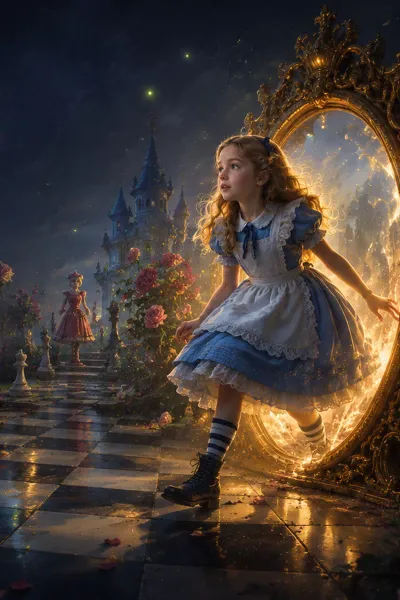
Through the Looking-Glass
Lewis Carroll
C1.1orig.B1.6
The Call of the Wild
Jack London
C2orig.B1.6C1.3
Peter and Wendy
J. M. Barrie
C1.7orig.B1.6B2.7
White Fang
Jack London
C2orig.B1.5B2.6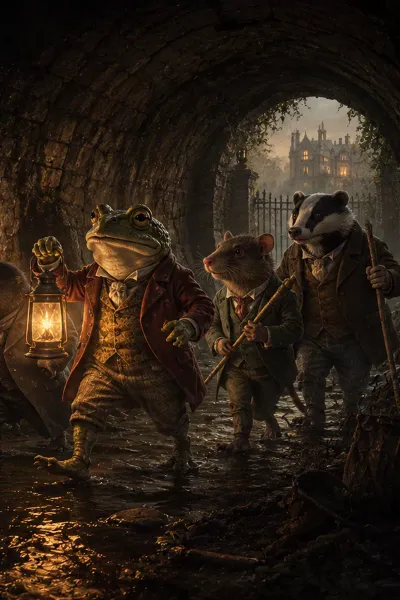
The Wind in the Willows
Kenneth Grahame
C2orig.B1.6B2.8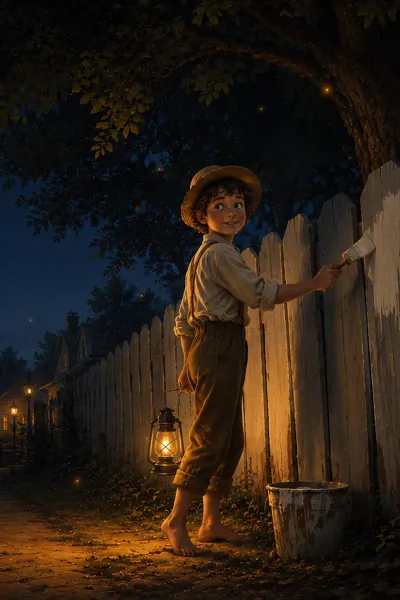
The Adventures of Tom Sawyer
Mark Twain
C2orig.B1.6C1.1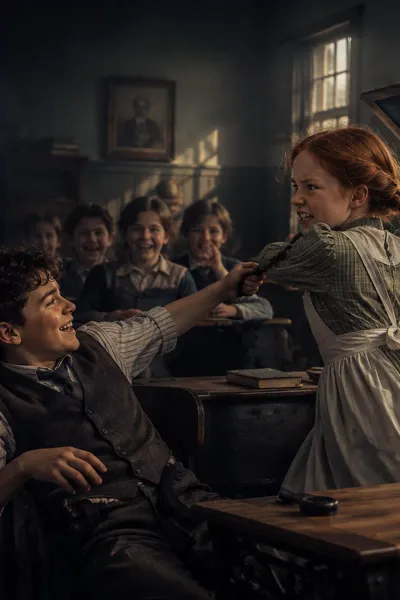
Anne of Green Gables
L. M. Montgomery
C1.6orig.B1.6B2.6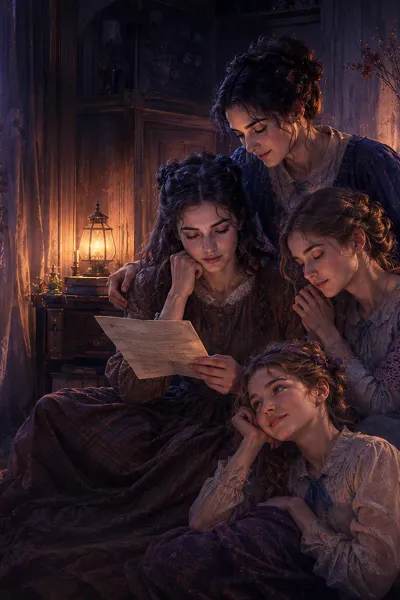
Little Women
Louisa May Alcott
C1.8orig.B1.6B2.9
The Odyssey
Homer
C1.8orig.B1.6B2.7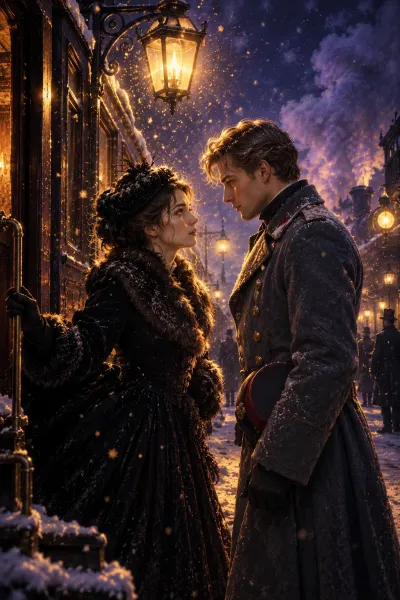
Anna Karenina
Leo Tolstoy
C1.7orig.B1.6B2.6
The whole level, 73 editions with label and time, is in the article on English books at B1.
And if you want the original, without adaptation?
The easiest original in the catalog is the same The Wonderful Wizard of Oz: B2.6, 3 h 40 min. It has about ten words per page outside the list, almost like the Alice edition, but a sentence averages over eighteen words. Next come the originals of Just So Stories and Through the Looking-Glass (C1.1) and Alice's Adventures in Wonderland (C1.2). The original opens on the same book page as the edition.
Between the B1 edition and the original there is a middle. Alice, for example, has a second edition, B2.1, and such books are collected in the article on English books at B2.
How to read so that you finish
Picture a page covered in pencil: fourteen underlined words, translations in the margins, and by the third paragraph you no longer remember how it began. That is what school teaches: a hard text, every word into a notebook. Extensive reading suggests almost the opposite.
- A lot, not deep. Day and Bamford advise reading at least a book a week, so that reading becomes a habit[3]. That means short books like Alice: 1 h 50 min is fifteen to twenty minutes a day.
- Speed matters more than accuracy. They describe the vicious circle of a weak reader: reads slowly, gets no pleasure, reads little, and so stays slow[3]. An easy book breaks that circle at the first link.
- A dictionary, but only when it counts. Tap a word that breaks the plot or has turned up for the third time. Repeats really do decide it: in the study by Brown, Waring and Donkaewbua, words that appeared more often were remembered better and stayed in memory longer[4].
- You may quit. The principles say outright that you can put a book down if it is hard or boring[3]. A boring book does not get more useful because you dragged yourself to the end.
A step-by-step plan for the first two weeks, with a three-page test and word cards, is in the article on how to read books in English.
Why an easy edition may not be easy for you
The label measures the text, and you are the one reading it. Between those two facts sits the error of the ruler and your own experience.
The error is the honest price of any ruler. On exam texts the program had not seen, the label was off the middle of the level by 0.51 on average, and a single text can be off by a whole level. So a difference of less than half a level between two books does not guarantee that one is easier than the other.
In practice: between Oz (B1.2) and Alice (B1.5) the difference is probably noticeable. Between The Secret Garden (B1.4) and Black Beauty (B1.5), your taste will decide, not the label.
The second half is your experience. A plot you know from a film, a favourite subject or vocabulary built up on series moves ease more than tenths of a label. That is why the first-page check has the last word.
How the list was made and how far to trust it
The list holds all editions with a label no higher than B1.5 on 16 November 2026, measurement method version 1.2. These are candidates, not a ranking: the order inside one label is arbitrary. Reading time is the length of the edition divided by 180 words a minute, and a page is 275 words. Both are fixed values the site uses, not a measurement of anyone's speed.
| Edition | Label | Different words | Words per sentence | A1–B2 share |
|---|---|---|---|---|
| Tao Te Ching | B1.0 | 937 | 7.1 | 99.1% |
| The Wonderful Wizard of Oz | B1.2 | 2,089 | 8.8 | 98.0% |
| Just So Stories | B1.4 | 2,093 | 8.2 | 97.0% |
| A Little Princess | B1.4 | 2,805 | 8.2 | 97.7% |
| The Secret Garden | B1.4 | 2,906 | 8.1 | 97.8% |
| The Story of King Arthur and his Knights | B1.4 | 2,548 | 8.7 | 97.0% |
| Alice's Adventures in Wonderland | B1.5 | 1,856 | 8.4 | 96.4% |
| The Jungle Book | B1.5 | 2,509 | 8.1 | 97.9% |
| Black Beauty | B1.5 | 2,513 | 8.4 | 97.8% |
| The Railway Children | B1.5 | 2,929 | 8.0 | 97.9% |
| Three Men in a Boat | B1.5 | 3,418 | 8.4 | 97.6% |
Coverage is the share of the words of the text that are in the CEFR-J Wordlist 1.5, a list of words that each have a level from A1 to B2. The column "words outside the list per page" in the first table is calculated from it.
Look at Alice: its coverage is lower than that of its neighbours at the same label, and the label is still B1.5. The label is built not only from words but also from the length and the structure of sentences.
For comparison: most often a B1 edition gets B1.8, and the median is B1.7. The eleven editions on this list are the easiest edge of the level.
Can I read these books for free?
Yes: the books in the catalog open for free, right in the browser. Narration and tap-for-a-definition are free too.
Can I read with help for hard words?
Yes, but not with a parallel text. Tap an unknown word and a short definition in plain English appears next to it. The text stays English, and the dictionary is always at hand.
Can I download these books?
Yes, free: there is a "Download" button on the book's page, and an EPUB file becomes available half a minute later. The narration cannot be downloaded as a separate file, and tap-for-a-definition and word cards work only on the site. You can also read online, with no download.
What is the easiest book to read in English?
In our catalog, the B1.0 edition of Tao Te Ching. The easiest book with a full plot is The Wonderful Wizard of Oz in the B1.2 edition.
Can I read real novels as a beginner?
Not at A1–A2: we have no editions that easy yet, and an original classic is written for native readers. From B1 you can read novels in adapted editions, with the same plot and characters as the original. Start with English books for beginners if you are below B1.
Are children's books good for learning English?
It depends on the edition. Children's classics are written in native English for native children: the originals of Alice and The Secret Garden are C1.2. Their B1 editions are a different matter, with short sentences and common words, and they are the easiest on this list.
Can I listen to these books?
Yes. Every edition on the list has narration with highlighted text, so you can read, listen, or do both at once. The voice is synthetic, and you can switch to your device's voice instead.
How do I know if a book is too hard?
Read one page and count the stops at unknown words. More than five means the book is heavy for now; one or two means it is your level. This is only a guide, and the page test is explained above.
How is this list different from other lists of easy books?
Many lists give a level by the author's feeling or by a publisher's label. Here every book's label is measured by one program from the text of the edition, so books can be compared with each other. How the measurement works is on the page how we measure reading levels.
At a glance
| What you look for | What the catalog has |
|---|---|
| The easiest book | Tao Te Ching, B1.0, 47 minutes: 937 different words, 7.1 words per sentence |
| The easiest book with a plot | The Wonderful Wizard of Oz, B1.2, 3.7 h |
| Label B1.4 | Just So Stories — 3.2 h A Little Princess — 6 h The Secret Garden — 7.3 h The Story of King Arthur and his Knights — 9.3 h |
| Label B1.5 | Alice's Adventures in Wonderland — 1.8 h The Jungle Book — 4.8 h Black Beauty — 5.5 h The Railway Children — 5.7 h Three Men in a Boat — 6 h |
| The shortest book with a plot | Alice's Adventures in Wonderland, 1.8 h: twenty minutes a day is about six evenings |
| How time is counted | At the site's standard speed, 180 words a minute; your own time may be twice as long |
| A typical B1 edition | Most often B1.8, for 39% of editions; the median is B1.7 |
| How exact the label is | About half a level: on average 0.51 from the middle of the level on exam texts[8] |
| Books for A1–A2 | None yet: the easiest edition is B1.0, the bottom edge of B1 |
| Narration | For every edition on the list; free for now |
Sources
8
- [1]Silver Shoesen.wikipedia.org
- [2]Alice's Adventures in Wonderlanden.wikipedia.org
- [3]Day & Bamford, Top Ten Principles for Teaching Extensive Reading, 2002 (Reading in a Foreign Language)nflrc.hawaii.edu
- [4]Brown, Waring & Donkaewbua, Incidental vocabulary acquisition from reading, reading-while-listening, and listening to stories, 2008 (Reading in a Foreign Language, via ERIC)files.eric.ed.gov
- [5]Black Beauty (Wikipedia)en.wikipedia.org
- [6]Three Men in a Boat (Wikipedia)en.wikipedia.org
- [7]Jeon & Day, The effectiveness of ER on reading proficiency: A meta-analysis, 2016 (Reading in a Foreign Language)nflrc.hawaii.edu
- [8]How we measure reading levels (books.dev)books.dev