English books for beginners: where to start
If you are a true beginner (A1-A2), a real book is still a big jump. Read short learner stories first. The catalogue here starts at B1, the level where real books become possible, and the editions are adapted to be easier to read. There are no A1 or A2 books.
One idea explains most of this. The first real book is a taller step than the ones before it. That is not your fault. It is just a different size, and you can measure it before you climb.
Where are you now?
| You can... | Start here |
|---|---|
| Understand simple phrases and short sentences (A1-A2) | Read the section "What to read before B1" |
| Get the main point of a simple article, but novels are hard (around B1) | Do the page test, then pick from five B1 editions to start with |
| Read B1 stories, but it takes effort | Go to books for B2 |
The letters are CEFR levels, a European scale for language skill. A means a basic user, B means an independent user[1]. The label on a book's card is the site's own, and the page about how we measure reading levels explains how it is measured.
Test your step height in two minutes
Imagine this. You open a real novel on page one. The unknown words arrive in groups. By the third paragraph you remember how the sentence began, but not what it said.
That is not a talent problem. It is simple counting.
Researchers Coady and Nation suggested that readers need to know about 98% of the words for reading to be pleasant[2]. Take 100 words. At 98%, only two are new. You can guess them or tap them, and the story keeps moving. With ten new words, the page is work. Treat this as a rough guide, not a law.
Here is a real first sentence, from a book you can try:
Alice was beginning to get very tired of sitting by her sister...
You can run this test on Alice's Adventures in Wonderland right now.
Does reading really teach new words?
Researchers do not fully agree. Cobb (2007) doubted that reading alone can build a big enough vocabulary. McQuillan and Krashen replied that learners may read a million words or more in two years, so reading can go much further than Cobb counted. Cobb answered that this depends on very easy texts. You can see the debate on the same Wikipedia page[2]. A safe middle: read a lot, and add some word practice.
What to read before B1
At A1-A2, learner stories are the right size. They are short books with limited vocabulary and simple grammar, written for one set level. People call them graded readers. They are not on this site, but they exist, and many are good.
Here are three places to look:
- Macmillan Readers. A series with levels from Starter to Upper. The publisher maps its levels to CEFR itself: Starter and Beginner are A1, Elementary is A2[3].
- Cambridge English Readers. Cambridge's Spanish-language blog advises A1-A2 learners to choose graded readers with a glossary and audio[4]. This is the publisher's advice, not a study.
- Paul Nation's free readers. They are free to share, but not to sell. Two of the readers on his page are written within a 1,200-word vocabulary[5].
A small warning: "beginner" on a cover is the publisher's word. The level label is the useful part, so check that.
What helps at your first real book
Tools do not remove the step. They make each unknown word cheaper. A tap on a word costs a few seconds. A trip to another app costs you the story.
Here are the usual problems and what to do:
| Stuck on... | Try this |
|---|---|
| One unknown word that blocks the plot | Tap it to see a dictionary card and an explanation in context. More in how to read books in English. |
| A sentence you cannot untangle, even though you know every word | Translate the whole sentence. The MosaLingua blog suggests this as a last step, after word lookups[6]. |
| Losing the thread while reading | Follow the narration. It is synthetic speech, so names may sound wrong. See English audiobooks. |
| Words that come back every chapter | Save them as word cards with spaced repetition. Keep short phrases, not lists of single words, as the Skysmart blog suggests[7]. |
0-2 min
Page test
Do the page test on the first page.
2-10 min
Read
Read without stopping. Guess from context. Tap only the words that block the plot.
10-15 min
Listen
Listen to the same page once.
At the end
Keep
Keep three to five phrases you liked.
This is a suggested routine, not research. Change it to fit your day.
Five B1 editions to start with
The shelf sorts books by level, easier first, and the sort uses the label of the original book. Each edition also has its own label on its card, so check that too. A famous classic can still feel like work at B1, and that is fine.
Start here


Pick by taste
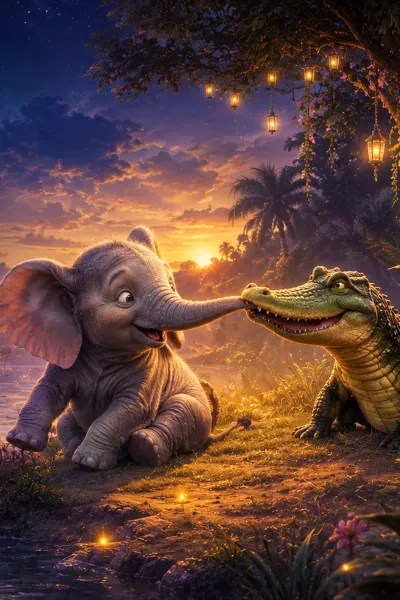
- Short tales about animals: Just So Stories.
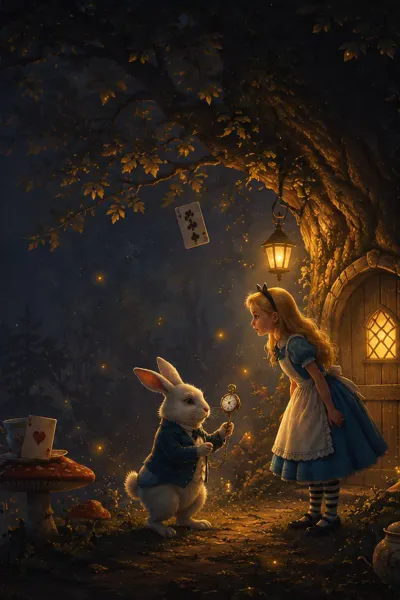
- Jokes, riddles and nonsense: Alice's Adventures in Wonderland.
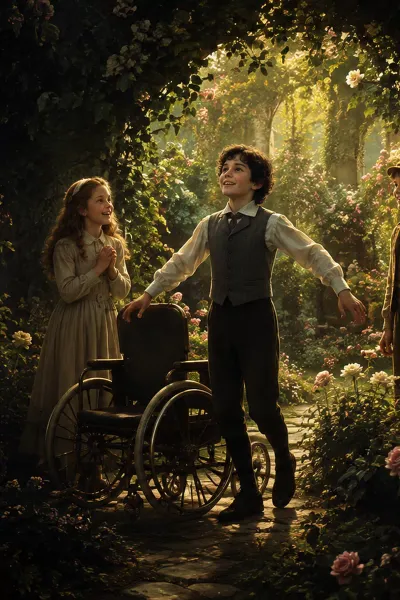
- A locked garden and a mystery: The Secret Garden.
- A story told by a horse: Black Beauty.
- A girl at a London boarding school: A Little Princess.
These are classics, not only children's books. Pick the story you want to know the end of. That matters more than the label.
FAQ
Can I read a real book at A2?
A few pages with tools, maybe. A whole book is easier after learner stories. Use the page test to decide.
Does books.dev have A1 or A2 books?
No. The catalogue starts at B1. See "What to read before B1" for where to start.
How many minutes a day should I read?
Are bilingual books good for beginners?
They exist. Here you tap a word or translate a sentence instead. We make no claim about which way works better.
Is it free?
Reading and the dictionary are free for everyone, as the terms say. Other features may have paid plans; the terms explain this.
Start with the page test. Two minutes now can save you a lot of effort later. If B1 feels easy, move up to books for B1 or B2.
Sources
- [1]https://en.wikipedia.org/wiki/Common_European_Framework_of_Reference_for_Languages
- [2]https://en.wikipedia.org/wiki/Extensive_reading
- [3]https://www.macmillanenglish.com/us/macmillanreaders
- [4]https://blog.cambridge.es/libros-para-leer-ingles-recomendaciones-por-niveles-y-consejos/
- [5]https://www.wgtn.ac.nz/lals/resources/paul-nations-resources/readers
- [6]https://www.mosalingua.com/es/leer-tu-primer-libro-en-ingles/
- [7]https://english.skysmart.ru/14-luchshih-knig-na-anglijskom-dlya-nachinayushih