Captain Blood auf Englisch
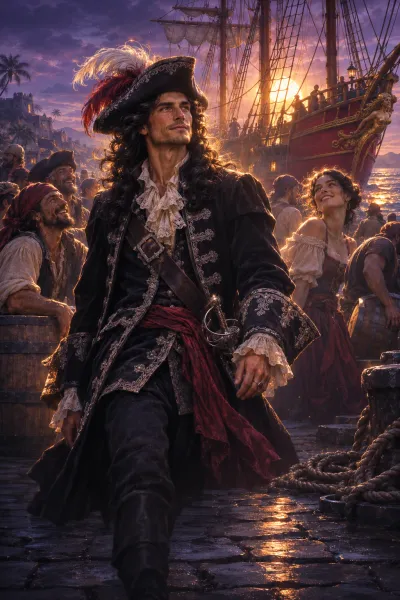
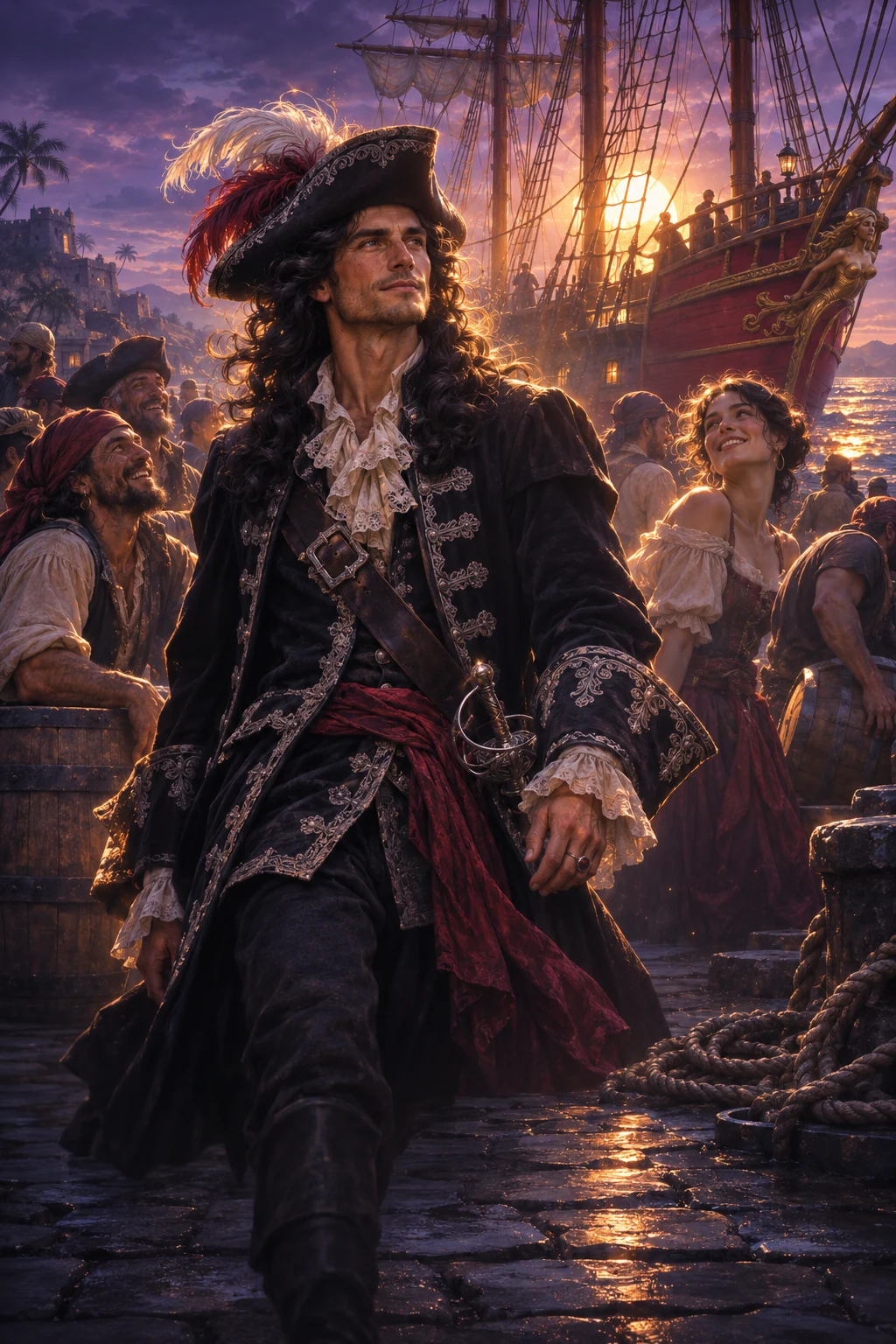
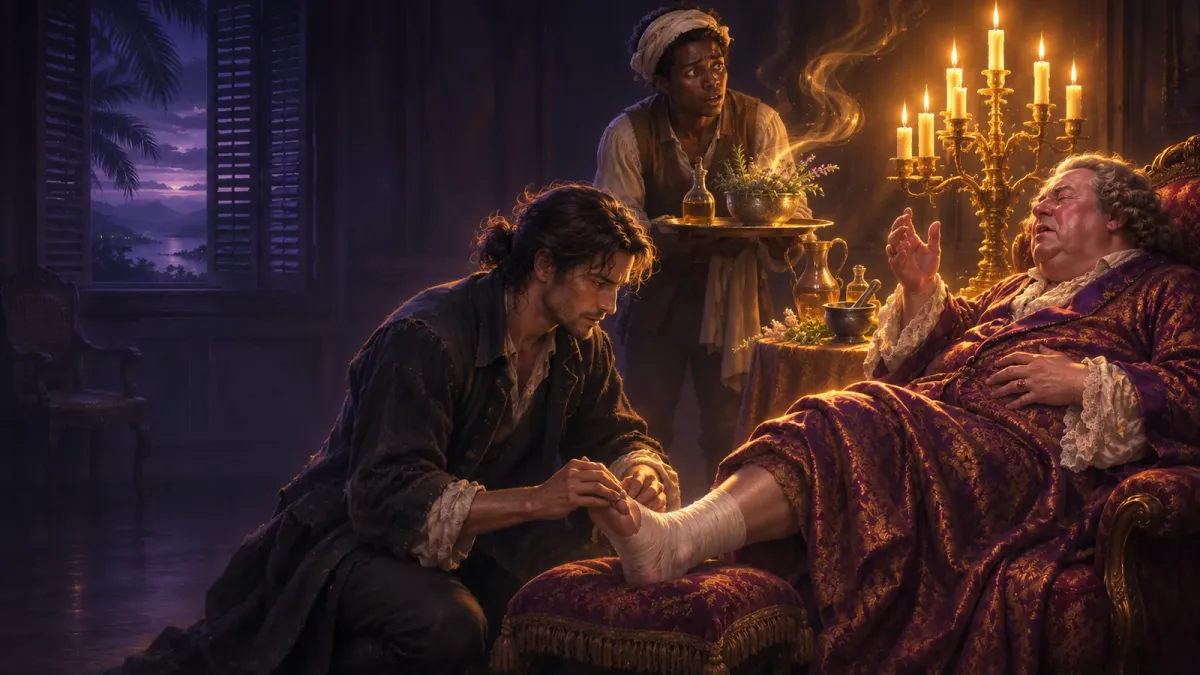
An Irish doctor in 1685 patches up a wounded rebel, gets shipped to Barbados as a slave for treason, and escapes on a stolen Spanish warship to become the sharpest pirate in the Caribbean.
The book moves in three clear stages: a short opening in England and the Barbados plantations, a string of self-contained raids and sea duels around Tortuga and the Spanish Main, and a final campaign when European politics catch up with the Caribbean. Sabatini frames the adventure as the chronicle of an intelligent man who wins his battles by outthinking rival admirals before a single cannon is fired. The prose is formal early-twentieth-century British English that enjoys dry irony and polite insults just as much as boarding actions. Even when cannonballs are flying, the sentences stay poised and orderly.
- a hero who wins sea battles with ruses and geometry rather than blind luck
- dry, polite banter between people who have cannons pointed at each other
- seventeenth-century colonial politics where empires change sides mid-story
- a romance built on stubborn pride and mutual misunderstanding rather than easy flattery
- heavy on wooden-ship rigging, wind direction, and broadside tactics
- the hero is almost never wrong, and the book knows it
- stately 1920s narration that dresses up simple actions in formal Latinate verbs
- the romance runs for hundreds of pages on a single refusal to explain a misunderstanding
Was für ein Buch „Captain Blood“ ist
Das Original von „Captain Blood“ auf Englisch
Wähle eine Version. Über die Leiste unten auf der Seite öffnest du deine Auswahl.
Wortschatz nach Niveau
- A1 59%
- A2 15%
- B1 9%
- B2 7%
- nicht im Wörterbuch 5%
Die Originalsprache von „Captain Blood“ und was sie dir bringt
Wie schwer die Sprache ist C2
Our measurement puts the original text at C2, which on the page means a formal, literary vocabulary rather than tangled grammar. The sentences themselves are medium-length and cleanly built, and most of the running text uses everyday words. What pushes the book to the top level is Sabatini's fondness for cultured Latinate verbs and adjectives alongside a steady stream of seventeenth-century naval, legal, and medical terms. You will also meet occasional French and Spanish phrases dropped in by rival captains across the Caribbean.
Was das praktisch heißt: The original suits C2 readers or confident advanced learners who do not mind sea terms; no adapted editions are available for this book yet.
Worauf du dich einstellen solltest
Wie du es liest und nicht aufhörst
- Do not stop to look up every sail or rope: keep four basic ship words straight — bow (front), stern (back), windward (upwind), and leeward (downwind) — and you can follow who has the advantage in any sea fight.
- Watch for formal English words that look like familiar European cognates but carry an older legal or naval sense here, such as 'transported' (sent to the colonies as a convict), 'articles' (a pirate ship's written contract), and 'execution' (damage done by cannon fire).
- Pay attention to 'would' and 'should' in dialogue: Sabatini uses them in the older British way for polite threats, dry hypotheses, and formal promises.
Leseprobe aus „Captain Blood“ auf Englisch
Tippe auf ein Wort – wir zeigen dir die Übersetzung
Mit den Pfeiltasten wechselst du zwischen Wörtern, Enter zeigt die Übersetzung.Original · C2174 Wörter
“Why, so he had. Yet what I am telling you is also true, so it is. For some years I was a soldier; but before that I was a physician, and I have been one again since January last, established in Bridgewater, as I can bring a hundred witnesses to prove.”
“There’s not the need to waste our time with that. I will convict you out of your own rascally mouth. I will ask you only this: How came you, who represent yourself as a physician peacefully following your calling in the town of Bridgewater, to be with the army of the Duke of Monmouth?”
“I was never with that army. No witness has sworn to that, and I dare swear that no witness will. I never was attracted to the late rebellion. I regarded the adventure as a wicked madness. I take leave to ask your lordship” (his brogue became more marked than ever) “what should I, who was born and bred a papist, be doing in the army of the Protestant Champion?”
Illustrationen zu „Captain Blood“
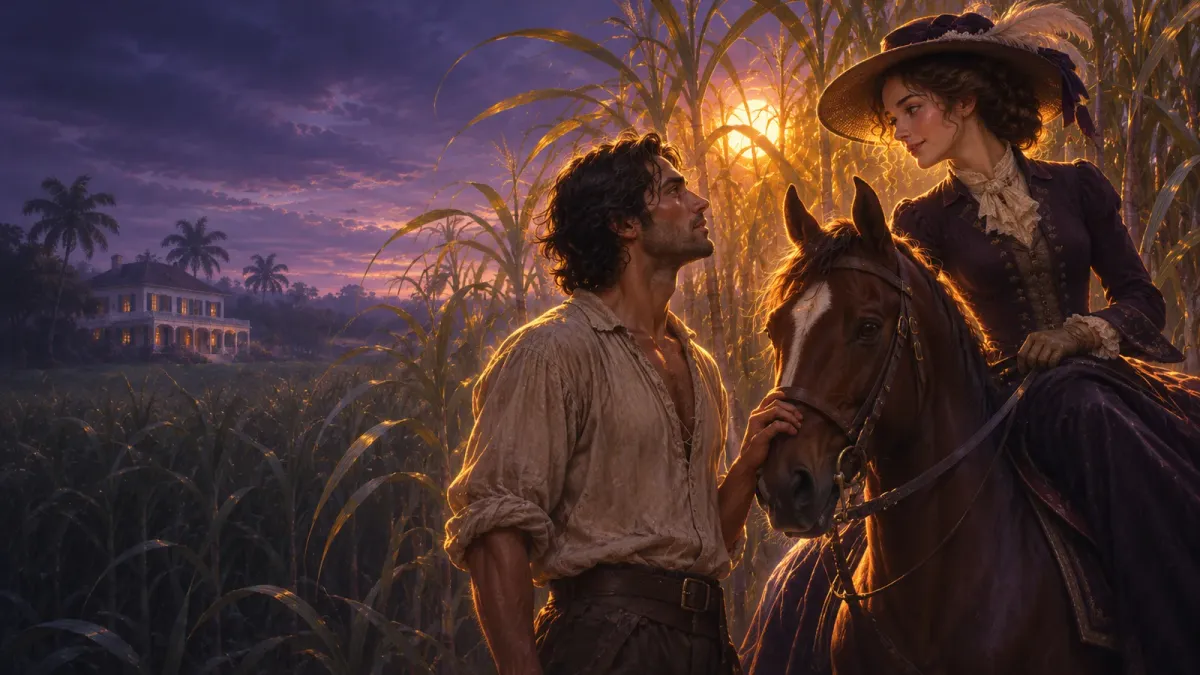
6 Szenen aus „Captain Blood“, in der Reihenfolge der Geschichte und ohne das Ende.

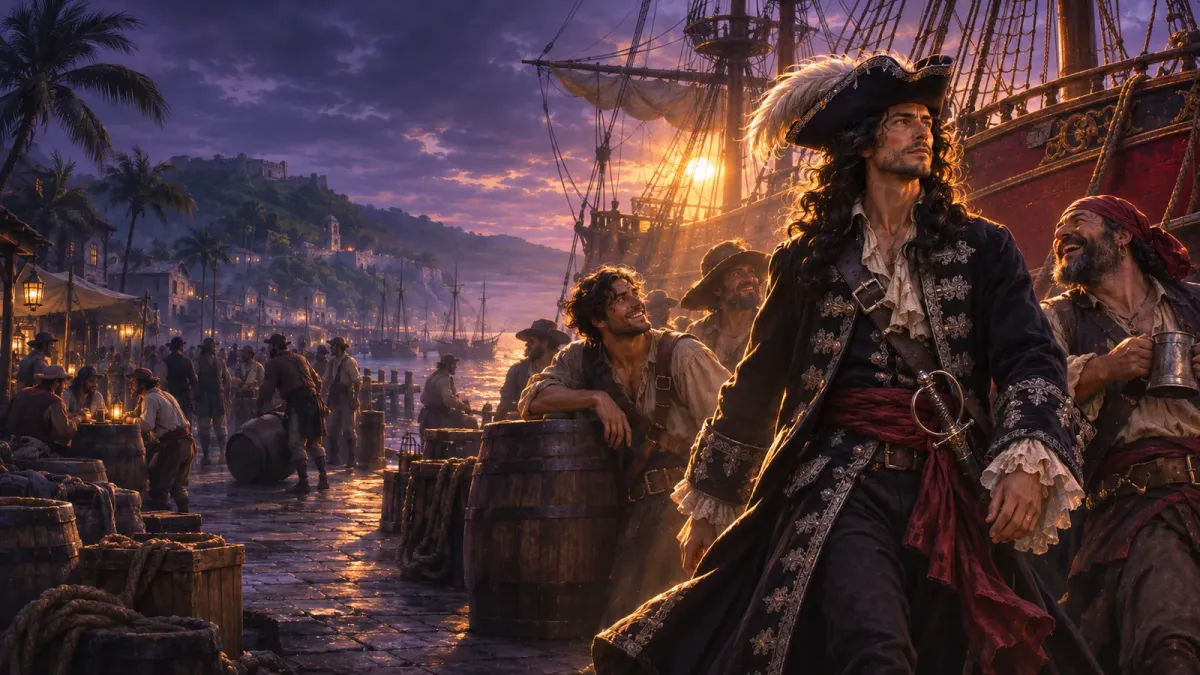
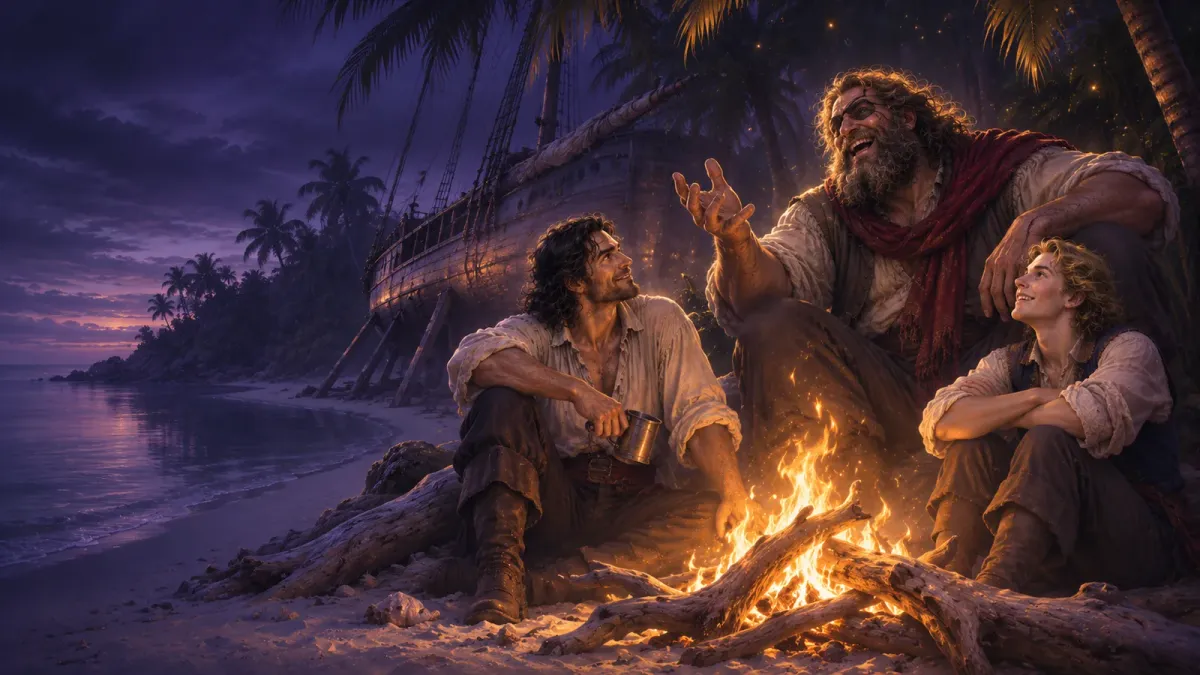
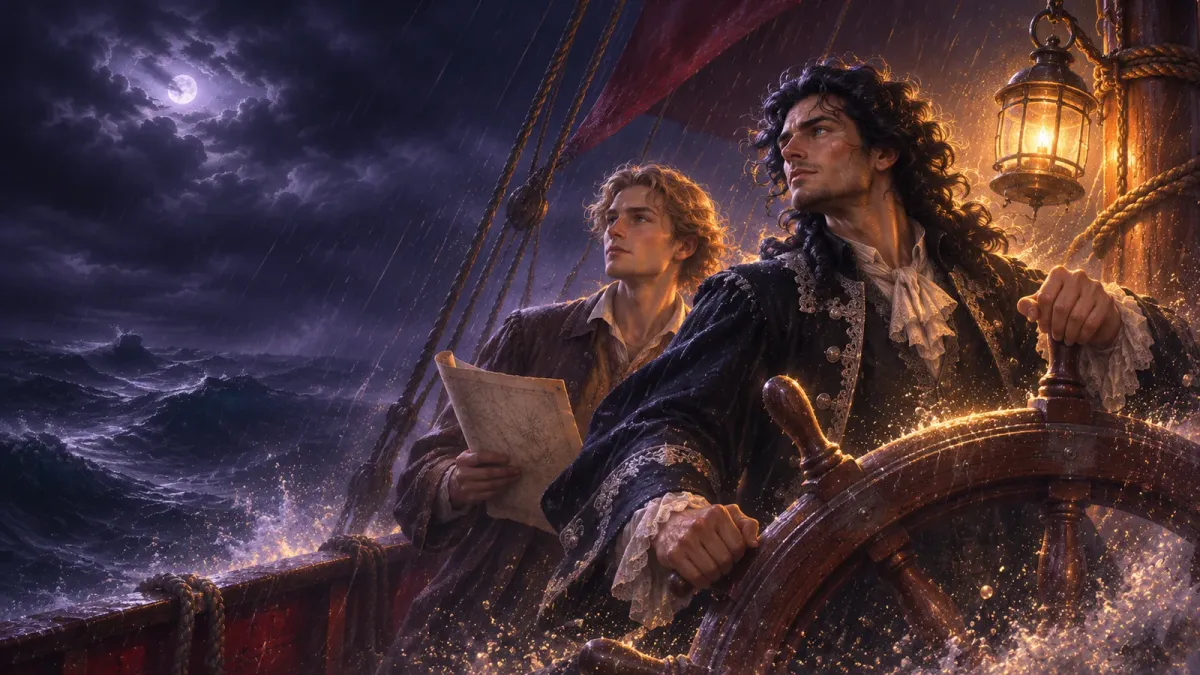
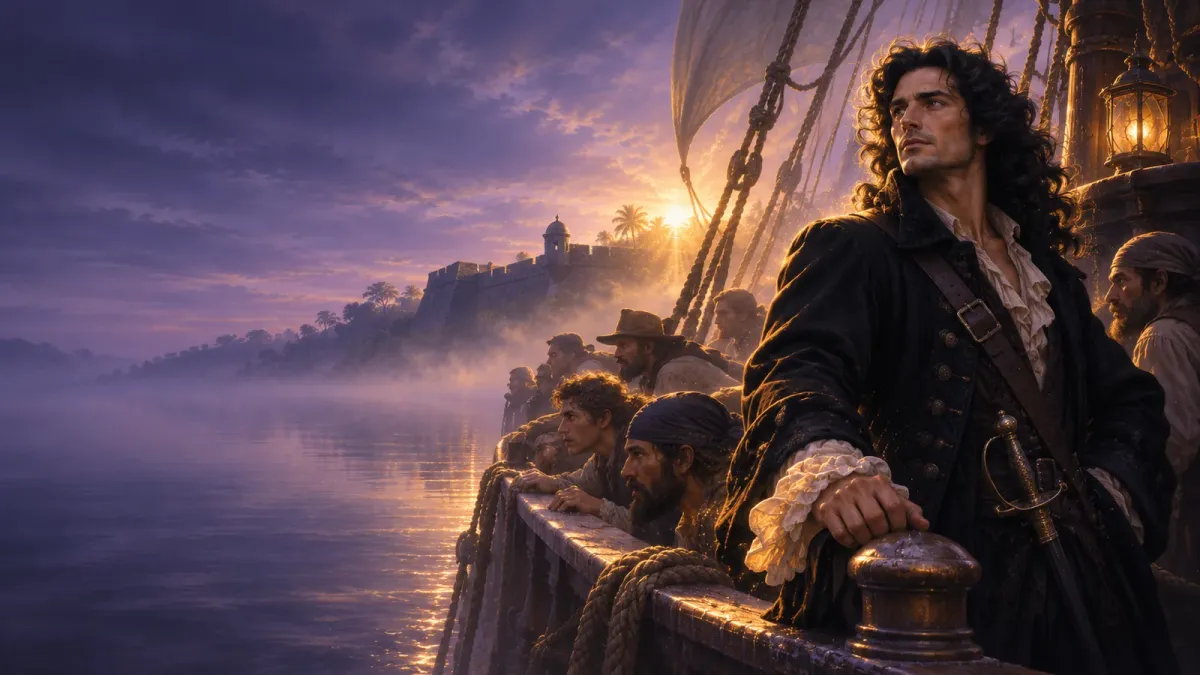
Inhalt von „Captain Blood“ · 31 Kapitel
- I: The MessengerSeite 1
- II: Kirke’s DragoonsSeite 12
- III: The Lord Chief JusticeSeite 22
- IV: Human MerchandiseSeite 40
- V: Arabella BishopSeite 49
- VI: Plans of EscapeSeite 66
Alle 31 KapitelWeniger anzeigen
- VII: PiratesSeite 87
- VIII: SpaniardsSeite 100
- IX: The Rebels-ConvictSeite 109
- X: Don DiegoSeite 124
- XI: Filial PietySeite 132
- XII: Don Pedro SangreSeite 147
- XIII: TortugaSeite 156
- XIV: Levasseur’s HeroicsSeite 167
- XV: The RansomSeite 179
- XVI: The TrapSeite 195
- XVII: The DupesSeite 211
- XVIII: The MilagrosaSeite 230
- XIX: The MeetingSeite 247
- XX: Thief and PirateSeite 261
- XXI: The Service of King JamesSeite 276
- XXII: HostilitiesSeite 294
- XXIII: HostagesSeite 304
- XXIV: WarSeite 320
- XXV: The Service of King LouisSeite 337
- XXVI: M. de RivarolSeite 350
- XXVII: CartagenaSeite 366
- XXVIII: The Honour of M. de RivarolSeite 378
- XXIX: The Service of King WilliamSeite 388
- XXX: The Last Fight of the ArabellaSeite 395
- XXXI: His Excellency the GovernorSeite 403
Bewertungen für „Captain Blood“
Noch keine Bewertungen. Gib die erste ab.
Deine Bewertung
Rezensionen zu „Captain Blood“
Noch keine Rezensionen.
Die Geschichte hinter „Captain Blood“
A pirate who was no Henry Morgan
To build Peter Blood, Rafael Sabatini studied records of the Monmouth Rebellion and the memoirs of Alexandre Exquemelin, a surgeon who sailed with buccaneers. Sabatini saw the real-life pirate Henry Morgan as a brutal criminal, so he made his own hero the opposite: an honourable doctor pushed into piracy only by a false treason conviction.
Hot on the heels of Scaramouche
Hutchinson in Britain and Houghton Mifflin in the United States brought out Captain Blood: His Odyssey just a year after Sabatini's Scaramouche became an international hit. Readers on both sides of the Atlantic immediately made the new pirate novel a bestseller too.
New raids squeezed into the middle
Readers wanted more of Blood, so Sabatini wrote two short-story collections: Captain Blood Returns (called The Chronicles of Captain Blood in Britain) and, in 1936, The Fortunes of Captain Blood. Instead of disturbing the original ending, he tucked all these extra adventures back into Blood's years as a Caribbean buccaneer.
A pirate approved by Soviet censors
First translated into Russian in the 1920s, the book became a favourite foreign adventure across the Soviet Union. State publishers happily printed millions of copies across dozens of editions because Blood was a rebel fighting royal tyranny and colonial slavery.
In der Kultur „Captain Blood“
7 Adaptionen und Erwähnungen, 1924–2003
Film Nine reels now mostly lost
Two years after the book came out, director David Smith filmed the first adaptation for Vitagraph Studios with J. Warren Kerrigan as Peter Blood and Jean Paige as Arabella Bishop. Most of that nine-reel silent movie has since disappeared.
Film The gamble that made Errol Flynn
Warner Bros. handed director Michael Curtiz two largely unknown actors, Errol Flynn and Olivia de Havilland, for its sound adaptation. The gamble paid off with a box-office hit, four Academy Award nominations including Best Picture, and Flynn's new career as Hollywood's top swashbuckler.
Musik Franz Liszt on the Spanish Main
Austrian composer Erich Wolfgang Korngold wrote his first original dramatic score for Hollywood for the 1935 film, though the schedule was so tight he had to borrow themes from Franz Liszt to finish it. That symphonic soundtrack ended up setting the musical style for Hollywood adventure movies.
Bühne Back at the microphone for DeMille
On February 22, 1937, Errol Flynn and Olivia de Havilland stepped up to the microphone to play their screen roles again on the Lux Radio Theatre. Cecil B. DeMille hosted the live one-hour broadcast.
Film Errol Flynn's real son takes the helm
Columbia Pictures turned Sabatini's later stories into Fortunes of Captain Blood (1950) and Captain Pirate (1952) with Louis Hayward in the lead. Ten years later, the Italian-Spanish film The Son of Captain Blood (1962) handed the pirate's sword to Sean Flynn—Errol Flynn's own son.
Film Crimea stands in for the Caribbean
Director Andrei Prachenko turned the book into Odisseya Kapitana Blada (Odyssey of Captain Blood), a two-part Soviet-French film for television and cinemas. Shot at the Gorky Film Studio and on the Crimean coast, it cast Yves Lambrecht as the captain.
Spiel The game that took twenty years
Russian studio Akella started building a hack-and-slash sea-combat game from Sabatini's books, only to see it trapped in publisher disputes and cancellations for over two decades. The publisher SNEG finally rescued the project to bring it out on modern platforms.
Fragen und Antworten zu „Captain Blood“ auf Englisch
Why is Doctor Peter Blood arrested if he did not fight in the rebellion?
He is arrested under seventeenth-century English treason law, which made giving any aid to a rebel just as much a capital crime as bearing arms. Blood rides out after the Battle of Sedgemoor strictly as a physician to treat a wounded acquaintance, Lord Gildoy, and the royal dragoons catch him with bandages in his hands. At the Bloody Assizes, the real historical judge George Jeffreys refuses to listen to medical ethics and sentences him to hang before the Crown commutes the sentence to plantation labour.
How could Englishmen be sold onto Barbados plantations in the book?
After the 1685 Monmouth Rebellion, convicted rebels were transported to the West Indies and sold there as forced labour. In the book Colonel Bishop buys Peter Blood and the other prisoners and works them on his Barbados plantation, beating them and using them beside enslaved Africans. Historically the usual sentence was a term of transportation, commonly ten years, not hereditary slavery; the novel still shows the men bought and treated as slaves.
What is the difference between a buccaneer, a pirate, and a privateer in Captain Blood?
The three words mark which side of colonial law a captain stands on at that moment. A pirate attacks any ship for private gain and can be hanged by any nation; a privateer carries a royal commission (a letter of marque) allowing him to raid the ships of his king's enemies in wartime; and the 'Brethren of the Coast' or buccaneers were Caribbean adventurers based on Tortuga who shifted between the two. Blood moves across all three statuses as England, France, and Spain change alliances.
Why does Arabella Bishop call Peter Blood a 'thief and pirate' after he saves her?
She thinks Blood bought her as plunder. He had paid his partner, the French buccaneer Captain Levasseur, out of his own pocket to free both Arabella and Lord Julian Wade, and he kills Levasseur when Levasseur will not give her up. She hears what was paid and, because neither of them will ask or explain, takes Blood for a man who traffics in prisoners. That belief keeps them apart through the middle of the book. Lord Julian is the other captive, not the seller.
How does the 1935 Errol Flynn movie differ from Sabatini's book?
The 1935 Warner Bros. film compresses Blood’s years at sea and drops several of the book’s campaigns, including the trap in the Gulf of Maracaibo. Levasseur is still a main villain, and the duel with him remains. Arabella Bishop is still Colonel Bishop’s niece and is part of the Barbados plantation story. The sharpest change is Peter Blood himself: the book’s ironic, disillusioned Irish physician in his thirties becomes the youthful romantic hero Errol Flynn plays.
Why does everything suddenly change for Blood in England at the end of the book?
In the Glorious Revolution of 1688–89, England deposes the Catholic King James II and gives the crown to the Protestant William of Orange and Mary. Blood and the other Monmouth rebels had been condemned for opposing James, so the new government treats them as political victims and can pardon them. England then goes to war with France, with Spain an ally, which cancels the cover of Blood’s French commission to raid Spaniards and makes him useful to the new government in the Caribbean. The same change takes him from outlaw to the man the new regime will trust with authority there.
Why is the full title Captain Blood: His Odyssey?
Sabatini subtitled the book His Odyssey because Peter Blood, like Homer’s Odysseus, is driven into a long exile and has to live by his wits on a hostile sea. Before he settled as a doctor in Somerset he had already wandered Europe in the Dutch and French service, and the Caribbean years are a second forced voyage, full of raids that turn on trickery as much as on force. He cannot go back to England until the government that condemned him falls.
Steckbrief zu „Captain Blood“
15 Angaben zu Ausgabedaten und gemessenen Textmerkmalen. Alles nachprüfbar.
- Originaltitel
- Captain Blood
- Autor
- Rafael Sabatini · 1875–1950
- Ersterscheinung
- 1922
- Originalsprache
- Englisch
- Genre
- Abenteuer · Klassiker · Liebesromane
- Stimmung
- Romantisch
- Themen
- Gerechtigkeit · Freiheit · Liebe · Erlösung
- Schauplatz
- Somerset, England; Barbados; and the Caribbean Sea · 1685–1689
- Verschiedene Wörter
- 9.112
- Wörter pro Satz
- 15 Wörter
- Niveau des Originals
- C2So messen wir
- Versionen
- C2
- Umfang des Originals
- 31 Kap. · 113.387 Wörter
- Lesezeit
- ~10 Std. 30 Min.
- Herunterladen
- EPUB
Ähnliche Bücher was du nach „Captain Blood“ lesen kannst
Ähnlich im Geist
8Dasselbe Genre und dieselbe Stilebene.

Die blaue Lagune
H. de Vere Stacpoole
C2Orig.B1B2
~5 Std. 50 Min. · Abenteuer
Reise um die Erde in 80 Tagen
Jules Verne
C2Orig.B1B2
~5 Std. 50 Min. · Abenteuer

Wolfsblut
Jack London
C2Orig.B1B2
~6 Std. 40 Min. · Abenteuer

Stolz und Vorurteil
Jane Austen
C2Orig.B1C1
~11 Std. 20 Min. · Klassiker
20.000 Meilen unter dem Meer
Jules Verne
C2Orig.B1B2
~9 Std. 40 Min. · Abenteuer
Don Quijote
Miguel de Cervantes
C2Orig.B1B2
~41 Std. 40 Min. · Klassiker

Am grünen Rand der Welt
Thomas Hardy
C2Orig.B1B2
~12 Std. 40 Min. · Klassiker

Martin Eden
Jack London
C2Orig.B1B2
~12 Std. 50 Min. · Klassiker