The Story of King Arthur and his Knights englanniksi
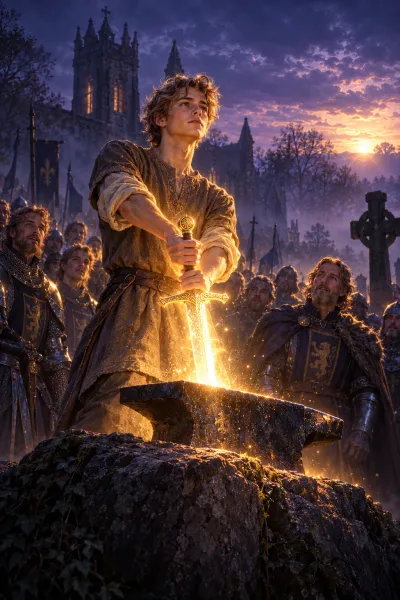
A boy raised in secret pulls a sword from an anvil to become King of Britain, then gathers an order of knights to bring justice to the land.
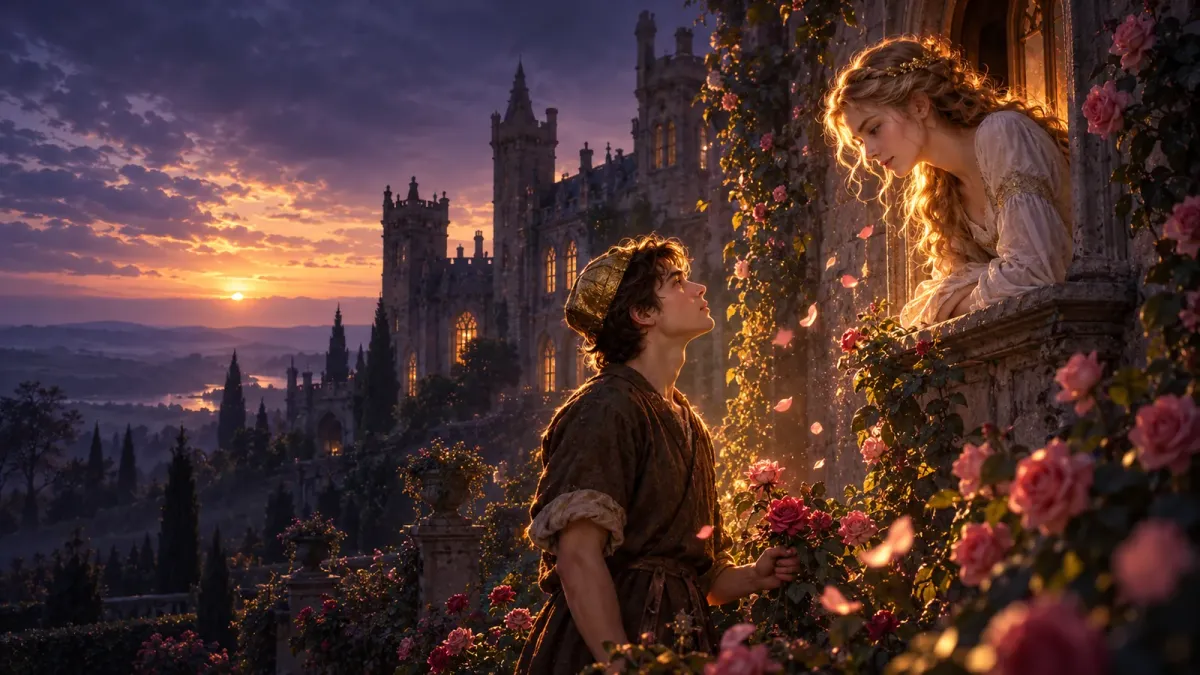
The book is divided into two main parts: the Book of King Arthur and the Book of Three Worthies. The first half covers Arthur's rise to the throne, his marriage, and how he acquires Excalibur, including a stretch where he disguises himself as a gardener's boy to court Guinevere. The second half shifts focus to the separate adventures of Merlin, Sir Pellias, and Sir Gawaine. Although written in 1903, the book uses an imitation of older English, with long sentences and formal speeches that treat the legends as moral lessons.
Pidät tästä, jos
- tales of knights, tournaments, and quests
- clear moral lessons where good and honour win
- stories where kings travel in disguise to prove their worth
- magic swords, enchantresses, and forest adventures
Et pidä tästä, jos
- deliberately old-fashioned grammar in every dialogue
- long descriptions of armour, clothing, and castles
- the story leaves Arthur midway to follow other knights
- frequent pauses where the narrator explains the moral of the scene
Millainen kirja “The Story of King Arthur and his Knights” on
Versiot kirjasta “The Story of King Arthur and his Knights” englanniksi: C2
Sama kirja mukautettuna tasolle, jota luet pysähtymättä
Valitse versio. Sivun alareunan palkki avaa valitsemasi version.
Sanavarasto tasoittain
- A1 58%
- A2 14%
- B1 7%
- B2 9%
- ei sanakirjassa 5%
Tietoa tästä painoksesta Alkuperäinen · C2
This edition is at level C2. At this level you can read long and complex texts with ease. This is the complete original text by Howard Pyle. It was first published in 1903. Its measured level is C2. The average sentence length is 26.6 words. The book has 114196 words. Reading it takes about ten and a half hours.
About the level
This original text is C2 on the NewGen Books scale (version 1.2), measured from the text itself. On the Flesch–Kincaid formula's US school scale it reads at grade 10. In the CEFR's words, a C2 reader “can read virtually all forms of the written language including classical or colloquial literary and non-literary writings in different genres, appreciating subtle distinctions of style and implicit as well as explicit meaning.”
Näyte kirjasta “The Story of King Arthur and his Knights” englanniksi
Yksi katkelma sellaisena kuin kukin versio sen esittää.
Napauta mitä tahansa sanaa – näytämme käännöksen
Nuolinäppäimillä siirryt sanojen välillä, Enter näyttää käännöksen.Alkuperäinen · C2153 sanaa
And, indeed it is a very pleasant thing for to ride forth in the dawning of a Springtime day. For then the little birds do sing their sweetest song, all joining in one joyous medley, whereof one may scarce tell one note from another, so multitudinous is that pretty roundelay; then do the growing things of the earth smell the sweetest in the freshness of the early daytime—the fair flowers, the shrubs, and the blossoms upon the trees; then doth the dew bespangle all the sward as with an incredible multitude of jewels of various colors; then is all the world sweet and clean and new, as though it had been fresh created for him who came to roam abroad so early in the morning.
So King Arthur’s heart expanded with great joy, and he chanted a quaint song as he rode through the forest upon the quest of that knightly adventure.
Kirjan alkuperäiskieli “The Story of King Arthur and his Knights” ja mitä se sinulle antaa
Miten vaikeaa kieli on C2
Our lexical analysis rates the original text at C2. While 72% of the vocabulary sits in the basic A1–A2 bands and the book uses only 4,926 distinct word forms across 113,799 words, the sentences average a long 25.5 words. Additionally, 5% of the words fall outside standard dictionaries due to archaic spellings and proper names, and 6% sit beyond the 5,000 most frequent English words.
Mitä tämä tarkoittaa käytännössä: Basic core vocabulary stretched into long, formal sentences with artificial old grammar.
Mihin kannattaa varautua
Näin luet kirjan loppuun asti
- Learn the second-person singular pronouns early: 'thou' is the subject (you), 'thee' is the object (you), and 'thy' or 'thine' means 'your'.
- Treat verb endings in '-eth' or '-est' (like 'goeth', 'hath', 'spakest') as standard third-person or second-person verbs in the present or past tense.
- Watch out for inverted word order after introductory adverbs, such as 'Then came Arthur' instead of 'Then Arthur came', where the verb precedes the subject.
Illustrations for “The Story of King Arthur and his Knights”
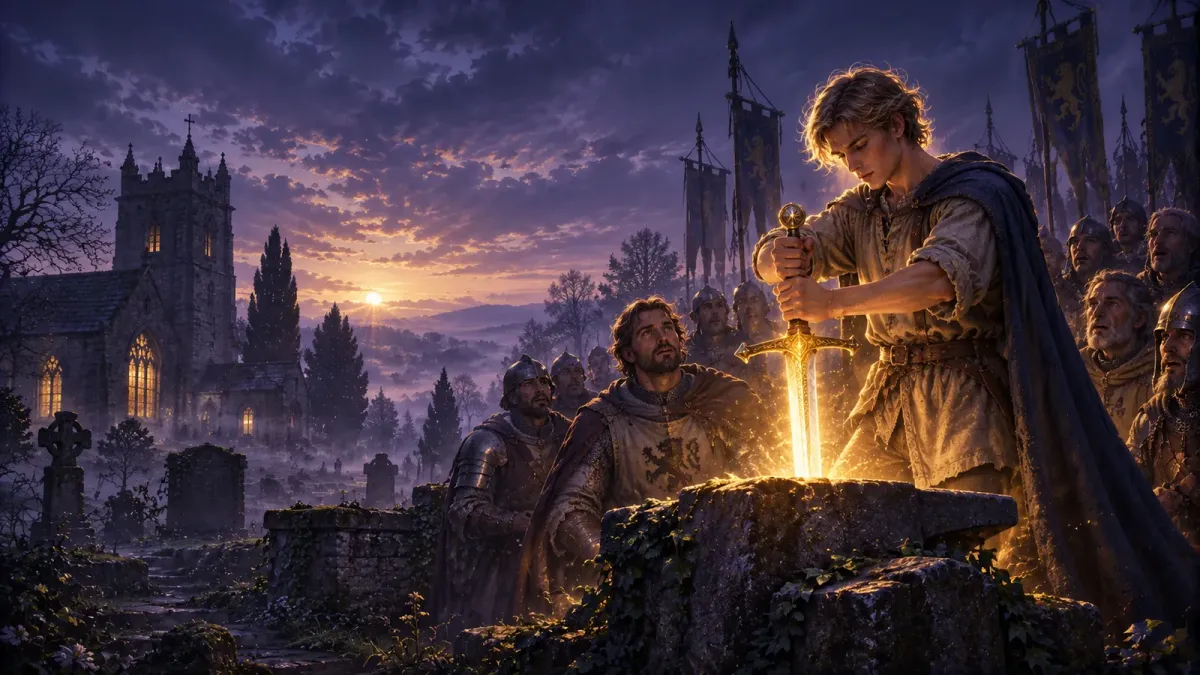
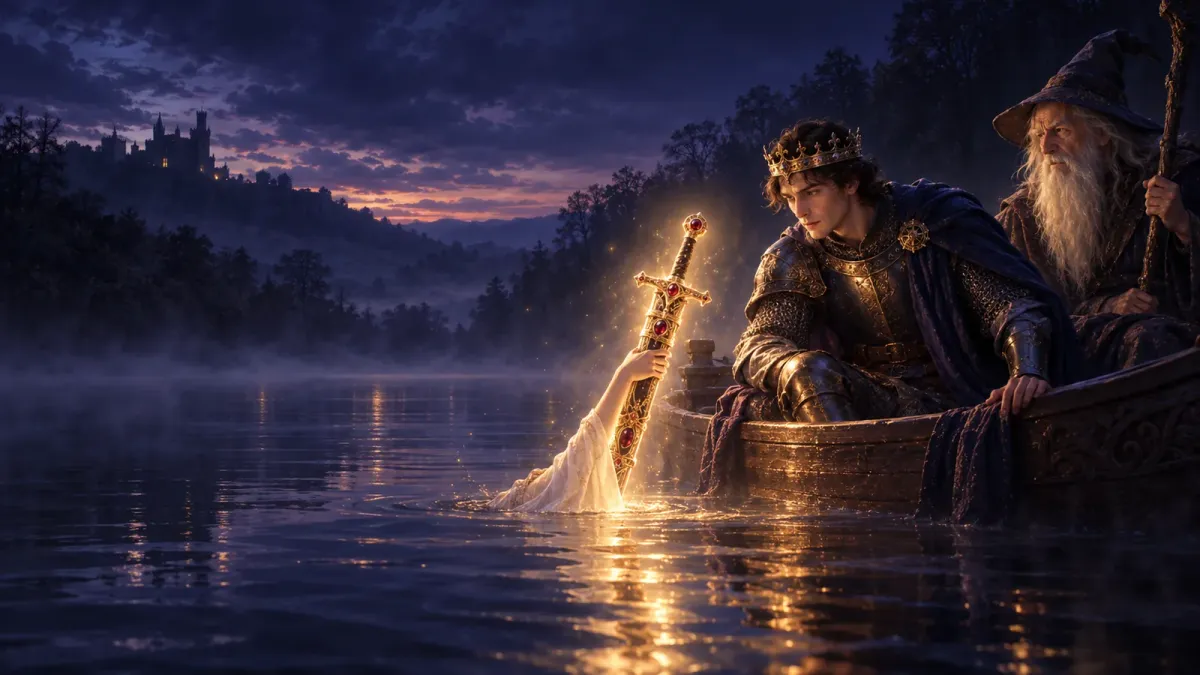
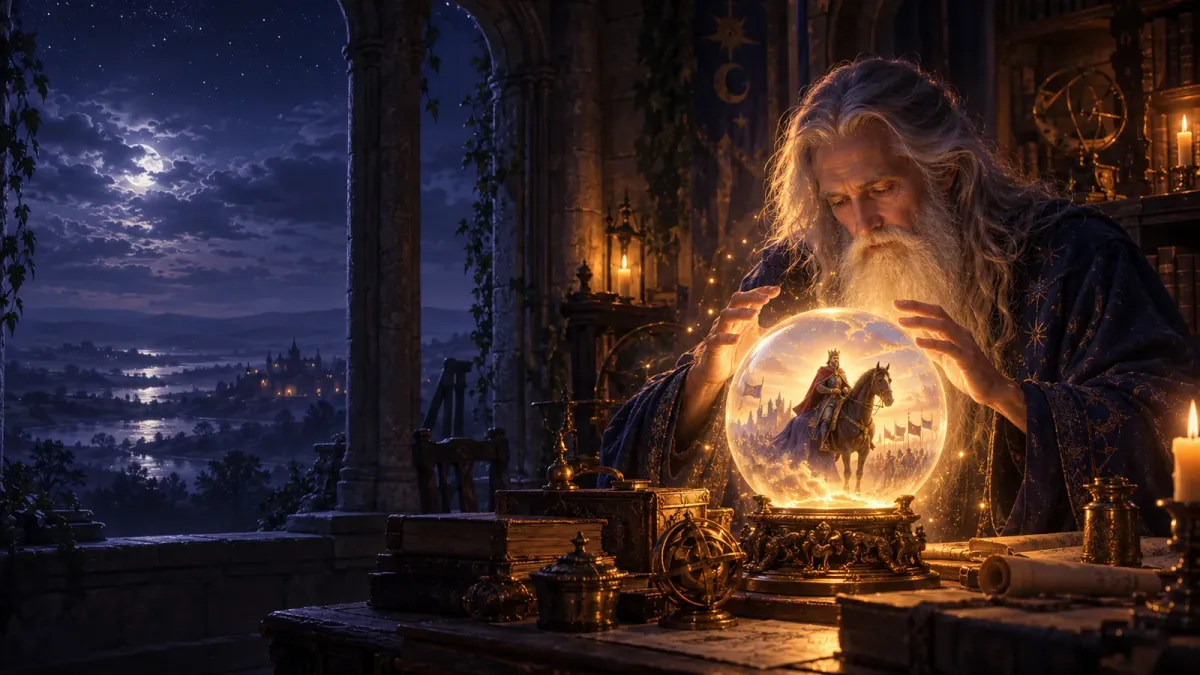
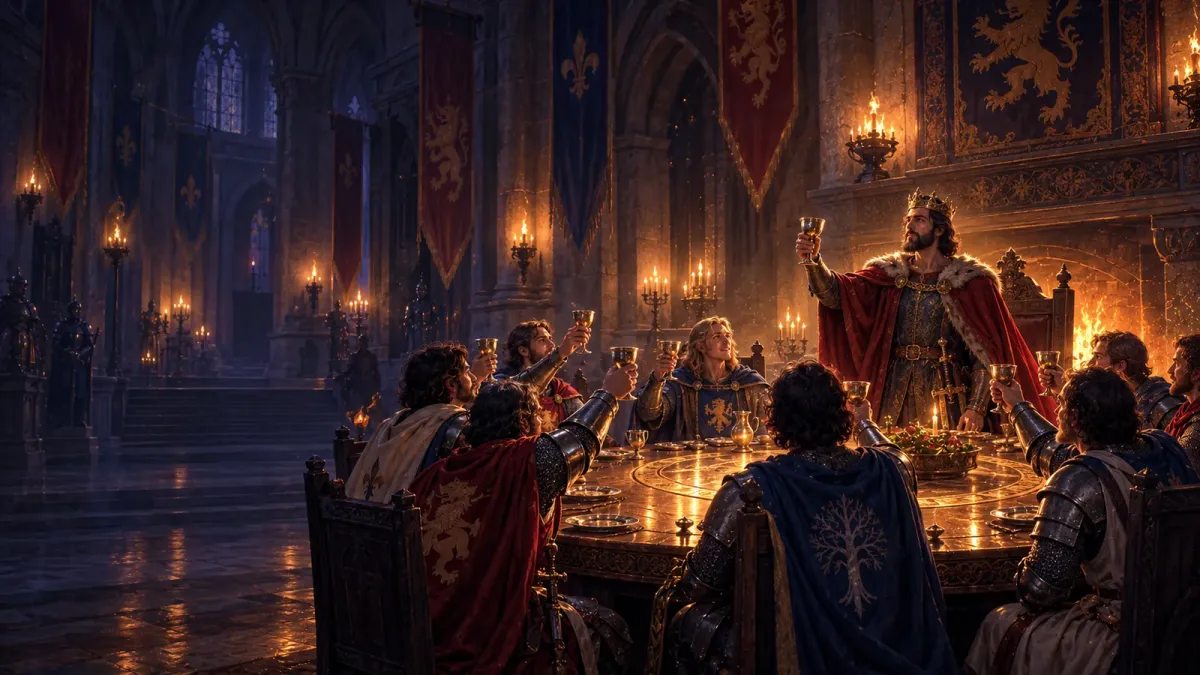
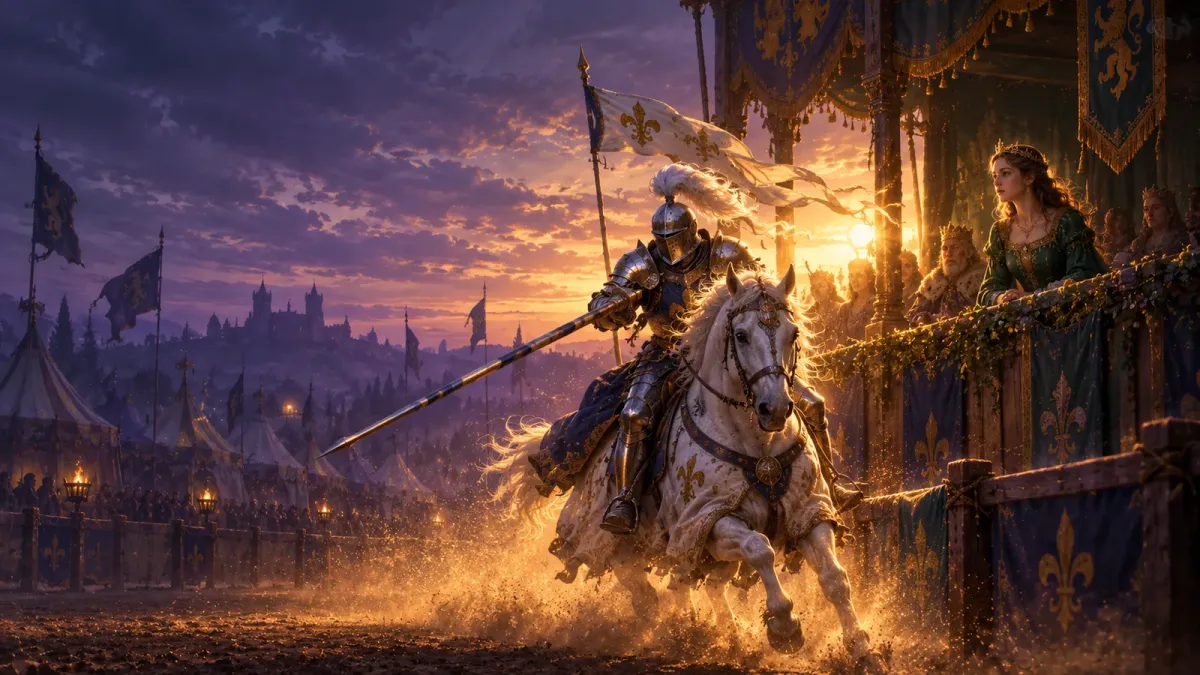
5 scenes from “The Story of King Arthur and his Knights”, in story order and without the ending.
Sisällys kirjan “The Story of King Arthur and his Knights” · 39 lukua
- Foreword.sivu 1
- Prologue.sivu 2
- PART I The Winning of Kinghoodsivu 8
- Chapter First.sivu 8
- Chapter First. (jatkuu)sivu 17
- Chapter Second.sivu 24
Kaikki 39 lukuaNäytä vähemmän
- Chapter Third.sivu 34
- CONCLUSIONsivu 45
- PART II The Winning of a Swordsivu 49
- Chapter First.sivu 50
- Chapter First. (jatkuu)sivu 58
- Chapter Second.sivu 66
- Chapter Second. (jatkuu)sivu 74
- Chapter Third.sivu 81
- Chapter Third. (jatkuu)sivu 91
- PART III The Winning of a Queensivu 101
- Chapter First.sivu 102
- Chapter First. (jatkuu)sivu 110
- Chapter Second.sivu 118
- Chapter Third.sivu 130
- Chapter Third. (jatkuu)sivu 138
- Chapter Fourth.sivu 146
- Chapter Fourth. (jatkuu)sivu 154
- Chapter Fifth.sivu 162
- Chapter Fifth. (jatkuu)sivu 172
- Chapter Sixth.sivu 182
- CONCLUSIONsivu 194
- Foreword.sivu 194
- Prologue.sivu 196
- PART I The Story of Merlinsivu 205
- Chapter First.sivu 205
- Chapter Second.sivu 218
- Chapter Third.sivu 228
- Chapter Third. (jatkuu)sivu 235
- Chapter Fourth.sivu 241
- Chapter Fourth. (jatkuu)sivu 248
- CONCLUSIONsivu 254
- PART II The Story of Sir Pelliassivu 259
- Chapter First.sivu 260
- Chapter Second.sivu 272
- Chapter Second. (jatkuu)sivu 280
- Chapter Third.sivu 288
- Chapter Third. (jatkuu)sivu 298
- Chapter Fourth.sivu 308
- Chapter Fourth. (jatkuu)sivu 319
- Chapter Fifth.sivu 329
- Chapter Fifth. (jatkuu)sivu 338
- Chapter Sixth.sivu 346
- Chapter Sixth. (jatkuu)sivu 356
- PART III The Story of Sir Gawainesivu 367
- Chapter First.sivu 367
- Chapter First. (jatkuu)sivu 377
- Chapter Second.sivu 387
- Chapter Second. (jatkuu)sivu 394
- Chapter Third.sivu 401
- Chapter Third. (jatkuu)sivu 408
- CONCLUSIONsivu 414
Lukijoiden arviot kirjalle “The Story of King Arthur and his Knights”
Kukaan ei ole vielä arvioinut tätä. Ole ensimmäinen.
Oma arvosanasi
Lukijoiden arvostelut kirjasta “The Story of King Arthur and his Knights”
Ei vielä arvioita.
Kirjan tarina: “The Story of King Arthur and his Knights”
Serialization in St. Nicholas
Before appearing as a book, the text and illustrations ran as a serial in the children's magazine St. Nicholas from November 1902 through October 1903.
St. Nicholas Magazine archives
First book edition by Scribner's
Charles Scribner's Sons published the complete volume in November 1903, retaining Pyle's ornate pen-and-ink illustrations, full-page plates, and decorative chapter headings.
Charles Scribner's Sons bibliography
Expansion into a four-volume cycle
The book's strong reception prompted Pyle to write and illustrate three sequels—The Story of the Champions of the Round Table (1905), The Story of Sir Launcelot and His Companions (1907), and The Story of the Grail and the Passing of Arthur (1910).
Sanitizing Malory for young readers
Pyle adapted Thomas Malory's Le Morte d'Arthur and other medieval romances by removing courtly adultery and moral ambiguity, recasting Arthurian legend as an unambiguous ethical guide for American youth.
Kulttuurissa “The Story of King Arthur and his Knights”
6 sovitusta ja mainintaa, 1911–1985
Taide N. C. Wyeth's The Boy's King Arthur
Pyle's star pupil at the Brandywine School, N. C. Wyeth, illustrated Sidney Lanier's competing edition of Malory, translating Pyle's black-and-white medievalism into full-color painted plates.
Taide Hal Foster's Prince Valiant
Comic strip creator Hal Foster drew heavily on Pyle's pen-and-ink crosshatching, page layouts, and idealized chivalric tone when designing his long-running Arthurian adventure strip.
Elokuva Knights of the Round Table
MGM's Technicolor epic adopted the wholesome, pageant-like visual style and simplified moral framing that Pyle's juvenile editions had made the standard American view of Camelot.
Peli Pendragon role-playing game
Greg Stafford's tabletop RPG cites Pyle's Arthurian cycle as a primary literary source for its system of chivalric traits and courtly adventures.
King Arthur Pendragon rulebook bibliography
Kielessä Mock-archaic 'Pyle-speak'
Pyle's invented synthesis of Malory and King James Bible diction ('wherefore', 'betwixt', 'rightroyally') became the default template for how medieval knights speak in 20th-century English-language popular culture.
Taide The Brandywine visual vocabulary of chivalry
Pyle's Durer-inspired woodcut-style borders and heraldic costumes defined the standard look of Arthurian legend in American schoolbooks and library editions for generations.
Kysymyksiä ja vastauksia kirjasta “The Story of King Arthur and his Knights” englanniksi
is this the complete king arthur story with lancelot and the holy grail
No, this book only covers the beginning of Arthur's reign. It is the first of four volumes Howard Pyle wrote about the Round Table. Lancelot, the Grail, and the fall of Camelot appear in the later books in the series.
does king arthur pull the sword from the stone or an anvil in this book
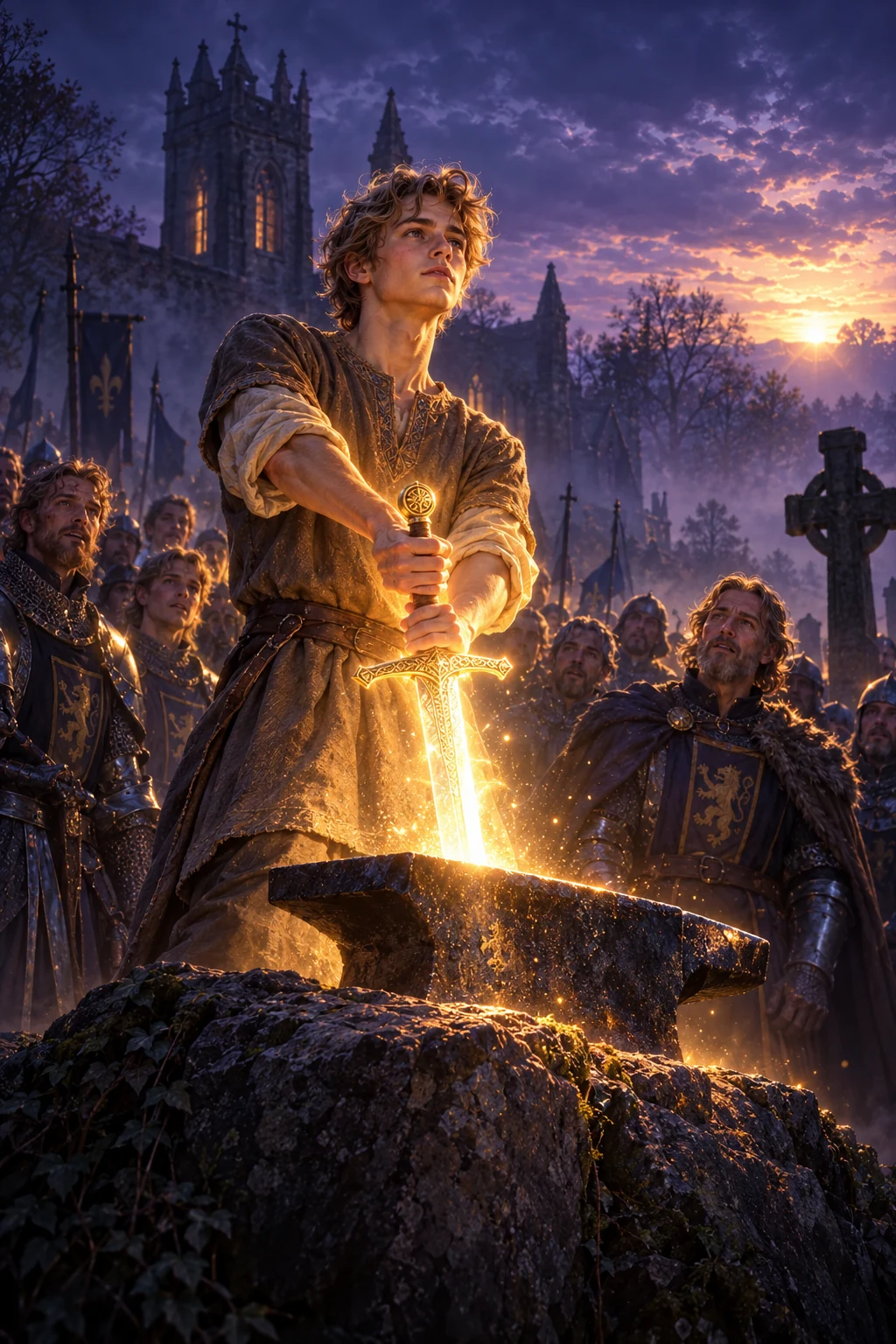
He pulls it from a steel anvil that rests on top of a cube of marble. In Pyle's version, the sword is driven through the anvil and into the stone beneath it, and Arthur draws it out three times in front of the crowd.
are excalibur and the sword in the stone the same sword here
No, they are two different weapons. Arthur breaks the sword from the anvil during a fight with King Pellinore. Afterward, Merlin takes him to an enchanted lake where the Lady of the Lake gives him Excalibur and its magical scabbard.
is this the book the disney movie the sword in the stone is based on
No, the Disney film is based on the 1938 novel by T. H. White, not Howard Pyle's 1903 book. In Pyle's version, Merlin does not tutor Arthur by turning him into animals, and the tone is serious rather than comedic.
why is the language so old fashioned if it was written in 1903
Howard Pyle imitated the style of Thomas Malory's 15th-century prose to give the stories a medieval feel. He used words like 'thou', 'hath', and 'wherefore' on purpose, even though he was writing for early 20th-century American readers.
does this book have the darker parts of the arthurian legend
No, Pyle wrote this version for young readers and removed the adultery and incest found in medieval sources. Morgana le Fay and Vivien still use dark magic and betrayal, and knights are wounded in battle, but the moral tone stays clean.
what happens to merlin in this version
Merlin is tricked and trapped by a young sorceress named Vivien. He teaches her his magic even though he knows she plans to use it against him, and she seals him away under a stone slab before the final section of the book.
why does Arthur disappear in the second half of the book
The book is structured as an anthology of connected tales rather than a single biography. Once Arthur establishes his court and marries Guinevere, the focus moves to the individual quests of Merlin, Sir Pellias, and Sir Gawaine.
do I need to read the other three books by howard pyle after this one
No, this book stands alone and finishes every quest it starts. If you want to read about Lancelot, Tristram, or the Grail, you can continue to the sequels, starting with 'The Story of the Champions of the Round Table'.
Lyhyesti kirjasta “The Story of King Arthur and his Knights”
15 julkaisutieto- ja tekstiominaisuuskenttää. Kaikki tarkistettavissa.
- Alkuperäinen nimi
- The Story of King Arthur and his Knights
- Kirjailija
- Howard Pyle · 1853–1911
- Ensijulkaisu
- 1903
- Alkuperäiskieli
- Englanti
- Tyylilaji
- Klassikot · Seikkailu
- Tunnelma
- Romanttinen
- Teemat
- Rohkeus · Velvollisuus · Uskollisuus · Oikeus
- Tapahtumapaikka ja -aika
- Britain · Early Middle Ages
- Eri sanoja
- 4 926
- Sanoja virkkeessä
- 26 sanaa
- Alkuperäisen taso
- C2
- Versiot
- C2
- Alkuperäisen pituus
- 57 lukua · 113 799 sanaa
- Lukuaika
- ~10 t 30 min
- Lataa
- EPUB
Samankaltaisia mitä lukea kirjan “The Story of King Arthur and his Knights” jälkeen
Samalta kirjailijalta
1Sama kynä, eri tarina.
Samanhenkisiä
7Sama lajityyppi ja sama sävy.

Susikoira
Jack London
C2alkup.B1B2
~6 t 40 min · Seikkailu
Maailman ympäri 80 päivässä
Jules Verne
C2alkup.B1B2
~5 t 50 min · Seikkailu
Maailmojen sota
H. G. Wells
C2alkup.B1C1
~5 t 30 min · Scifi

Sininen laguuni
H. de Vere Stacpoole
C2alkup.B1B2
~5 t 50 min · Seikkailu
Sukelluslaivalla maapallon ympäri
Jules Verne
C2alkup.B1B2
~9 t 40 min · Seikkailu
Oliver Twist
Charles Dickens
C2alkup.B1B2
~14 t 30 min · Klassikot
Pimeyden sydän
Joseph Conrad
C2alkup.B2
~3 t 30 min · Seikkailu
Kirjan sivu 0.2.0 · 22.10.2026